
SaaS SEO: Marketing, Importance, Strategy & Software
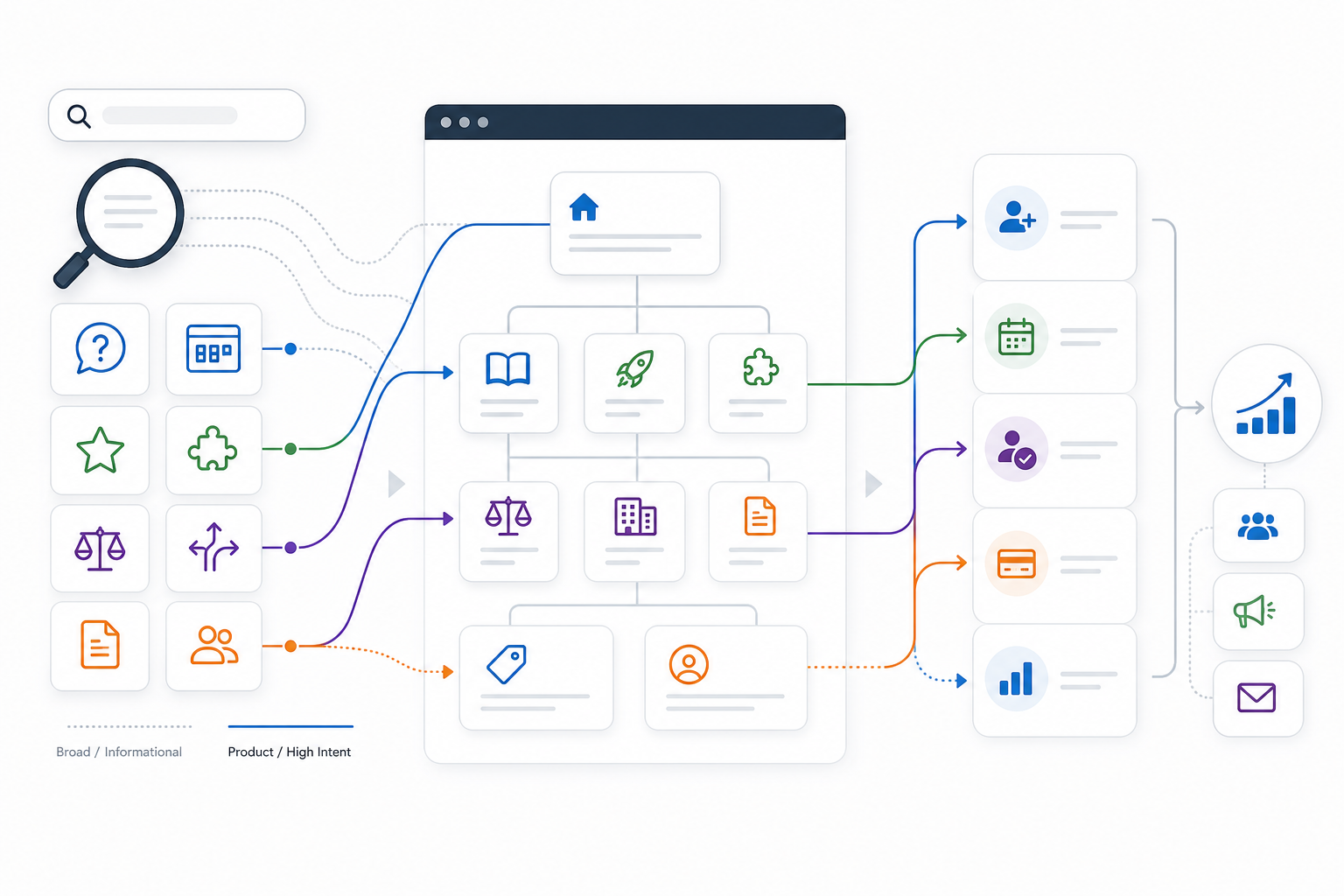
SaaS SEO is the process of improving a software-as-a-service website’s organic search visibility for searches related to customer problems, software categories, features, use cases, integrations, comparisons, alternatives, and other information relevant to potential or existing users. It applies established SEO principles to the specific product, customer journey, and recurring-revenue model of a SaaS business.
The objective is not simply to generate more organic traffic. SaaS SEO connects relevant search demand with pages and resources that help users understand a problem, discover a software category, evaluate a product, compare possible solutions, understand a feature, explore an integration, or complete another product-related task.
A SaaS website can therefore use several types of search assets. Informational resources can explain problems, concepts, workflows, and categories. Product, feature, solution, industry, integration, and use-case pages can connect search demand with specific product capabilities. Comparison and alternative pages can support users evaluating software options. Public documentation and help content can also capture searches where prospects or existing customers need product information.
SaaS SEO extends beyond content creation. It can include keyword and search-intent research, website architecture, technical SEO, internal linking, product-led pages, informational content, comparison content, external authority, conversion paths, analytics, and performance measurement.
Different searches also represent different levels of product relevance. A high-volume informational query with little connection to the software can contribute less business value than a smaller search directly related to a feature, integration, customer problem, or buying decision.
Organic visibility and customer acquisition also remain separate outcomes. SEO can create qualified entry points into the website, but demos, free trials, signups, qualified leads, subscriptions, and revenue also depend on factors such as product-market fit, positioning, pricing, website experience, trust, conversion design, and the sales process.
SaaS SEO is therefore best understood as a business-context specialization of SEO that connects relevant organic search demand with the product information, content, and pages capable of satisfying that demand while supporting measurable SaaS objectives.
Where Does SaaS SEO Fit Into SaaS Marketing?
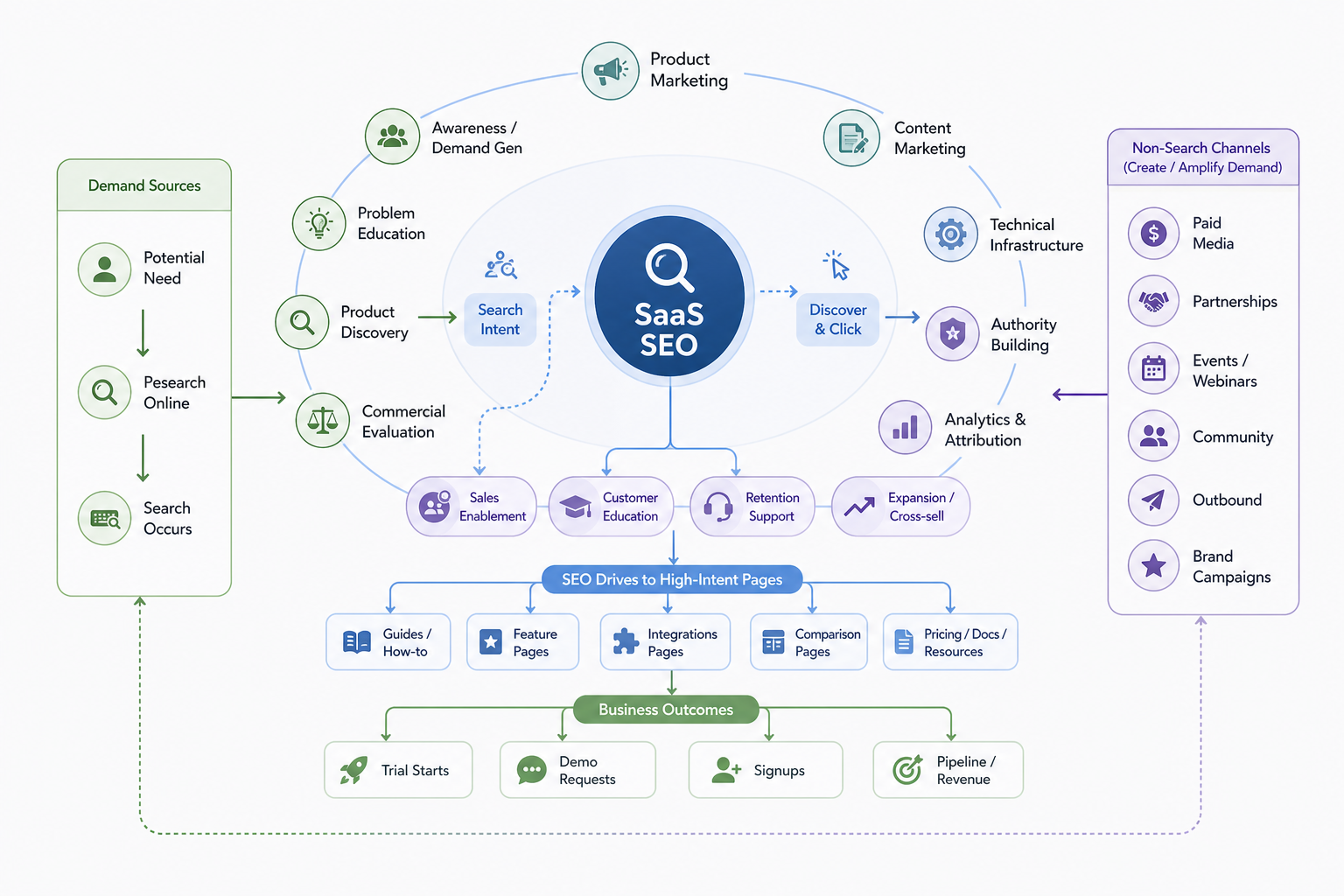
SaaS SEO functions as an organic acquisition and demand-capture channel within the wider SaaS marketing system. Within broader SEO marketing, that role is specifically about capturing relevant organic search demand and connecting it with pages that support product discovery, education, evaluation, and acquisition. It helps a software company become discoverable when potential or existing users actively search for problems, categories, capabilities, products, integrations, alternatives, or information connected with the software.
Its contribution depends on whether meaningful search demand exists. Some SaaS categories contain substantial search activity around products, features, comparisons, and customer problems, while other markets depend more heavily on outbound sales, partnerships, communities, paid acquisition, events, or category creation.
SaaS SEO can support several marketing functions.
- Demand Generation and Awareness: SEO can capture people already researching customer problems, workflows, concepts, or emerging software categories. Guides, research, glossaries, templates, and educational resources can introduce a company before the searcher knows the product.
- Problem and Solution Education: Search content can help users understand a problem, the methods available to solve it, and the software categories related to that problem. This becomes particularly useful in complex or unfamiliar SaaS markets.
- Product Discovery: Feature, solution, use-case, industry, integration, and category pages can introduce the product when users search for a capability rather than for the brand itself.
- Commercial Evaluation: Comparison pages, alternative pages, category pages, pricing information, reviews, use-case pages, and other decision-oriented resources can help users evaluate competing software options.
- Customer Acquisition: High-intent organic landing pages can contribute to trials, demos, account creation, purchases, contact forms, or other acquisition events. The search visit creates the opportunity, while conversion depends on the wider product and website experience.
- Product Marketing: Product marketing defines positioning, differentiation, customer language, proof, and product value. SEO adds evidence about search demand, query language, search intent, competing result types, and the pages required for organic discovery.
- Content Marketing: SEO can help content teams identify topics with observable demand and connect those topics with product relevance. SaaS content marketing remains broader than SEO because research reports, customer stories, opinion pieces, thought leadership, community content, and other assets can provide value even when they have little search demand.
- Technical Marketing Infrastructure: Technical SEO helps ensure that public marketing pages, product pages, integrations, resources, documentation, and other intended search assets are accessible to search engines. Not every authenticated application URL or private product environment belongs in organic search.
- Authority Building: Digital PR, relevant editorial backlinks, research citations, brand mentions, partnerships, and other external references can strengthen the external visibility and credibility of important SaaS pages.
- Sales Enablement: Search-focused comparison pages, use-case resources, customer stories, feature explanations, and product education can also support sales conversations when they answer questions prospects raise during evaluation.
- Customer Education: Public documentation, tutorials, knowledge-base pages, implementation guides, and integration resources can help both prospects and customers find product information through search.
- Retention Support: Searchable educational resources can indirectly support retention when they help existing users solve problems or understand more of the product. SEO itself does not directly reduce churn.
- Expansion and Cross-Sell: Advanced feature, integration, workflow, and use-case pages can expose existing users to capabilities they have not yet adopted when meaningful search demand exists around those uses.
- Analytics and Attribution: Organic landing pages can be connected with downstream events such as trials, demos, qualified leads, subscriptions, pipeline, and revenue when the measurement infrastructure supports that attribution.
The role of SaaS SEO can be summarized across three broad marketing contexts.
Demand Capture
SEO captures existing or emerging search demand across informational, navigational, commercial, and transactional searches relevant to the product.
This differs from demand creation. Advertising, events, partnerships, brand campaigns, communities, and other channels can actively stimulate interest where search demand does not yet exist.
Product Discovery and Evaluation
SEO gives potential customers opportunities to encounter the product while researching categories, features, integrations, problems, alternatives, and competing solutions.
These searches do not have to follow a fixed funnel. One prospect can discover a company through a broad informational guide, while another can first encounter it through a high-intent comparison or integration search.
Customer Education
Searchable help resources, tutorials, integration guides, documentation, and product education can serve prospects and existing users who are actively looking for answers.
Search intent and funnel stage should not be treated as the same thing. An informational query is not automatically an early-stage search, and a commercial query is not automatically the final step before purchase. A technical implementation question from an existing customer can be highly specific and informational, while a first interaction with a brand can happen through a commercial comparison.
The marketing value of SEO therefore depends less on where a keyword sits in a theoretical funnel and more on whether the search demand is relevant to the product, customer, and business objective.
How Important Is SEO in a SaaS Business?
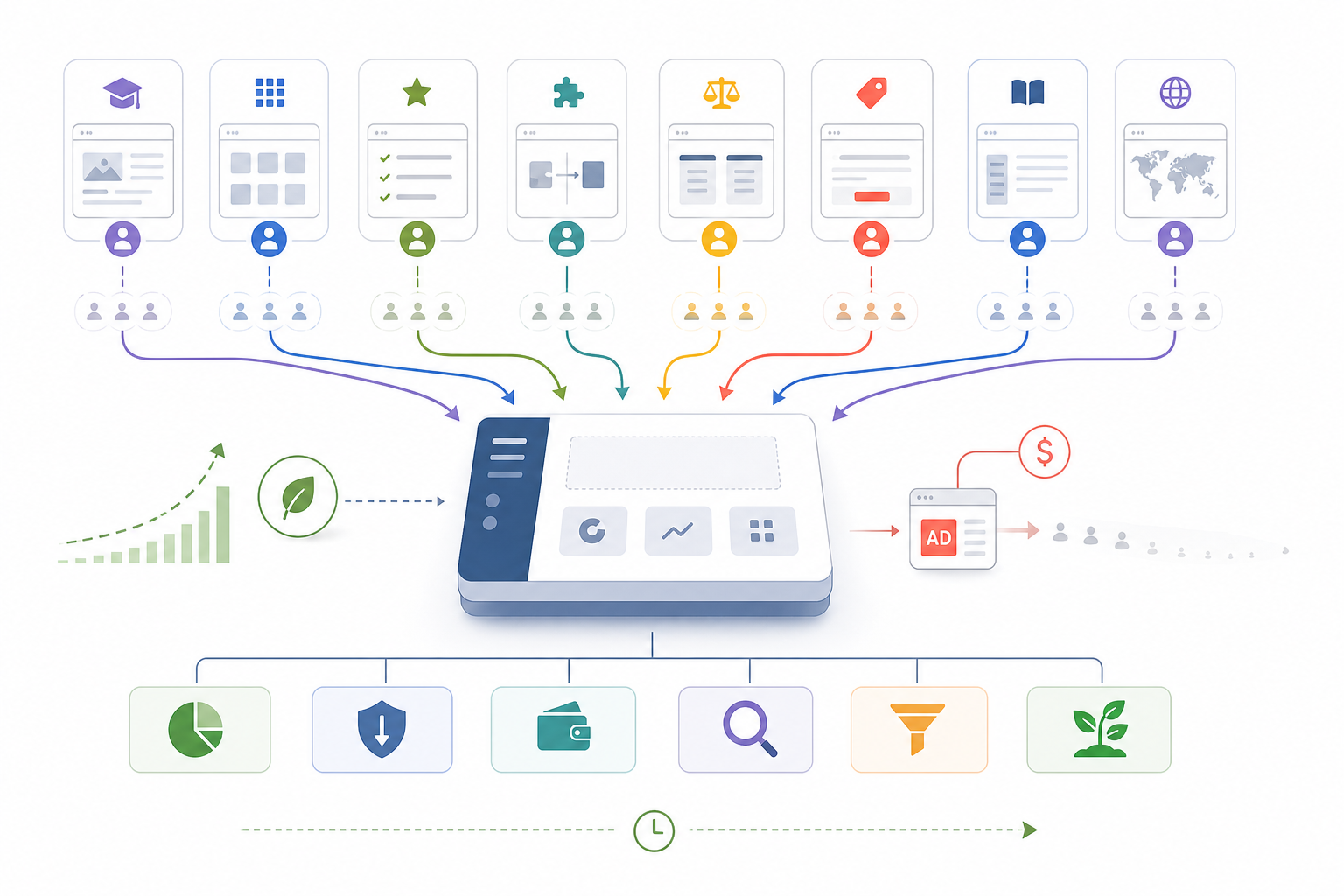
SEO can be highly important for a SaaS business when potential customers actively search for the problems, software categories, features, use cases, integrations, alternatives, or solutions the product addresses. Its value depends on search demand, product relevance, market maturity, competition, conversion potential, customer buying behavior, available resources, and the company’s broader acquisition model.
Its business value can appear in several ways.
- Organic Customer Acquisition: SEO can attract potential customers through unpaid search results across informational, commercial, navigational, and transactional searches relevant to the product.
- Reduced Dependence on Paid Acquisition: A productive organic channel can diversify acquisition alongside paid search, paid social, outbound sales, partnerships, affiliates, events, and other channels.
- Potential CAC Efficiency: Established organic pages can continue generating visits without a direct charge for every click. SEO still requires investment in people, content, technology, tools, promotion, links, maintenance, and experimentation, so organic traffic is not free traffic.
- Longer-Term Content Value: Useful pages can continue earning impressions, clicks, links, and conversions after their initial publication. Their performance can also decline as competitors, search results, customer needs, and search demand change.
- High-Intent Demand Capture: Users searching for software categories, specific features, integrations, alternatives, competitors, or particular problem solutions can already have strong product relevance.
- Product Discovery: Product-led pages can introduce a SaaS company to people who know the capability they need but do not yet know the brand.
- Commercial Evaluation: Comparison, alternative, category, pricing, review, and use-case searches can help a SaaS company participate in the evaluation process alongside competing products.
- Content-Led Demand Capture: Educational content can attract potential users who are researching problems, workflows, methods, terminology, or related topics before they evaluate software.
- Long Buying-Journey Support: B2B and higher-consideration software purchases can involve several searches over time. A SaaS company can appear across multiple relevant research and evaluation moments without assuming every customer follows the same sequence.
- Brand Discovery and Familiarity: Repeated visibility across relevant searches gives potential customers more opportunities to encounter the company and product. Rankings alone do not automatically create trust.
- Sales Pipeline Support: Organic landing pages can contribute demos, trials, signups, leads, and other pipeline events when the page and conversion path are aligned with the user’s intent.
- Product-Led Acquisition: Free tools, templates, integrations, interactive resources, and feature-led pages can sometimes connect search traffic directly with account creation or product usage.
- Competitive Visibility: Ranking for category, comparison, alternative, feature, and problem searches gives the company opportunities to appear alongside competing solutions during research.
- Market Education: SaaS companies in emerging or complex categories can use search-focused resources to explain customer problems, terminology, workflows, and the type of solution the product provides.
- International Expansion: Localized search assets can support expansion into new regions, languages, industries, or audience segments when real demand exists and localization reflects the market accurately.
- Customer Education: Public documentation and tutorials can help users discover solutions to product-related questions through search. Any retention benefit remains indirect.
- Revenue Attribution: Organic search performance can ultimately be connected with qualified leads, trials, demos, pipeline, subscriptions, and revenue where reliable tracking exists.
The broader commercial value of SaaS SEO can be considered across three areas.
Acquisition Efficiency
Organic search can diversify acquisition and potentially improve acquisition economics as valuable pages continue generating qualified visits without a separate media charge for every click.
This does not mean SEO always produces a lower CAC than paid acquisition. Content production, technical implementation, link acquisition, specialist staff, software, and ongoing maintenance all have costs.
Demand Capture
SEO allows a company to capture people who are already expressing a relevant need through search.
The quality of that demand matters more than raw volume. A query with 300 searches per month that closely matches a product capability can have greater strategic value than a 20,000-search topic with weak commercial relevance.
Durable Marketing Assets
Search-focused landing pages, comparison resources, guides, tools, templates, and product pages can continue creating value beyond the campaign or month in which they were produced.
Durability does not mean permanence. Organic visibility can increase, decline, or disappear as search demand, competitors, content, products, and search systems change.
SEO is therefore important when it gives a SaaS company relevant, measurable opportunities to attract and influence people who are already searching for problems or capabilities connected with the product.
How Do You Build a SaaS SEO Strategy?
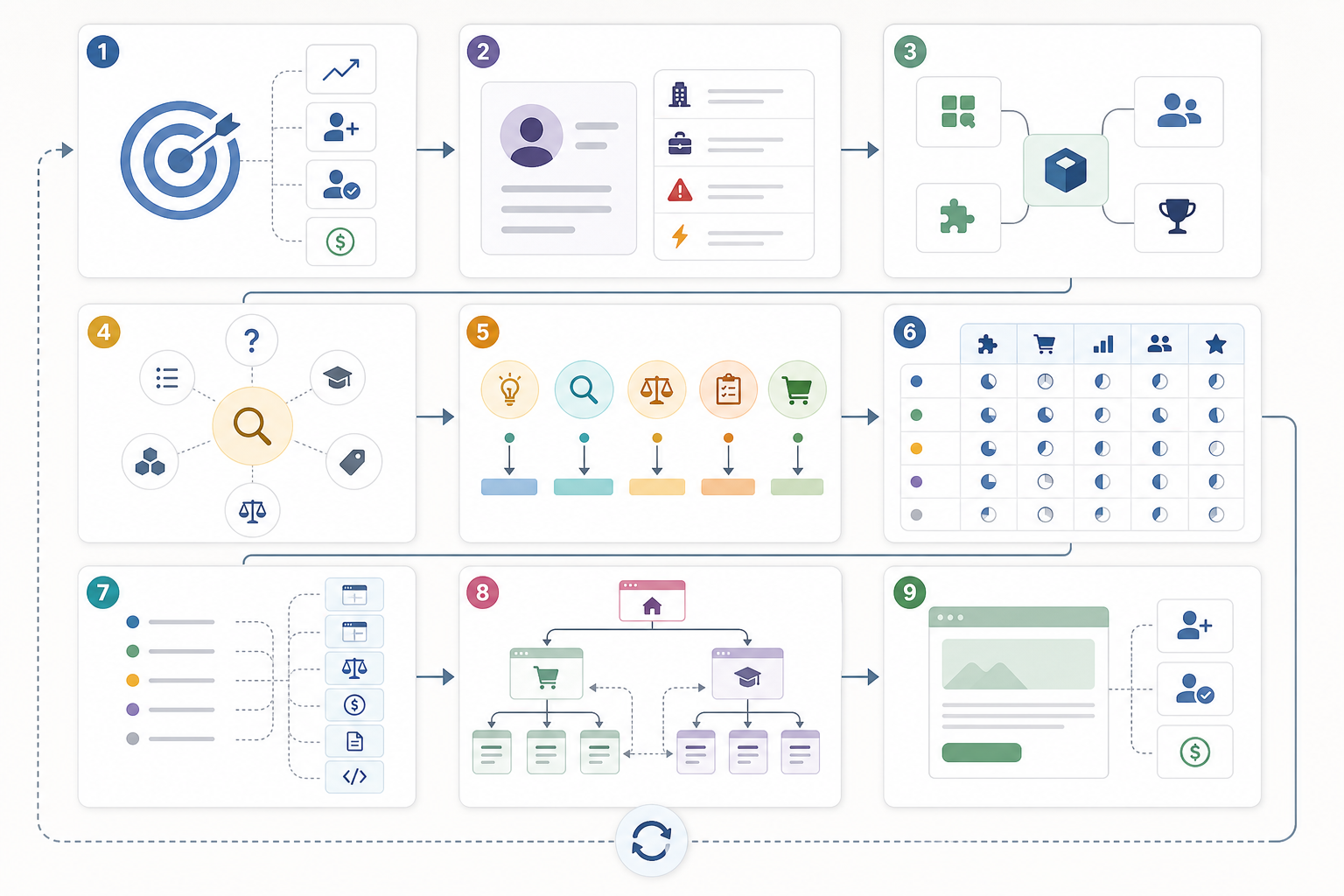
A SaaS SEO strategy is built by connecting business goals and customer problems with relevant search opportunities, then creating the page, technical, authority, conversion, and measurement systems needed to capture that demand. This adapts the broader principles of an SEO strategy to the product model, buying context, search behavior, and commercial priorities of a SaaS business. Search volume is one input, but product relevance, intent, competition, and business value determine which opportunities deserve priority.
1. Define SaaS Business Goals
Start with the outcomes SEO is expected to support.
These can include:
- Qualified organic traffic
- Product discovery
- Demo requests
- Free trials
- Signups
- Qualified leads
- Sales pipeline
- Subscriptions
- Revenue
- Customer education
Keep business outcomes separate from SEO performance indicators.
Rankings, impressions, clicks, backlinks, and indexed pages can help diagnose performance, but they are not the final business objective.
2. Define the ICP and Buying Context
Identify who the product serves and what creates the need for it.
Document:
- Customer type
- Company size
- Industry
- User role
- Primary problem
- Use case
- Buying trigger
- Common objections
- Existing alternatives
- Customer terminology
Useful sources can include customer interviews, sales calls, CRM notes, support tickets, reviews, product analytics, community discussions, and customer-success conversations.
This gives keyword and content research a real customer context rather than starting with an abstract list of search volumes.
3. Define the Product and Entity Context
Document what the SaaS product is and how it relates to the market.
Include:
- Software category
- Core problem solved
- Features
- Use cases
- Industries
- Integrations
- Customer types
- Competitors
- Alternatives
- Differentiators
Keep important facts consistent across product pages, company pages, documentation, profiles, and other owned properties.
This product context helps determine which search themes belong within the SEO strategy.
4. Research the Relevant Search Demand
Research searches connected with:
- Customer problems
- Software categories
- Features
- Use cases
- Jobs to be done
- Industries
- Integrations
- Alternatives
- Competitors
- Comparisons
- Pricing
- Branded terms
- Educational topics
Include informational, navigational, commercial, and transactional searches where they are relevant.
Do not restrict research to large head terms. Highly specific searches can have stronger product alignment even when their individual demand is smaller.
5. Classify Search Intent
Determine what users are trying to accomplish for each important query group.
They can be trying to:
- Learn
- Find a specific destination
- Compare options
- Evaluate a product
- Complete an action
Validate intent through the wording of the query, modifiers, ranking page types, SERP composition, and competing results.
Some searches have mixed intent. Record the dominant need while preserving important secondary needs.
6. Prioritize Keywords by Business Value
Evaluate opportunities using several factors rather than search volume alone.
Consider:
- Product relevance
- Customer relevance
- Search intent
- Conversion potential
- Search demand
- Competitive difficulty
- Existing authority
- Current rankings
- Strategic importance
- Available resources
Queries closely connected with what the product actually solves can deserve priority even when their volume is lower.
Informational searches should not automatically be deprioritized in favor of every commercial query. Their value depends on the business objective and how strongly the topic connects with the product.
7. Match Keyword Groups With the Right Page Type
Different searches require different page types.
Possible destinations include:
- Homepage
- Software category page
- Feature page
- Solution page
- Use-case page
- Industry page
- Integration page
- Comparison page
- Alternative page
- Pricing page
- Template
- Free tool
- Documentation
- Glossary
- Article
Avoid creating an article for every query.
Several related keywords with the same intent can often belong on one page.
8. Build the SaaS Information Architecture
Organize pages so the relationship between product capabilities and informational topics remains clear.
A SaaS website can contain relationships between:
- Categories and features
- Features and use cases
- Use cases and industries
- Products and integrations
- Broad topics and supporting guides
- Comparisons and alternatives
- Informational content and commercial pages
Use meaningful cross-links where subjects overlap instead of forcing rigid topic silos.
Important pages also need reasonable internal accessibility rather than being buried without meaningful navigation or contextual links.
9. Build Commercial and Product-Led Pages
Create commercial pages only where genuine product and search relationships exist.
These can include:
- Category pages
- Feature pages
- Solution pages
- Industry pages
- Use-case pages
- Integration pages
- Comparison pages
- Alternative pages
Each page should explain how the product relates to the user’s searched problem or decision.
Avoid creating thin variations of the same sales page simply to target slightly different keywords.
10. Build Informational Content Around Customer Problems
Create useful content around the subjects customers genuinely need to understand.
Potential formats include:
- Guides
- Tutorials
- Definitions
- Templates
- Research
- Workflows
- Checklists
- Calculators
- Educational resources
Keep the content ecosystem connected with the product and market.
Broad informational content with high traffic potential but no meaningful relationship with the SaaS product can consume substantial resources without supporting product discovery or business outcomes.
11. Create Comparison and Alternative Content Carefully
Comparison and alternative searches can be strategically important for SaaS businesses because they often occur during product evaluation.
Useful pages can include:
- Product A vs Product B
- Product alternatives
- Category comparisons
- Feature comparisons
Use factual and consistent evaluation criteria.
Explain:
- Who each product serves
- Relevant features
- Differences
- Limitations
- Use-case fit
- Pricing context where current and verifiable
- Important decision criteria
Avoid unverifiable competitor claims or comparisons designed only to make your own product appear superior.
12. Align Each Page With Search Intent
Match the page with the task the user wants to complete.
Review:
- Page type
- Content format
- Angle
- Depth
- Answer structure
- Supporting information
- Examples
- Evidence
- Calls to action
Give the primary answer early where appropriate.
Intent optimization is not about inserting more keywords associated with a specific funnel stage. It is about providing the type of page and information the searcher needs.
13. Establish Strong Topical Relationships
Cover the entities, attributes, questions, comparisons, and concepts necessary to explain each topic properly.
Keep every page centered on one clear macro-purpose.
Do not add loosely related sections merely because a content tool recommends more semantic terms or because a competitor has covered them.
Use contextual internal links where another page provides useful additional information.
14. Build a Reliable Technical SEO Foundation
Important public pages need to be accessible and technically consistent.
Review:
- Crawlability
- Rendering
- Indexability
- Status codes
- Redirects
- Canonicals
- Robots directives
- XML sitemaps
- Duplicate URLs
- JavaScript rendering
- Mobile usability
- Website performance
- Structured data
Technical SEO enables pages to participate in search but does not replace useful content, relevant targeting, or authority.
15. Implement Structured Data Where Appropriate
Use structured data when a supported type accurately represents content already visible on the page.
Possible types depend on the page and can include organization, software application, product, breadcrumb, article, or other appropriate schema vocabularies.
Do not add a schema type simply because another SaaS website uses it.
Structured data also does not guarantee rankings, rich results, or AI visibility.
16. Build Internal Links Deliberately
Connect related pages according to their context and user value.
Examples include:
- Informational guide to relevant feature page
- Feature page to use case
- Use-case page to integration
- Comparison page to pricing
- Glossary entry to deeper educational guide
- Supporting article to broader topic hub
Use descriptive anchor text.
Prioritize relevant connections and important pages instead of targeting a predetermined number of links per page.
17. Build External Authority
Earn external references from relevant publishers, websites, organizations, partners, and communities.
Authority-building activities can include:
- Editorial backlinks
- Original research
- Digital PR
- Expert contributions
- Industry partnerships
- Data assets
- Tools
- Studies
- Relevant citations
Evaluate opportunities using relevance, editorial context, source quality, and audience fit rather than Domain Authority or Domain Rating alone.
Third-party authority metrics can support comparison, but they are not Google metrics.
18. Connect SEO Pages With Appropriate Conversion Paths
Match the call to action with the user's current need.
Possible next actions include:
- Read another resource
- Explore a feature
- View an integration
- Compare products
- See pricing
- Start a free trial
- Request a demo
- Create an account
- Contact sales
A user reading an early research guide does not necessarily need the same CTA as someone searching specifically for software pricing.
19. Establish SEO Measurement
Track both search performance and business performance.
Useful SEO indicators can include:
- Impressions
- Clicks
- CTR
- Rankings
- Landing-page traffic
- Indexation
- Technical health
- Backlinks
Business outcomes can include:
- Signups
- Free trials
- Demo requests
- Qualified leads
- Pipeline
- Subscriptions
- Revenue
Search Console provides first-party information about Google Search performance, while analytics platforms can connect organic acquisition with website events and business outcomes. Third-party platforms can add competitor, backlink, keyword, and market evidence.
20. Measure Pages According to Their Purpose
Different page types perform different jobs.
An informational guide does not need to be judged only by direct demo requests.
Useful indicators can include:
- Organic visibility
- Qualified visits
- Next-page behavior
- Assisted conversions
- Product-page visits
- Trial starts
- Demo requests
- Lead quality
- Pipeline
- Revenue
Use the metric that reflects what the page is intended to accomplish.
21. Identify Gaps and Reprioritize
Review performance to identify:
- Missing search coverage
- Declining pages
- Weak commercial pages
- Technical issues
- Internal-link gaps
- Content gaps
- Competitor improvements
- Authority gaps
- Weak conversion performance
The correct action can be to:
- Create
- Improve
- Refresh
- Consolidate
- Reposition
- Internally link
- Fix technically
- Strengthen externally
- Monitor
- Leave unchanged
Not every declining or imperfect page requires immediate rewriting.
22. Refresh the Strategy as the Product and Market Change
A SaaS SEO strategy changes when the company changes.
Reassess priorities when there are changes in:
- Product features
- Positioning
- Integrations
- ICP
- Competitors
- Search behavior
- Customer needs
- SERPs
- New markets
- Business priorities
A page system built around an outdated version of the product can remain technically optimized while becoming commercially irrelevant.
A strong SEO strategy for SaaS therefore combines business priorities, customer understanding, product relevance, search demand, appropriate page types, technical accessibility, useful content, internal relationships, external authority, conversion opportunities, and meaningful performance measurement.
Which Software Can Support SaaS SEO?
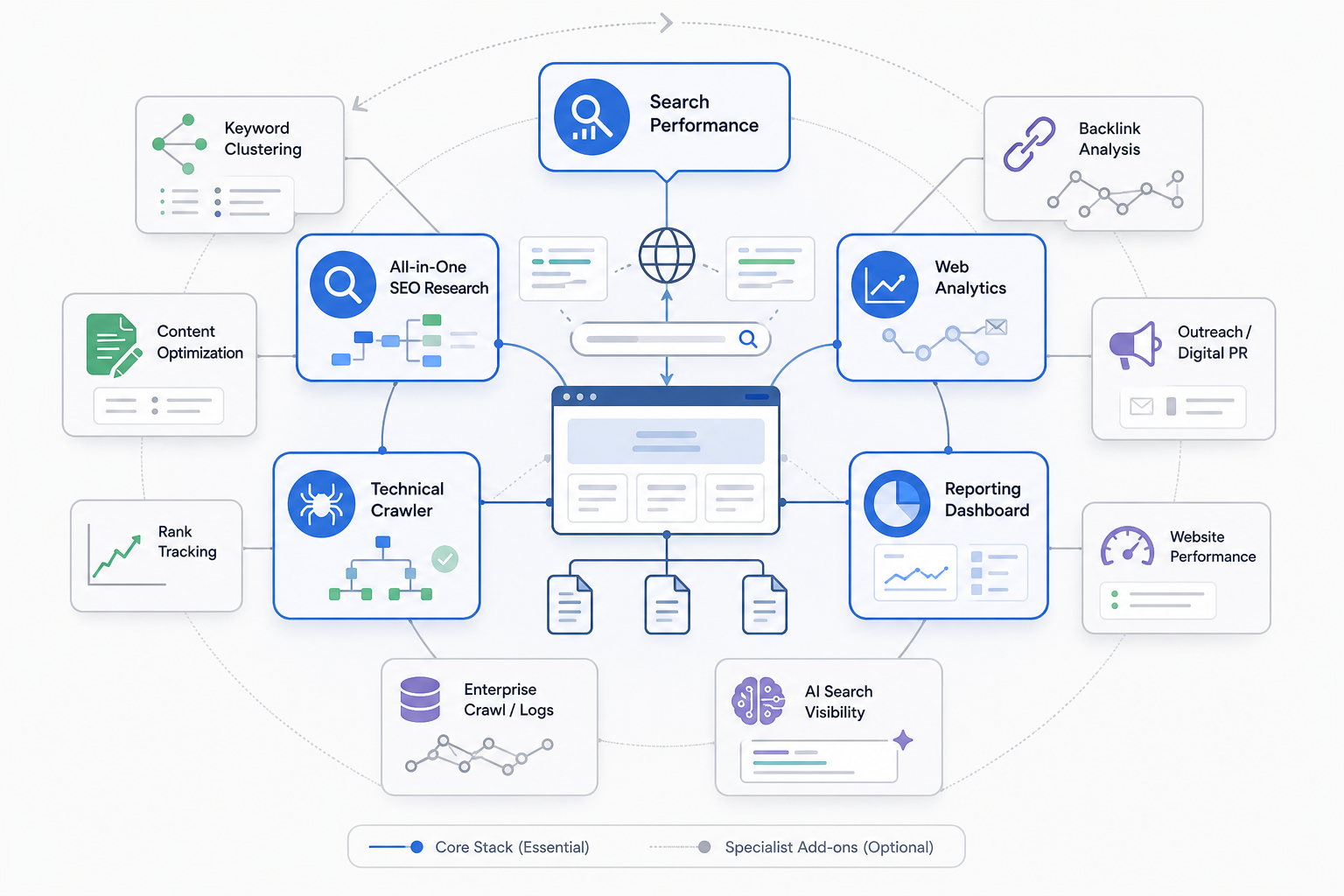
SaaS SEO can be supported by a combination of first-party search and analytics platforms, all-in-one SEO suites, technical crawlers, rank trackers, content tools, backlink platforms, and reporting software. No single platform is required to perform every activity, and specialist software can provide greater depth where a particular SEO function matters more. The right stack depends on the task, which is why broader comparisons of top SaaS software are useful when evaluating tools across different SaaS functions rather than SEO alone.
| SaaS SEO Requirement | Suitable Software | Main Capability | Data / Output | When to Use It |
|---|---|---|---|---|
| Keyword Research | Semrush, Ahrefs | Keyword discovery, SERPs, competitor terms, demand estimates | Query opportunities and prioritization evidence | Building or expanding the search-demand map |
| Competitor Research | Semrush, Ahrefs, Similarweb | Competitor keywords, ranking pages, links, visibility | Competitive gaps and market evidence | Evaluating competing SaaS websites |
| Backlink Analysis | Ahrefs, Semrush, Majestic | Referring domains, backlinks, anchors, new and lost links | External-authority evidence | Link building and competitor authority research |
| Technical SEO Auditing | Screaming Frog, Sitebulb | Crawling, status codes, canonicals, links, rendering, metadata | Technical findings and affected URLs | Audits, migrations, architecture reviews |
| Enterprise Technical SEO | Botify, Lumar, JetOctopus | Large crawls, log analysis, monitoring | Crawl and bot-behavior evidence | Large SaaS websites and complex architectures |
| Search Performance | Google Search Console | Queries, impressions, clicks, pages, indexing evidence | First-party Google Search data | Measuring actual Google Search performance |
| Rank Tracking | AccuRanker, SE Ranking, Advanced Web Ranking | Keyword monitoring across locations and devices | Ranking trends and visibility | Monitoring strategic query groups |
| Content Research | Clearscope, Surfer SEO, Frase | SERP comparison and topical analysis | Briefs and page-level recommendations | Creating or refreshing content |
| Keyword Clustering | Keyword Insights | SERP and intent-based query grouping | Keyword-to-page groups | Mapping large keyword datasets |
| Analytics and Conversion Measurement | Google Analytics 4 | Organic sessions, events, key events, revenue | Post-click behavior and outcomes | Connecting SEO traffic with product and business actions |
| Internal Linking Analysis | Screaming Frog, Sitebulb | Incoming links, outgoing links, crawl paths, orphan discovery | Internal architecture evidence | Strengthening priority pages and content relationships |
| Website Performance | PageSpeed Insights, Lighthouse | Core Web Vitals and loading diagnostics | Performance evidence | Investigating slow or unstable templates |
| SEO Reporting | Looker Studio, AgencyAnalytics | Multi-source dashboards and recurring reports | Performance reporting | Stakeholder and client communication |
| WordPress SEO Implementation | Yoast SEO, Rank Math, AIOSEO | Metadata, sitemaps, schema, redirects | CMS implementation | SaaS marketing sites built on WordPress |
| Outreach and Digital PR | Respona, BuzzSumo | Prospecting, media research, outreach workflows | External promotion opportunities | Authority and link-building campaigns |
| AI-Search Visibility | Platforms that explicitly monitor AI answers, such as current modules within Ahrefs or Surfer | Brand mentions and visibility across supported AI-search environments | AI-answer visibility evidence | Only where AI-search monitoring is strategically relevant |
Semrush currently provides site auditing and broader SEO research functions, while Ahrefs combines Site Explorer, Keywords Explorer, Site Audit, Rank Tracker, backlink research, content tools, and newer AI-search visibility capabilities.
Screaming Frog remains a specialist crawler and supports technical site auditing, JavaScript rendering, link analysis, architecture analysis, and configurable URL crawling, making it particularly useful when a SaaS website requires deeper technical investigation than an all-in-one platform provides.
Content platforms serve a different purpose. Surfer, for example, currently provides content optimization, content auditing, topical planning, and AI-visibility functionality, while specialist rank trackers such as AccuRanker focus more deeply on keyword-position and SERP monitoring.
First-party tools remain important even when a company pays for several commercial SEO platforms. Google Analytics can connect organic acquisition with website events and business outcomes, while commercial keyword, backlink, authority, visibility, and competitor metrics remain third-party datasets or estimates.
A practical SaaS SEO stack can therefore include:
- A first-party search-performance platform
- A website analytics platform
- A broad SEO research platform
- A technical crawler
- A reporting layer
Specialist rank tracking, content optimization, backlink analysis, log analysis, outreach, or AI-search monitoring can then be added when the depth of the task justifies another platform.
The objective is not to maximize the number of subscriptions. Effective SEO SaaS software should provide the research, technical evidence, monitoring, analytics, and workflow support required by the strategy without creating unnecessary tool overlap.
Need links on real SaaS and business websites?
Links are placed after your approval, on sites with guaranteed DR and traffic, with a 1-year replacement guarantee.

