
AI SEO: Impact, Marketing, Applications, Content, AI Search & Services
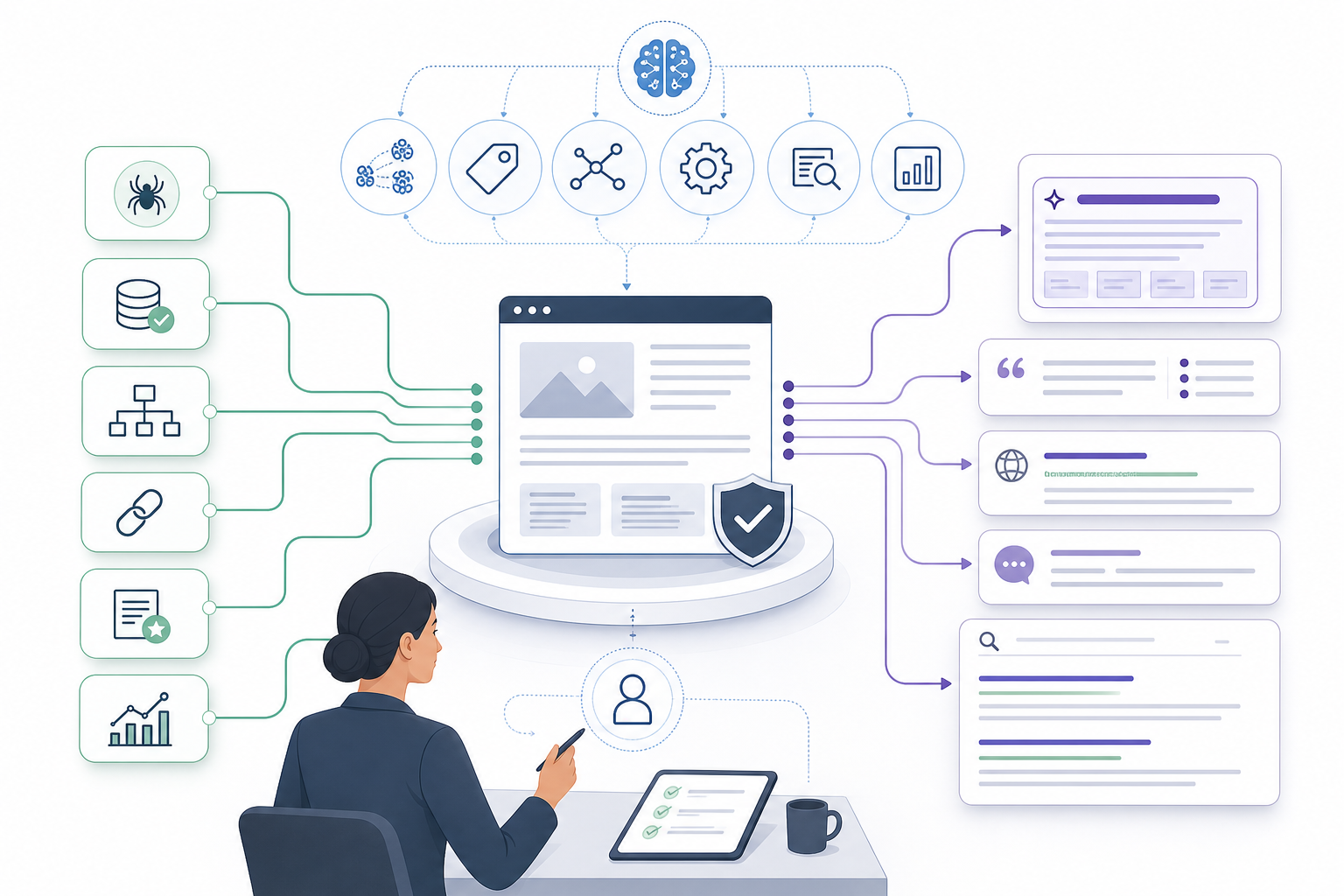
AI SEO is the application of artificial intelligence within search engine optimization to support research, analysis, content, automation, and decision-making while also adapting websites for search experiences that use AI-generated or synthesized answers. It combines established SEO principles with AI-assisted workflows and newer search interfaces.
AI SEO has two related dimensions. AI for SEO uses artificial intelligence to assist work such as keyword classification, SERP analysis, content briefing, technical-data analysis, internal linking, reporting, and automation. SEO for AI-assisted search focuses on keeping website information discoverable, understandable, retrievable, and useful when systems such as AI-generated search experiences synthesize information from web sources.
AI SEO is therefore broader than AI content writing. Generative AI can support language-based tasks such as outlining, drafting, rewriting, summarizing, and metadata creation, while other AI capabilities can support classification, clustering, semantic similarity, anomaly detection, forecasting, and pattern recognition across SEO datasets.
AI also does not create a separate universal ranking system. Conventional SEO requirements remain important, including search relevance, crawlability, indexability, website architecture, content quality, internal links, external references, and performance measurement. AI changes how some SEO work is performed and how some search interfaces retrieve and present information rather than replacing these fundamentals.
AI-assisted search can create additional forms of visibility beyond conventional organic rankings. Examples include AI citations, referenced URLs, brand mentions, synthesized answers, featured search results, and traditional organic listings. These outcomes should not be treated as identical metrics because each interface can use different retrieval, ranking, grounding, and presentation mechanisms.
AI SEO still begins with genuine user needs and reliable search evidence. AI can identify related entities, questions, modifiers, attributes, and patterns, but generated ideas do not automatically represent verified search demand. Keyword data, Search Console data, SERPs, customer research, analytics, and other reliable datasets remain necessary where factual search evidence is required.
AI can also increase SEO execution capacity. Repetitive activities such as classifying thousands of queries, grouping crawl findings, drafting metadata, reviewing content inventories, or summarizing reports can be completed more efficiently with AI assistance. Greater automation also increases the potential impact of errors, making data quality, validation, quality assurance, and governance more important.
Human judgment remains responsible for business priorities, SEO strategy, source selection, factual validation, editorial quality, technical decisions, implementation approval, and measurement interpretation. AI can process, generate, classify, and summarize information, but it does not determine which SEO opportunity is strategically valuable simply because it can execute the task faster.
AI SEO therefore combines traditional search optimization, AI-assisted SEO execution, and adaptation to AI-assisted search discovery while keeping user needs, reliable evidence, accessible information, human validation, and measurable business outcomes central.
How Is AI Changing SEO?
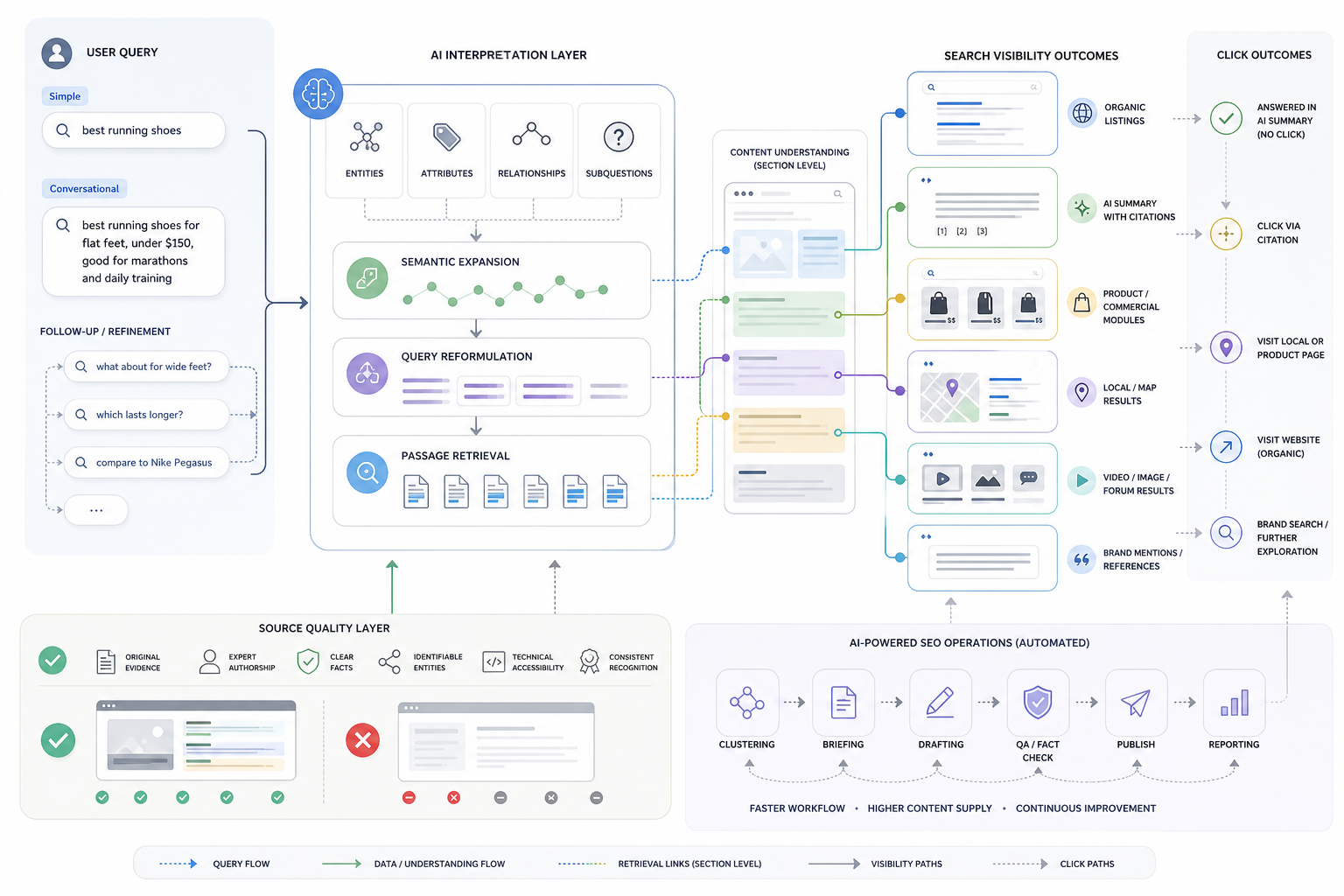
AI is changing SEO by altering how users express searches, how search systems interpret and synthesize information, how answers are presented, and how websites can gain visibility beyond traditional organic listings. AI expands the search environment without removing the need for accessible, relevant, useful, and credible webpages.
The main changes include the following.
- More Conversational Search Behavior: Users can submit longer and more specific requests containing multiple constraints, comparisons, or follow-up questions. Short searches such as “CRM software” still exist alongside longer searches such as “Which CRM is suitable for a 20-person B2B sales team that needs WhatsApp integration?”
- Query Interpretation and Reformulation: AI systems can interpret a request through related concepts, entities, attributes, and subquestions. Exact wording therefore remains useful evidence, but semantic relationships can also influence which information is retrieved.
- AI-Generated Search Summaries: Some search experiences synthesize information directly inside the interface rather than requiring users to visit every source individually. This can affect click behavior for informational searches such as definitions, summaries, comparisons, and factual questions.
- Changing Click Distribution: A generated answer can satisfy some information needs without a click, while other queries can still produce visits through citations, referenced URLs, product research, branded follow-up searches, or conventional listings. AI-generated answers do not universally eliminate clicks.
- Search Visibility Beyond Rankings: Visibility can include organic positions, cited sources, referenced URLs, brand mentions, featured results, knowledge-based surfaces, and synthesized answers. A citation and a conventional ranking are related forms of visibility but are not the same outcome.
- Greater Importance of Source Selection: AI-assisted systems that retrieve web information need sources capable of answering the user's task. Pages benefit from clear facts, relevant context, identifiable entities, evidence, and technically accessible information.
- Stronger Entity Clarity: Content benefits from explicitly identifying entities such as companies, products, people, locations, concepts, features, specifications, and relationships. Entity clarity is different from mechanically repeating entity names.
- More Granular Information Retrieval: Search systems can retrieve relevant passages or sections rather than treating a page only as one indivisible document. Clear sections therefore help users and retrieval systems locate specific answers.
- Greater Value From Well-Scoped Sections: A section explaining “How does SSO work in a SaaS application?” should answer that subject clearly rather than mix SSO, pricing, CRM integrations, analytics, and unrelated security topics into one block.
- Higher Value of Original Evidence: Generic information is easier to generate at scale. Original research, first-hand tests, proprietary datasets, expert interpretation, case studies, measurements, and unique examples can provide information that generic summaries cannot reproduce independently.
- More Attention to Source Recognition: Consistent company information, expert authorship, legitimate references, editorial citations, reviews, and relevant mentions can help users and systems understand the entity behind a source. These signals do not guarantee AI citations.
- More Complex Search Results: A webpage can compete for attention with result types such as AI summaries, organic listings, Shopping results, maps, videos, images, forums, and product modules. Page format should reflect the actual search task and result environment.
- More Automated SEO Production: AI can assist activities such as keyword grouping, briefs, outlines, drafting, metadata creation, content analysis, reporting, and data classification. Faster production does not guarantee higher SEO quality.
- Higher Content Supply: Generative AI lowers the operational cost of producing text. This increases competition among generic explanations and raises the relative value of differentiated information, utility, expertise, data, tools, and practical evidence.
- Faster SEO Research: AI can summarize supplied SERPs, organize competitor information, classify query sets, identify recurring attributes, and interpret large exports. Conclusions still need to be checked against their underlying sources.
- Easier Scaled SEO Operations: Structured-data websites such as ecommerce stores, SaaS directories, marketplaces, location databases, and product catalogs can use AI to assist repetitive enrichment or QA where genuine search demand and reliable source data exist.
- More Complex Measurement: SEO teams can now monitor traditional outcomes such as impressions, clicks, rankings, sessions, conversions, and revenue alongside newer indicators such as AI citations, mentions, referenced URLs, and answer presence where measurement is available.
- Greater Focus on Business Outcomes: A brand can receive AI visibility without an immediate website visit. Measurement can therefore include later branded searches, assisted conversions, direct visits, leads, purchases, subscriptions, or revenue where reliable attribution exists.
- More Multi-Platform Discovery: Users can discover information through traditional search engines, AI assistants, marketplaces, social platforms, forums, video platforms, and specialist search products. These environments do not all use the same technical retrieval mechanisms.
Four broader changes summarize AI's effect on SEO.
| Area | AI-Driven Change | SEO Implication | What Remains Important |
|---|---|---|---|
| Search Behavior | More contextual, conversational, and multi-part searches | Understand the complete user task | Keywords, intent, entities, relevance |
| Search Presentation | More synthesized and direct answers | Optimize for useful source visibility as well as clicks | Accurate and accessible webpages |
| SEO Execution | More AI-assisted research, analysis, and automation | Automate repeatable work with validation | Strategy and human judgment |
| Measurement | Citations and AI mentions add new visibility indicators | Measure business contribution beyond rankings | Traffic, leads, conversions, revenue |
Technical SEO remains necessary. Where a search system depends on web discovery or retrieval, pages can still need to be discoverable, crawlable, renderable, indexable, and retrievable. Different AI products can use different combinations of web indexes, live browsing, proprietary retrieval, model knowledge, or external datasets, so no single technical sequence describes every system.
Structured data also remains a supporting mechanism rather than an AI citation shortcut. Markup such as Organization, Product, Article, Breadcrumb, Event, and other supported schema types can clarify machine-readable information where it accurately represents visible content. Schema does not guarantee inclusion in an AI-generated answer.
Terms such as Answer Engine Optimization (AEO) and Generative Engine Optimization (GEO) are increasingly used for answer-oriented or generative search visibility. Their definitions vary across the industry, and many underlying practices overlap with SEO, including technical accessibility, relevance, clear information architecture, entity understanding, source credibility, and useful content.
AI is therefore changing SEO by expanding search from a system centered primarily on ranked webpages into one that can also involve retrieval, synthesis, direct responses, citations, conversational follow-ups, and conventional organic results.
Where Does AI SEO Fit Into Marketing?
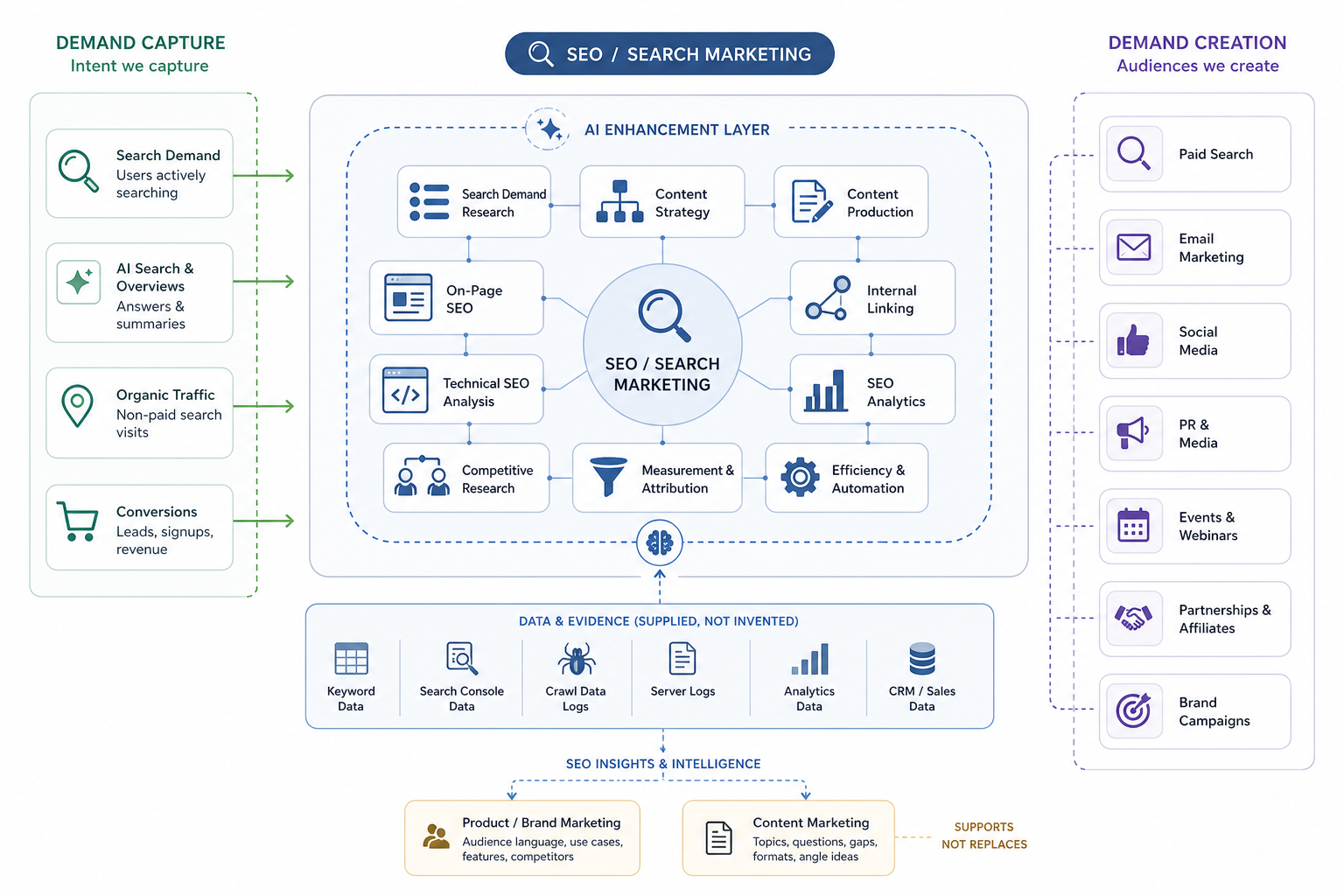
AI SEO fits into marketing as an AI-enabled capability layer within SEO and search marketing that can support search research, execution, analysis, automation, and adaptation to AI-assisted search interfaces. Within SEO marketing, AI mainly improves how search opportunities are researched, executed, analyzed, and scaled rather than creating a separate marketing channel. It is not a separate acquisition channel in the same sense as organic search, paid search, email, or social media.
AI SEO can support several marketing functions.
Search Demand Research
AI can help organize datasets containing:
- Keywords
- Questions
- Modifiers
- Topics
- Entities
- Product categories
- Competitor terms
- Search-intent patterns
For example, an SEO team can supply 20,000 keyword rows from a research platform and use AI to classify them by topic, intent, product family, or modifier.
AI does not automatically know current search volume, ranking difficulty, CPC, or competitor traffic without access to the relevant data.
Content Strategy
AI can help organize:
- Topic ideas
- Search questions
- Entity relationships
- Content gaps
- Supporting subtopics
- Search-result patterns
The marketer still determines which subjects are relevant to the audience and business.
A generated content idea should not receive priority simply because an AI model produced it.
Content Production
AI can assist with:
- Briefs
- Outlines
- Drafts
- Rewrites
- Summaries
- Metadata
- Product copy
- Repetitive content operations
Production efficiency is separate from content effectiveness. Useful SEO content still requires accurate facts, appropriate search intent, source quality, differentiation, and editorial control.
On-Page SEO
AI can help review relationships involving:
- Queries
- Entities
- Headings
- Attributes
- Related topics
- Internal links
- Missing information
These recommendations remain analytical suggestions rather than direct evidence of what a search engine requires.
Technical SEO Analysis
AI can analyze structured technical evidence such as:
- Crawl exports
- Server logs
- Indexation reports
- Status codes
- Canonicals
- Redirects
- Internal-link data
- Page templates
It can classify issues or identify repeated patterns across large datasets.
The underlying crawler, server logs, search data, or platform evidence remains the factual source.
Internal Linking
AI can compare page content and suggest relationships between:
- Guides and product pages
- Parent and child topics
- Category and subcategory pages
- Definitions and deeper resources
- Related services
- Comparison pages and products
A suggested link should still be reviewed for actual contextual and user value.
Competitive Research
AI can organize public competitor information such as:
- Ranking pages
- Page structures
- Topic coverage
- Product positioning
- Common comparison attributes
- Search-result patterns
The quality of the analysis depends on whether current and reliable competitor evidence was supplied.
SEO Analytics
AI can assist with datasets from:
- Google Search Console
- Web analytics
- Crawlers
- Rank trackers
- CRM platforms
- Conversion systems
Useful applications include identifying declining page groups, summarizing query changes, segmenting traffic patterns, and detecting unusual movements.
Generated explanations should remain traceable to the source data.
Marketing Measurement
Traditional SEO outcomes remain central:
- Rankings
- Impressions
- Clicks
- Organic traffic
- Leads
- Signups
- Purchases
- Pipeline
- Revenue
AI-assisted search can add indicators such as:
- Mentions
- Citations
- Referenced URLs
- Answer presence
These newer indicators are not yet standardized across all AI search products.
Content Marketing
AI SEO can help content marketers understand which questions, comparisons, problems, and product relationships have observable search demand.
Content marketing remains broader than SEO. Assets such as research reports, newsletters, webinars, social posts, customer stories, podcasts, and thought leadership can provide marketing value without targeting search demand.
Product and Brand Marketing
Search research can reveal how users describe:
- Product categories
- Features
- Competitors
- Problems
- Use cases
- Alternatives
This evidence can support positioning work, but it does not replace customer interviews, CRM insights, market research, product data, or brand strategy.
Demand Capture
SEO primarily helps businesses meet existing or emerging search demand.
Demand creation can also come from channels such as:
- Advertising
- PR
- Events
- Communities
- Social media
- Partnerships
- Influencers
- Brand campaigns
AI SEO should therefore not be described as an independent demand-generation channel.
Efficiency and Automation
AI can reduce repetitive work in areas such as:
- Query classification
- Reporting
- Metadata drafting
- Content QA
- Data transformation
- Monitoring
- Pattern identification
Efficiency is valuable only when the underlying tasks deserve to be performed.
Automating an unnecessary page, weak keyword, incorrect technical recommendation, or low-value content idea simply produces the wrong result faster.
AI SEO marketing works best when AI improves research, analysis, execution, and search adaptation, while marketers retain responsibility for audience relevance, positioning, evidence, business priorities, and final decisions.
How to Use AI for SEO?
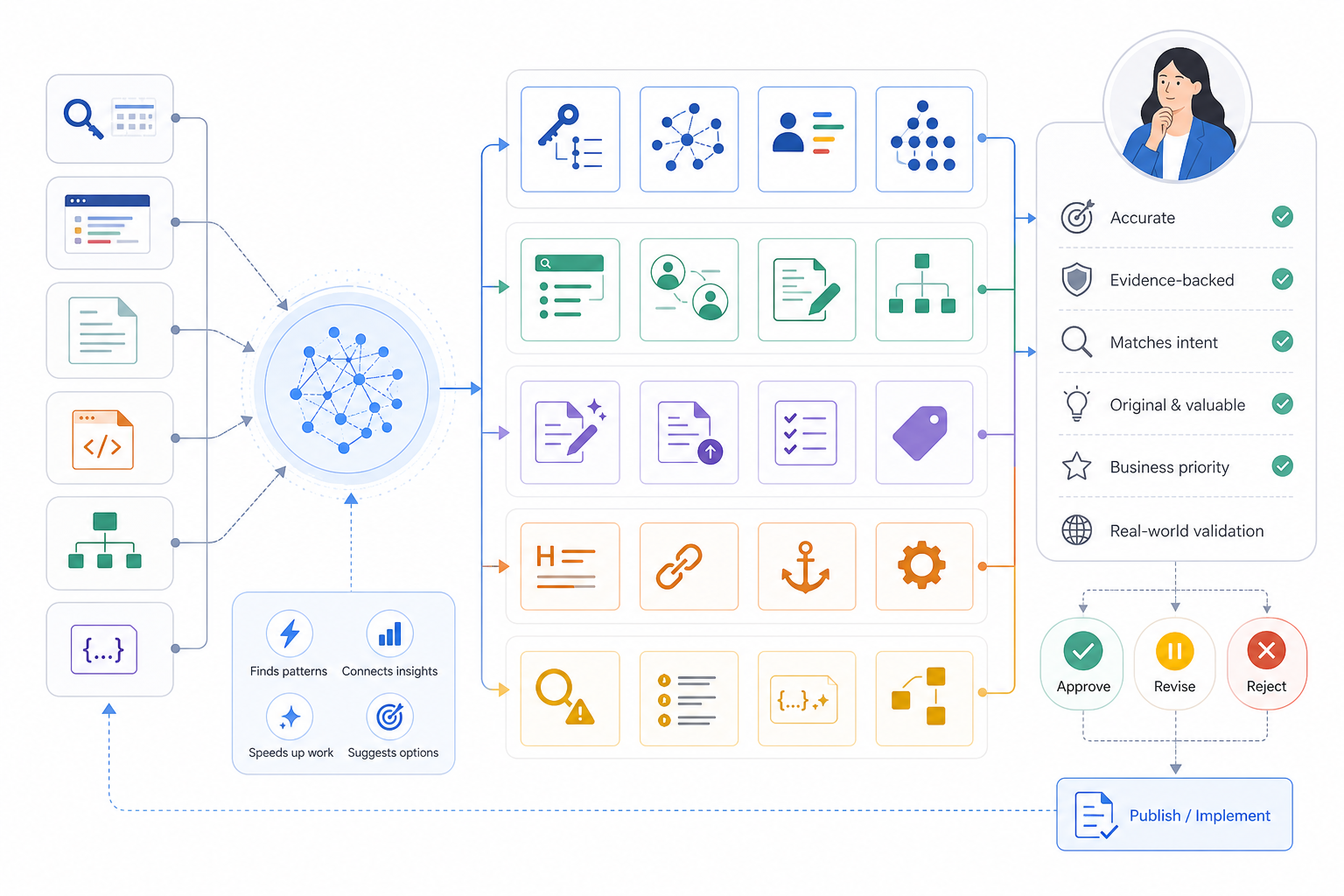
AI can be used for SEO to accelerate research, organize large datasets, support content creation, analyze technical and performance data, identify optimization opportunities, and automate repeatable operations. AI should assist SEO judgment rather than independently decide what should be published, indexed, changed, or prioritized.
1. Organize Keyword Research
Use AI to classify supplied keyword datasets according to factors such as:
- Topic
- Product family
- Modifier
- Intent
- Brand status
- Geography
- Page family
Use reliable keyword exports or first-party query data where search metrics matter.
Do not ask an AI model to invent search volume and treat the result as keyword research data.
2. Expand Topic Relationships
AI can suggest related:
- Questions
- Entities
- Attributes
- Comparisons
- Problems
- Use cases
- Subtopics
These suggestions are research hypotheses.
Validate commercially or strategically important ideas with sources such as:
- SERPs
- Keyword databases
- Search Console
- Customer interviews
- Support data
- Product research
3. Classify Search Intent
AI can classify query sets into likely intent groups such as:
- Informational
- Navigational
- Commercial
- Transactional
- Local
Validate important terms against current SERPs because intent classification remains an inference.
4. Cluster Keywords
AI can identify semantically related queries and help organize large keyword sets.
Final page grouping should also consider:
- Search intent
- SERP overlap
- Entity relationship
- Page purpose
Two linguistically similar searches do not necessarily belong on the same URL.
5. Analyze SERPs and Competitors
Supply current SERP or competitor data and use AI to identify:
- Ranking page types
- Recurring sections
- Common entities
- Comparison attributes
- Content gaps
- Repeated result patterns
Keep the underlying pages available for verification.
6. Build Content Briefs
AI can organize a content brief containing:
- Central query
- Search intent
- Relevant entities
- Heading hierarchy
- Attributes
- Supporting questions
- Evidence requirements
- Recommended answer formats
The brief should reflect the user task rather than copy competitor headings mechanically.
7. Create Page Outlines
AI can propose H1, H2, and H3 structures from validated research.
Review whether:
- Every heading belongs to the central topic.
- Child headings genuinely support their parent.
- Adjacent headings have distinct purposes.
- Important questions are covered.
- Repetition is removed.
8. Assist First Drafts
Generative AI can help draft:
- Definitions
- Explanations
- Examples
- Comparisons
- Summaries
- Transitions
Provide reliable sources and factual inputs when accuracy matters.
Human review should confirm:
- Accuracy
- Evidence
- Completeness
- Originality
- Brand fit
- Search intent
9. Improve Existing Content
AI can identify:
- Repetition
- Vague explanations
- Missing context
- Unsupported claims
- Weak transitions
- Conflicting terminology
- Overlapping sections
Do not implement recommendations without considering real page performance and search intent.
10. Review Semantic Coverage
AI can compare a draft against a defined set of:
- Entities
- Attributes
- Questions
- Comparisons
- Relationships
- Mechanisms
Use the output to identify possible omissions rather than to enforce a fixed number of semantic terms.
11. Draft Titles and Meta Descriptions
AI can generate page-specific options based on existing content or structured product information.
Review for:
- Accuracy
- Duplication
- Search intent
- Natural language
- Page differentiation
Do not use arbitrary exact-match or character-count formulas.
12. Improve Heading Structure
AI can detect:
- Duplicate headings
- Weak hierarchy
- Vague labels
- Repeated questions
- Sections outside the page scope
Restructure for information clarity, not simply to make the page appear “AI optimized.”
13. Find Internal-Link Opportunities
Supply page titles, headings, content, or embeddings and use AI to identify relevant relationships.
Examples include:
- Guide to service page
- Category to product
- Definition to deeper explanation
- Comparison to product
- Supporting article to parent topic
Validate each proposed relationship before implementation.
14. Draft Anchor Text
AI can suggest descriptive anchor wording based on:
- Source sentence
- Destination page
- Relationship between both pages
Keep anchors natural and context dependent instead of scaling exact-match phrases.
15. Analyze Technical SEO Data
AI can analyze exports containing:
- HTTP status codes
- Canonicals
- Metadata
- Internal-link counts
- Indexation states
- Templates
- Crawl depth
- Server-log data
Use it to classify large issue sets and highlight repeated patterns.
Technical conclusions should remain grounded in the actual crawl, server, or search evidence.
16. Prioritize Technical Findings
AI can group technical issues according to:
- URL type
- Template
- Page importance
- Issue category
- Business segment
The resulting groups can help prioritization, but the model should not automatically determine severity.
17. Assist Structured Data Work
AI can help:
- Draft JSON-LD
- Map visible fields to schema properties
- Check consistency
- Explain validation errors
Always compare generated markup with the visible page and applicable official specifications.
Never allow AI to invent ratings, prices, authors, organizations, or unsupported properties.
18. Create Image and Media Metadata
Multimodal models can draft:
- Alt text
- Captions
- Image descriptions
- Media summaries
Review for visual accuracy and accessibility.
Generated alt text is not automatically an image-ranking improvement.
19. Support Large-Scale Page Systems
AI can support sites with structured page inventories such as:
- Ecommerce catalogs
- SaaS directories
- Location databases
- Marketplaces
- Product comparison systems
Scalable generation should require:
- Real search demand
- Reliable source data
- Meaningful differentiation
- Quality control
Low-cost content production alone does not justify creating thousands of URLs.
20. Analyze Content Refresh Needs
AI can compare older content with:
- Updated sources
- Product information
- SERPs
- Competitor evidence
- Performance data
Use the analysis to identify information requiring review.
Do not change content simply to create a new modification date.
21. Analyze Search Console and Analytics Data
AI can summarize:
- Query gains and losses
- Landing-page changes
- CTR patterns
- Traffic changes
- Conversion differences
- Segment-level anomalies
Keep all numerical conclusions traceable to the actual exported dataset.
22. Detect Patterns and Anomalies
AI and statistical systems can flag unusual changes in:
- Rankings
- Impressions
- Clicks
- Organic traffic
- Crawling
- Indexation
- Conversions
An anomaly indicates something worth investigating. It does not establish the cause.
23. Summarize SEO Reports
AI can convert large datasets into stakeholder summaries containing:
- Major gains
- Major declines
- Important technical changes
- Significant ranking movements
- Business outcomes
Generated explanations should not introduce unsupported causes.
24. Automate Repetitive SEO Operations
Suitable recurring tasks can include:
- Classification
- Metadata drafting
- Data transformation
- Content QA
- Issue grouping
- Alerts
- Report summaries
High-impact actions should remain behind human review or clearly defined safeguards.
25. Build Human Validation Into AI Work
Validate important AI outputs against:
- Current SERPs
- First-party search data
- Analytics
- Official documentation
- Product information
- Primary sources
- Business requirements
Stronger verification is necessary for topics involving medical, financial, legal, scientific, safety, pricing, product, or technical claims.
26. Measure AI's Operational Value
Measure whether AI improves:
- Research speed
- Dataset coverage
- Classification consistency
- Analysis time
- Reporting efficiency
- Content-operation throughput
Keep operational efficiency separate from final SEO outcomes such as rankings, clicks, leads, transactions, and revenue.
AI use in SEO can be summarized across four functions.
| Function | Examples |
|---|---|
| Research | Keyword organization, intent classification, SERP analysis, clustering |
| Execution | Briefs, drafts, metadata, internal links, structured data |
| Analysis | Crawls, Search Console, analytics, anomalies, performance groups |
| Automation | Classification, reporting, monitoring, repetitive operations |
Effective AI for SEO means applying artificial intelligence where it can improve the speed or consistency of research, execution, analysis, and automation while preserving reliable inputs and human validation.
How Is Machine Learning Used in SEO?
Machine learning is used in SEO to identify patterns across large datasets, classify and cluster information, estimate relationships, detect anomalies, forecast outcomes, and automate analytical tasks that are difficult to perform manually at scale. Machine learning is one subset of AI rather than a synonym for every AI SEO workflow.
| Machine-Learning Capability | SEO Input | Model Output | Practical SEO Use | Main Limitation |
|---|---|---|---|---|
| Classification | Keywords, URLs, pages, issues | Labels or categories | Intent, page type, topic, issue grouping | Labels remain model estimates |
| Clustering | Queries, pages, embeddings | Related groups | Keyword clustering, topic mapping | Similarity does not prove same intent |
| Semantic Similarity | Text, queries, passages | Similarity values | Related content and internal-link research | Similarity is not a ranking factor |
| Anomaly Detection | Time-series SEO data | Unusual changes | Traffic or indexing investigation | Does not identify cause |
| Forecasting | Historical performance | Estimated future values | Planning and prioritization | Results depend on assumptions |
| Generation | Structured inputs or prompts | Text or summaries | Metadata, reports, descriptions | Requires factual review |
Keyword Classification
Models can classify query datasets by attributes such as:
- Topic
- Modifier
- Intent
- Brand status
- Product type
- Geography
The output is an organized dataset, not a final strategy.
Keyword Clustering
Machine-learning models can group queries using signals such as:
- Semantic similarity
- Embeddings
- Lexical similarity
- SERP overlap
Clustering can reduce manual work when dealing with thousands of searches.
Semantic similarity alone does not prove that two queries require one page.
Semantic Similarity
Embeddings represent words, queries, passages, or webpages as numerical vectors that allow models to estimate meaning similarity.
SEO applications can include:
- Topic mapping
- Duplicate detection
- Internal-link discovery
- Content clustering
- Related-page analysis
A similarity score is an analytical output rather than a search ranking factor.
Search Intent Classification
Models can estimate whether queries are:
- Informational
- Navigational
- Commercial
- Transactional
- Local
Important queries should still be validated against actual SERPs.
SERP Pattern Recognition
Machine learning can analyze large result datasets and identify repeated:
- Page types
- Domains
- SERP features
- Content structures
- Result characteristics
Shared characteristics are signals for analysis, not proof that those characteristics caused rankings.
Entity and Topic Extraction
NLP and machine-learning models can identify:
- Entities
- Attributes
- Relationships
- Phrases
- Recurring concepts
These outputs can support taxonomy development and content analysis.
Detected entities should not be inserted mechanically into content.
Content Classification
Large sites can classify pages according to:
- Topic
- Intent
- Page type
- Business value
- Freshness
- Performance
This becomes useful when a site has thousands or millions of URLs.
Content Similarity Analysis
Models can identify pages with overlapping semantic coverage.
The finding can trigger review for possible:
- Consolidation
- Repositioning
- Differentiation
- Canonicalization
Similarity alone does not prove keyword cannibalization.
Content Gap Analysis
Models can compare a page against:
- Competitor pages
- Topic models
- Entity frameworks
- Defined briefs
Potential gaps should be treated as research questions rather than mandatory content additions.
Internal-Link Recommendations
Models can compare page meaning using:
- Text
- Headings
- Topics
- Embeddings
- Entities
This can produce candidate source and destination relationships.
Human review remains necessary.
Technical Issue Classification
Machine learning can group technical findings according to:
- URL pattern
- Template
- Page type
- Error class
- Likely cause
This becomes particularly valuable on large websites with extensive crawl datasets.
Log Analysis
Models can help detect:
- Unusual bot activity
- Unexpected request patterns
- URL classes consuming disproportionate crawl activity
- Sudden changes in crawler behavior
This use case is most relevant to sufficiently large or technically complex websites.
Anomaly Detection
Models can flag unexpected changes in:
- Traffic
- Clicks
- Impressions
- Rankings
- Crawling
- Indexation
- Conversion
The alert indicates where investigation should begin.
It does not explain why the change occurred.
Forecasting
Machine-learning systems can estimate future:
- Search demand
- Organic traffic
- Conversions
- Revenue
- Ranking-related outcomes
Forecasts are probabilistic and can be affected by:
- Seasonality
- Algorithm changes
- Market changes
- Product changes
- Competitor activity
- Input quality
They should not be presented as guaranteed SEO results.
Performance Segmentation
Models can group URLs or queries according to:
- Growth
- Decline
- Visibility
- Traffic
- Conversion
- Revenue
This can help teams determine which page families deserve deeper analysis.
CTR Modeling
Statistical models can compare observed CTR with expected patterns using variables such as:
- Organic position
- Query type
- Brand status
- Device
- SERP environment
CTR models are diagnostic tools rather than ranking factors.
Conversion and Lead-Quality Analysis
Where SEO data connects with analytics or CRM systems, models can identify relationships among:
- Landing pages
- Query categories
- Leads
- Opportunities
- Purchases
- Revenue
Correlation and prediction should remain separate from causal claims.
Duplicate Detection
Similarity models can identify near-identical:
- Pages
- Product descriptions
- Templates
- Records
The results can support decisions about differentiation or consolidation without implying an automatic duplicate-content penalty.
Machine learning is therefore valuable in SEO when reliable data exists at a scale where classification, similarity analysis, prediction, anomaly detection, or repeated analysis would otherwise require substantial manual work.
Which AI Tools Can Be Used for SEO?
Different AI tools support different SEO tasks, including research, keyword clustering, content planning, drafting, technical-data interpretation, internal linking, reporting, automation, and AI-search visibility monitoring. There is no single AI tool that provides every required SEO dataset and capability equally well. AI platforms therefore work best alongside broader SEO tools that provide the search, crawling, ranking, backlink, analytics, and reporting data needed to support SEO decisions.
| Tool / Tool Type | Best SEO Use | AI Capability | Main Input | Main Output | Main Limitation |
|---|---|---|---|---|---|
| ChatGPT, Claude, Gemini | Research assistance, classification, drafting, analysis | Language generation and reasoning | Prompts, files, connected data | Analysis and generated language | Not inherently an SEO data source |
| Semrush, SE Ranking | SEO research with AI-assisted workflows | SEO data plus AI interpretation | Proprietary SEO datasets | Research, recommendations, reports | Vendor data remains modeled |
| Surfer SEO, MarketMuse, Clearscope, Frase | Content analysis and briefing | SERP/content modeling | Page and SERP data | Briefs and content recommendations | Scores are not Google metrics |
| Jasper and AI writing systems | Drafting and rewriting | Language generation | Briefs and source inputs | Draft content | Requires factual and editorial review |
| Perplexity and research-focused AI systems | Source discovery and current research | Retrieval plus generation | Web sources and queries | Cited research summaries | Original sources still require verification |
| AI visibility monitoring platforms | AI-answer monitoring | Prompt and answer analysis | Selected queries and AI outputs | Mentions, citations, visibility | Measurement is not standardized |
| AI-enabled data analysis | Search Console, analytics, crawl analysis | Pattern recognition and reasoning | CSVs and structured data | Trends, segments, summaries | Depends on data quality |
| AI-assisted technical platforms | Large technical datasets | Classification and prioritization | Crawl or server data | Issue groups and analysis | AI does not replace technical evidence |
| AI internal-linking systems | Link opportunity discovery | Semantic similarity | Page text or embeddings | Candidate links | Requires contextual validation |
| Workflow automation systems | Repeated SEO operations | Orchestration and automation | APIs, models, CMS, datasets | Automated actions | Automation can scale errors |
| Multimodal AI systems | Image and media analysis | Vision and language | Images and media | Alt-text drafts, classification | Needs accuracy and accessibility review |
| Custom ML models | Advanced structured-data analysis | Classification, clustering, forecasting | Large datasets | Specialized analytical outputs | Requires data and technical expertise |
General-Purpose AI Assistants
General-purpose systems can support:
- Brainstorming
- Summarization
- Query classification
- Clustering
- Outlining
- Rewriting
- Metadata drafting
- Dataset interpretation
Their output is primarily generated analysis or language unless they are connected to reliable external SEO data.
AI-Assisted SEO Platforms
SEO platforms can combine established datasets with AI functions.
Typical use cases include:
- Keyword research
- Competitor analysis
- Site auditing
- Rank tracking
- Content planning
- Reporting
The underlying SEO database and the AI interpretation layer should remain conceptually separate.
AI Content Optimization Tools
Content systems can analyze:
- SERPs
- Related topics
- Entities
- Page structure
- Term usage
- Content coverage
Outputs can include:
- Briefs
- Coverage suggestions
- Structural recommendations
- Page-level guidance
Proprietary optimization scores are vendor metrics rather than Google ranking scores.
AI Writing Platforms
Writing platforms can support:
- Outlines
- Drafts
- Rewrites
- Product descriptions
- Metadata
- Summaries
- Variants
Their primary advantage is production assistance.
Fluent output can still contain factual errors, duplication, weak positioning, or unsupported claims.
AI Search Visibility Tools
AI visibility platforms can attempt to monitor:
- Brand mentions
- Citations
- Referenced URLs
- Prompt visibility
- Answer presence
- Competitor presence
These measurements remain less standardized than conventional rank tracking.
AI Research Tools
Research-focused AI systems can help:
- Discover sources
- Summarize current information
- Compare viewpoints
- Identify entities
- Organize research
Generated summaries should not replace verification of the original source material.
AI Data-Analysis Tools
AI can analyze structured SEO exports such as:
- Search Console data
- Analytics data
- Crawl exports
- Ranking datasets
- Internal reports
Applications include:
- Trend analysis
- Segmentation
- Anomaly review
- Performance summaries
- Pattern detection
AI Automation Tools
Workflow software can connect AI with systems such as:
- Spreadsheets
- CMS platforms
- Crawlers
- APIs
- Databases
- Analytics systems
- Reporting tools
Useful automated tasks include:
- Classification
- Metadata drafting
- Content QA
- Alerts
- Data transformation
- Reporting
Automation software and the underlying AI model are separate components.
Tool selection should therefore begin with the SEO task and data requirement rather than with the number of AI features marketed by a vendor.
A practical AI SEO stack can combine reliable SEO data, a capable AI assistant, technical or analytics data, and automation where repetition justifies it.
Where Does AI Fit Into SEO Content Creation?
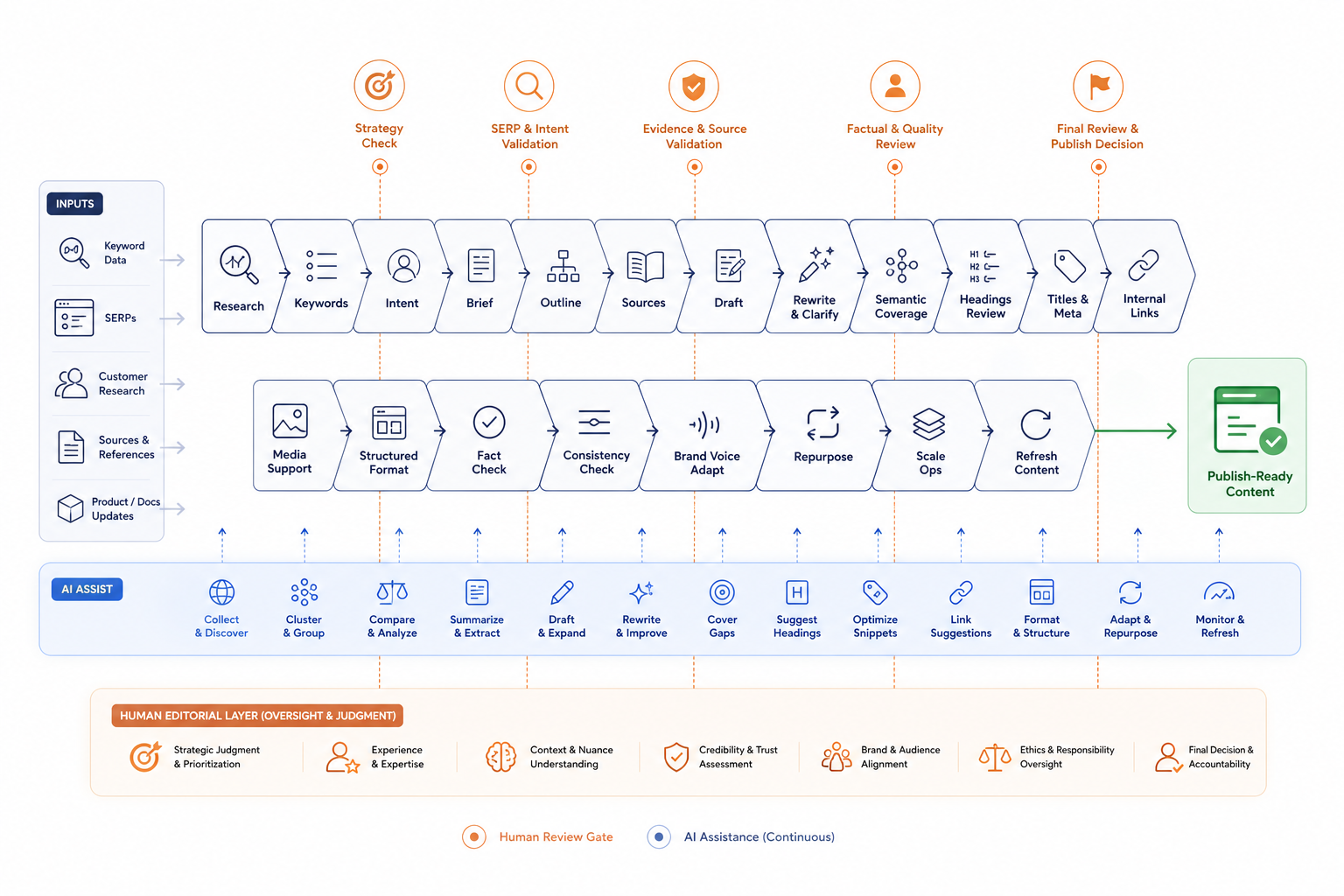
AI fits into SEO content creation as an assistance layer for research, organization, drafting, optimization, quality assurance, and content maintenance, while human judgment remains responsible for strategy, accuracy, expertise, evidence, and final editorial quality. AI can support much more than first-draft writing.
Topic Research
AI can organize:
- Topic ideas
- Related questions
- Entities
- Attributes
- Use cases
- Audience problems
Generated ideas should be validated through real evidence such as keyword data, SERPs, customer research, Search Console, or authoritative sources.
Keyword Organization
AI can classify supplied keyword datasets by:
- Topic
- Modifier
- Intent
- Entity
- Page family
Current search volume or ranking difficulty still requires appropriate external data.
Search Intent Interpretation
AI can summarize likely intent patterns across query sets.
High-value decisions should still be checked against current ranking pages and SERP composition.
Content Brief Creation
AI can structure:
- Main query
- Page purpose
- Relevant entities
- Heading hierarchy
- Important attributes
- Supporting questions
- Evidence requirements
- Answer formats
The final brief should remain centered on the user task.
Outline Development
AI can suggest H1, H2, and H3 structures.
Human review should confirm:
- Parent-child hierarchy
- Clear scope
- Non-repetition
- Logical progression
- Distinct section purposes
Source Organization
AI can help:
- Summarize supplied research
- Extract claims
- Group evidence
- Associate sources with sections
Important facts should always remain traceable to the original source.
First-Draft Assistance
Generative AI can produce:
- Definitions
- Explanations
- Examples
- Comparisons
- Transitions
- Summaries
Draft quality depends heavily on the brief, source material, topic complexity, and model output.
There is no reliable universal percentage indicating how “complete” an AI first draft is.
Rewriting and Clarity
AI can:
- Simplify dense passages
- Remove repetition
- Improve transitions
- Adjust tone
- Reorganize explanations
The factual meaning must remain unchanged during rewriting.
Semantic Coverage Review
AI can compare content with a defined set of:
- Entities
- Attributes
- Questions
- Relationships
- Mechanisms
- Comparisons
Potential omissions can inform editorial review.
They should not become mandatory keyword or entity insertion requirements.
Heading Review
AI can identify:
- Overlapping headings
- Weak hierarchy
- Vague labels
- Repeated sections
- Off-topic expansion
Headings should improve information structure rather than act as containers for keyword variants.
Titles and Meta Descriptions
AI can generate alternative titles and meta descriptions based on completed content.
Review each option for:
- Accuracy
- Search intent
- Differentiation
- Natural wording
- Duplication
Internal-Link Suggestions
AI can compare related pages and identify possible links between them.
Human editors should determine whether each proposed link improves:
- Navigation
- Discovery
- Hierarchy
- Context
Anchor Text Drafting
AI can propose anchors based on the surrounding passage and destination meaning.
Avoid repetitive exact-match anchor generation across large sites.
Image and Media Support
Multimodal AI can assist with:
- Alt-text drafts
- Captions
- Image descriptions
- Media summaries
Human review should verify visual accuracy and accessibility.
Structured Information Formatting
AI can transform appropriate information into:
- Tables
- Lists
- Summaries
- Comparisons
- FAQs
The chosen format should match the information type.
A table is useful for comparing fixed attributes such as price, feature support, or specifications. An ordered list is appropriate for a sequence. A paragraph is usually better for a definition.
Fact-Checking Assistance
AI can flag:
- Numbers requiring verification
- Conflicting facts
- Unsupported claims
- Inconsistent dates
- Missing citations
The final verification should rely on appropriate authoritative sources rather than the AI output itself.
Consistency Checking
AI can identify conflicting:
- Product names
- Entity names
- Dates
- Specifications
- Terminology
- Definitions
- Claims
This can be especially useful across large content libraries.
Brand Voice Adaptation
AI can rewrite text according to documented requirements involving:
- Tone
- Vocabulary
- Sentence style
- Formality
- Brand terminology
Human editors should still confirm that the result sounds appropriate and natural.
Content Repurposing
AI can transform an original asset into:
- Social posts
- Email copy
- Summaries
- Scripts
- FAQs
- Shorter versions
Repurposed assets do not automatically require SEO targeting.
Large-Scale Content Operations
AI can support repetitive content activity across:
- Ecommerce
- SaaS
- Marketplaces
- Directories
- Large publishing websites
Scalable content should depend on real demand, reliable source data, meaningful differentiation, and quality assurance.
Content Refreshing
AI can compare an older page with:
- Updated documentation
- New product information
- Changed SERPs
- Recent research
- Performance changes
Content should be refreshed when the underlying information, search intent, or usefulness changes.
Content Decay Analysis
With Search Console or analytics data, AI can identify page groups losing:
- Impressions
- Clicks
- Rankings
- Conversions
The pattern should trigger investigation rather than an automatic rewrite.
Content QA
AI can review:
- Grammar
- Repetition
- Missing sections
- Formatting
- Unsupported claims
- Brief compliance
- Internal consistency
Automated QA supports editors rather than eliminating editorial responsibility.
Localization
AI can assist:
- Translation
- Terminology consistency
- Market adaptation
- Large multilingual workflows
Native-language validation and local search research remain important.
Original Experience and Evidence
AI cannot independently create authentic:
- First-hand experience
- Product testing
- Customer interviews
- Proprietary datasets
- Executive judgment
- Unique case evidence
unless that information is supplied.
These inputs need to come from people or organizations with genuine experience and access to the underlying evidence.
AI's role in SEO content can therefore be grouped into four areas.
| Content Area | AI Contribution | Human Responsibility |
|---|---|---|
| Research | Topic organization, keyword grouping, source synthesis | Demand validation and source selection |
| Creation | Briefs, outlines, drafts, rewrites | Expertise, accuracy, differentiation |
| Optimization | Semantic review, metadata, links, structure | Search relevance and editorial judgment |
| Maintenance | QA, refreshing, analysis, consistency | Final validation and prioritization |
AI-generated and AI-assisted content are not identical concepts. AI-assisted content can contain human research, original evidence, expertise, editing, strategy, and decision-making even when AI contributed to drafting.
Likewise, AI-written content is not automatically low quality, and human-edited content is not automatically high quality. SEO content should be evaluated according to accuracy, relevance, usefulness, originality, evidence, purpose, and execution.
How to Optimize for AI Search?
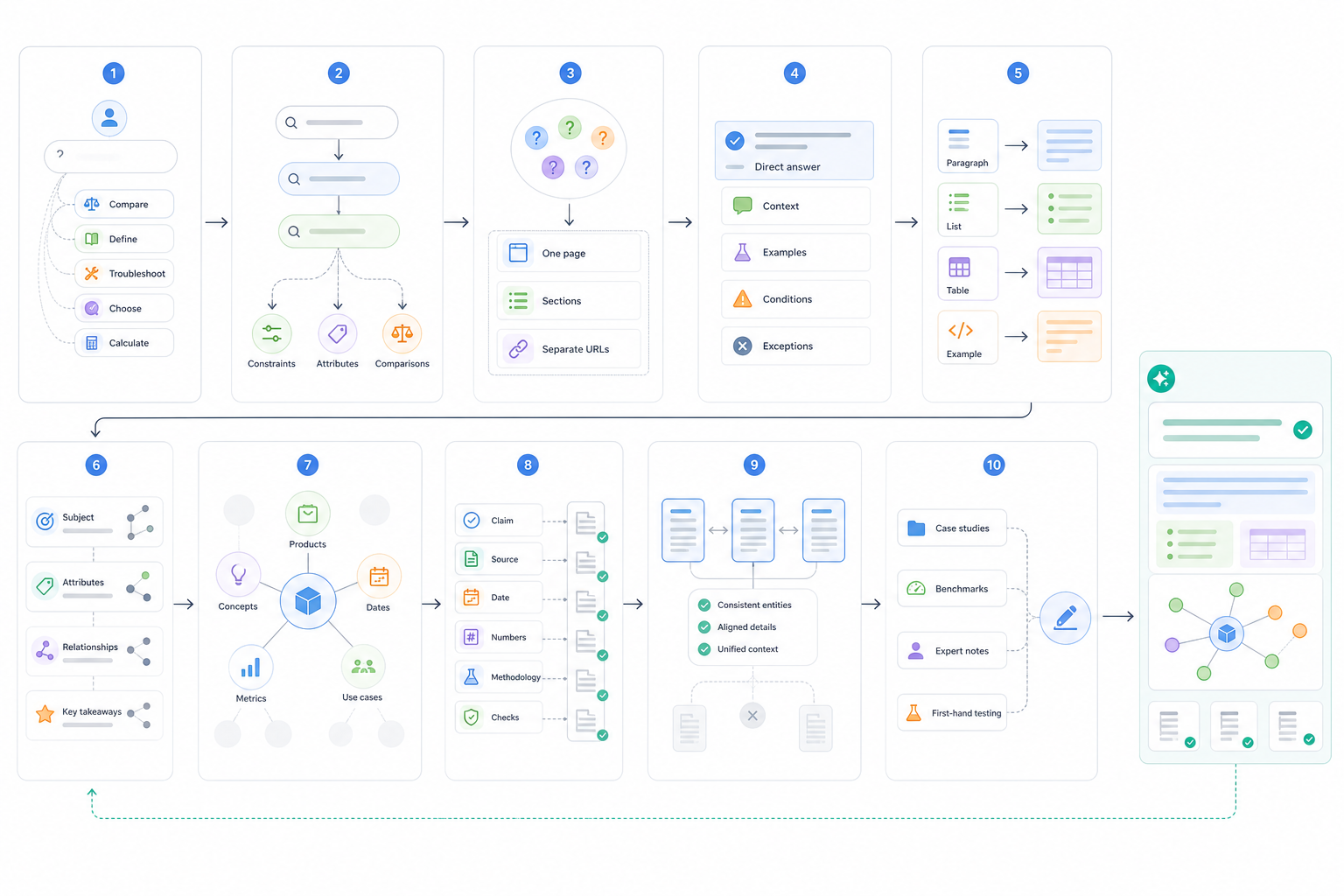
Optimizing for AI search means making website information easy to discover, understand, retrieve, verify, and connect with the user’s actual task across AI-assisted search experiences. No single method guarantees inclusion in ChatGPT, Google AI Overviews, Perplexity, Gemini, Claude, or another generated-answer environment because these products can use different retrieval, ranking, grounding, and generation systems.
1. Start With the Real User Task
Identify what the person wants to accomplish.
Examples include:
- Define a concept
- Compare products
- Evaluate software
- Troubleshoot a problem
- Choose an option
- Calculate a value
- Verify a claim
- Learn a process
Build the page around the complete information requirement rather than one isolated phrase.
Keywords remain useful evidence of demand.
2. Research Conversational and Multi-Part Queries
Investigate longer searches containing:
- Follow-up questions
- Comparisons
- Constraints
- Attributes
- Use cases
- Multiple conditions
Useful research inputs include:
- Keyword datasets
- SERPs
- Customer questions
- Support logs
- Forums
- AI-assisted research
Treat AI-generated questions as possible ideas until real evidence supports them.
3. Group Questions by Information Need
Determine whether related questions belong:
- On one page
- In different sections
- On separate URLs
Base the decision on page purpose, intent, entity relationship, and SERP evidence.
Do not create one URL for every conversational variation.
4. Use Clear Headings
H2 and H3 headings should identify the specific subject of their section.
Question headings are useful when they naturally reflect how the information is sought.
Statement headings can be better when they communicate the subject more clearly.
Every heading does not need to be written as a question.
5. Answer Important Questions Directly
Give the core answer early when the section contains:
- A definition
- A comparison
- An explanation
- A decision
- A factual answer
Then provide the required:
- Conditions
- Evidence
- Examples
- Exceptions
- Context
Direct answers should not remove necessary nuance.
6. Match Format to Information Type
Use:
- Paragraphs for definitions and explanations
- Ordered lists for processes
- Unordered lists for parallel attributes
- Tables for structured comparisons
- Examples for clarification
Choose formats because they communicate information effectively, not because one format supposedly guarantees AI retrieval.
7. Make Sections Understandable Independently
Each section should clearly identify:
- Its subject
- Important attributes
- Relevant relationships
- The actual answer
Avoid vague references when the subject could become unclear if a passage is retrieved without the surrounding article.
Maintain enough continuity that sections do not become repetitive standalone fragments.
8. Define Important Entities Clearly
Identify entities such as:
- Companies
- Products
- People
- Concepts
- Technologies
- Locations
- Dates
- Metrics
Explain useful attributes and relationships.
For example, a software comparison should clearly identify the product, feature, limitation, pricing context, use case, and intended customer where relevant.
9. Maintain Strong Topical Focus
Keep explanations, comparisons, examples, mechanisms, and evidence connected with the central page entity.
A page about AI SEO should not expand into unrelated general AI topics such as robotics, autonomous vehicles, healthcare AI, or image generation unless the relationship is necessary to answer the SEO question.
10. Support Important Claims With Evidence
Use strong sources for claims involving:
- Statistics
- Scientific findings
- Product specifications
- Legal information
- Financial information
- Search-engine documentation
- Industry data
Prefer primary sources where available.
Examples include:
- Official documentation
- Original research
- Government data
- Product documentation
- Direct datasets
11. Add Original Information
Useful differentiating assets can include:
- Proprietary research
- Original surveys
- Internal benchmarks
- Product tests
- Case studies
- Expert commentary
- First-hand examples
- Custom tools
Original information can make a source more useful but does not guarantee an AI citation.
12. Make Claims Easy to Verify
State clearly:
- Names
- Dates
- Numbers
- Measurement periods
- Methodologies
- Specifications
- Assumptions
- Source relationships
For a statistic that changes regularly, include relevant context such as the measurement date or geography.
13. Keep Entity Information Consistent
Maintain consistent factual information across relevant pages.
Examples include:
- Company name
- Product name
- Author details
- Address
- Product attributes
- Organization description
Consistency reduces ambiguity but should not be described as a guaranteed AI ranking factor.
14. Build Subject Depth Without Artificial Volume
Cover the attributes needed to satisfy the topic.
Create supporting pages when separate user needs justify them.
Avoid producing hundreds of loosely related articles merely to appear comprehensive.
15. Demonstrate Actual Expertise
Include useful specialist information such as:
- Practical constraints
- Edge cases
- Decision criteria
- Expert interpretation
- First-hand observations
- Implementation examples
A generic “reviewed by an expert” label does not substitute for expert information.
16. Create Information Worth Referencing
Useful reference assets can include:
- Original datasets
- Calculators
- Comparison frameworks
- Benchmarks
- Reference tables
- Definitions
- Methodologies
- Tools
- Unique examples
Do not create fabricated statistics or unsupported research as citation bait.
17. Strengthen Legitimate External Recognition
External recognition can include:
- Editorial mentions
- Citations
- Backlinks
- Reviews
- Expert references
- News coverage
- Industry references
Focus on legitimate relevance rather than raw mention volume.
No universal evidence proves that forum mentions, podcast appearances, backlinks, or social discussions alone determine AI citation selection across all systems.
18. Improve Internal Information Relationships
Connect related resources such as:
- Definitions
- Research
- Product pages
- Guides
- Comparisons
- Supporting explanations
Use descriptive anchors that communicate the destination topic.
Internal links support navigation, discovery, hierarchy, and contextual understanding.
19. Keep Important Pages Technically Accessible
Review:
- Status codes
- Robots directives
- Canonicals
- JavaScript rendering
- Internal links
- Sitemaps
- Indexability
Where web retrieval is involved, technical accessibility can determine whether information is available to the search system.
Different AI products can use different technical mechanisms.
20. Keep Critical Information Available in Accessible Text
Important facts should not exist only inside:
- Images
- Unreadable interactive interfaces
- Inaccessible scripts
- Scanned documents
Provide appropriate HTML or accessible text representations where the information should be searchable.
21. Use Structured Data Appropriately
Relevant supported markup can include:
- Organization
- Product
- Article
- Breadcrumb
- Event
Keep markup consistent with visible page content.
Structured data does not guarantee an AI citation or AI Overview inclusion.
22. Keep Facts Consistent Across Data Sources
Align information where the same fact appears in:
- Visible webpage content
- Structured data
- Product feeds
- Business profiles
- Documentation
This is especially important for changing values such as:
- Price
- Availability
- Specifications
- Event dates
- Business details
23. Update Content When Information Changes
Refresh pages when:
- Facts change
- Products change
- Prices change
- Regulations change
- Statistics change
- Interfaces change
- Recommendations become outdated
Do not update dates on an arbitrary schedule simply to create an appearance of freshness.
24. Explain Comparison Criteria Clearly
For evaluative content, compare attributes that actually matter.
Examples include:
- Price
- Features
- Limitations
- Compatibility
- Use cases
- Performance
- Customer fit
Recommendations should depend on the user's requirements rather than declaring one universal “best” option without context.
25. Address Useful Follow-Up Questions
Include important next questions when they help users complete the task.
Do not add every conceivable related question simply to increase topic coverage.
26. Provide Value Beyond a Basic AI Summary
Create reasons for users to visit the source.
Examples include:
- Detailed examples
- Templates
- Tools
- Calculators
- Product data
- Interactive resources
- Demonstrations
- Proprietary evidence
Basic facts that can be summarized in one sentence provide less differentiation than resources offering deeper utility.
27. Continue Optimizing for Traditional Search
Maintain established SEO practices involving:
- Keyword relevance
- Architecture
- Technical accessibility
- Content usefulness
- Internal links
- External references
AI-search optimization should extend SEO rather than require duplicate “Google SEO” and “AI SEO” versions of the same page.
28. Monitor AI Visibility Where Possible
Where reliable monitoring exists, record:
- Brand mentions
- Citations
- Referenced URLs
- Prompt categories
- Competitor appearances
- Changes over time
AI visibility datasets should not be treated as exhaustive.
29. Measure Downstream Behavior
Monitor potential outcomes such as:
- Organic impressions
- Clicks
- Branded searches
- Referral visits
- Leads
- Assisted conversions
- Purchases
- Revenue
Do not assume every branded search or conversion resulted from an earlier AI mention.
30. Improve Based on Evidence
Use actual performance and quality gaps to refine content.
Examples include:
- Missing evidence
- Outdated facts
- Weak page structure
- Poor technical accessibility
- Unclear definitions
- Low-value sections
- Search-demand gaps
Avoid making changes solely because a proprietary “AI optimization score” recommends them.
AI-search optimization can be summarized through five areas.
| Area | Main Focus |
|---|---|
| Intent | Understand the full user task |
| Information | Provide clear, accurate, differentiated answers |
| Retrievability | Keep content accessible and well organized |
| Credibility | Support claims with evidence and expertise |
| Measurement | Track search and AI-assisted visibility where possible |
Optimizing for AI search ultimately means creating technically accessible, clearly organized, evidence-backed information that satisfies real user tasks and remains useful whether it appears through a conventional organic result, a cited source, or an AI-generated answer.
When Should You Use AI SEO Services?
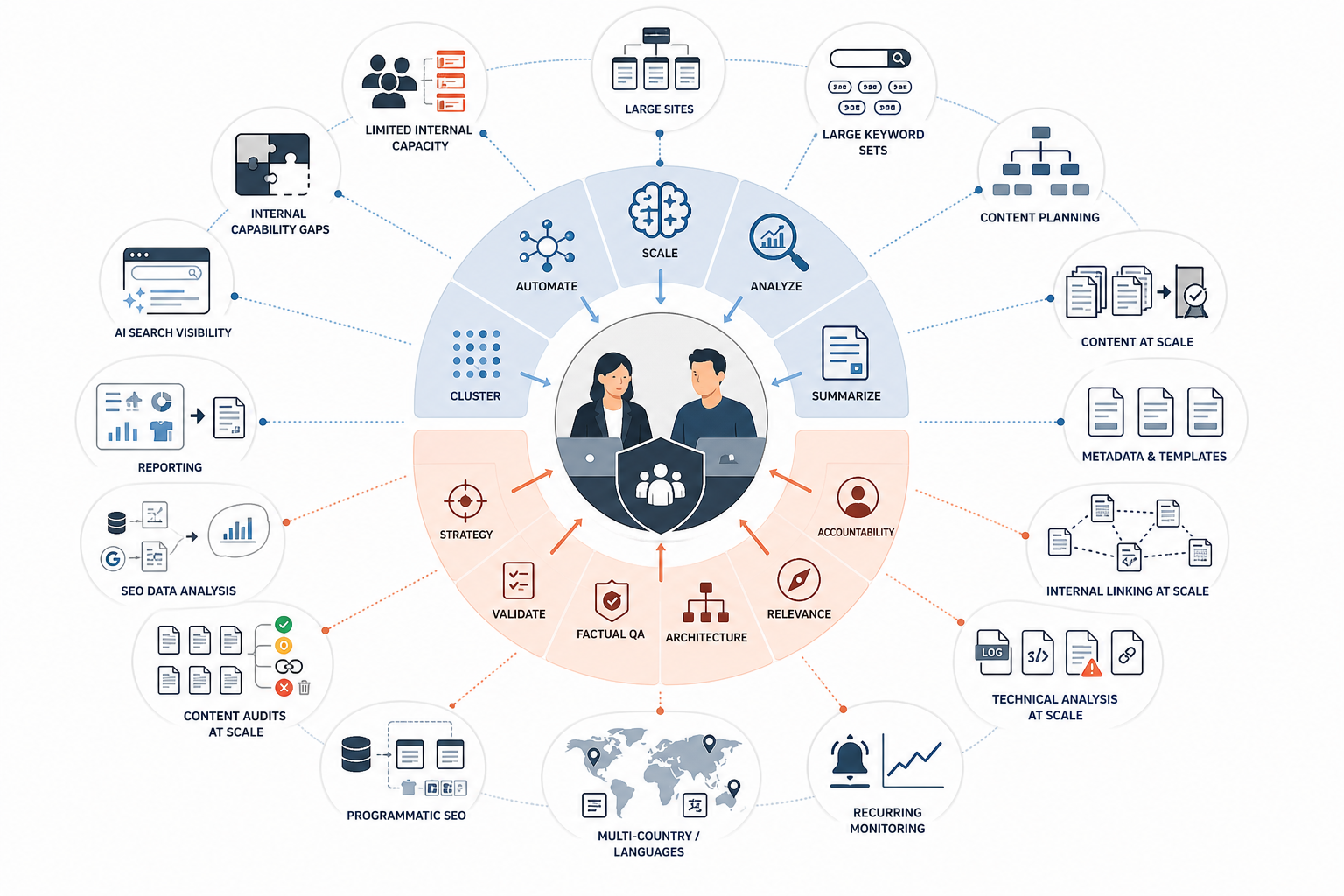
AI SEO services are useful when a business needs external SEO expertise combined with AI-assisted research, data analysis, automation, content operations, or monitoring to manage work that is difficult to execute efficiently in-house. Hiring an AI SEO service should provide strategy, implementation, validation, and accountability rather than access to AI software alone.
Large Websites
External support can help when a website contains:
- Hundreds of pages
- Thousands of pages
- Millions of URLs
- Large template systems
- Complex internal linking
- Extensive technical datasets
AI-assisted services can support classification, template analysis, metadata workflows, content QA, and monitoring.
Large Keyword Sets
Businesses targeting:
- Many product categories
- Multiple countries
- Several audience groups
- Large content universes
can use AI-assisted services to speed up keyword clustering, intent classification, modifier analysis, and topic organization.
Important clusters should still be validated against search results and page purpose.
Complex Content Planning
Large content inventories can require organization across:
- Product families
- Services
- Industries
- Use cases
- Audience groups
- Informational topics
AI can accelerate research and brief creation while experienced strategists determine which pages should exist.
Content Production at Scale
External AI SEO support can be useful for legitimate large-scale needs such as:
- Ecommerce product descriptions
- Category pages
- Knowledge resources
- Location pages
- Multilingual content
Production should rely on:
- Reliable source data
- Editorial standards
- Differentiation
- Factual validation
- Human QA
Faster generation alone does not create SEO value.
Metadata and Template Management
AI-assisted services can help manage repeated:
- Titles
- Meta descriptions
- Headings
- Structured page fields
This becomes particularly useful when changes need to be designed and validated at the template or URL-class level.
Internal Linking at Scale
Semantic models can identify candidate relationships across thousands of pages.
SEO specialists should still validate:
- Destination relevance
- Anchor context
- Hierarchy
- User usefulness
Technical Analysis at Scale
Large technical datasets can include:
- Crawl exports
- Log files
- Indexation reports
- Canonicals
- Redirects
- Structured data
- Status codes
AI can help organize and summarize these datasets.
Technical diagnosis should remain evidence based.
Recurring Monitoring
A service can monitor changes involving:
- Rankings
- Organic traffic
- Crawling
- Indexation
- Metadata
- Templates
- Conversions
AI can classify and summarize unusual movements.
Alerts indicate potential problems rather than proving their causes.
Multiple Countries or Languages
AI can assist with:
- Research scaling
- Translation support
- Terminology consistency
- Reporting
- Content operations
Native-market review remains important for language, cultural context, and local search intent.
Ecommerce SEO
AI SEO services can be useful where ecommerce complexity involves:
- Products
- Categories
- Variants
- Filters
- Stock changes
- Generated URLs
- Product attributes
AI can assist classification, template QA, enrichment, internal linking, and monitoring.
Architecture and indexation decisions still need experienced SEO oversight.
Programmatic SEO
AI-assisted services can support programmatic SEO when the business has:
- Structured data
- Repeatable search demand
- Distinct landing-page value
- Scalable templates
Mass-generating AI text without these conditions is not a programmatic SEO strategy.
Large Content Audits
AI can help classify thousands of pages as potentially:
- Useful
- Declining
- Outdated
- Overlapping
- Redundant
- Strategically important
Final actions such as retain, improve, consolidate, redirect, or remove should use broader SEO evidence.
SEO Data Analysis
Services can combine information from:
- Search Console
- Analytics
- Crawlers
- Rank trackers
- Backlink tools
- CRM systems
- Revenue data
AI can accelerate segmentation and pattern analysis when the underlying datasets are reliable.
Reporting
AI-assisted reporting can help summarize large datasets across:
- Markets
- Websites
- Categories
- Campaigns
- Page types
Important numbers and explanations should remain traceable to their source.
AI Search Visibility
Specialized services can help businesses evaluate visibility across AI-assisted answer environments.
Relevant work can include:
- Citation monitoring
- Mention monitoring
- Referenced-source analysis
- Entity consistency
- Source retrievability
- Evidence review
No provider can guarantee citations across ChatGPT, Google AI Overviews, Gemini, Perplexity, Claude, and every other system through one universal optimization formula.
Internal Capability Gaps
External services can help when the business lacks expertise in:
- SEO strategy
- Technical SEO
- Automation
- Machine learning
- Data engineering
- Large-scale content operations
The scope should define whether the provider owns strategy, execution, training, implementation, or analysis.
Limited Internal Capacity
A competent internal SEO team can still need external assistance when recurring research, production, monitoring, or QA exceeds available resources.
External support should expand execution capacity without replacing business knowledge or internal prioritization.
Custom Automation
Specialized providers can build workflows such as:
- Keyword clustering pipelines
- Internal-link systems
- Catalog enrichment
- Reporting automation
- Content QA
- Data integrations
Custom AI is useful only where it adds value beyond simpler deterministic automation.
Connecting SEO With Business Data
Services can become valuable when SEO decisions need to include:
- Inventory
- Product margin
- Lead quality
- CRM stages
- Sales
- Revenue
These datasets can improve prioritization when connected appropriately.
AI-specialized outsourcing is not always necessary.
A small website with limited pages can often use conventional SEO expertise with selective AI assistance.
A deterministic task such as detecting broken links, applying a spreadsheet formula, validating status codes, or matching a regular expression can often be handled more reliably without an AI model.
Likewise, a mature internal SEO team with suitable data, automation, engineering support, and technical expertise may need only specialist consulting instead of a fully outsourced AI SEO program.
Businesses should be cautious when a provider's primary explanation is simply “we use AI.” A capable service should be able to explain its:
- SEO methodology
- Data sources
- Automation approach
- QA process
- Implementation controls
- Measurement framework
- Data privacy practices
- Ownership arrangements
A strong AI SEO service should provide SEO expertise, reliable data, appropriate automation, technical and editorial capability, human quality assurance, implementation support, monitoring, and measurable reporting.
The value of AI SEO services comes from solving a meaningful scale, complexity, data, or capacity problem while retaining expert validation and accountability for the final SEO decisions.
Need links on real SaaS and business websites?
Links are placed after your approval, on sites with guaranteed DR and traffic, with a 1-year replacement guarantee.

