
SEO Competitor Analysis: Competitors, Keywords, Content Gaps, Backlinks & Actions
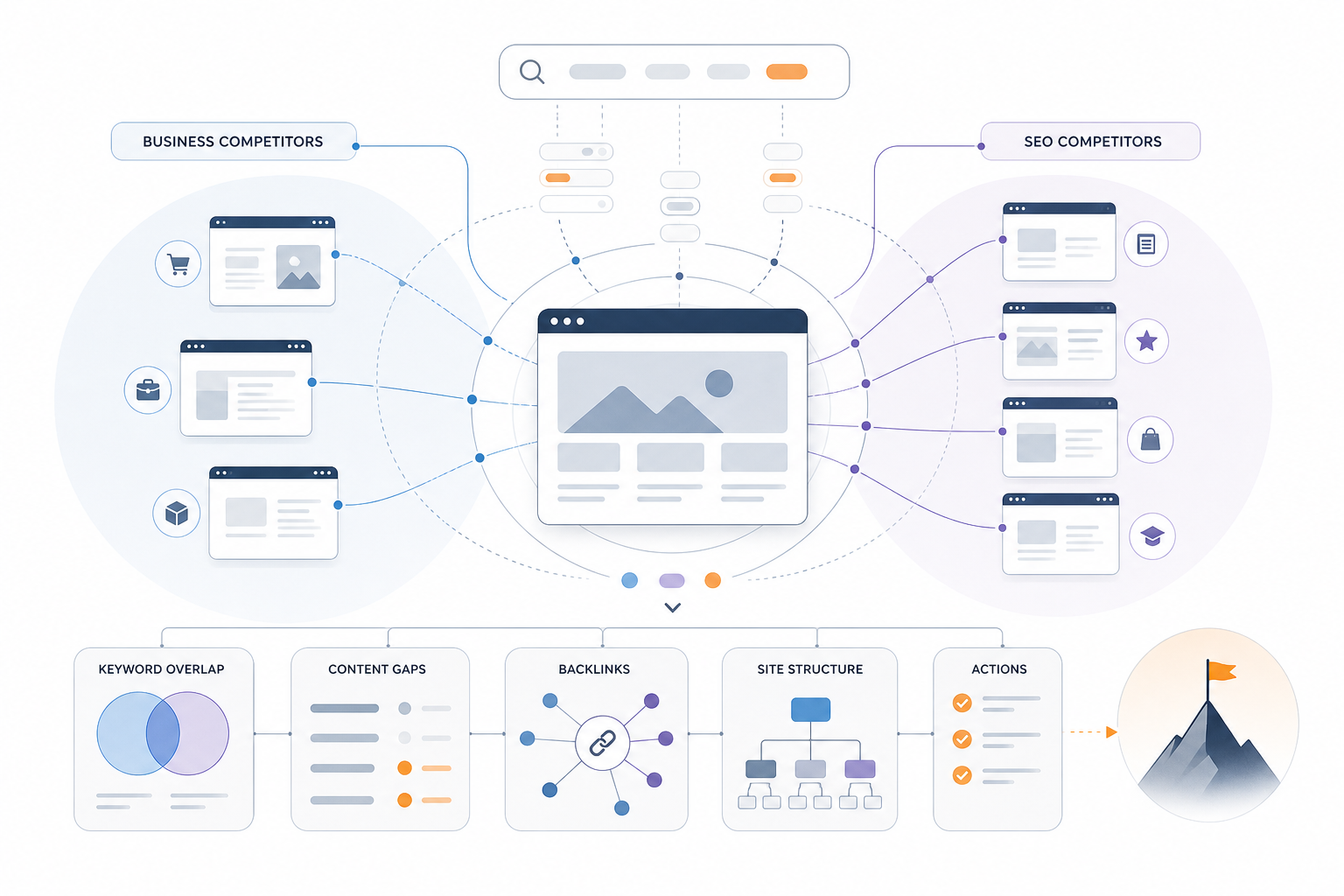
SEO competitor analysis is the process of researching websites competing for the same organic search visibility to understand their strengths, weaknesses, strategies, and gaps. It shows which domains compete for relevant searches and what contributes to their performance across keywords, content, backlinks, technical SEO, and organic visibility.
SEO competitors are not always direct business competitors. A business competitor sells a similar product or service, while an SEO competitor competes for the same valuable search queries.
For example, a SaaS company selling project management software competes commercially with other project management platforms. In organic search, it can also compete with software-review websites, publishers, marketplaces, and educational websites ranking for terms such as “best project management software” or “how to manage projects.”
This distinction matters because organic competition is determined by SERP overlap and relevant search demand, not by business category alone.
Competitor analysis reduces guesswork by providing evidence about what already performs in the search landscape. It reveals:
- Which websites repeatedly rank for important queries
- Which topics generate competitor visibility
- Which pages attract the most organic traffic
- Which search intents competitors satisfy effectively
- Which content formats perform across important SERPs
- Which websites link to competing domains
- Where competitors possess stronger technical or structural foundations
- Which relevant topics or keywords remain weakly covered
- Where the target website has a competitive advantage
SEO competitor analysis tools provide ranking, keyword, backlink, traffic, and visibility data that supports this research. Third-party metrics still require interpretation because estimated traffic, authority scores, difficulty metrics, and visibility scores are proprietary measurements rather than direct Google metrics.
The analysis becomes valuable when the findings influence SEO decisions. A relevant keyword gap can identify a new content opportunity. Weak competitor coverage can create an opportunity for a more complete resource. A backlink gap can expose relevant publishers already linking within the topic. Technical differences can reveal structural weaknesses limiting search performance.
Competitor research does not exist to copy another website. A competitor ranking successfully provides evidence about search demand and existing competitive standards, not a template that must be duplicated.
Search competition also changes. Competitors publish new content, improve existing pages, acquire backlinks, lose rankings, enter new topics, and change site architecture. Competitive analysis therefore represents an ongoing source of SEO intelligence rather than a one-time snapshot.
The practical value of the research starts with conducting the analysis systematically.
How Do You Conduct an SEO Competitor Analysis?
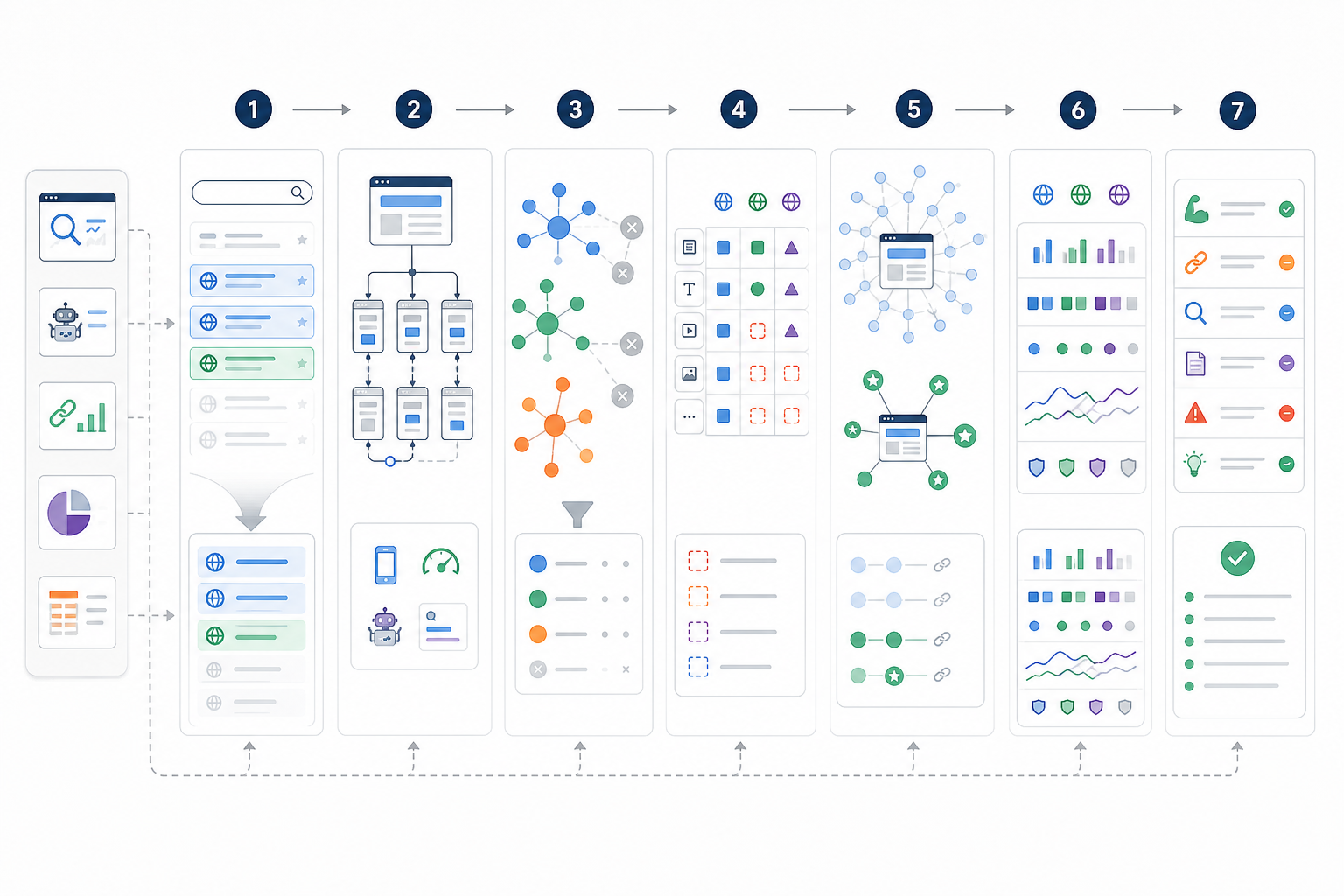
SEO competitor analysis is conducted by identifying the websites competing for relevant organic searches, examining the factors supporting their visibility, comparing those findings with your own website, and documenting meaningful competitive gaps.
A structured analysis prevents large volumes of competitor data from becoming disconnected observations.
1. Identify Your SEO Competitors
Find the domains that repeatedly appear across strategically relevant queries.
Focus on searches connected with:
- Core products
- Services
- Commercial categories
- Important use cases
- High-value informational topics
- Comparison queries
- Transactional searches
Look for domains with recurring visibility rather than websites appearing for one isolated keyword.
Evaluate competitors based on:
- Keyword overlap
- Topical relevance
- Search visibility
- Audience similarity
- Commercial relevance
- Frequency of SERP competition
Create a focused shortlist for deeper research. Analyzing every website that appears somewhere in the SERPs creates unnecessary noise.
2. Analyze Competitor Websites
Review the pages and site structures responsible for competitor search visibility.
Examine:
- Content architecture
- Important directories
- Page types
- Search-intent alignment
- On-page optimization
- Internal linking
- Site architecture
- Crawlability
- Indexability
- Mobile usability
- Page performance
- SERP presentation
The objective is to identify patterns that help explain why competitors consistently attract organic visibility.
3. Analyze Competitor Keywords
Identify the keywords and topics producing competitor rankings.
Compare these searches with your current visibility and content coverage.
Evaluate the relevant competitor terms according to:
- Search intent
- Search demand
- Topical relevance
- Difficulty
- Ranking feasibility
- Traffic potential
- Business value
Not every keyword generating competitor traffic belongs in your strategy. Competitors frequently rank for subjects that have little connection with your products, expertise, or audience.
4. Identify Content Gaps
Determine where competitors cover important search demand more effectively.
A content gap can represent:
- A missing topic
- A missing subtopic
- A missing user question
- A weak section inside an existing page
- A missing search intent
- A missing page type
- A missing comparison
- A missing tool or template
- An outdated answer
- A lack of original evidence
Separate opportunities requiring a new page from weaknesses that belong inside an existing page.
One missing competitor keyword does not automatically justify one new URL. Related queries sharing the same intent often belong together.
5. Analyze Competitor Backlinks
Review the external websites and pages linking to competitors.
Compare:
- Referring domains
- Relevant backlinks
- Linked pages
- Link-source types
- Editorial context
- Anchor patterns
- Link-earning assets
- Backlink gaps
The goal is to understand how competitors earn external authority and which relevant sources support them but not your website.
Total backlink count alone provides weak competitive context. A smaller set of relevant editorial referring domains often tells more than thousands of low-value links.
6. Compare Overall SEO Performance
Combine the major competitive dimensions into one benchmark.
Compare:
- Organic visibility
- Relevant keyword coverage
- Ranking distribution
- Estimated organic traffic
- Top-performing pages
- Topic coverage
- Referring-domain strength
- Technical foundations
- Search-result presence
- Growth trends
Review trends over meaningful periods rather than evaluating only the current snapshot.
A competitor with less current traffic but rapid growth represents a different competitive situation from a larger domain losing visibility consistently.
7. Document the Competitive Findings
Consolidate the meaningful evidence into an SEO competitor analysis report.
Record:
- Competitor strengths
- Competitor weaknesses
- Keyword gaps
- Content gaps
- Backlink gaps
- Technical differences
- Visibility differences
- High-performing competitor pages
- Competitive opportunities
- Important risks
Keep analysis separate from execution. The report establishes what the competitive evidence shows before those findings become SEO priorities.
What SEO Competitor Analysis Tools Can You Use?
SEO competitor analysis tools collect and compare competitor data across keywords, rankings, backlinks, traffic, content, and organic visibility.
Competitor research platforms are part of the broader set of SEO Tools used to research, analyze, monitor, and measure organic search performance.
Different platforms provide stronger datasets for different parts of the analysis.
| Tool | Best For | Main Competitor Data | When to Use It |
|---|---|---|---|
| Semrush | Organic and paid competitive research | Competitor keywords, ranking pages, keyword gaps, backlinks, traffic estimates, visibility | Keyword research, competitor discovery, gaps, and broader search analysis |
| Ahrefs | Organic search and backlink analysis | Organic keywords, top pages, backlinks, referring domains, content gaps, traffic estimates | Content, keyword, backlink, and ranking-page analysis |
| SE Ranking | SEO and PPC competitor monitoring | Organic keywords, paid keywords, competitor traffic estimates, rankings, backlinks | Search competitor discovery and ongoing competitive monitoring |
| Similarweb | Website and channel benchmarking | Estimated traffic, engagement, search traffic, referral traffic, geographic and channel data | Broader traffic and digital-performance comparison |
| Moz Pro | Link and search comparison | Ranking keywords, linking domains, link metrics, competitive link profiles | Link benchmarking and SEO comparison |
| SpyFu | SEO and PPC history | Organic rankings, competitor keywords, paid keywords, ad history, ranking movements | Historical competitor research and SEO/PPC overlap |
No single SEO competitor analysis tool represents every competitive dimension equally.
Semrush and Ahrefs provide strong search-focused competitive datasets. Similarweb adds broader website-traffic and channel context. SpyFu adds historical SEO and PPC information. Moz and SE Ranking provide additional ranking, keyword, and link perspectives.
Using multiple tools also exposes metric differences. The same website can receive different traffic estimates, authority scores, or keyword counts across platforms because each provider uses its own database and methodology.
Third-party metrics therefore work best as comparative indicators. Actual SERPs, competitor pages, search intent, and first-party data from your own website provide additional context before strategic decisions are made.
Once reliable data sources are available, the first analytical question is determining which websites genuinely compete for the same search demand.
How Do You Identify Your SEO Competitors?
SEO competitors are websites that repeatedly compete for visibility across the same strategically relevant search queries, even when they are not direct business competitors.
The most useful competitor set reflects organic-search overlap.
Several methods identify these domains:
- Review target SERPs manually
- Search important product, service, commercial, and informational terms.
- Record domains appearing repeatedly in the leading organic results.
- Look for recurring visibility across several queries.
- Give greater importance to searches connected with strategic business topics.
- Use SEO competitor-discovery tools
- Enter your domain into platforms that identify organic competitors.
- Review shared keyword counts and competing search visibility.
- Examine the pages producing the overlap.
- Prioritize websites consistently competing across relevant subject areas.
- Compare keyword overlap
- Measure the number of important queries shared between domains.
- Give greater weight to overlap within core topics.
- Discount overlap generated by unrelated informational content.
- Identify competitors with strong visibility across multiple commercially relevant themes.
- Review alternative search environments
- Examine which brands and sources repeatedly appear for important queries across relevant AI-assisted search experiences.
- Use this information as an additional competitive signal.
- Keep traditional organic SERP competition as the primary basis for SEO competitor identification.
After gathering candidates, reduce the set to the domains that matter most.
A practical competitor shortlist often focuses on websites with strong combinations of:
- Relevant keyword overlap
- Similar audience demand
- Topical similarity
- Strong organic visibility
- Repeated SERP presence
- Commercial or informational importance
Direct business competitors still belong in the analysis when they compete in search. They simply do not define the entire competitor set.
Once the relevant domains are identified, deeper website analysis explains how they capture that visibility.
What Should You Analyze on a Competitor’s Website?
Competitor website analysis means examining the SEO characteristics that help a competing domain attract, organize, and rank for relevant organic search demand.
Focus on the website elements directly connected with search performance.
- Analyze site and content architecture
- Review how the competitor organizes topics, products, services, categories, and resources.
- Identify important directories and content hubs.
- Examine pillar pages and supporting content.
- Review how users and search engines reach strategically important pages.
- Look for clear topical relationships between broader and narrower subjects.
- Analyze high-performing page types
- Identify pages producing strong organic visibility.
- Determine whether rankings come primarily from articles, guides, category pages, product pages, service pages, comparisons, templates, tools, glossaries, or other formats.
- Identify repeated formats connected with commercially important search demand.
- Analyze search-intent alignment
- Compare the page type with the objective behind the query.
- Review how competitors handle informational, commercial, transactional, and navigational intent.
- Identify cases where their page structure matches SERP expectations more closely than yours.
- Analyze content quality and topical coverage
- Review usefulness and accuracy.
- Examine information depth.
- Check whether key attributes and questions receive adequate coverage.
- Review examples and supporting evidence.
- Assess freshness where recency matters.
- Look for original information, data, testing, or expert input.
- Analyze on-page SEO
- Review title tags and H1s.
- Examine heading hierarchy.
- Check URL patterns.
- Review how the central topic is introduced.
- Examine relevant terminology and entity coverage.
- Review images and supporting media.
- Assess metadata and SERP-facing copy.
- Analyze internal linking
- Identify pages receiving strong internal-link support.
- Review anchor text and surrounding context.
- Examine links between informational and commercial pages.
- Assess how broader topic hubs connect with supporting content.
- Identify whether important destinations appear deeply buried or remain easy to reach.
- Analyze technical accessibility
- Review crawlability and indexability.
- Examine canonicalization.
- Check page performance and mobile usability.
- Review structured data where relevant.
- Identify technical barriers affecting important page groups.
- Focus on technical differences with a plausible connection to search performance or usability.
- Analyze SERP presentation
- Review competitor titles and descriptions.
- Examine featured snippets and other enhanced-result formats.
- Look for video, image, product, local, or structured-result visibility where relevant.
- Compare how effectively ranking pages communicate relevance before the click.
Website-level analysis explains the structure supporting competitor visibility. Keyword analysis identifies the searches producing that visibility.
How Do You Analyze Competitor Keywords?
SEO competitor keyword analysis is the process of identifying the search terms competing websites rank for and evaluating which of those terms represent meaningful opportunities for your website.
Competitor keyword data becomes useful when every relevant term is evaluated against the same attributes.
| Keyword | Competitor Position | Search Volume | Difficulty | Search Intent | Traffic Potential | Business Relevance | Current Coverage | Opportunity |
|---|---|---|---|---|---|---|---|---|
| Example keyword A | 2 | 2,400 | 35 | Commercial | High | High | Weak | High |
| Example keyword B | 6 | 900 | 22 | Informational | Medium | High | Missing | High |
| Example keyword C | 4 | 5,000 | 60 | Informational | High | Low | Missing | Low |
Evaluate the following attributes:
- Competitor position: Determine whether the competitor has meaningful visibility for the query.
- Search volume: Estimate the level of direct search demand.
- Keyword difficulty: Use the metric as a comparative indicator of competitive intensity.
- Search intent: Determine whether the user seeks information, comparison, navigation, purchase, or another outcome.
- Traffic potential: Consider the broader traffic generated by the topic rather than exact-match volume alone.
- Business relevance: Determine whether the query connects with the website’s products, services, audience, or objectives.
- Current coverage: Check whether your site already addresses the search intent effectively.
- Opportunity: Combine relevance, demand, intent, feasibility, and business value into a practical priority.
Not every competitor keyword deserves targeting.
A large publisher can rank for thousands of queries outside your business scope. Copying those topics expands the site away from its core topical relevance.
The strongest opportunities appear where competitor proof of search demand overlaps with your own topical relevance, audience requirements, business value, and realistic ability to compete.
Competitor keyword analysis also reveals broader topic gaps that extend beyond individual terms.
How Do You Find Content Gaps From Competitors?
Competitor content-gap analysis identifies valuable keywords, topics, subtopics, search intents, information, and content formats that competitors cover more effectively than your website.
These findings can guide SEO Content decisions by showing where new pages, stronger coverage, different formats, or updated information may be required.
A content gap is broader than a missing keyword.
Several methods reveal these opportunities:
- Use keyword and content-gap tools
- Compare your domain with relevant competitors.
- Find queries where competitors have organic visibility and your site has little or none.
- Filter the resulting list using topical relevance, search intent, demand, difficulty, feasibility, and business value.
- Group related keyword gaps according to shared topic and intent.
- Audit competitor pages manually
- Review leading pages for strategically important queries.
- Identify user questions they answer that your page misses.
- Compare examples, definitions, use cases, data, sections, and supporting evidence.
- Determine whether their page satisfies the dominant search intent more completely.
- Analyze content depth
- Identify meaningful attributes competitors explain in greater detail.
- Find areas where your content stops before resolving the user’s next relevant question.
- Separate useful depth from unnecessary word-count expansion.
- Add information only when it strengthens the answer.
- Compare content formats
- Look for comparison tables, step-by-step instructions, calculators, templates, visuals, videos, FAQs, examples, or interactive tools.
- Treat a format difference as a gap only when it improves intent satisfaction or information delivery.
- Do not add a table, video, or calculator merely because a competitor has one.
- Check freshness and evidence
- Identify outdated competitor statistics.
- Review unsupported claims.
- Look for weak examples.
- Check stale screenshots, pricing, product data, regulations, or recommendations.
- Create stronger coverage using current and verifiable evidence where the query depends on recency.
- Find original-value opportunities
- Add first-hand testing.
- Use proprietary data.
- Include expert commentary.
- Publish original research.
- Add real examples.
- Explain a methodology.
- Provide information unavailable in competing results.
The final content-gap list requires prioritization.
| Gap | Competitor Coverage | Current Coverage | Search Intent | Business Value | Recommended Action |
|---|---|---|---|---|---|
| Missing core topic | Strong | None | Commercial | High | Create page |
| Missing subtopic | Strong | Weak | Informational | High | Expand existing page |
| Outdated statistics | Weak | Outdated | Informational | Medium | Refresh evidence |
| Missing comparison format | Strong | Paragraph only | Commercial | High | Improve answer format |
A relevant gap can lead to a new page, expansion of an existing page, improved answer formatting, fresher evidence, or original information.
Competitor coverage is evidence of an opportunity, not an instruction to reproduce everything competitors publish.
Content explains one part of competitive strength. External links reveal another.
How Do You Analyze Competitor Backlinks?
SEO competitor link analysis means examining the external links supporting competing websites to understand their authority, link-earning patterns, and meaningful backlink gaps relative to your website.
A deeper competitor backlinks analysis can then turn these differences into specific link prospects and authority-building opportunities.
Backlink analysis focuses on the quality and context of referring relationships rather than raw link quantity.
| Competitor | Referring Domains | Link Quality | Topical Relevance | Top Linked Pages | Main Link Sources | Link Gap |
|---|---|---|---|---|---|---|
| Competitor A | — | High | High | Research report | Editorial, PR, research citations | High |
| Competitor B | — | Medium | High | Free tool | Resource pages, blogs | Medium |
| Competitor C | — | Mixed | Medium | Homepage | Directories, mentions | Low |
Review the following elements:
- Referring domains
- Compare unique websites linking to each competitor.
- Distinguish diverse editorial support from large backlink counts generated by a small number of domains.
- Focus on relevant referring domains rather than total link volume alone.
- Link quality and credibility
- Review the quality of important referring websites.
- Examine whether the linking page contains legitimate editorial content.
- Check whether the site has genuine relevance and visibility.
- Treat third-party authority scores as comparative proxies rather than Google metrics.
- Topical relevance
- Determine whether the linking website relates to the industry, product, subject, or audience.
- Review the relevance of the specific linking page, not only the domain.
- Give greater strategic value to links with genuine contextual relationships.
- Linked pages
- Identify competitor URLs attracting the strongest relevant referring-domain support.
- Determine why these pages attract links.
- Look for research, statistics, free tools, templates, original data, guides, or other assets with repeated link acquisition.
- Link-source patterns
- Categorize recurring sources such as:
- Editorial mentions
- Digital PR
- Research citations
- Statistics pages
- Resource pages
- Partnerships
- Industry directories
- Guest contributions
- Tools and templates
- Repeated patterns provide more strategic value than isolated examples.
- Categorize recurring sources such as:
- Anchor and placement context
- Review how external sites describe the competitor.
- Examine branded, topical, partial-match, exact-match, and generic anchors where relevant.
- Interpret the anchor together with the surrounding paragraph and editorial placement.
- Backlink gaps
- Identify relevant websites linking to competitors but not to your site.
- Remove spam, irrelevant directories, manipulative sources, and unsuitable websites.
- Prioritize domains with genuine topical and editorial relevance.
Competitor backlink analysis identifies differences in external authority and the types of content or relationships generating those differences.
Those findings become more meaningful when combined with the wider SEO benchmark.
How Do You Compare SEO Performance With Competitors?
SEO competitor comparison means benchmarking your website and relevant competitors across the same organic-search metrics to identify relative strengths, weaknesses, and significant competitive gaps.
This comparison adds competitive context to SEO ranking data by showing how your visibility, keyword positions, traffic, and other search-performance signals compare with competing websites.
The comparison combines evidence from keywords, content, links, technical SEO, and search visibility.
| Metric | Your Site | Competitor A | Competitor B | Competitor C | Competitive Gap |
|---|---|---|---|---|---|
| Organic visibility | — | — | — | — | — |
| Top 3 keywords | — | — | — | — | — |
| Top 10 keywords | — | — | — | — | — |
| Relevant keyword coverage | — | — | — | — | — |
| Estimated organic traffic | — | — | — | — | — |
| High-performing pages | — | — | — | — | — |
| Relevant referring domains | — | — | — | — | — |
| Technical strength | — | — | — | — | — |
| Growth trend | — | — | — | — | — |
Important comparison dimensions include:
- Organic visibility
- Compare visibility across strategically relevant search demand.
- Review individual topic areas rather than relying solely on one sitewide score.
- Keyword coverage
- Compare relevant keywords ranking in positions such as Top 3, Top 10, and Top 20.
- Separate strategically important rankings from irrelevant keyword volume.
- Identify subjects where one competitor consistently dominates.
- Organic traffic
- Compare estimated traffic and growth trends.
- Interpret third-party competitor traffic directionally rather than as exact analytics data.
- Use first-party analytics for your own website wherever available.
- Content performance
- Compare pages and directories generating the strongest visibility.
- Identify dominant content types.
- Review which topics drive the largest proportion of relevant search traffic.
- Backlink strength
- Compare relevant referring domains.
- Review link quality and topical relevance.
- Examine the competitor assets earning repeated links.
- Compare link growth over time where useful.
- Technical and structural strength
- Summarize material differences in architecture, internal links, crawlability, indexation, page experience, mobile usability, and other relevant foundations.
- Focus on differences with genuine search impact.
- Growth trends
- Determine whether each competitor is gaining, declining, or remaining stable.
- Compare periods long enough to distinguish a sustained movement from temporary volatility.
- Identify competitors gaining rapidly within core topics.
The objective is not to declare one universal “SEO winner.” Different competitors frequently lead in different areas.
One domain can have stronger backlinks while another has superior content coverage. Your site can lead commercially while a publisher controls most informational search demand.
The comparison identifies which gaps matter enough to document and evaluate further.
What Should an SEO Competitor Analysis Report Include?
An SEO competitor analysis report consolidates competitive evidence into a structured document showing who the relevant search competitors are, where they outperform your website, where meaningful gaps exist, and which findings require strategic consideration.
These findings can form a dedicated competitive section within a broader SEO report used to communicate search performance, gaps, priorities, and subsequent actions.
The report needs enough evidence to support SEO decisions without becoming a raw data dump.
Include the following sections:
- Executive summary
- Identify the competitors analyzed.
- Summarize the most important findings.
- Highlight major competitive strengths and weaknesses.
- Identify significant gaps.
- Keep the summary focused on evidence that influences SEO decisions.
- Competitor overview
- List the selected domains.
- Explain why each qualifies as an organic competitor.
- Include relevant keyword overlap and topic overlap.
- Summarize the major areas where competition occurs.
- Record relative search visibility where useful.
- Website and SEO observations
- Summarize material differences in:
- Content architecture
- Page types
- Search-intent alignment
- On-page SEO
- Internal linking
- Technical accessibility
- SERP presentation
- Exclude observations with no meaningful connection to organic-search performance.
- Summarize material differences in:
- Keyword comparison
- Record strategically relevant competitor keywords.
- Include search intent and demand.
- Document competitor ranking strength.
- Record current-site coverage.
- Identify keyword groups representing meaningful opportunities.
- Content gaps
- Record missing topics and subtopics.
- Identify incomplete existing coverage.
- Document search-intent gaps.
- Note useful content-format differences.
- Identify freshness and evidence gaps.
- Separate new-page opportunities from existing-page improvements.
- Backlink comparison
- Compare relevant referring domains.
- Record major backlink gaps.
- Identify competitor pages earning the strongest links.
- Document recurring link-source patterns.
- Distinguish relevant opportunities from low-quality sources.
- SEO performance benchmark
- Compare the website and competitors across consistent metrics.
- Include relevant keyword coverage, organic visibility, estimated traffic, strong content areas, backlink strength, and growth direction.
- Use tables where repeated metrics require direct comparison.
- Competitive gap summary
- Consolidate the most important differences across keywords, content, links, technical SEO, and visibility.
- Classify findings according to strategic importance.
- Keep implementation details separate until priorities have been evaluated.
- Supporting evidence
- Include relevant keyword datasets.
- Add SERP observations.
- Include competitor-page examples.
- Add backlink evidence.
- Include comparison tables and charts where they improve understanding.
- Remove raw exports that do not support a conclusion.
A useful competitor report explains what the competitive difference is and what evidence supports that conclusion.
Once the findings are documented, the next task is deciding which gaps deserve actual SEO investment.
How Do You Turn Competitor Analysis Into SEO Actions?
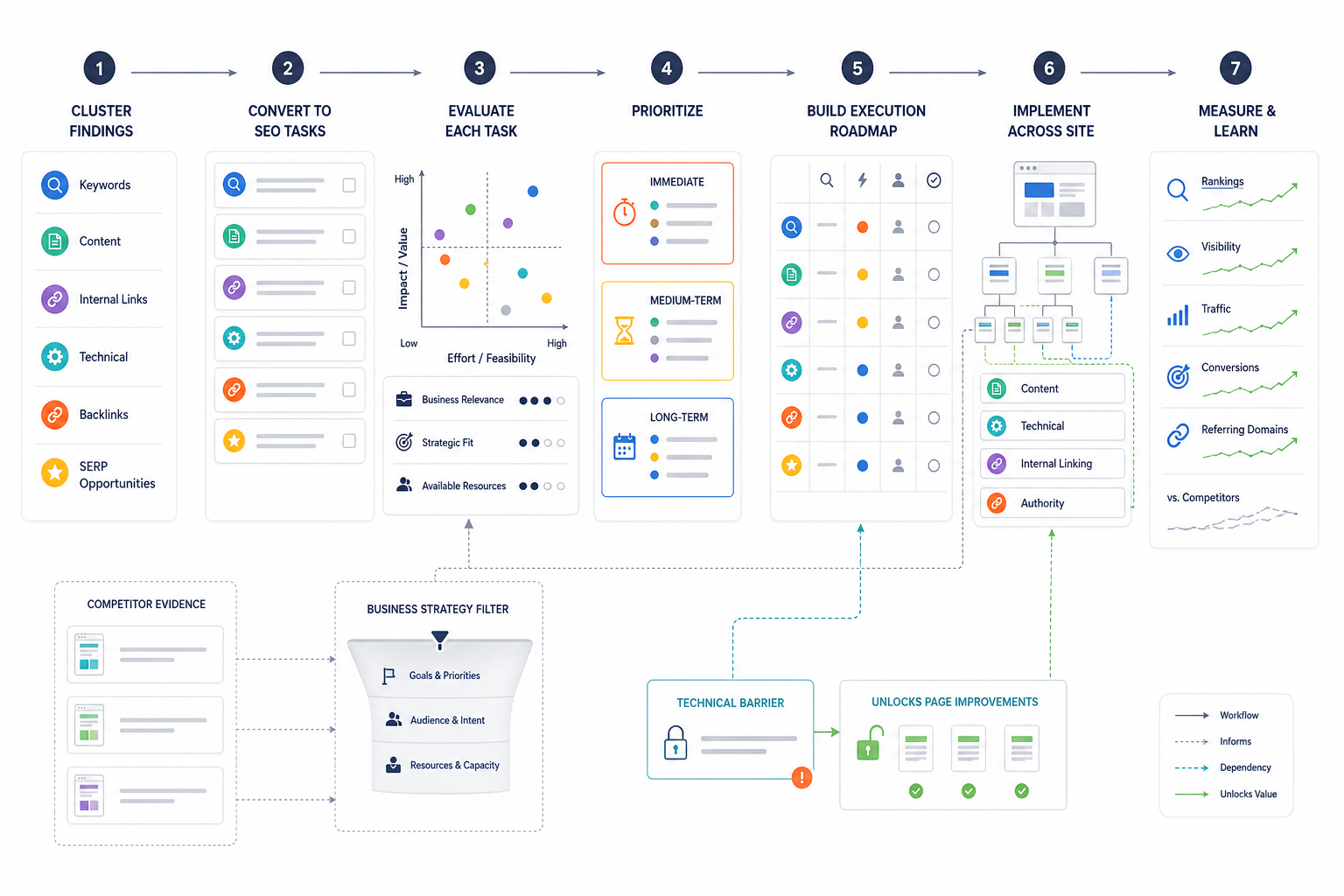
Competitor analysis becomes actionable when validated competitive gaps are converted into prioritized SEO tasks according to business value, expected organic impact, feasibility, effort, and available resources.
Competitor evidence informs strategy. It does not dictate strategy.
1. Classify the Competitive Findings
Group validated findings into practical SEO categories.
Common workstreams include:
- Keyword opportunities
- Missing content
- Weak existing content
- Search-intent gaps
- Internal-linking weaknesses
- Technical disadvantages
- Backlink gaps
- SERP-presentation opportunities
Remove findings that do not support business goals or realistic SEO opportunities.
A competitor advantage is not automatically relevant to your strategy.
2. Convert Findings Into Specific Actions
Translate each retained finding into a concrete SEO task.
Examples include:
- Create a missing commercial page.
- Expand an existing article with an important missing subtopic.
- Rewrite a page to align more closely with search intent.
- Add a comparison table where users require direct evaluation.
- Consolidate overlapping pages.
- Strengthen internal links to a strategically important page.
- Resolve a crawling or indexing problem.
- Improve SERP-facing title relevance.
- Create original research around a topic earning competitor links.
- Pursue relevant authority opportunities identified through backlink analysis.
Tie every action to the competitive evidence that justified it.
3. Evaluate Expected Value and Feasibility
Assess each action against consistent criteria.
Consider:
- Business relevance
- Search demand
- Expected organic impact
- Ranking feasibility
- Implementation effort
- Required resources
- Dependencies
- Existing website strength
- Competitive intensity
A high-impact action with unrealistic competitive conditions can rank below a smaller opportunity with strong relevance and achievable results.
4. Prioritize the SEO Opportunities
Rank actions according to their combined value and feasibility.
Separate priorities where useful into:
- Immediate opportunities
- Medium-term improvements
- Long-term strategic investments
Resolve dependencies logically.
A major indexation problem affecting an important directory takes priority over minor on-page improvements inside the same directory because the technical barrier affects whether the pages participate effectively in search.
5. Build the Execution Roadmap
Document each prioritized task clearly.
A useful roadmap includes:
| Finding | Evidence | SEO Action | Expected Impact | Effort | Priority | Owner | Status |
|---|---|---|---|---|---|---|---|
| Missing commercial topic | Competitors rank across high-value terms | Create dedicated page | High | Medium | High | — | Planned |
| Weak internal links | Competitors provide stronger hub support | Add contextual links | Medium | Low | High | — | Planned |
| Linkable asset gap | Competitor research page earns strong links | Develop original resource | High | High | Medium | — | Planned |
Assign each action to the relevant page, directory, or workstream.
Keep related content, technical, internal-link, and authority actions grouped so implementation remains manageable.
6. Implement the Prioritized Actions
Execute the selected improvements according to priority.
Competitor evidence establishes the opportunity, but implementation must create a stronger result for your audience rather than reproduce a rival’s work.
A competitor’s 4,000-word guide does not mean your page requires 4,500 words. The relevant question is whether your page satisfies the search intent more effectively through stronger information, clearer structure, better evidence, improved experience, or a more useful format.
The same principle applies to links, page templates, tools, and technical changes.
7. Measure the Competitive Impact
Evaluate whether the implemented improvements change organic performance.
Track relevant indicators such as:
- Rankings
- Search visibility
- Impressions
- Clicks
- Organic traffic
- Conversions
- Keyword coverage
- Referring domains
- Backlink quality
- Topic-level visibility
Compare new performance with the benchmark established during the competitor analysis.
Determine whether the important competitive gap has narrowed, remained unchanged, or widened.
Competitor analysis creates SEO value only when competitive evidence results in relevant improvements and those improvements produce measurable gains in organic-search performance.
Need links on real SaaS and business websites?
Links are placed after your approval, on sites with guaranteed DR and traffic, with a 1-year replacement guarantee.

