
SEO Marketing: Digital Marketing, Business Applications, Strategy, Marketer Role & Services
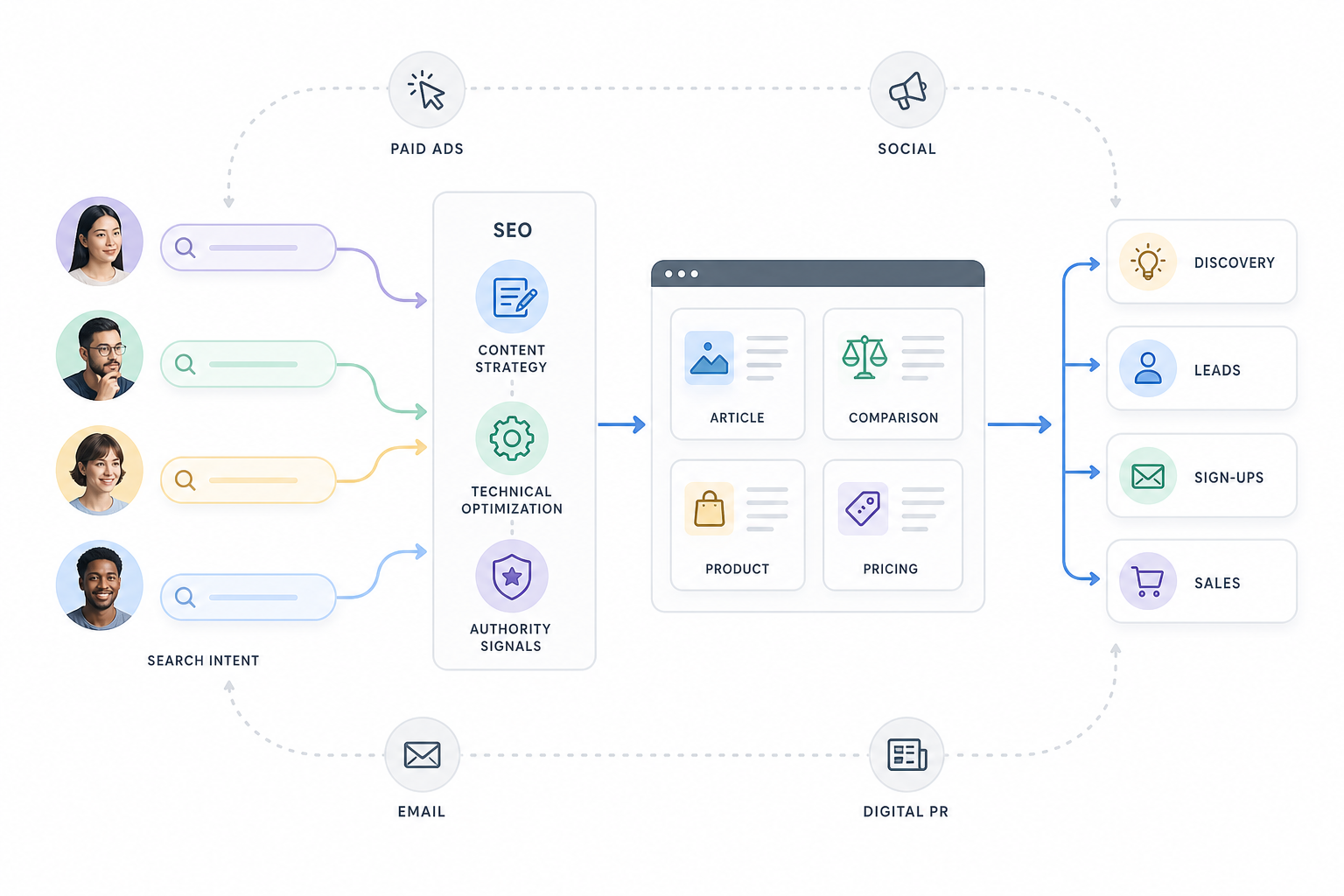
SEO marketing is the use of search engine optimization to connect relevant organic search demand with a website, its content, and defined business goals. It helps businesses become visible when people search for information, products, services, comparisons, or solutions related to what they offer.
SEO primarily focuses on visibility within organic search results rather than purchasing individual search placements. Organic clicks do not carry a direct advertising cost per click, but SEO itself is not free. Businesses invest in content, technical development, research, tools, specialists, design, digital PR, and ongoing optimization.
SEO belongs within marketing because it connects audience behavior with customer acquisition. Search queries reveal what people want to understand, compare, solve, or buy. SEO helps businesses identify that demand and create website experiences capable of satisfying it.
A person searching for “how payroll software works” has a different objective from someone searching for “best payroll software for small business” or “payroll software pricing.” SEO marketing helps a company address these different forms of demand with appropriate pages and information.
The value of SEO therefore extends beyond rankings. Effective SEO marketing contributes to qualified organic visibility, website visits, product discovery, leads, sign-ups, sales, revenue, and other relevant business outcomes.
SEO operates within the broader digital marketing system alongside paid search, content marketing, social media, email, advertising, partnerships, digital PR, and other acquisition or communication channels.
Understanding SEO marketing first requires understanding the specific role organic search plays within that wider system.
How Does SEO Fit Into Digital Marketing?
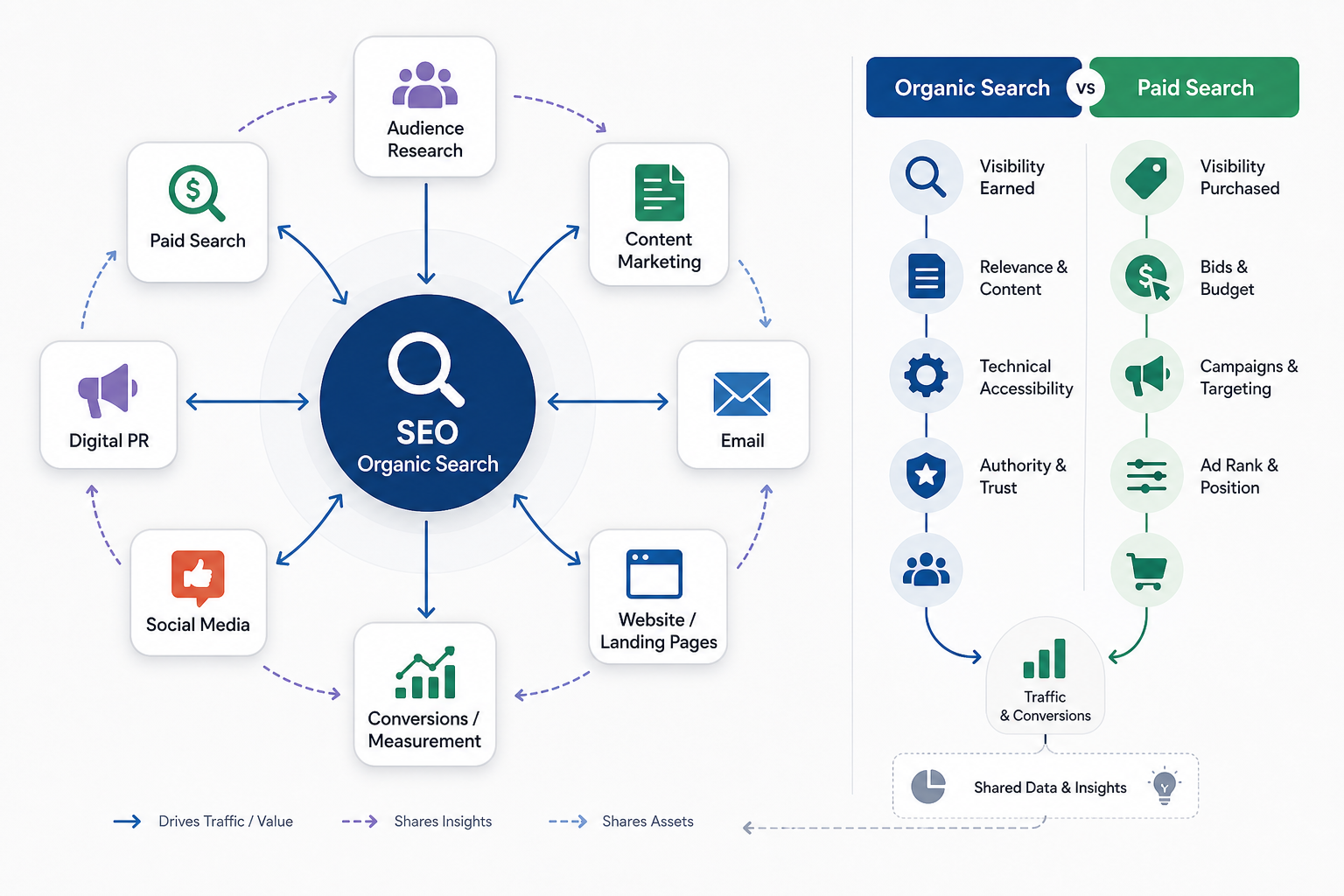
SEO fits into digital marketing as the organic-search acquisition channel that helps businesses capture existing search demand and direct it toward relevant website content.
Digital marketing includes multiple channels that reach audiences in different ways. Paid advertising creates purchased exposure. Email communicates with known contacts. Social media distributes content and builds audience engagement. SEO focuses on people actively using search engines to find information, products, services, or solutions.
SEO also supports other marketing activities.
- Support organic acquisition
- SEO helps a website appear when users actively search for relevant topics.
- This demand already exists before the website receives the visit.
- Strong visibility allows the business to capture a share of that demand without paying for each organic click.
- Inform content marketing
- Keyword and search-intent research reveal recurring questions, problems, comparisons, and information needs.
- These insights help content teams decide which topics deserve investment.
- Search data also helps determine whether a topic requires an article, guide, product page, comparison, landing page, or another format.
- Complement paid search
- SEO and paid search can target overlapping search demand through different acquisition models.
- Paid campaigns provide controlled advertising visibility.
- SEO develops organic visibility through relevant pages, content, technical accessibility, and authority.
- Businesses can use both channels where the economics and objectives justify them.
- Support social and email distribution
- Useful resources created for search can also be distributed through newsletters, social platforms, communities, sales outreach, and customer communications.
- A high-quality guide does not have to serve only organic traffic.
- Inform audience research
- Search behavior reveals the terminology audiences use.
- It exposes recurring problems, objections, comparisons, and questions.
- Changes in search demand can also indicate changing customer priorities or market interest.
- Support digital PR and authority building
- Original research, statistics, tools, reports, and useful resources created for SEO can earn external mentions and backlinks.
- These assets can support brand exposure beyond organic search.
- Contribute to measurable acquisition
- SEO performance can be connected with landing pages, leads, sign-ups, purchases, revenue, or other defined outcomes.
- Rankings become useful when they contribute to business-relevant visibility and traffic.
SEO therefore has a distinct role inside digital marketing while sharing content, audience insights, website assets, and performance data with other channels.
The difference becomes clearer when SEO is compared with paid search acquisition.
How Is SEO Different From Search Engine Marketing and Advertising?
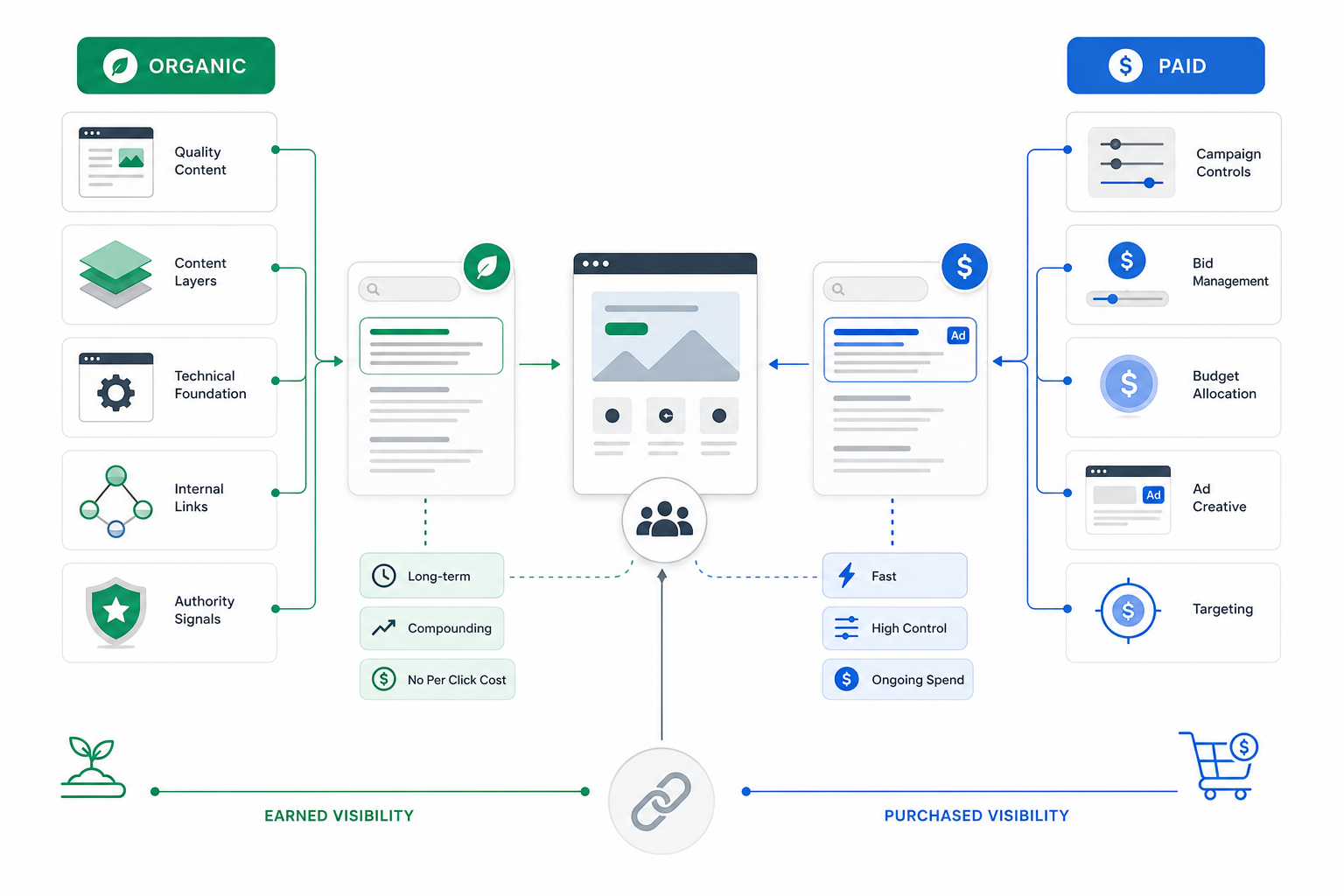
SEO earns visibility through organic search results, while paid search advertising purchases eligible visibility through sponsored placements.
The term search engine marketing, or SEM, has historically been used in different ways. Some definitions include both organic and paid search, while modern marketing usage commonly uses SEM to refer primarily to paid search advertising.
| Attribute | SEO | SEM / Paid Search Advertising |
|---|---|---|
| Visibility type | Organic search results | Sponsored search placements |
| Acquisition method | Relevance, content, technical SEO, internal relationships, authority | Campaigns, bids, budgets, targeting, ad copy |
| Direct click cost | No advertising charge for each organic click | Commonly incurs CPC or another advertising cost |
| Investment required | Content, technology, expertise, tools, optimization | Media budget, campaign management, creatives, landing pages |
| Time to visibility | Depends on crawling, indexing, competition, and ranking improvement | Eligible campaigns can gain visibility relatively quickly |
| Duration | Visibility can continue while pages remain relevant and competitive | Placement depends largely on continued campaign activity and budget |
| Control | Rankings are determined by search-engine systems | Advertisers control bids, budgets, targeting, and campaign settings |
| Testing speed | Organic changes often require longer observation | Offers, messaging, keywords, and audiences can often be tested faster |
| Common metrics | Rankings, impressions, clicks, organic traffic, conversions | Impressions, clicks, spend, CPC, CPA, ROAS, conversions |
| Long-term role | Builds organic-search assets that can attract demand over time | Provides controlled visibility through continued media investment |
SEO traffic is not “free traffic.” The click itself has no advertising charge, but producing and maintaining competitive organic visibility requires resources.
Paid search also does not replace SEO, and SEO does not automatically eliminate the value of paid search. A business can use paid campaigns for immediate commercial demand while developing organic visibility around the same or related topics.
The fundamental distinction is how visibility is acquired: SEO earns organic exposure through optimization, while paid search purchases advertising exposure through campaigns.
Regardless of acquisition model, search marketing ultimately creates value through the website pages visitors reach.
How Does SEO Support Website Marketing?
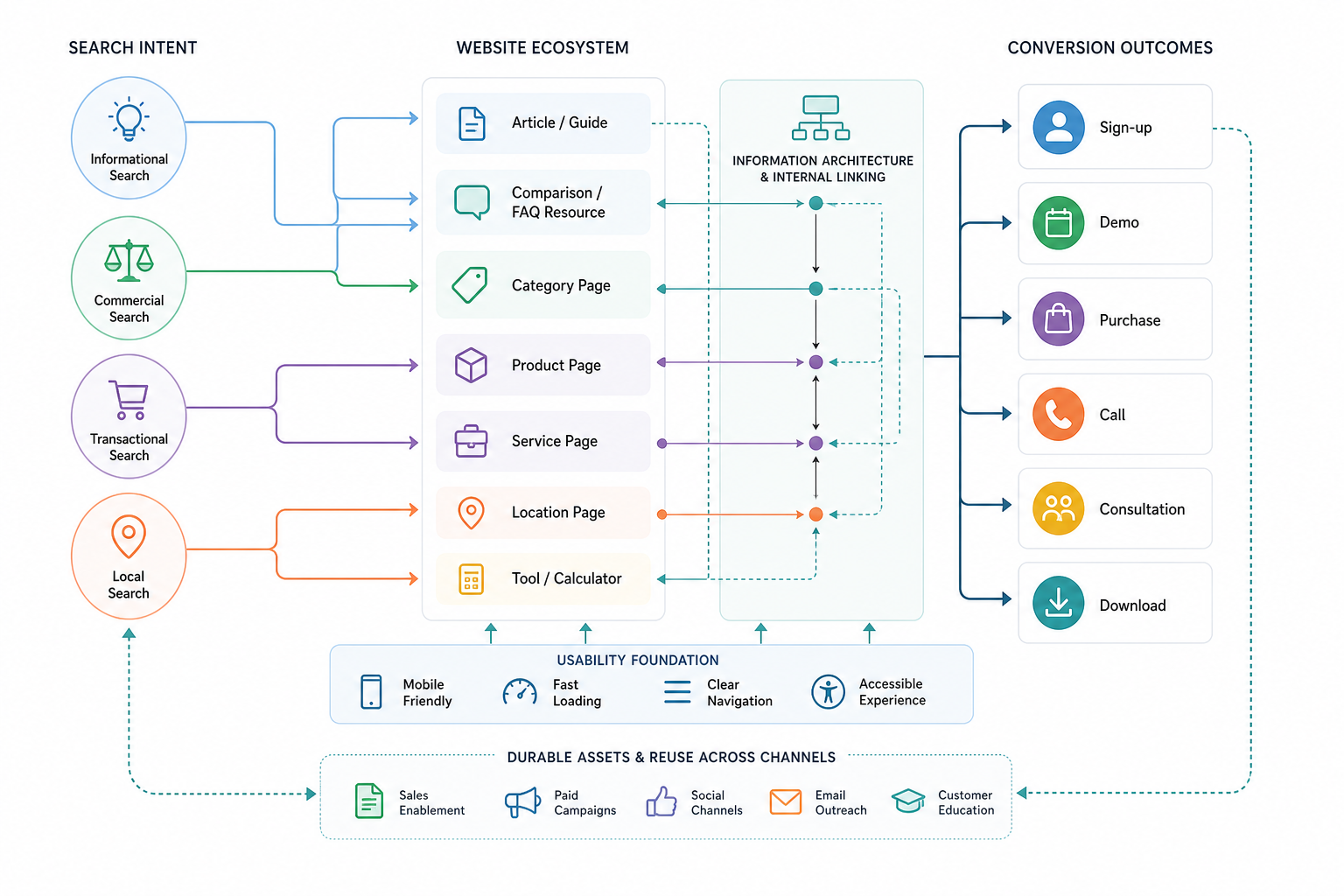
SEO supports website marketing by connecting relevant search demand with website pages designed to inform, persuade, help, or convert visitors.
Organic visibility becomes commercially useful only when the destination page satisfies the reason the user searched.
- Connect search demand with landing pages
- Informational searches require pages that explain or educate.
- Commercial searches require pages that help users evaluate options.
- Transactional searches require product, service, pricing, category, or conversion-focused pages.
- Local searches require location-relevant information.
- Strengthen commercial page discovery
- Product pages can attract product-specific demand.
- Service pages can capture users searching for a particular solution.
- Category pages can address broader product or service searches.
- Location pages can capture geographically relevant demand.
For online stores, optimizing product, category, and supporting informational pages around this search demand forms a central part of Ecommerce SEO.
- Support information journeys
- Articles, guides, FAQs, comparisons, templates, calculators, and tools help users understand problems before they are ready to buy.
- These resources can introduce the company earlier in the customer journey.
- Internal links can then connect educational content with more commercial destinations where appropriate.
- Improve information architecture
- Clear website organization helps users move between related information.
- Relevant internal links connect broad topics with supporting pages.
- Commercial pages gain stronger contextual relationships when relevant informational content supports them.
- Improve website usability
- Mobile usability, navigation, loading performance, accessibility, and clear information structure influence the experience after the search click.
- Search visibility has limited marketing value when visitors cannot use the resulting page effectively.
- Support conversion paths
- Qualified visitors require an appropriate next action.
- Depending on the page, this can include a demo request, form, product purchase, consultation, sign-up, free trial, download, phone call, or another relevant conversion.
- Create durable website assets
- A useful page can continue attracting organic search demand while it remains relevant, accessible, and competitive.
- Existing content can also be updated as markets, products, and audience needs change.
- Support other marketing channels
- Search-focused website assets can also support sales teams, paid campaigns, social distribution, newsletters, and customer education.
SEO web marketing therefore uses organic search as a way to bring relevant audiences into website experiences built around their current needs.
Different businesses use that visibility for different commercial purposes.
How Do Businesses Use SEO Marketing?
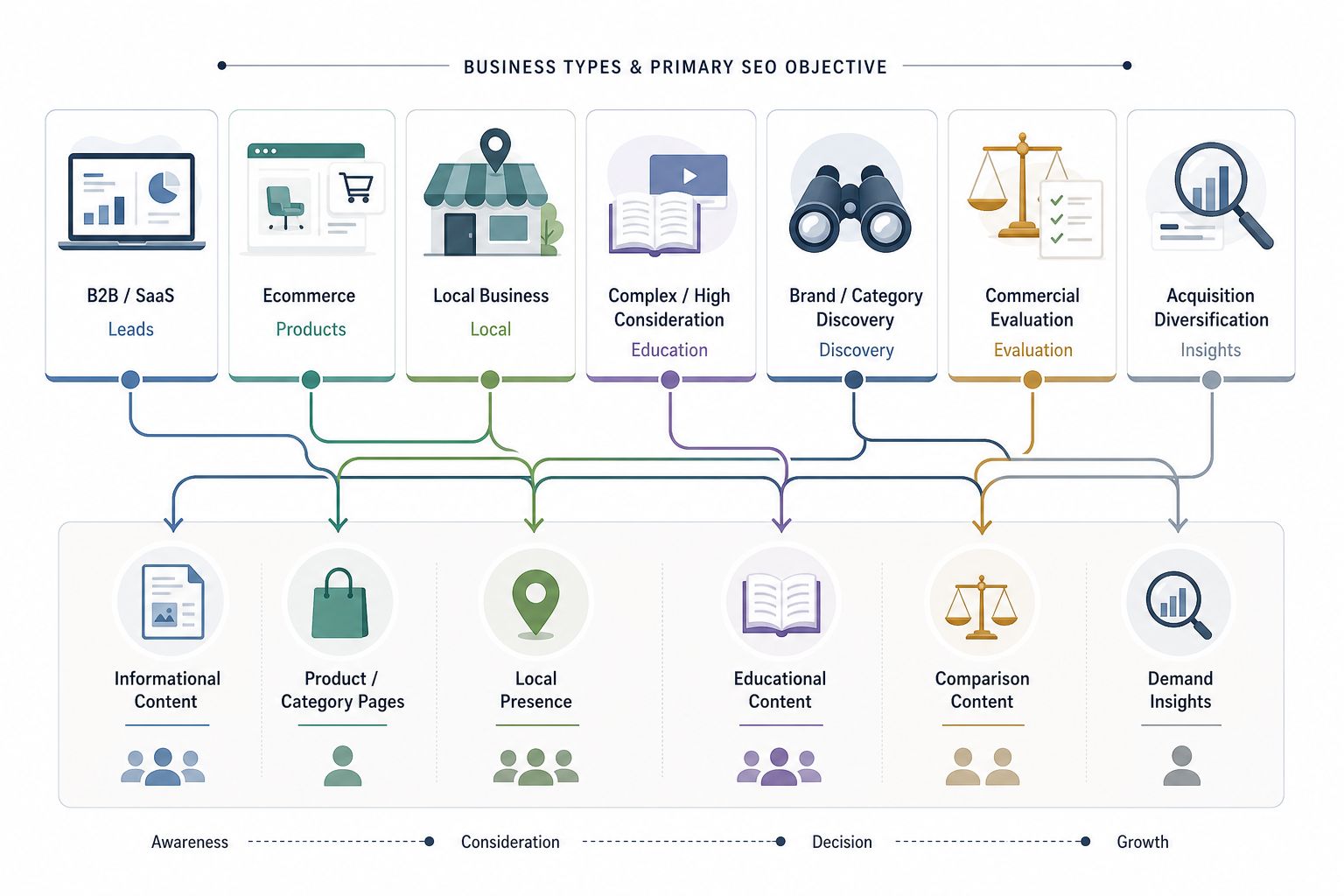
Businesses use SEO marketing to capture relevant search demand and connect it with objectives such as lead generation, product discovery, sales, local visibility, market education, and brand discovery.
The right SEO application depends on the business model and customer journey.
- Generate qualified leads
- B2B companies, SaaS businesses, professional services firms, agencies, and other lead-driven organizations can target searches related to problems, services, solutions, comparisons, and buying decisions.
- Commercial pages can convert relevant searchers into enquiries, trials, consultations, or demos.
- Informational content can create earlier touchpoints before a buyer reaches the final decision stage.
- Drive ecommerce and product discovery
- Ecommerce businesses can target product, category, buying-guide, comparison, and informational demand.
- Category pages capture broader product searches.
- Product pages address specific purchasing demand.
- Guides and comparisons help users evaluate choices before conversion.
- Capture local demand
- Restaurants, clinics, salons, service businesses, professionals, stores, and location-dependent businesses can target searches with geographic intent.
- Local SEO can help users discover nearby businesses and individual locations.
- The website, local landing pages, business information, reviews, and local search presence work together.
- Educate complex markets
- Technical, expensive, unfamiliar, or high-consideration products often require substantial customer education.
- Informational search content can explain the problem, category, methodology, use cases, risks, benefits, and terminology before a buyer enters a commercial conversation.
- Support category and brand discovery
- Potential customers do not always start by searching for a brand name.
- Visibility across broader industry topics exposes users to companies they did not previously know.
- Repeated useful exposure can build familiarity before branded demand develops.
- Support commercial evaluation
- Comparison, alternative, feature, integration, use-case, pricing, and solution searches occur when potential customers are actively evaluating options.
- SEO can help a business appear during these high-value consideration stages.
- Diversify customer acquisition
- Organic search provides an additional acquisition source alongside advertising, outbound, partnerships, social media, referrals, and other channels.
- Diversification reduces dependence on one source of traffic or customer acquisition.
- Gather market-demand intelligence
- Search behavior reveals recurring customer questions.
- Keyword patterns expose the terminology audiences use.
- Changes in demand highlight emerging or declining topics.
- Search data can inform content, positioning, product education, and broader marketing decisions.
Not every business requires every SEO application. A local dental clinic has different search opportunities from a global SaaS platform or ecommerce retailer.
Marketing with SEO works best when search demand matches the business model, market, customer journey, website capabilities, and intended commercial outcome.
Once the objective is clear, the business can build a strategy around the search opportunities most likely to support it.
How Do You Build an SEO Marketing Strategy?
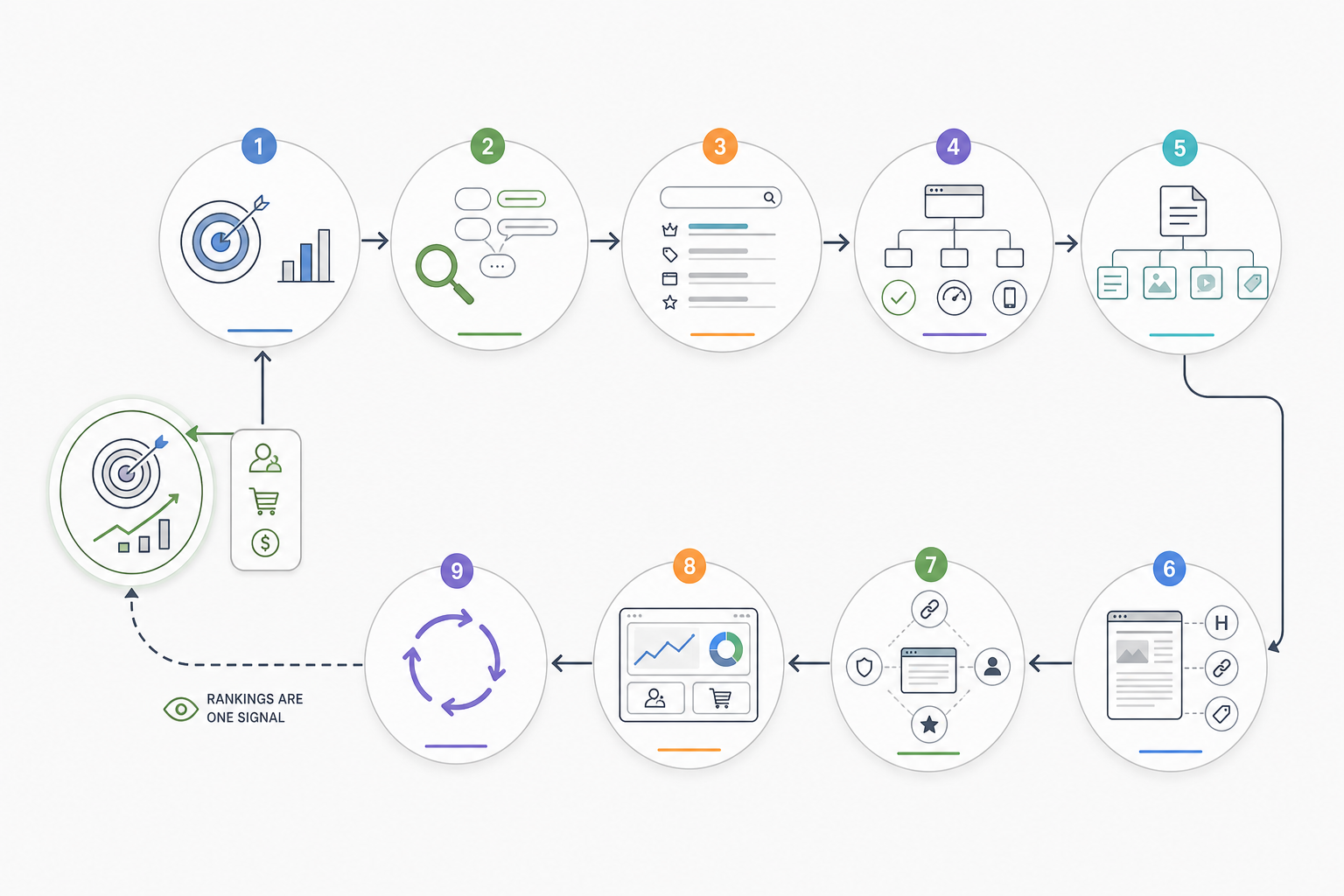
An SEO marketing strategy turns a business objective into a coordinated organic-search plan based on audience demand, competition, website condition, relevant content, authority, and measurable outcomes.
It applies the broader principles of an SEO Strategy to marketing objectives by connecting organic-search opportunities with measurable business outcomes.
1. Define the SEO Objective
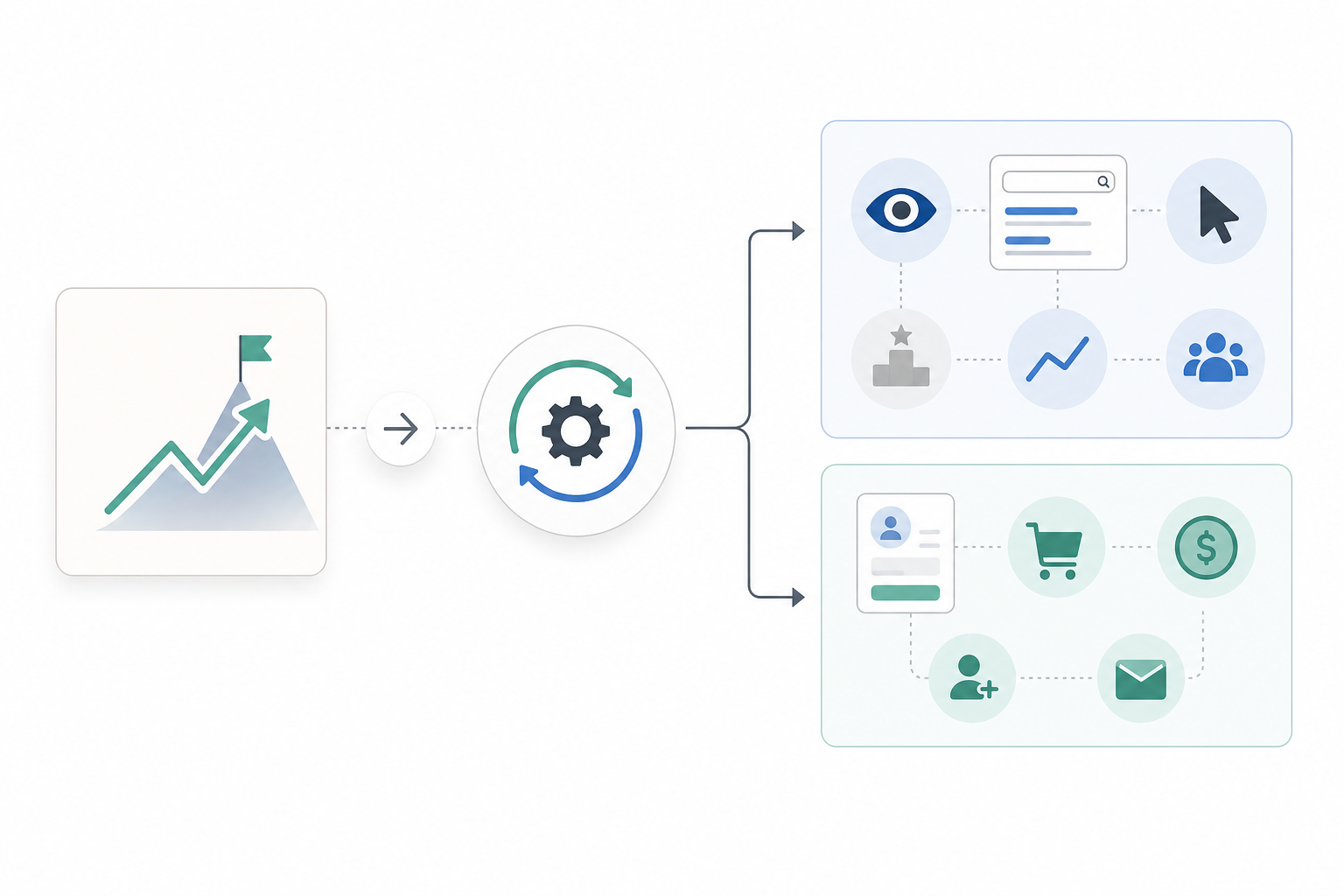
Translate the business goal into a measurable organic-search objective.
Examples include:
- Generate more qualified leads
- Increase ecommerce revenue
- Improve product discovery
- Capture local search demand
- Build category visibility
- Increase non-branded organic acquisition
- Support a new product or market
Define both SEO and business KPIs.
SEO indicators can include:
- Organic visibility
- Impressions
- Rankings
- Clicks
- Organic traffic
Business indicators can include:
- Leads
- Purchases
- Revenue
- Sign-ups
- Trials
- Qualified enquiries
Rankings alone do not define whether the strategy succeeds.
2. Research Search Demand
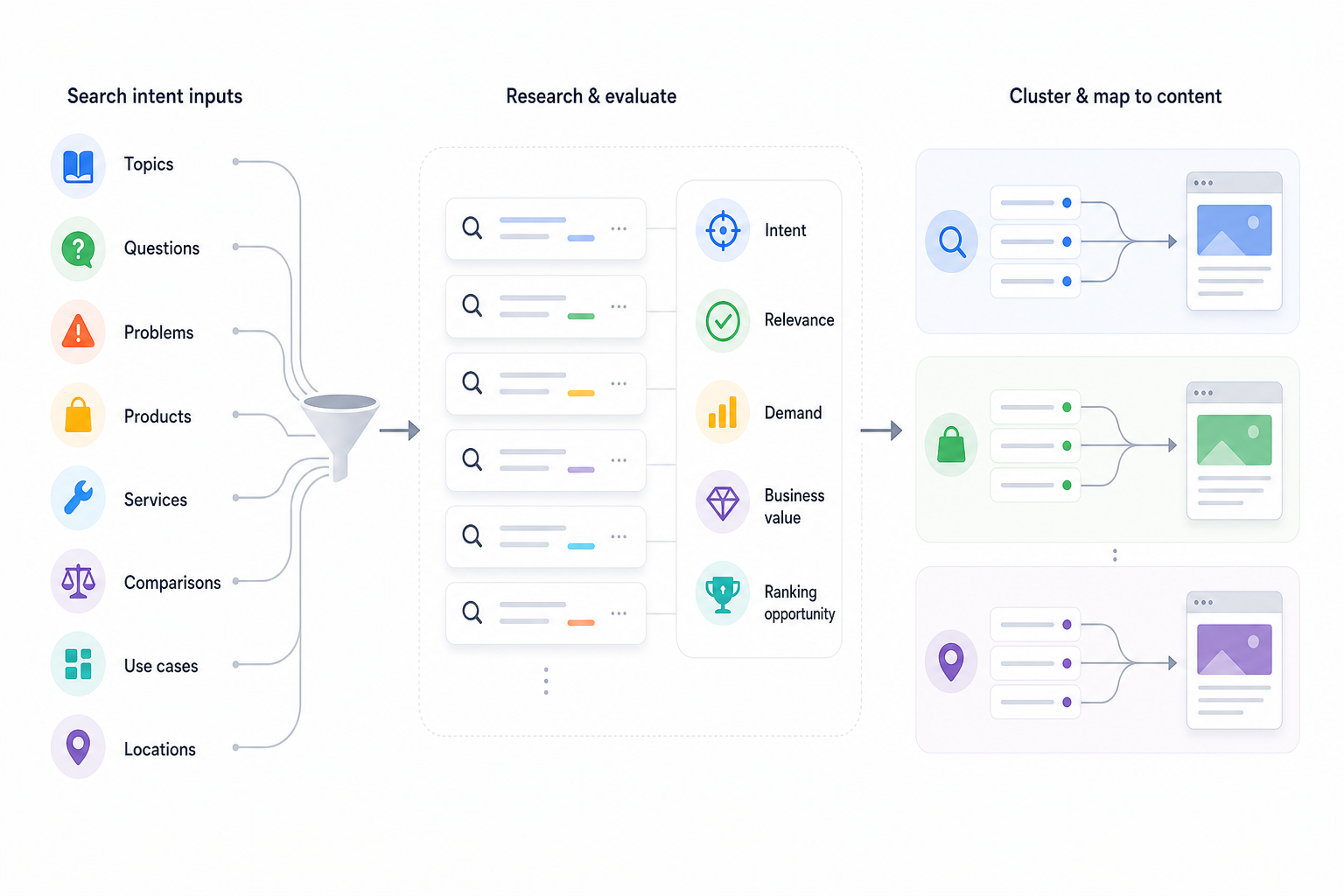
Identify what the target audience searches for.
Research:
- Topics
- Keywords
- Questions
- Problems
- Products
- Services
- Use cases
- Comparisons
- Solutions
- Locations where relevant
Evaluate search intent, relevance, demand, business value, and realistic ranking opportunity.
Related queries that represent the same intent can usually be grouped around one page rather than treated as separate targets.
Search research establishes where relevant demand exists.
3. Analyze Search Competitors
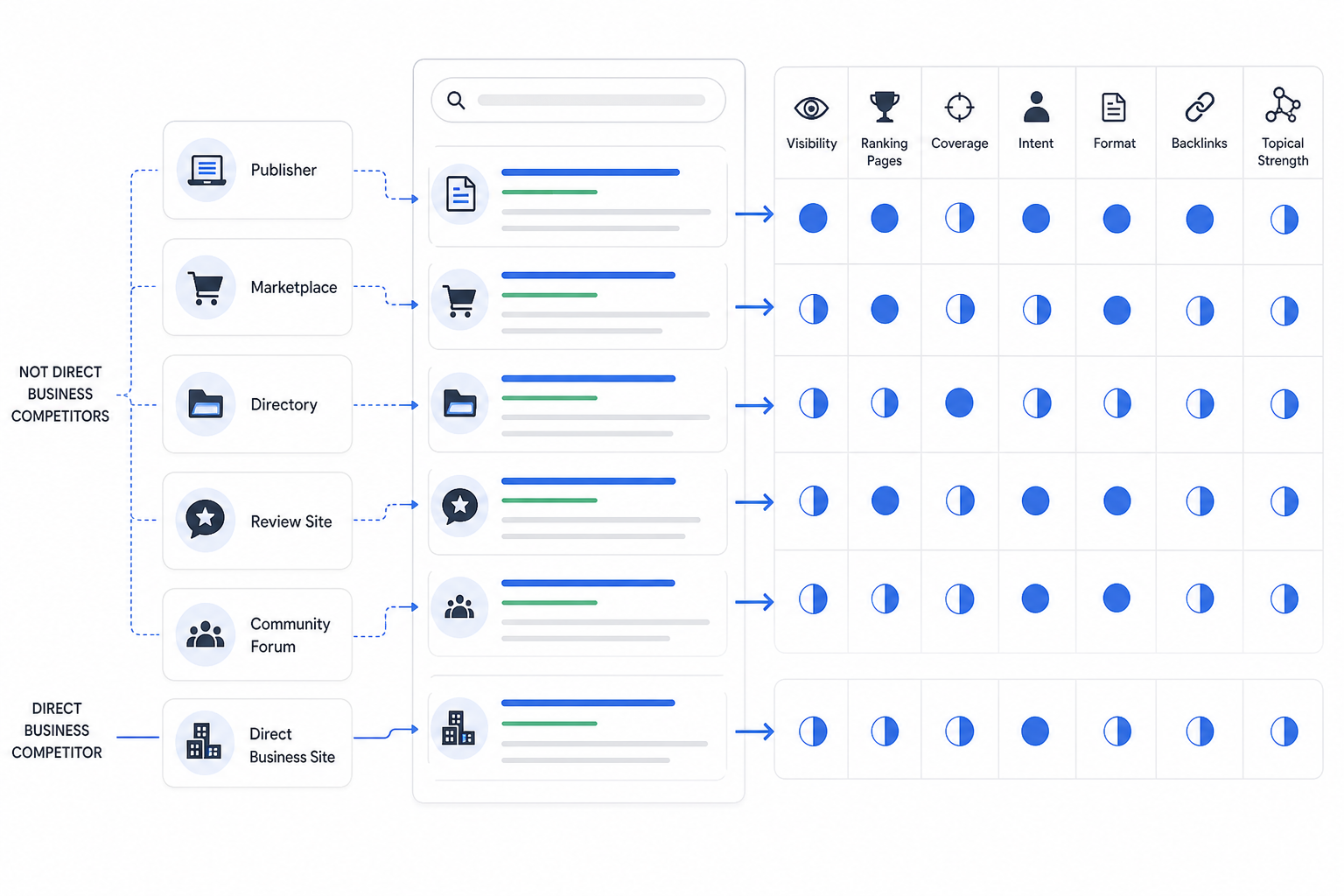
Identify the websites repeatedly appearing across strategically important SERPs.
Review:
- Keyword visibility
- Ranking pages
- Content coverage
- Search intent
- Page formats
- Backlinks
- Topical strength
- Search visibility
Search competitors are not always direct business competitors. Publishers, marketplaces, directories, review platforms, communities, and other sites can compete for the same demand.
Competitor evidence helps identify standards and gaps. It does not provide instructions to reproduce competitor content.
4. Strengthen the Technical Foundation
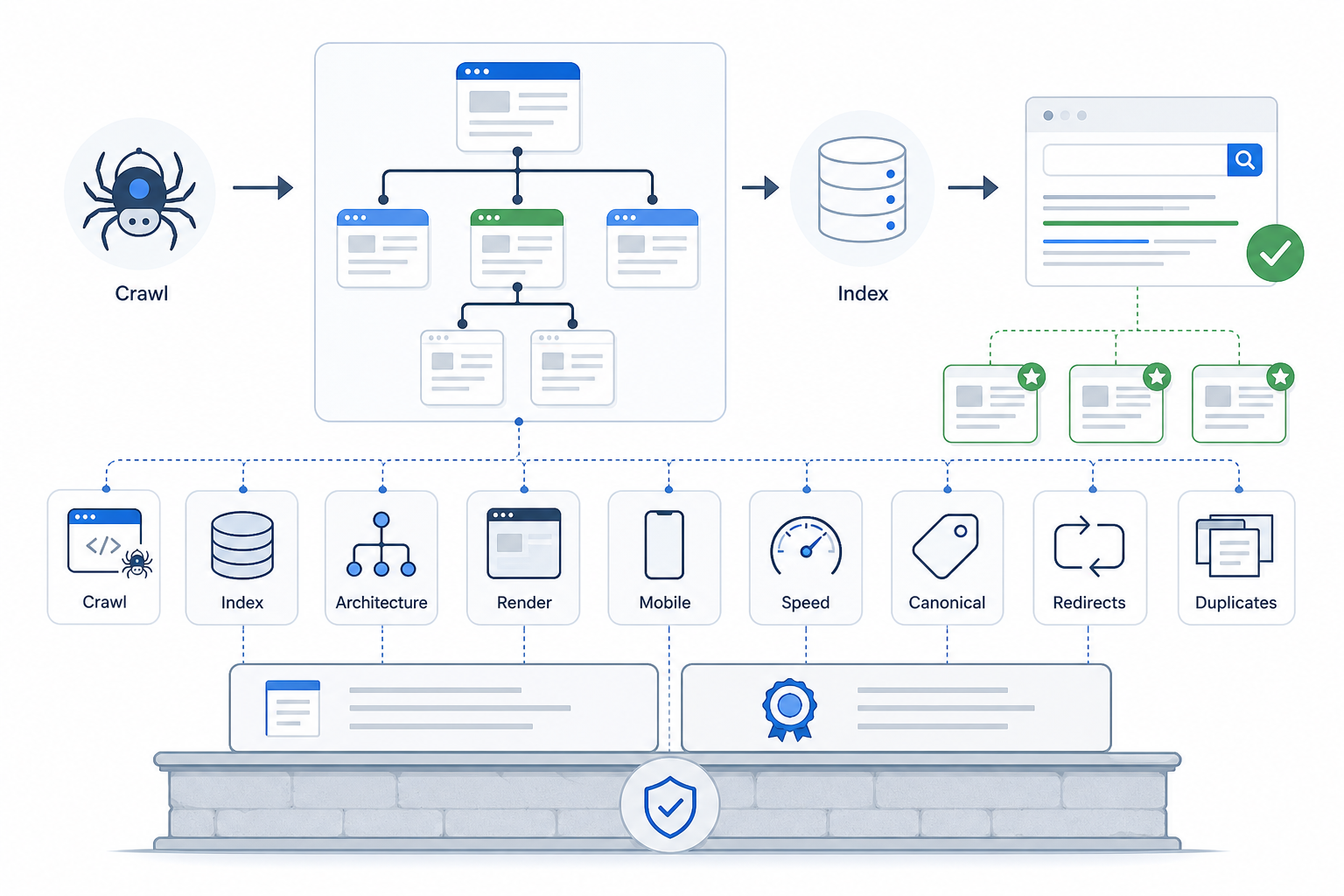
Confirm that important website pages can be discovered, processed, and indexed effectively.
Review issues involving:
- Crawlability
- Indexability
- Site architecture
- Internal discoverability
- Rendering
- Mobile usability
- Page performance
- Canonicalization
- Redirects
- Technical duplication
Prioritize issues that materially affect important search pages.
Technical SEO creates the foundation for organic participation. It does not replace relevance, content quality, or authority.
5. Plan and Create the Required Pages and Content
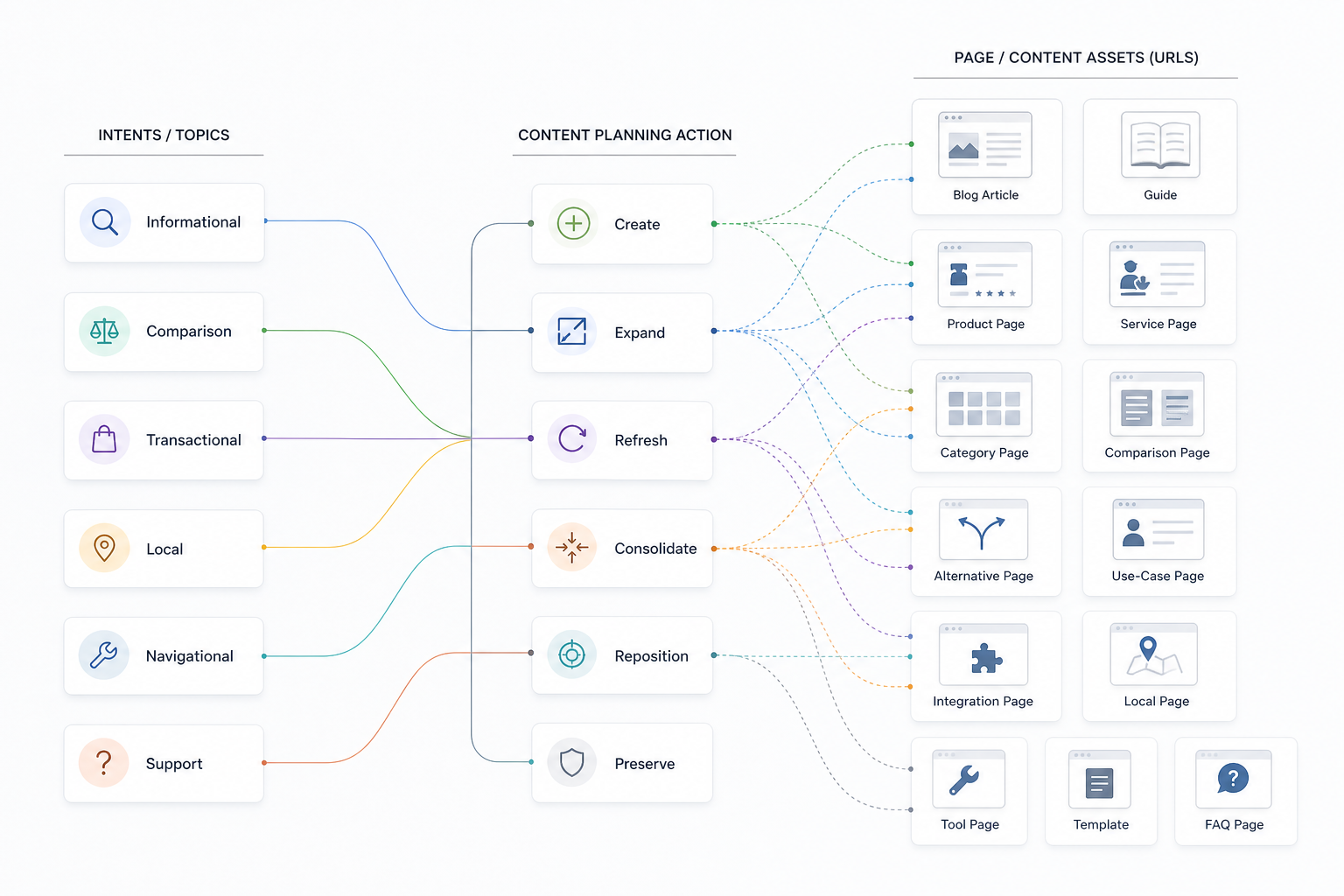
Assign important topics and search intents to appropriate website pages.
Determine which URLs require:
- Creation
- Expansion
- Refreshing
- Consolidation
- Repositioning
- Preservation
Different search intent requires different assets.
The website can require:
- Blog articles
- Guides
- Product pages
- Service pages
- Category pages
- Comparison pages
- Alternative pages
- Use-case pages
- Integration pages
- Local pages
- Tools
- Templates
- FAQs
Each page requires a distinct role.
Content planning determines what information or page needs to exist. It does not determine how every on-page element is optimized.
6. Optimize Page-Level Relevance
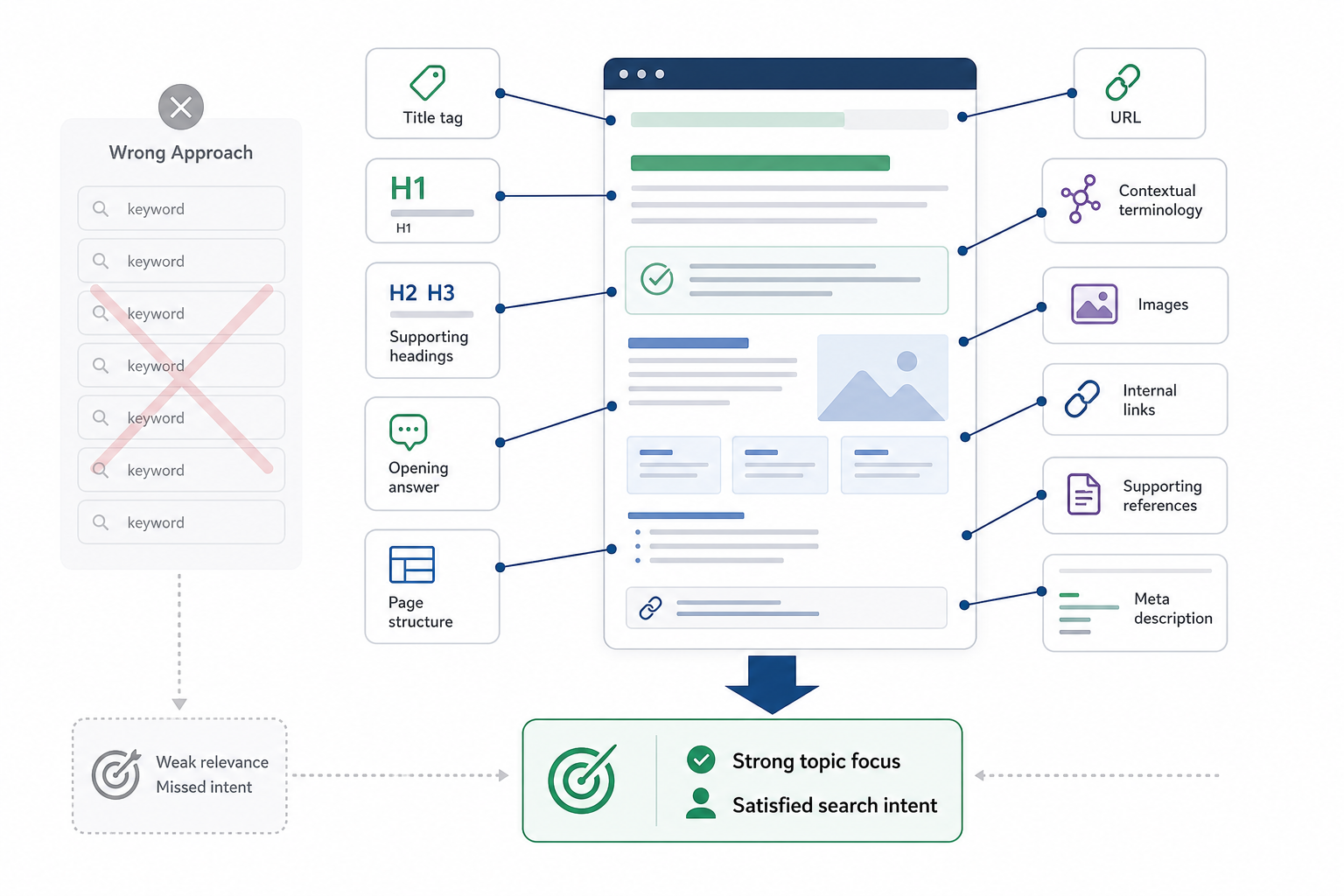
Improve how important pages communicate their subject and purpose.
Review:
- Title tags
- H1 headings
- Supporting headings
- URLs
- Opening answers
- Page structure
- Contextual terminology
- Images
- Internal links
- Supporting references
- Meta descriptions
Keep each important page focused on one coherent topic and search intent.
Avoid treating optimization as keyword repetition. Page relevance comes from clear information, appropriate terminology, structure, and intent satisfaction.
7. Build External Authority
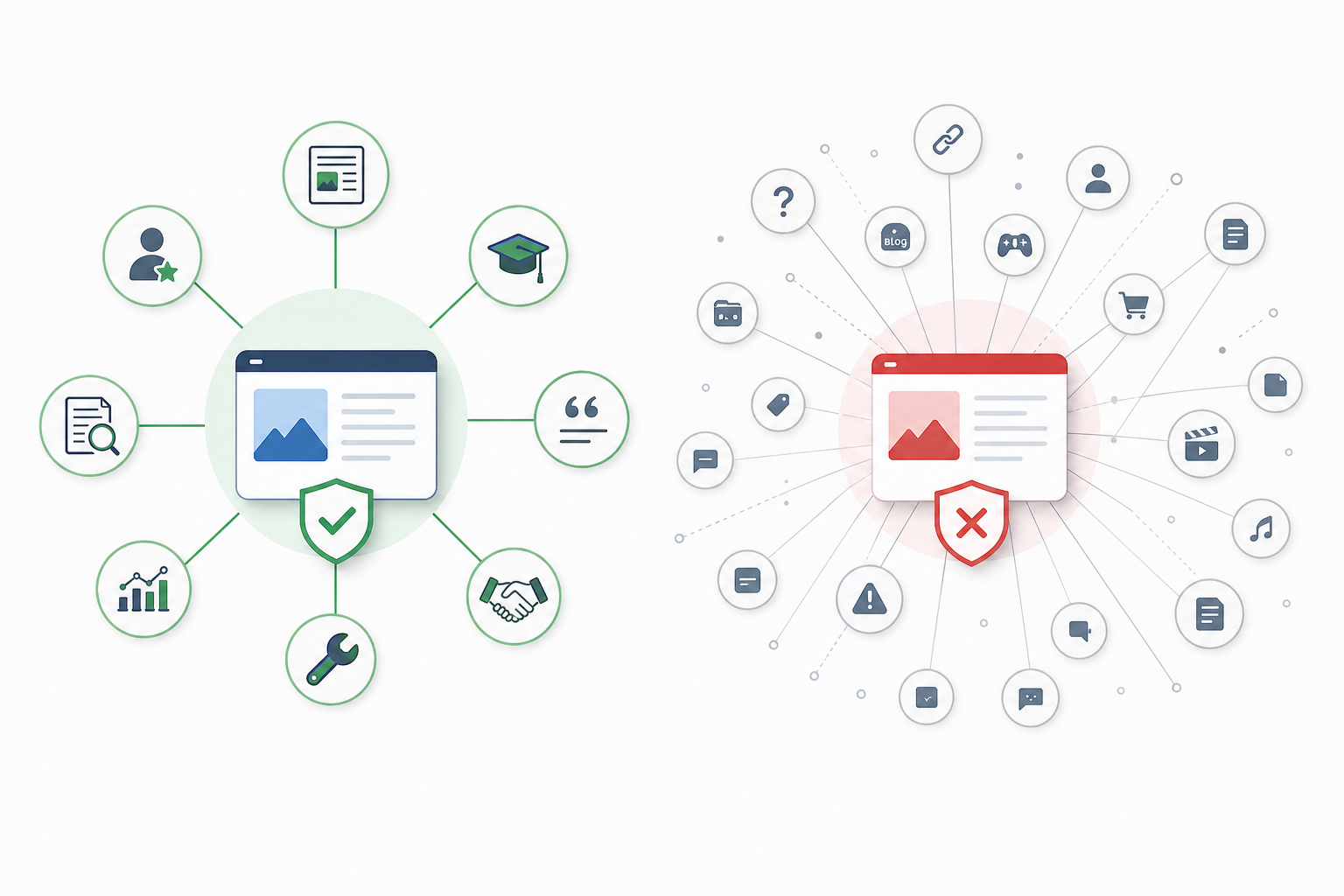
Strengthen important topics and pages through credible external references.
Authority-building activities can include:
- Editorial backlinks
- Digital PR
- Research
- Data studies
- Statistics resources
- Useful tools
- Partnerships
- Industry citations
- Expert contributions
- Linkable assets
Prioritize relevance and credibility rather than raw link quantity.
A smaller number of contextually relevant links from credible sources can provide stronger competitive value than large numbers of unrelated links.
8. Measure SEO and Business Outcomes
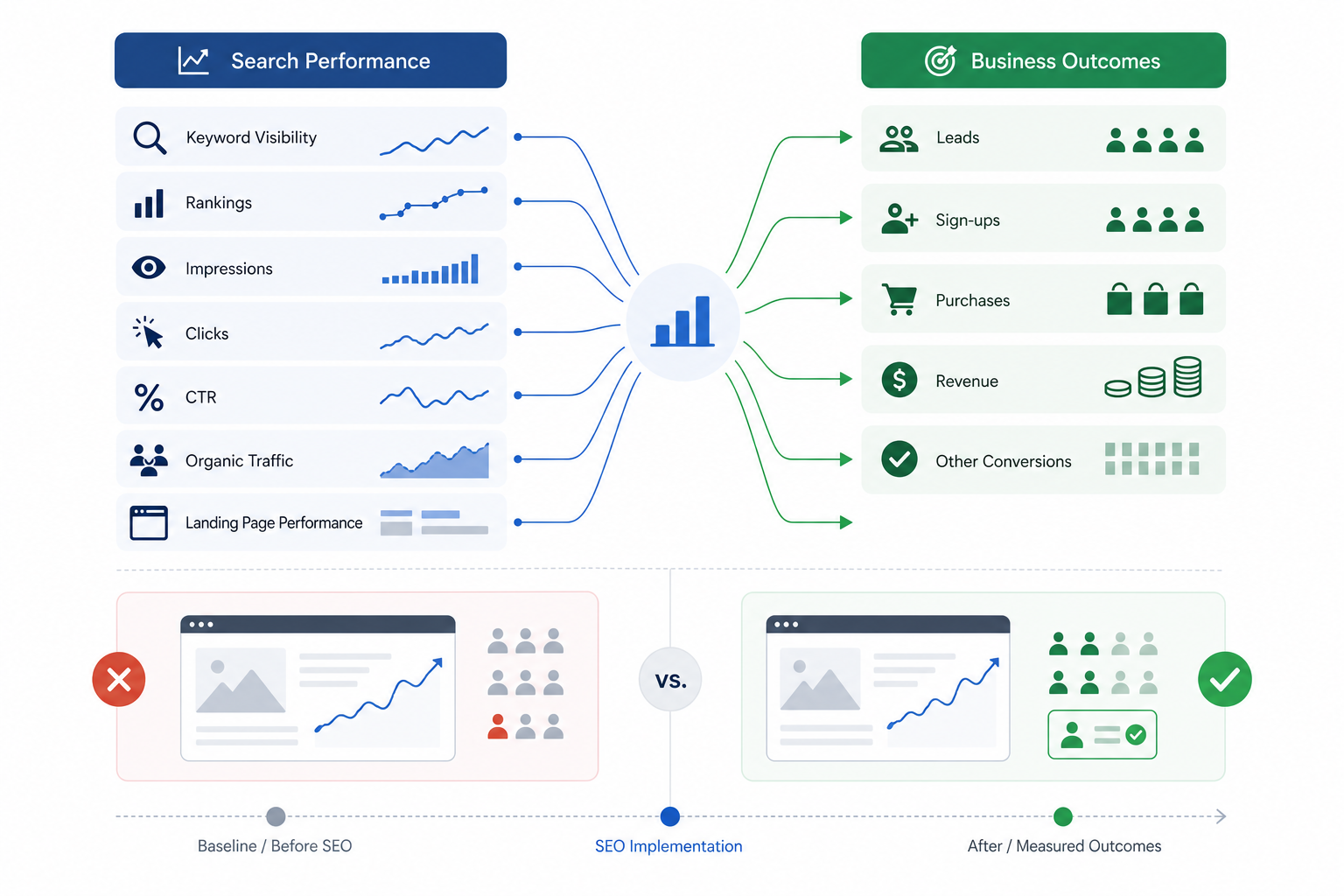
Track how organic visibility changes after implementation.
Review:
- Keyword visibility
- Rankings
- Impressions
- Clicks
- CTR
- Organic traffic
- Landing-page performance
- Leads
- Purchases
- Revenue
- Sign-ups
- Other defined conversions
Compare results with baseline performance and the original objective.
A page gaining traffic but producing no relevant business activity requires different analysis from a page gaining qualified leads.
9. Refine the Strategy
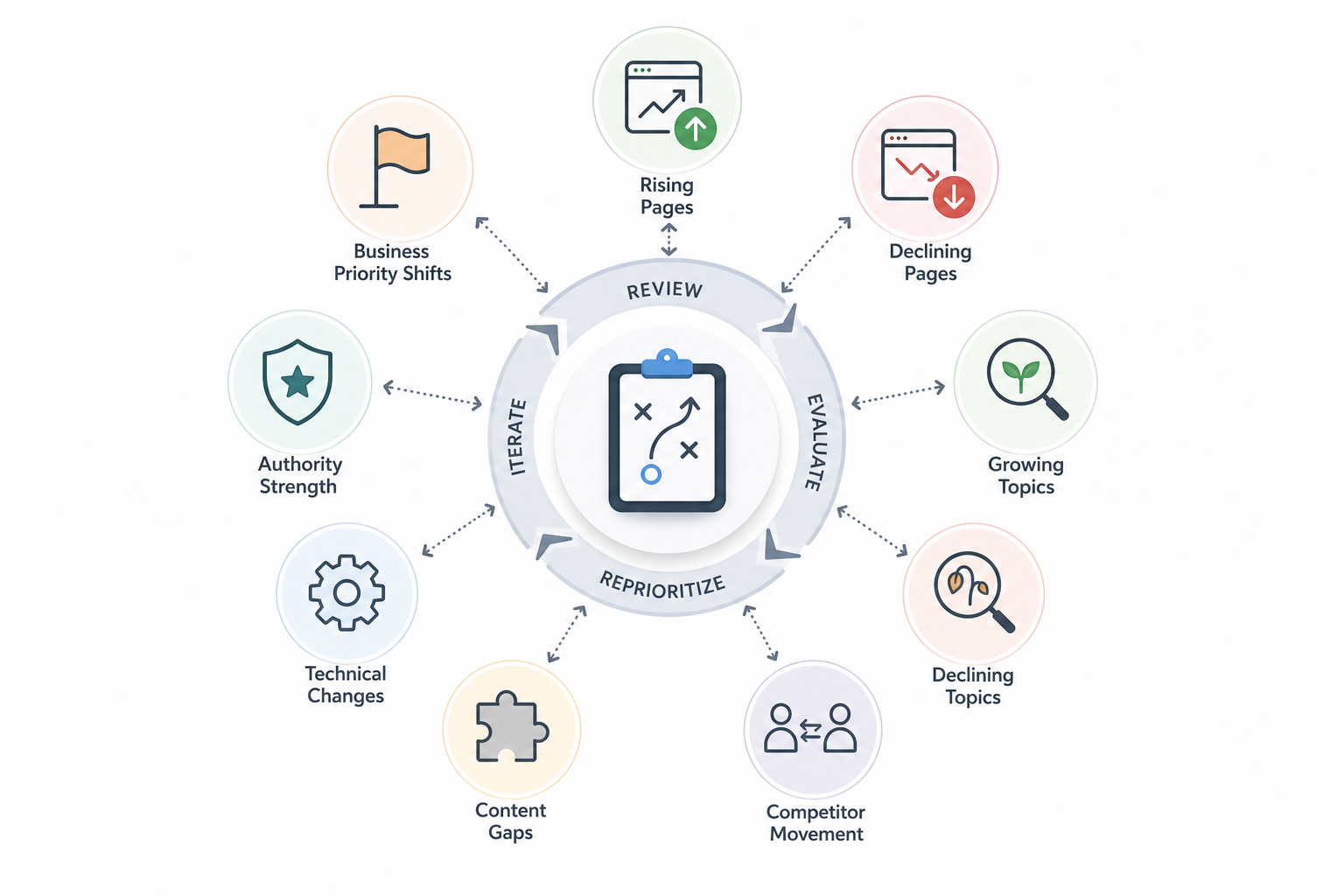
Use performance evidence to determine where priorities require adjustment.
Review:
- Pages gaining visibility
- Pages losing performance
- Topics with growing demand
- Declining topics
- New competitor activity
- Content gaps
- Technical changes
- Authority differences
- Changes in business priorities
SEO marketing strategy requires continuous adjustment because search demand, competitors, websites, and business conditions change.
What Tools and Platforms Support SEO Marketing?
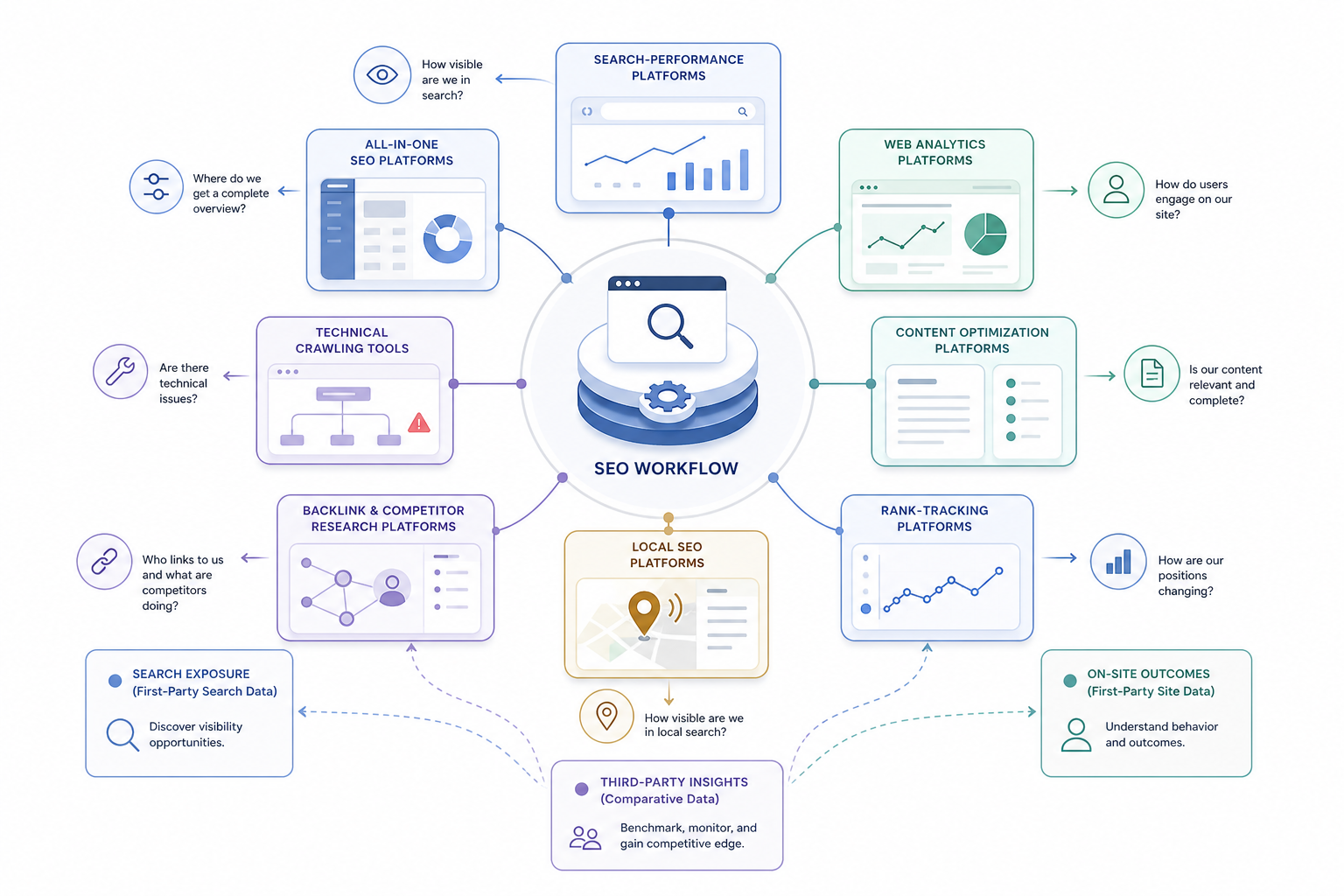
SEO marketing is supported by platforms that provide keyword, search-performance, technical, content, backlink, competitor, local SEO, and analytics data.
These platforms form part of the broader set of SEO tools used across research, optimization, analysis, monitoring, and reporting.
An SEO platform is software that collects or analyzes search-related data to support research, optimization, monitoring, and reporting.
The main tool categories include:
- All-in-one SEO platforms
- Platforms such as Semrush, Ahrefs, and SE Ranking combine several SEO datasets.
- They can support keyword research, competitor research, backlinks, rankings, site monitoring, and other SEO activities.
- Their metrics use proprietary databases and methodologies.
- Search-performance platforms
- Google Search Console provides information about Google Search impressions, clicks, queries, average position, pages, indexing, and search visibility.
- It provides first-party Google Search performance information for the verified website.
- Web analytics platforms
- Google Analytics 4 measures what users do after reaching the website.
- It provides organic traffic, landing-page, engagement, conversion, and revenue data where configured.
- Analytics and Search Console answer different questions: one measures search exposure, while the other measures on-site behavior and outcomes.
- Technical crawling tools
- Screaming Frog SEO Spider crawls website URLs and helps identify technical and page-level patterns.
- Common analyses include status codes, redirects, metadata, canonicals, internal links, indexability signals, and technical page elements.
- Automated findings still require interpretation before becoming priorities.
- Content optimization platforms
- Platforms such as Surfer analyze competing content and provide information about topical coverage and page structure.
- These recommendations support editorial analysis but do not replace search-intent judgment or subject expertise.
- Backlink and competitor research platforms
- Ahrefs and Semrush provide referring-domain, backlink, ranking-page, keyword-overlap, and competitive search data.
- These datasets help identify authority differences and competitor opportunities.
- Local SEO platforms
- Platforms such as BrightLocal support local rank tracking, citation management, review monitoring, and location-based search analysis.
- These tools matter primarily for businesses where local visibility contributes directly to customer acquisition.
- Rank-tracking platforms
- Dedicated or integrated rank trackers monitor selected keyword positions over time.
- Tracking can be segmented by location, device, market, or keyword group where relevant.
Third-party traffic estimates, authority metrics, difficulty scores, and visibility indexes are comparative indicators rather than direct Google measurements.
No single platform is universally best. The right combination depends on website size, SEO objectives, data requirements, internal workflows, and budget.
What Does an SEO Marketer Do?
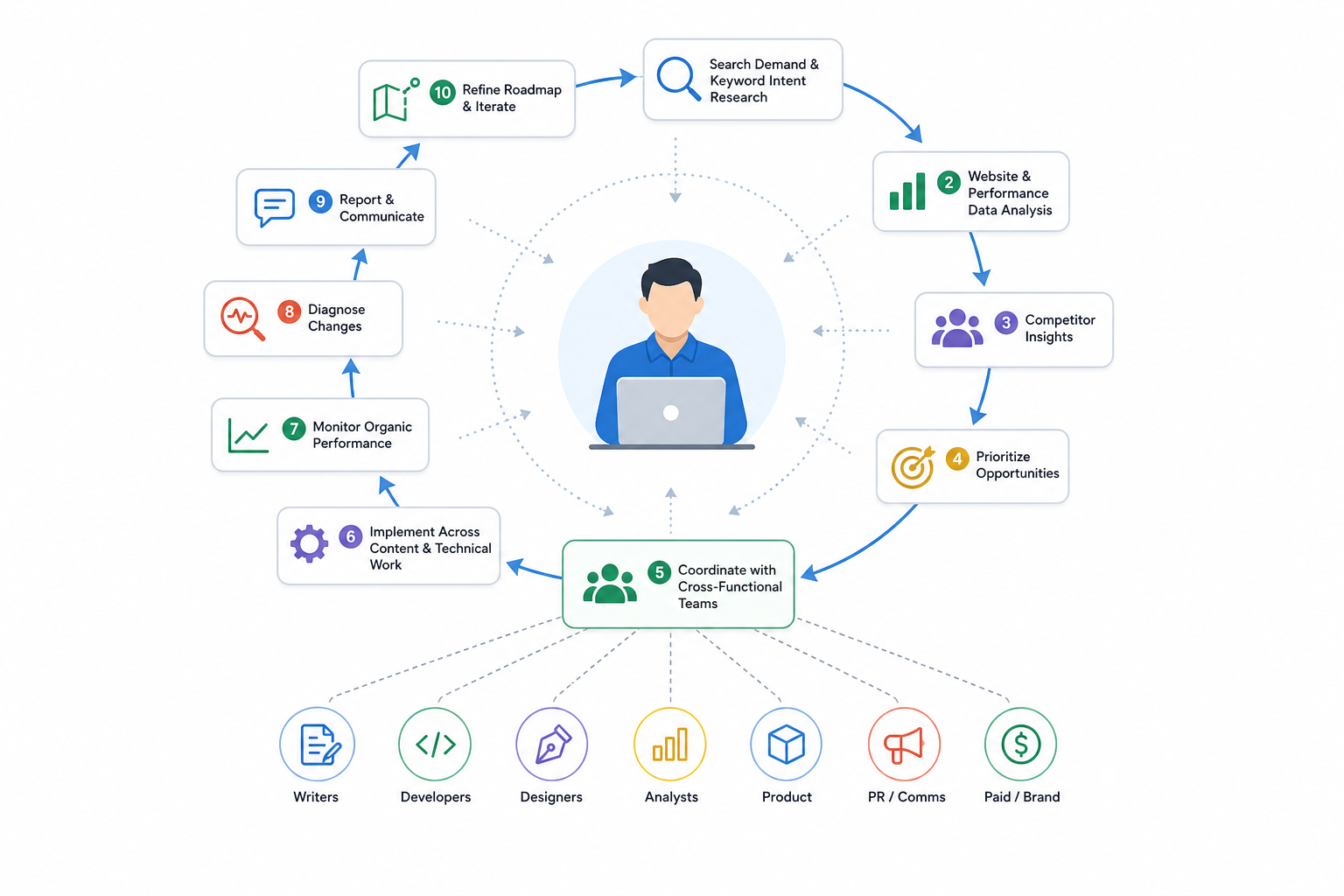
An SEO marketer is responsible for turning search demand, website data, competitive evidence, and organic performance information into prioritized actions that improve search visibility and support business objectives.
The role combines analysis, prioritization, coordination, and measurement.
- Research and interpret search demand
- Understand relevant keywords, topics, questions, and search intent.
- Identify opportunities aligned with the audience and business.
- Set SEO priorities
- Determine which technical issues, pages, topics, content gaps, and authority opportunities deserve resources.
- Balance potential impact with feasibility and business value.
- Coordinate implementation
- Work with writers, developers, designers, analysts, product teams, PR teams, and other specialists.
- Translate SEO requirements into tasks other teams can execute.
- Maintain search-content alignment
- Ensure important pages continue matching audience requirements and search intent.
- Identify outdated or overlapping content.
- Maintain clear roles across important website pages.
- Monitor organic performance
- Review rankings, visibility, impressions, clicks, traffic, and conversions.
- Identify gains, declines, and unexpected changes.
- Diagnose performance changes
- Investigate whether changes relate to technical issues, content, competitors, search demand, backlinks, SERP changes, or other factors.
- Avoid assigning causes from one metric alone.
- Communicate SEO decisions
- Create reports, recommendations, briefs, requirements, dashboards, and prioritization documents.
- Explain the business significance of SEO findings rather than only presenting raw metrics.
- Connect SEO with wider marketing
- Coordinate with content marketing, digital PR, product marketing, paid search, brand, web development, and other relevant functions.
- Use search insights to support wider audience and content decisions where appropriate.
- Refine priorities
- Update the SEO roadmap according to performance evidence, competitor movement, new search demand, technical changes, and evolving business goals.
The scope of an SEO marketer varies by organization.
In a small company, one person can personally perform research, optimization, reporting, content planning, and technical checks. Larger organizations often divide responsibilities between technical SEO specialists, content teams, developers, digital PR teams, analysts, designers, and other specialists.
Businesses that do not maintain these capabilities internally can obtain some or all of them through SEO marketing services.
What Do SEO Marketing Services Include?
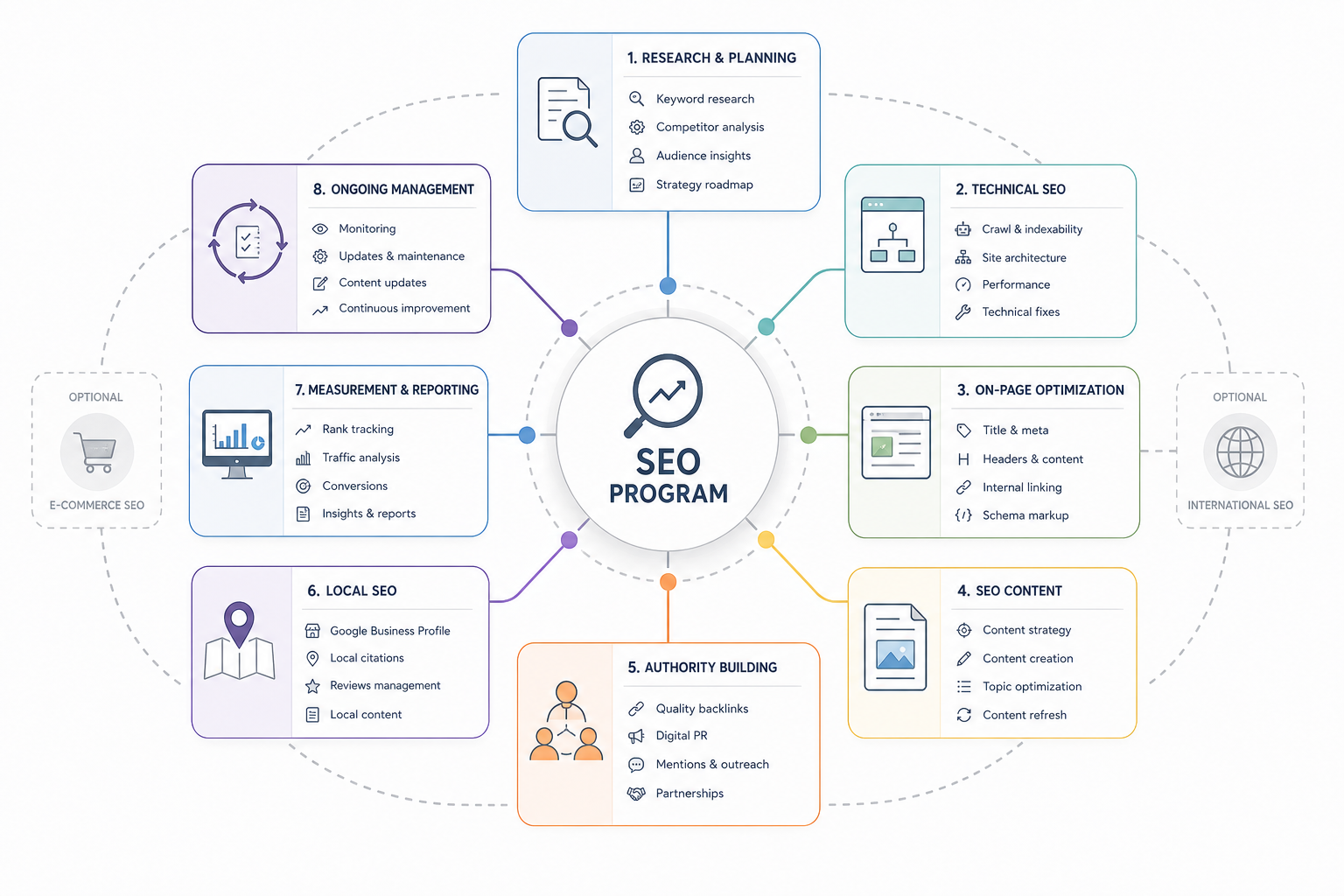
SEO marketing services package the research, recommendations, optimization work, implementation support, and reporting required to execute an organic-search program.
The exact scope varies according to the website, business objectives, competitive environment, internal resources, and engagement model.
Common SEO marketing services include:
- SEO research and planning
- Keyword research
- Search-intent analysis
- Competitor analysis
- Topic mapping
- Page opportunity mapping
- SEO roadmaps
- Prioritization plans
- Technical SEO
- Technical SEO audits
- Crawl and indexation analysis
- Architecture recommendations
- Redirect and canonical reviews
- Migration support
- Performance analysis
- Development requirements
- Technical implementation guidance
- On-page and website optimization
- Page recommendations
- Title and heading improvements
- URL recommendations
- Internal-linking improvements
- Metadata recommendations
- Page-level optimization
- Search-intent alignment
- SEO content
- Content briefs
- New organic-search pages
- Blog articles
- Guides
- Commercial landing pages
- Existing-content refreshes
- Content-gap analysis
- Topic roadmaps
- Content consolidation recommendations
- Authority building
- Backlink opportunity research
- Digital PR
- Outreach
- Linkable-asset planning
- Original research
- Relevant partnerships
- Other external authority initiatives
- Local SEO
- Local landing-page optimization
- Business-profile optimization
- Citation management
- Review support
- Local rank tracking
- Location visibility analysis
- Measurement and reporting
- Organic-performance dashboards
- Keyword tracking
- Visibility reporting
- Traffic reporting
- Conversion reporting
- Progress summaries
- Opportunity analysis
- Prioritized next actions
- Ongoing SEO management
- Monitoring
- Issue investigation
- Content maintenance
- Technical follow-up
- SEO testing
- Roadmap updates
- Performance reviews
- Cross-team coordination were included
Not every SEO marketing service includes every deliverable.
Some engagements focus on one defined problem, such as a technical audit, migration, content strategy, or backlink analysis. Others operate as ongoing retainers covering research, content, technical SEO, authority, reporting, and implementation support.
A useful SEO marketing service provides clearly defined deliverables connected with the business’s organic-search priorities and measurable outcomes, rather than presenting a long list of disconnected SEO activities.
Need links on real SaaS and business websites?
Links are placed after your approval, on sites with guaranteed DR and traffic, with a 1-year replacement guarantee.

