
SEO Keyword Research: Process, Analysis, Mapping, Tools & Usage
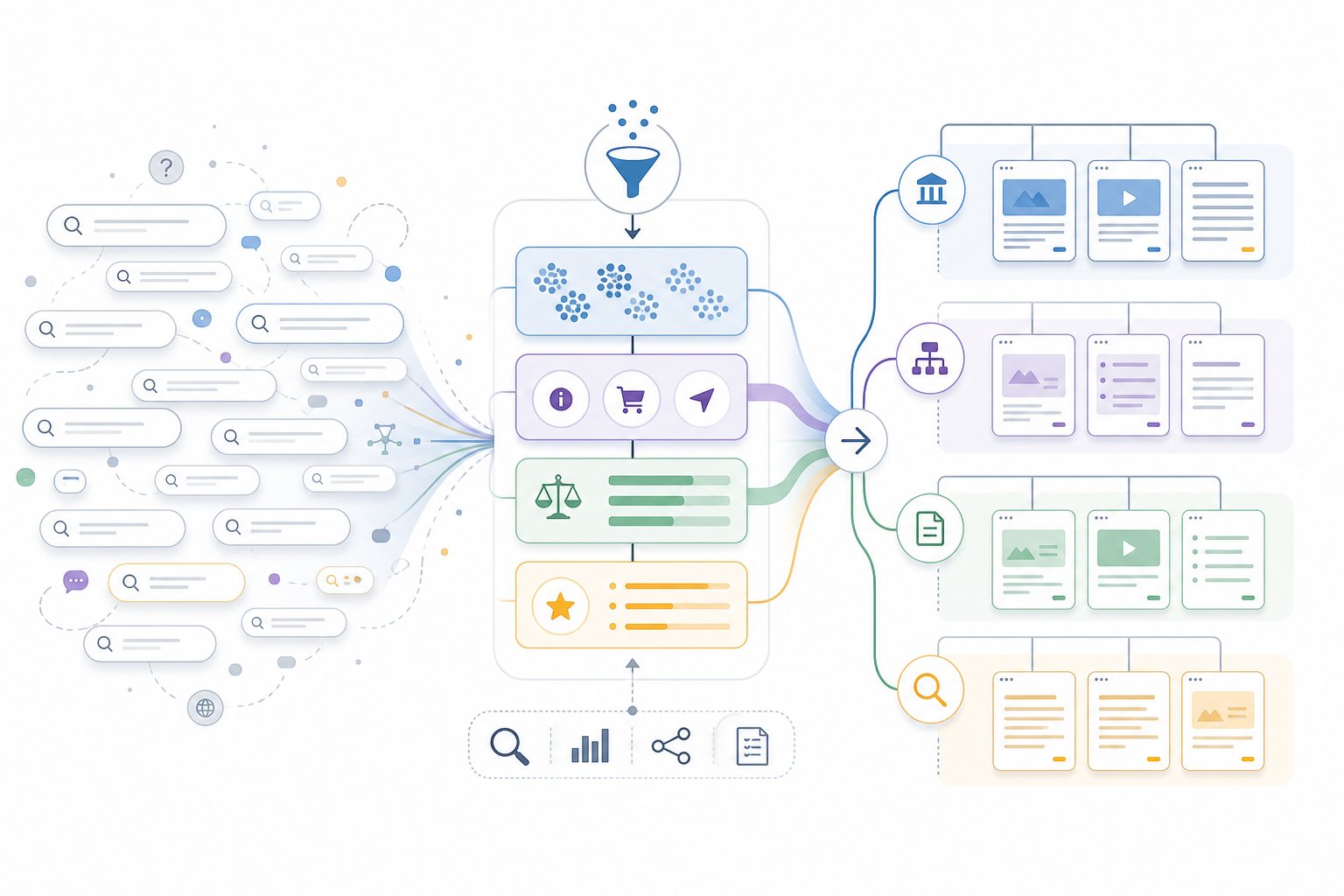
SEO Keyword research is the process of discovering, analyzing, and prioritizing the words and phrases people use when searching for information, products, services, or solutions. It connects audience search demand with the topics, pages, and content a website targets through SEO.
People use different queries depending on what they want to learn, compare, find, or purchase. Keyword research identifies those queries and determines which ones align with a website’s audience, expertise, products, services, and business goals.
Effective keyword research goes beyond finding terms with high search volume. A useful keyword opportunity combines relevant search demand, clear search intent, topical relevance, realistic ranking potential, traffic potential, and business value.
For example, a high-volume keyword has limited SEO value when the search intent does not match the website or when the topic has little connection with the business. A lower-volume keyword can carry greater value when it represents a specific problem, product requirement, or buying decision.
Keyword research also guides content planning. Related queries reveal which topics belong together, which searches fit the same page, where new pages are required, and where existing content requires optimization.
The research process starts with broad topics and gradually narrows them into prioritized SEO targets. It involves discovering possible search terms, analyzing their value and competition, selecting the strongest opportunities, grouping related keywords, assigning them to appropriate pages, and recording the final decisions.
Keyword research tools provide data for discovery, search demand, competitor analysis, keyword difficulty, SERP research, and trends. These metrics support decision-making, but they do not replace search-intent analysis, direct SERP evaluation, topical relevance, or business judgment.
Once the right keywords are selected, they inform how pages are created and optimized. The selected terms help clarify page topics, heading structure, content coverage, internal-link relationships, titles, URLs, metadata, and supporting information.
The first step is understanding how the complete keyword research process works.
How Do You Do Keyword Research?
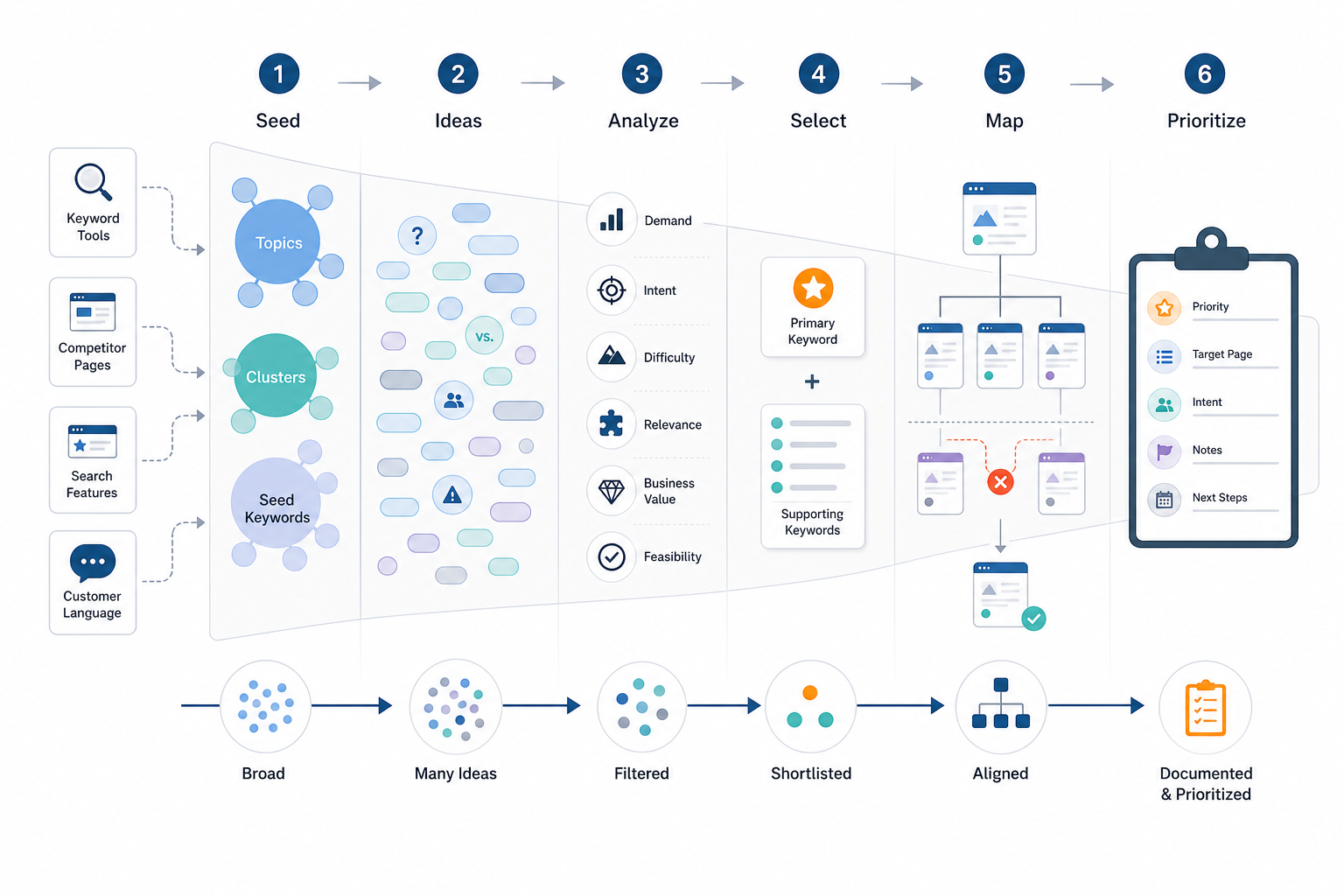
Keyword research is a structured process of defining relevant topics, discovering search terms, evaluating opportunities, selecting target keywords, mapping them to pages, and documenting the final decisions.
The process turns a broad collection of possible queries into a smaller set of relevant, valuable, and realistic SEO opportunities.
1. Define Topics and Seed Keywords
Start by identifying the subjects directly connected with the website.
These subjects include:
- Products
- Services
- Audience problems
- Customer questions
- Solutions
- Features
- Use cases
- Industry topics
- Business categories
Convert these broad subjects into seed keywords.
Seed keywords are broad terms used as starting points for keyword discovery. They represent the basic language people use to describe a topic.
For example, a CRM software company can begin with terms such as:
- CRM software
- Sales CRM
- Lead management
- Contact management
- Sales pipeline
- Sales automation
These terms establish the initial topic space. They are not automatically the final keywords the website targets.
2. Discover Keyword Ideas
Expand seed keywords into a broader candidate set.
Look for:
- Related queries
- Long-tail keywords
- Questions
- Comparison searches
- Product or service variations
- Feature-related queries
- Problem-based searches
- Audience-specific searches
- Use-case queries
- Related topics
Keyword tools, competitor rankings, Google search features, customer language, and existing search data all contribute ideas.
The purpose of this stage is discovery rather than selection. Build a sufficiently complete set of relevant opportunities before deciding which terms deserve priority.
3. Analyze Keyword Opportunities
Evaluate each relevant keyword using consistent criteria.
Important factors include:
- Search volume
- Search intent
- Keyword difficulty
- Traffic potential
- Topical relevance
- Business value
- Ranking feasibility
Search volume indicates demand, but demand alone does not establish value.
A keyword with 10,000 monthly searches can be less valuable than a keyword with 500 searches when the smaller keyword has stronger commercial intent and closer relevance to the business.
The actual search results also reveal important information. Review which page types rank, how strong the competitors are, which SERP features appear, and whether the query has one clear intent or several competing intents.
4. Choose Target Keywords
Prioritize keywords that combine relevance, demand, intent, business value, and realistic ranking potential.
Separate the primary keyword from supporting queries.
The primary keyword represents the page’s central search topic. Supporting keywords expand that topic through related questions, attributes, variations, and subtopics.
Closely related terms that represent the same search intent generally belong on the same page.
For example:
- project management software
- software for project management
- project management platform
These queries can represent substantially the same underlying search need.
Creating separate pages only because the wording changes creates unnecessary overlap.
5. Map Keywords to Pages and Topics
Assign each selected keyword group to an appropriate existing or planned page.
Keyword mapping determines:
- Which existing pages require optimization
- Which opportunities require new pages
- Which keywords belong together
- Which topics require supporting content
- Where multiple pages overlap
- How pages connect through internal links
Each important page requires a clear primary purpose.
When several URLs target substantially the same topic and search intent, they can compete with one another rather than strengthen the site’s overall coverage.
Keyword mapping prevents this overlap and creates a clearer relationship between search demand and website architecture.
6. Document and Prioritize the Research
Record the final research in a structured document.
Include:
- Target keywords
- Keyword groups
- Search intent
- Search volume
- Competition or difficulty
- Business value
- Target page
- Priority
- Recommended action
The final document must explain what the opportunity is, why it matters, where it belongs, and what action follows.
A raw export from a keyword tool only contains data. A complete keyword research document converts that data into SEO decisions.
The detailed research begins with discovering a sufficiently complete set of keyword ideas.
How Do You Find Keyword Ideas?
Keyword ideas are found by expanding broad seed topics through keyword research tools, competitor data, search-engine features, and audience language.
Several sources contribute useful keyword opportunities.
- Use keyword research tools
- Enter broad seed terms into keyword research platforms.
- Review related terms, questions, phrase variations, modifiers, and long-tail searches.
- Expand one broad subject into multiple dimensions of audience demand.
- Analyze competitor keywords
- Identify websites and pages already ranking within the same search market.
- Review the queries generating their organic visibility.
- Look for recurring topics across several relevant competitors.
- Separate organic-search competitors from direct business competitors because the two groups are not always identical.
- Find keyword and content gaps
- Compare competitor rankings with the website’s existing keyword coverage.
- Identify relevant topics competitors address that the website does not.
- Focus only on gaps connected with the website’s audience, expertise, products, or services.
- Review search suggestions
- Examine query variations and extensions associated with broad topics.
- Look for modifiers related to audiences, features, problems, locations, industries, comparisons, and use cases.
- Use these variations to expand the candidate keyword set rather than automatically treating each variation as a separate page target.
- Review related questions and searches
- Examine questions and related topics visible around relevant search results.
- Use them to identify supporting questions, concepts, and subtopics.
- Determine whether each question belongs within an existing topic or represents a distinct search intent.
Audience language also provides valuable keyword ideas. Customer interviews, sales conversations, support tickets, product reviews, community discussions, and internal site searches reveal how people describe problems in their own words.
Keyword discovery creates a set of possible opportunities. Keyword analysis determines which opportunities deserve further attention.
How Do You Analyze Keywords for SEO?
How Do You Analyze Keywords for SEO?
Keyword analysis for SEO is the evaluation of discovered search terms according to relevance, demand, intent, competition, ranking feasibility, traffic potential, and business value.
This keyword-level evaluation forms part of broader SEO Analysis, where search performance and optimization opportunities are examined across pages and websites.
The same core factors can be evaluated across each candidate keyword.
| Evaluation Factor | What It Measures | How It Affects the Decision |
|---|---|---|
| Search Volume | Estimated search demand for the query | Indicates potential audience size |
| Keyword Difficulty | Estimated organic ranking competition | Helps assess the level of competitive effort |
| Traffic Potential | Potential traffic available across the broader topic | Shows that a page can attract searches beyond one exact keyword |
| Search Intent | The objective behind the query | Determines the page type and information required |
| Topical Relevance | How closely the query relates to the website | Prevents irrelevant traffic from becoming an SEO priority |
| Business Value | Connection with leads, sales, awareness, sign-ups, or other goals | Determines the commercial or strategic importance of the query |
| Ranking Feasibility | The website’s ability to compete with current ranking pages | Helps distinguish realistic opportunities from highly difficult targets |
No individual metric provides a complete decision.
Search volume measures estimated demand rather than guaranteed traffic. A ranking page can appear for many related queries, so the total traffic opportunity often extends beyond the volume of one keyword.
Keyword difficulty provides a comparative estimate of ranking competition. Different SEO platforms calculate difficulty differently, so the metric functions as a reference point rather than an absolute measure of how Google ranks pages.
Direct SERP analysis adds information that keyword metrics cannot provide.
Check the following factors:
- Ranking page types: Identify whether guides, product pages, category pages, service pages, tools, videos, or other formats dominate the results.
- Competitor strength: Review the authority, topical depth, relevance, content quality, and backlink strength of existing results.
- SERP features: Identify elements such as AI Overviews, featured snippets, People Also Ask, local results, videos, shopping results, and other search features.
- Intent consistency: Determine whether the ranking pages serve one dominant user objective or several different intents.
- Topic scope: Determine whether the search results favor a focused answer or a broader page covering the parent topic.
The strongest keyword opportunities combine meaningful demand with strong relevance, compatible intent, realistic competitive conditions, and clear business value.
That analysis provides the evidence required to select the final target keywords.
How Do You Choose the Right Keywords for SEO?
Choosing the right keywords means selecting terms that match audience demand, align with the website’s topic and goals, and offer a realistic opportunity to rank.
Evaluate each keyword against several selection criteria.
- Match search intent
- Confirm that the planned page satisfies the goal behind the query.
- Identify whether the intent is informational, navigational, commercial, transactional, local, or another relevant type.
- Compare the intended page format with the types of pages already appearing in search results.
- Check topical relevance
- Confirm that the keyword relates directly to the website’s products, services, expertise, audience, or established topics.
- Avoid targeting terms solely because they have large search volumes.
- Evaluate search demand
- Review search volume and broader topic demand.
- Consider regional and seasonal patterns where relevant.
- Treat demand as one selection factor rather than the primary decision rule.
- Assess business value
- Determine whether the query contributes to a defined objective.
- Relevant outcomes include awareness, qualified traffic, product discovery, leads, sign-ups, purchases, or revenue.
- Commercially meaningful keywords can justify priority even when their volume is lower.
- Check difficulty and competition
- Evaluate the existing ranking pages.
- Compare their content quality, topical coverage, authority, and backlink strength with the website’s current position.
- Prioritize opportunities where the website has a realistic path to competitiveness.
- Consider long-tail keywords
- Include specific searches with lower volume when they represent clearer intent or stronger business relevance.
- Long-tail queries often expose distinct problems, audiences, features, industries, and use cases.
- Maintain a balanced keyword portfolio
- Combine broader topics with specific opportunities.
- Include informational terms that build topical coverage and commercial terms connected with business outcomes.
- Balance achievable near-term opportunities with competitive long-term targets.
The right keyword is not automatically the term with the highest volume or lowest difficulty. Strong target keywords balance intent, topical relevance, demand, business value, and ranking feasibility.
Selected keywords then require structured documentation.
What Should a Keyword Research Report Include?
A keyword research report is a structured record of research findings, selected keywords, supporting metrics, search intent, topic groups, page mappings, competitive insights, priorities, and recommended actions.
The keyword research report can also contribute to a broader SEO report by documenting the search-demand and keyword decisions behind subsequent SEO activity.
A complete report contains several components.
- Executive summary
- Define the objective of the research.
- Identify the target audience and market.
- Summarize the most important findings.
- Highlight the highest-priority opportunities.
- Identify major gaps or SEO problems.
- Keyword data and metrics
- Include each target keyword.
- Record relevant search-volume estimates.
- Include difficulty or competition data where useful.
- Add traffic-potential information where available.
- Include CPC when paid-search value provides useful commercial context.
- Search intent
- Classify keywords according to their underlying search objective.
- Connect each intent with the type of page required.
- Separate similar-looking queries when the search results indicate different user goals.
- Topic clusters and keyword groups
- Group related keywords according to topic and shared intent.
- Identify primary and supporting terms.
- Determine which queries belong on the same page.
- Page mapping
- Assign groups to existing or proposed URLs.
- Identify new-page opportunities.
- Flag existing pages requiring optimization.
- Identify potential keyword cannibalization.
- Competitor insights
- Record important competitor rankings and keyword gaps.
- Identify subjects where competing websites have stronger coverage.
- Highlight areas where competitor strength affects ranking feasibility.
- Priority and recommended action
- Assign a priority to each opportunity.
- Specify whether the page requires creation, optimization, consolidation, refreshing, monitoring, or deprioritization.
A practical keyword research dataset can use the following structure:
| Keyword | Topic Cluster | Search Intent | Search Volume | Difficulty | Business Value | Target URL | Priority | Recommended Action |
|---|---|---|---|---|---|---|---|---|
| CRM software | CRM | Commercial | — | — | High | /crm-software/ | High | Optimize |
| What is CRM | CRM Basics | Informational | — | — | Medium | /what-is-crm/ | Medium | Create |
| CRM for startups | CRM Use Cases | Commercial | — | — | High | /crm/startups/ | High | Create |
| CRM benefits | CRM Basics | Informational | — | — | Medium | /crm-benefits/ | Medium | Optimize |
The report must remain focused on decisions rather than every metric available inside an SEO platform.
A complete keyword research report makes it clear which keywords matter, why they matter, where they belong, and what action happens next.
What Keyword Research Tools Should You Use?
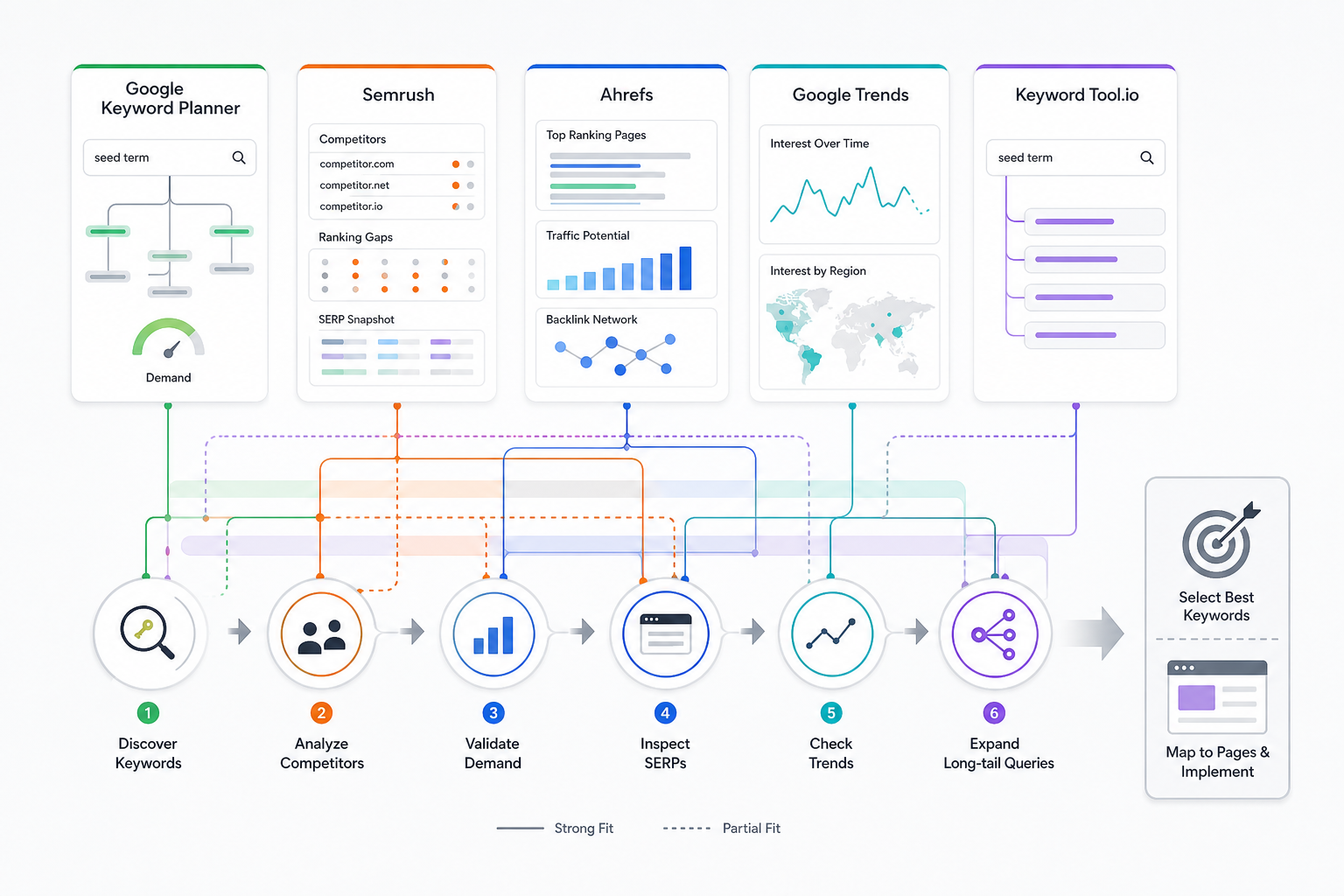
The best keyword research tools depend on which part of the research process requires data, such as keyword discovery, competitor analysis, demand validation, SERP research, trend analysis, or long-tail expansion.
Keyword research platforms form one part of the broader set of SEO Tools used for research, analysis, optimization, monitoring, and measurement.
Different platforms provide different datasets and competitive metrics.
| Tool | Best For | Key Capability | When to Use It |
|---|---|---|---|
| Google Keyword Planner | Keyword discovery and demand estimates | Generates related keyword ideas and approximate search-demand data | Early discovery and market exploration |
| Semrush | Competitive keyword analysis | Provides keyword data, competitor rankings, gaps, difficulty estimates, and SERP information | Discovery, competitive analysis, and prioritization |
| Ahrefs | Organic opportunity analysis | Provides keyword ideas, traffic potential, ranking-page data, backlinks, and competitor visibility | Keyword analysis and ranking-feasibility research |
| Google Trends | Search-interest trends | Shows relative interest, seasonality, geographic patterns, and changing demand | Trend and market validation |
| Keyword Tool.io | Long-tail query expansion | Expands seed terms using autocomplete-based variations | Early keyword discovery |
Google Keyword Planner
Google Keyword Planner helps expand broad seed terms into related searches and provides demand estimates.
It works well during early-stage research where the objective is to understand how a market describes products, services, problems, or categories.
Its competition data relates primarily to paid advertising activity rather than organic ranking difficulty, so organic competition requires separate evaluation.
Semrush
Semrush combines keyword research with competitive analysis.
It helps identify:
- Keyword ideas
- Search-demand estimates
- Keyword difficulty
- Search intent
- Competitor rankings
- Keyword gaps
- Ranking URLs
- SERP characteristics
Its competitive data becomes especially useful when the research question moves from “What do people search for?” to “Which competitors already capture this demand?”
Ahrefs
Ahrefs provides keyword data together with ranking-page, traffic, competitor, and backlink information.
Its broader traffic-potential analysis helps evaluate a topic beyond the exact monthly volume of one search term.
This context becomes useful when one page can rank for a large collection of semantically related queries.
Google Trends
Google Trends helps identify how search interest changes across time and geography.
It is useful for:
- Seasonality
- Emerging topics
- Declining demand
- Regional differences
- Comparing search interest
- Identifying changing terminology
Trend data represents relative interest rather than an absolute monthly search-volume count, so it serves a different role from traditional keyword-volume metrics.
Keyword Tool.io
Keyword Tool.io expands seed terms into autocomplete-based query variations.
It works primarily as an ideation source for:
- Long-tail terms
- Questions
- Modifiers
- Product variations
- Audience-specific searches
The resulting ideas still require analysis before becoming SEO targets.
No single platform provides every input required for keyword research.
Tool data becomes most useful when combined with direct search-result analysis, audience understanding, topical relevance, competitive feasibility, and business objectives.
Once the research process identifies and validates the strongest opportunities, the selected keywords move into page-level SEO implementation.
How Do You Use Keywords for SEO?
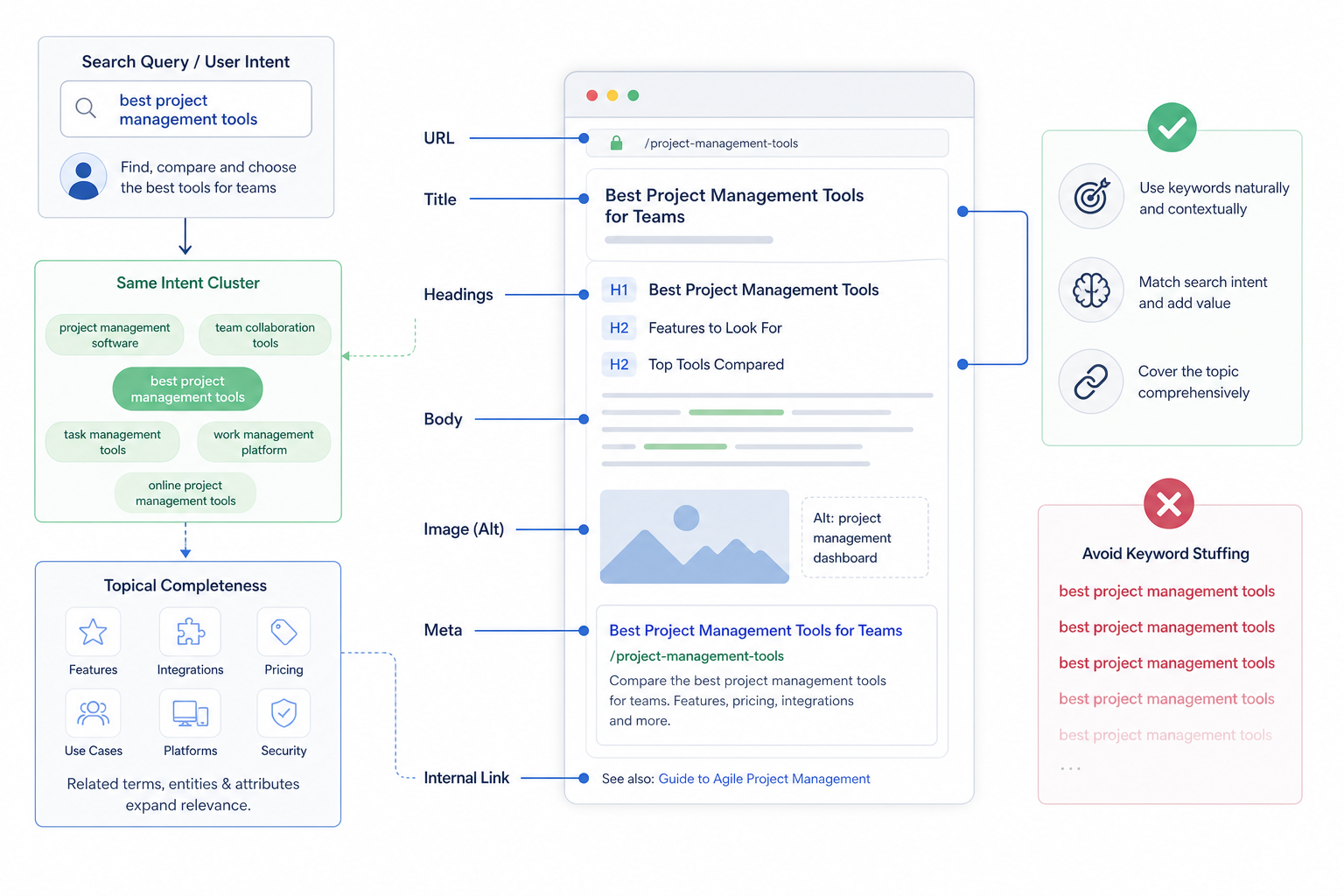
Keywords are used to connect a webpage’s topic and purpose with the language users enter into search engines.
Effective keyword usage starts with relevance and search intent rather than repetition.
- Select the primary keyword
- Choose the query that best represents the page’s central topic and intended search purpose.
- Keep the page focused on one coherent subject instead of combining unrelated keyword targets.
- Add supporting keywords
- Include secondary queries, related phrases, synonyms, entities, attributes, and concepts where they expand the central topic.
- Keep supporting terms directly connected with the page’s purpose.
- Group terms that represent the same search intent rather than creating unnecessary pages.
- Use relevant terms in the URL and title
- Create a concise URL that accurately communicates the page topic.
- Use the central topic naturally in the page title where it accurately describes the content.
- Avoid repeating keyword variations solely for optimization.
- Use relevant terms in headings
- Use H2 and H3 headings for genuine subtopics, questions, attributes, or processes.
- Include related keyword language when it accurately describes the information inside the section.
- Keep each heading aligned with the contextual focus of the content beneath it.
- Use keywords naturally in body content
- Establish the central subject early.
- Use primary and supporting terminology where the explanation requires it.
- Include related entities and attributes when they increase topical completeness.
- Prioritize clarity and information value over exact-match repetition.
- Use keywords in metadata
- Write a title that represents the page accurately.
- Use the meta description to summarize the page and communicate its relevance to the searcher.
- Include important terminology naturally rather than filling metadata with keyword variations.
- Use keywords in image context
- Write alt text that accurately describes the image.
- Include relevant terminology only when it genuinely describes the visual content.
- Avoid placing keyword lists inside alt attributes.
- Use keywords in internal links
- Write descriptive anchor text that communicates the subject of the destination page.
- Use surrounding text to establish why the linked resource relates to the current topic.
- Connect pages according to real topical relationships.
Keyword density does not provide a useful fixed target for SEO writing. Repeating a phrase a predetermined number of times does not make a page more complete or relevant.
Strong topical optimization comes from explaining the subject accurately. Complete explanations naturally introduce the relevant entities, attributes, terminology, questions, relationships, and supporting concepts associated with the topic.
Effective keyword usage therefore means using relevant search language wherever it naturally clarifies the page’s topic, search intent, information structure, and relationships with other content.
Need links on real SaaS and business websites?
Links are placed after your approval, on sites with guaranteed DR and traffic, with a 1-year replacement guarantee.

