
Programmatic SEO: Process, Examples, Implementation, Automation, Tools & Services
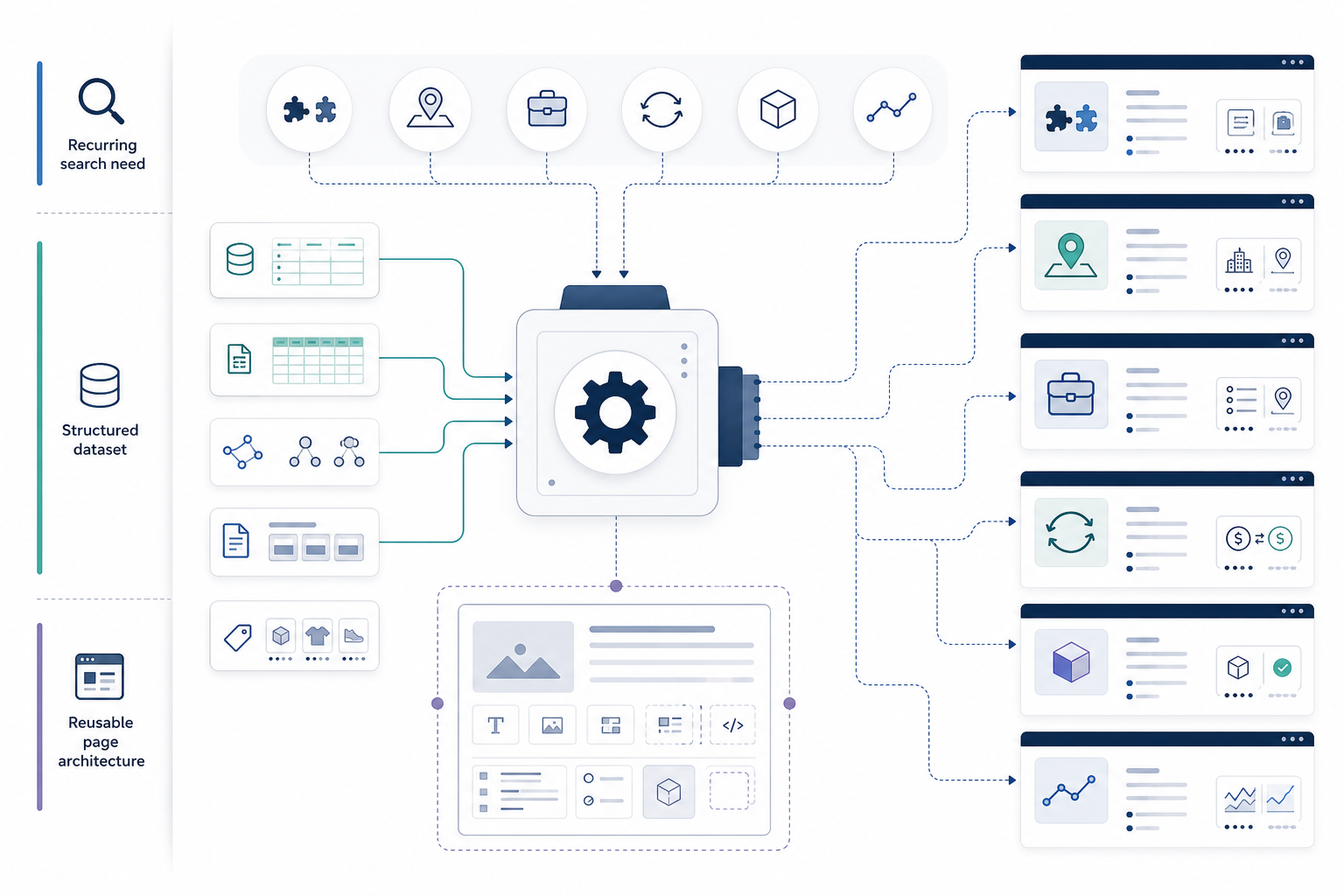
Programmatic SEO is the systematic creation and maintenance of search-focused page families using repeatable search needs, structured data, reusable page logic, and automated or semi-automated production. Instead of building every page independently, programmatic SEO creates a system that can produce multiple useful pages from changing entities, attributes, relationships, or data records.
The word programmatic refers to the repeatable production system behind the pages. That system can use databases, APIs, product catalogs, CMS fields, spreadsheets, reusable components, conditional rules, templates, and automation. Automation helps execute the system, but programmatic SEO is not simply another name for automated SEO.
The SEO component comes from connecting that repeatable production system to genuine organic search demand. A website can generate thousands of database-driven pages without using programmatic SEO. It becomes a programmatic SEO system when those page families are deliberately structured around recurring user needs that deserve distinct search destinations.
The scalable unit is usually not an exact keyword. It is a repeatable relationship such as:
- Software and integration
- Service and location
- Job and city
- Currency and currency
- Product and compatibility
- Entity and metric
For example, an integration page family can use the same broad structure while changing the two software products, their supported actions, available triggers, setup options, and related workflows. A currency-conversion family can use the same interface while changing the currencies, rates, historical values, and calculations.
A programmatic page family therefore shares a broad user task and information architecture while changing the facts that matter for each page. The underlying data can come from sources such as product databases, APIs, CMS records, inventory systems, spreadsheets, or proprietary datasets. This structured dataset should not be confused with Schema.org structured-data markup; the dataset supplies the page information, while schema markup is optional machine-readable markup added to eligible pages.
A page system can contain fixed components, such as navigation and shared explanations; variable components, such as prices, locations, products, or ratings; and conditional components that appear only when the relevant data exists. This allows one reusable architecture to handle different data states without forcing every page into identical content.
Every indexable page should still have an independent reason to exist. Meaningful variation can come from inventory, compatibility, calculations, availability, local information, comparisons, live metrics, specifications, or functionality. Simply changing a city, product, or keyword while leaving the underlying answer effectively unchanged does not create a strong programmatic page.
Programmatic SEO can reduce the marginal effort required to create and maintain additional valid pages because improvements to a dataset, template, or rule can affect many page instances. It is defined by repeatability rather than page count; a programmatic system can contain dozens, hundreds, thousands, or millions of URLs depending on the underlying business and data model.
Programmatic SEO is also not synonymous with AI-generated content. AI can assist with classification, transformation, generation, quality assurance, and analysis, but a pSEO system can operate entirely through structured data and deterministic logic. It is not synonymous with faceted navigation, dynamic websites, templates, or mass publishing either.
Programmatic and editorial SEO can coexist. Editorial production is usually better suited to pages requiring original explanation, expert analysis, narrative, or independent research. Programmatic production is better suited to recurring needs where the answer changes systematically with real data.
How Does Programmatic SEO Work?
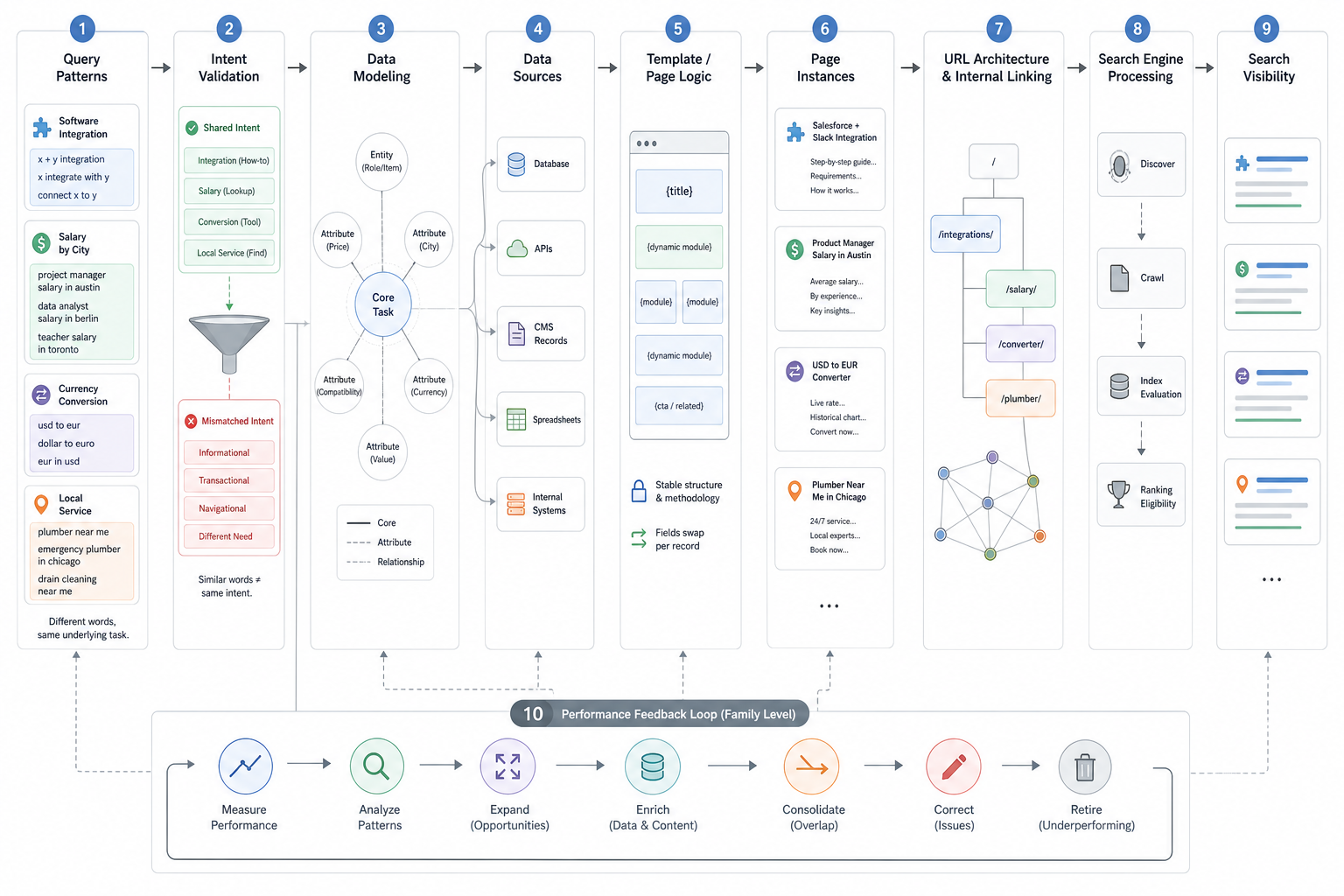
Programmatic SEO works by identifying search needs that repeat around changing entities or attributes, representing those relationships as structured data, and using reusable page logic to produce useful individual pages. Search engines then discover, crawl, evaluate, index, and potentially rank those pages through the same search processes applied to other webpages.
1. Identify a Repeatable Search Need
Many different queries can represent the same underlying task.
Examples include:
- Slack Trello integration
- HubSpot Salesforce integration
- UX designer salary in Chicago
- Accountant salary in Boston
- EUR to USD
- GBP to INR
- Dentist in Austin
- Dentist in Dallas
The words change, but the underlying task remains stable.
2. Confirm That the Search Intent Is Actually Shared
Repeated wording alone is not enough.
The queries should generally require a similar:
- Answer structure
- Data type
- User task
- Functionality
- Decision experience
For example, “Slack Trello integration” and “Slack vs Trello” mention the same products but represent different needs. One asks about connection or workflow capability; the other asks for a comparison.
They should therefore not be forced into the same page family.
3. Identify the Entities, Attributes, and Relationships
Determine what stays constant and what changes.
For an integration family:
- The stable task is understanding whether two software products work together.
- Product A changes.
- Product B changes.
- Supported triggers change.
- Available actions change.
- Setup options change.
For a salary family:
- Job role changes.
- Location changes.
- Salary data changes.
- Experience distribution can change.
- Sample size can change.
The page should be generated from the real relationship rather than from a keyword string.
4. Connect the Model to Structured Data
The changing information needs a reliable source.
Common sources include:
- Product databases
- APIs
- CMS records
- Catalogs
- Spreadsheets
- Internal applications
- Licensed datasets
The dataset becomes the factual input for individual page instances.
5. Apply Reusable Page Logic
The page system defines which parts remain common and which parts change.
For example, a salary page can share:
- Page layout
- Salary chart format
- Methodology module
- Related-role navigation
while changing:
- Role
- City
- Median salary
- Salary range
- Experience data
- Sample size
The template should model the repeated user task rather than merely provide fields for inserting keywords.
6. Produce Page-Specific Utility
Each valid record should change the answer in a useful way.
Useful differences can include:
- Current inventory
- Actual pricing
- Product compatibility
- Local availability
- Calculated values
- Ratings
- Comparisons
- Real workflows
- Entity-specific facts
A different URL should represent meaningfully different information or functionality.
7. Give Valid Pages Stable URLs
Each legitimate page instance needs a predictable URL and a sensible position within the website architecture.
For example:
/integrations/slack/trello/
can represent a genuine relationship between Slack and Trello rather than an arbitrary keyword variation.
8. Connect Related Pages
Programmatic pages should participate in normal site navigation.
Examples include:
- App page linking to supported integrations
- City page linking to relevant services
- Category page linking to products
- Job role linking to location-specific salary pages
These relationships help users navigate the dataset and help crawlers discover pages.
9. Let Search Engines Process the Pages Normally
Programmatic pages do not receive a special ranking mechanism.
The normal process still applies:
- Discovery
- Crawling
- Rendering where required
- Index evaluation
- Ranking eligibility
- Search visibility
Publishing a page does not guarantee any later stage.
10. Use Performance to Improve the System
Performance should be evaluated at both page and family level.
The data can show whether a family needs to be:
- Expanded
- Enriched
- Consolidated
- Corrected
- Retired
The main scaling advantage is that a recurring problem can often be fixed once at the data, template, or logic level rather than patched manually across every URL.
What Are Some Examples of Programmatic SEO?
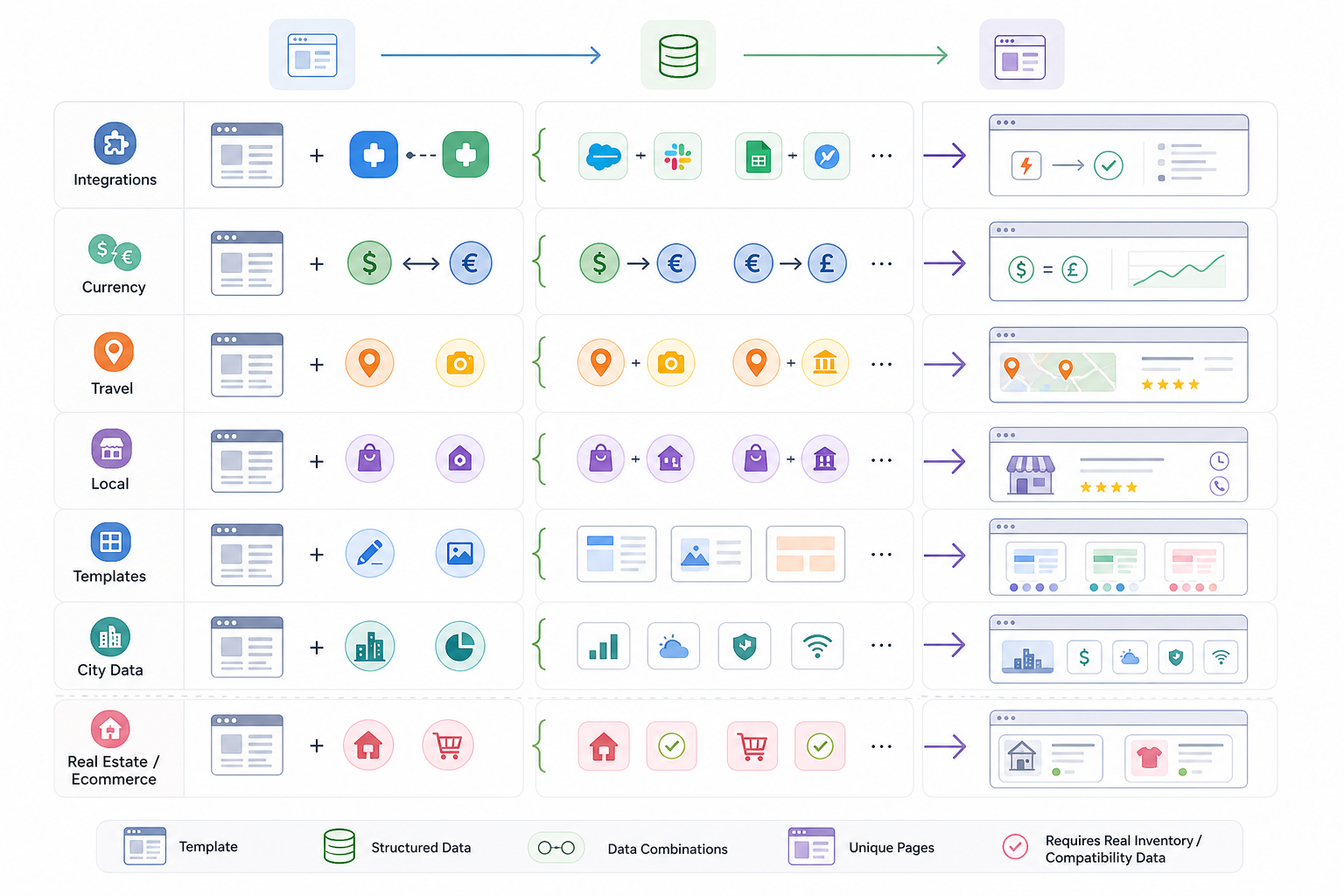
Common programmatic SEO examples include software integration pages, currency-conversion pages, local directories, product collections, template libraries, and data-driven entity profiles. The defining characteristic is not the number of URLs; it is the combination of recurring search demand, structured information, reusable page logic, and meaningfully different outputs.
| Example | Search Pattern | Structured Information | Page-Specific Value | Programmatic Pattern |
|---|---|---|---|---|
| Zapier integrations | App A + App B integration | Apps, triggers, actions, workflows | Actual supported integrations | Entity × Entity |
| Wise currency pages | Currency A to Currency B | Currencies, rates, historical data | Live conversion results | Entity × Entity + live data |
| Tripadvisor | Things to do in City | Locations, attractions, ratings, reviews | Local inventory | Location × Category |
| Yelp | Business type in Location | Businesses, categories, geography, reviews | Relevant local listings | Category × Location × Inventory |
| Canva | Design-type templates | Template inventory, styles, formats | Matching assets | Category × Asset Inventory |
| Nomads.com | Cost of living in City | City metrics | Distinct city profile | Entity × Attribute Dataset |
Zapier Integration Pages
Zapier-style integration pages are a clear example of an entity-to-entity programmatic model.
The underlying search need can be:
- Slack Trello integration
- HubSpot Salesforce integration
- Notion Gmail integration
The page system can reuse the broad integration structure while changing:
- Applications
- Supported triggers
- Available actions
- Workflow options
- Integration availability
The page is useful because the actual relationship between the two products changes, not merely because two product names were inserted into a template.
Wise Currency-Conversion Pages
Currency pages demonstrate a programmatic model where functionality and live data create the variation.
A page for USD to EUR and a page for GBP to INR can share the same interface while changing:
- Source currency
- Destination currency
- Exchange rate
- Conversion values
- Historical movement
The value comes from the actual calculation and data.
Tripadvisor Location Pages
Travel directories can systematically combine geography with local inventory.
A city page can expose:
- Attractions
- Ratings
- Reviews
- Categories
- Maps
- Booking availability
The actual entities available in Paris differ from those available in Rome, so the pages provide distinct location-specific information.
Yelp Local Category Pages
A local directory can combine categories and locations.
Examples include:
- Restaurants in Chicago
- Plumbers in Austin
- Coffee shops in Brooklyn
The useful variation comes from real businesses, addresses, ratings, hours, reviews, and services in each location.
Changing only the city name would not create the same value.
Canva Template Pages
Template libraries can organize large asset inventories around repeated design needs.
Examples include:
- Resume templates
- Presentation templates
- Invitation templates
The shared interface can remain stable while the actual templates, styles, categories, formats, and editing options differ.
Nomads.com City Profiles
City-data platforms can generate comparable profiles from consistent metric sets.
A city profile can contain:
- Cost of living
- Rent
- Internet speed
- Weather
- Safety
- Air quality
- Coworking information
The page family is repeatable, while the underlying values change for every city.
Ecommerce Collections
Ecommerce can use programmatic models around legitimate product relationships such as:
- Product type and brand
- Product category and material
- Product and compatible device
- Product category and use case
The combination deserves an indexable page only when real inventory and user demand justify it.
Not every filter permutation should become a search landing page.
Real-Estate Pages
Real-estate marketplaces can create useful page families around combinations such as:
- Property type and location
- Bedrooms and location
- Property status and neighborhood
Actual listings, prices, amenities, availability, and geographic information provide page-specific value.
The strongest programmatic SEO examples therefore scale real relationships and real utility, not merely keyword substitutions.
Who Is Programmatic SEO Best Suited For?
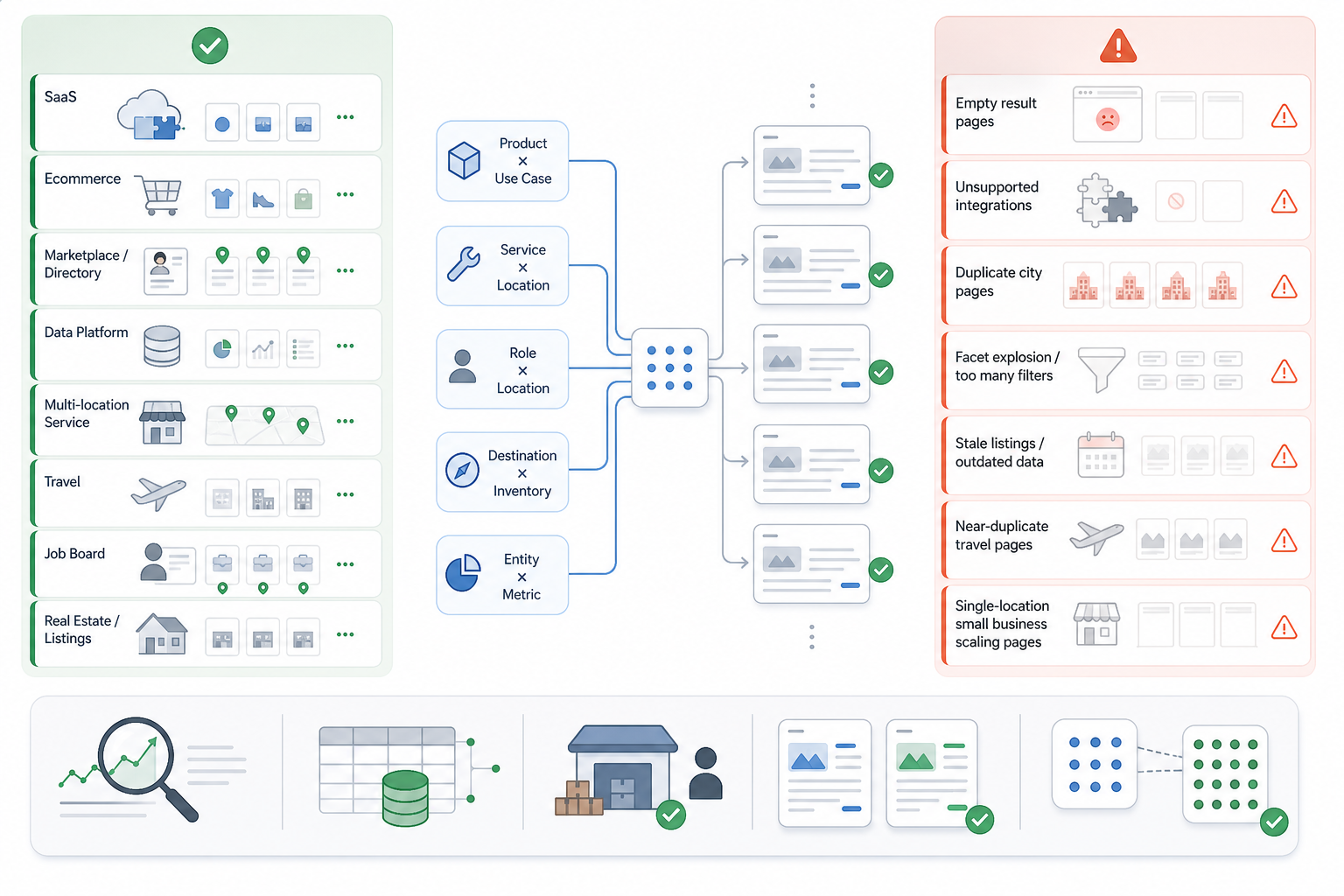
Programmatic SEO is best suited to businesses whose customers repeatedly search across changing entities, attributes, locations, products, or use cases and that have enough structured information to create a useful page for each valid combination. A large dataset alone does not make a business a good candidate.
| Business Type | Typical Pattern | Why It Can Fit | Main Risk |
|---|---|---|---|
| SaaS | App × integration/use case | Real product relationships | Unsupported combinations |
| Ecommerce | Category × attribute/product | Structured catalog and inventory | Facet explosion |
| Marketplace | Category × location/entity | Large live dataset | Empty result pages |
| Multi-location service | Service × location | Genuine local operations | Doorway pages |
| Data platform | Entity × metric | Distinct data records | Stale data |
| Travel | Destination × inventory | Geographic and inventory data | Near-duplicate pages |
| Job board | Role × location | Current jobs | Empty/stale results |
| Real estate | Property × location | Live listings | Excessive facets |
| Asset library | Task × asset category | Large structured inventory | Generic collection pages |
SaaS Businesses
Programmatic SEO for SaaS can work well when products contain repeatable relationships involving:
- Integrations
- Use cases
- Roles
- Industries
- Templates
- Comparisons
- Compatibility
Examples include:
- CRM for nonprofits
- CRM for agencies
- HubSpot Salesforce integration
- Product A vs Product B
The strongest opportunities are supported by real product information such as features, integrations, workflows, pricing, API capabilities, or templates.
Do not generate integration pages for integrations that do not exist or comparison pages without meaningful comparison data.
Ecommerce Businesses
Ecommerce already contains structured relationships among:
- Products
- Brands
- Categories
- Materials
- Sizes
- Specifications
- Inventory
- Compatibility
This creates potential page families such as:
- Running shoes for flat feet
- Leather office chairs
- Product compatible with Device
The main risk is turning every filter combination into an indexable page.
A navigation facet should become an SEO landing page only when the combination represents a meaningful search need and sufficiently useful inventory. This is also a core concern in ecommerce SEO, where products, categories, attributes, filters, inventory, and indexable landing pages have to be managed as one connected search system.
Marketplaces and Directories
Directories are natural programmatic candidates because their core product often consists of structured collections of entities.
Examples include:
- Job boards
- Software directories
- Real-estate marketplaces
- Professional directories
- Local business directories
- Course marketplaces
Page-specific value should come from real matching inventory rather than rewritten generic text.
Data Platforms
Data-driven websites can be particularly strong fits because each entity naturally contains different information.
Examples include datasets about:
- Salaries
- Exchange rates
- Weather
- Sports statistics
- Demographics
- Product specifications
- Cost of living
The data itself provides differentiation.
Multi-Location Service Businesses
Location-based programmatic SEO can work when the business genuinely operates across multiple areas and meaningful information changes by location.
Useful differences can include:
- Actual branch
- Local team
- Service radius
- Availability
- Local regulations
- Location-specific pricing
- Local case studies
Simply changing “Delhi” to “Mumbai” in otherwise identical copy is not a sufficient model.
Auto Repair Businesses
Programmatic SEO for auto repair can make sense when genuine relationships exist among:
- Vehicle make
- Vehicle model
- Repair type
- Branch location
- Service requirements
For example, a page about brake replacement for one model should differ because the underlying parts, specifications, requirements, pricing, or servicing information differs.
A single local garage should not manufacture hundreds of vehicle and location pages when every page gives essentially the same answer.
Travel Platforms
Travel businesses can systematically connect:
- Destinations
- Hotels
- Flights
- Routes
- Attractions
- Amenities
- Neighborhoods
Examples include:
- Hotels in Singapore
- Flights from Delhi to Dubai
- Things to do in Bangkok
Real availability, pricing, route data, reviews, and inventory provide the differentiation.
Job Boards
Job platforms can create pages around:
- Job role
- Location
- Remote status
- Skill
For example:
- Product manager jobs in London
- Remote Python jobs
The usefulness comes from current job inventory.
Small Businesses
Programmatic SEO is not reserved for large companies.
A small business can be a valid candidate when it has:
- Multiple genuine locations
- Repeatable product or service combinations
- Structured inventory
- Meaningful page-specific information
- Enough recurring search demand
However, a business with one location and five services may be better served by a small number of carefully built pages.
A Simple Programmatic SEO Fit Test
A business is a stronger candidate when most of these conditions are true:
- Many searches share a repeated task.
- Real entities or attributes change between searches.
- Those entities can be stored reliably.
- Each valid combination changes the answer meaningfully.
- One broad page structure can serve the family.
- Enough valid pages exist to justify automation.
- Pages fit into a sensible site architecture.
- Data can be maintained.
- Search traffic connects to a real user or business outcome.
Programmatic SEO is a weak fit when page variation exists only at the keyword level, every topic requires independent editorial research, the dataset cannot be maintained, or multiple proposed URLs would all answer the same need.
How Does Programmatic SEO Compare With Traditional SEO?
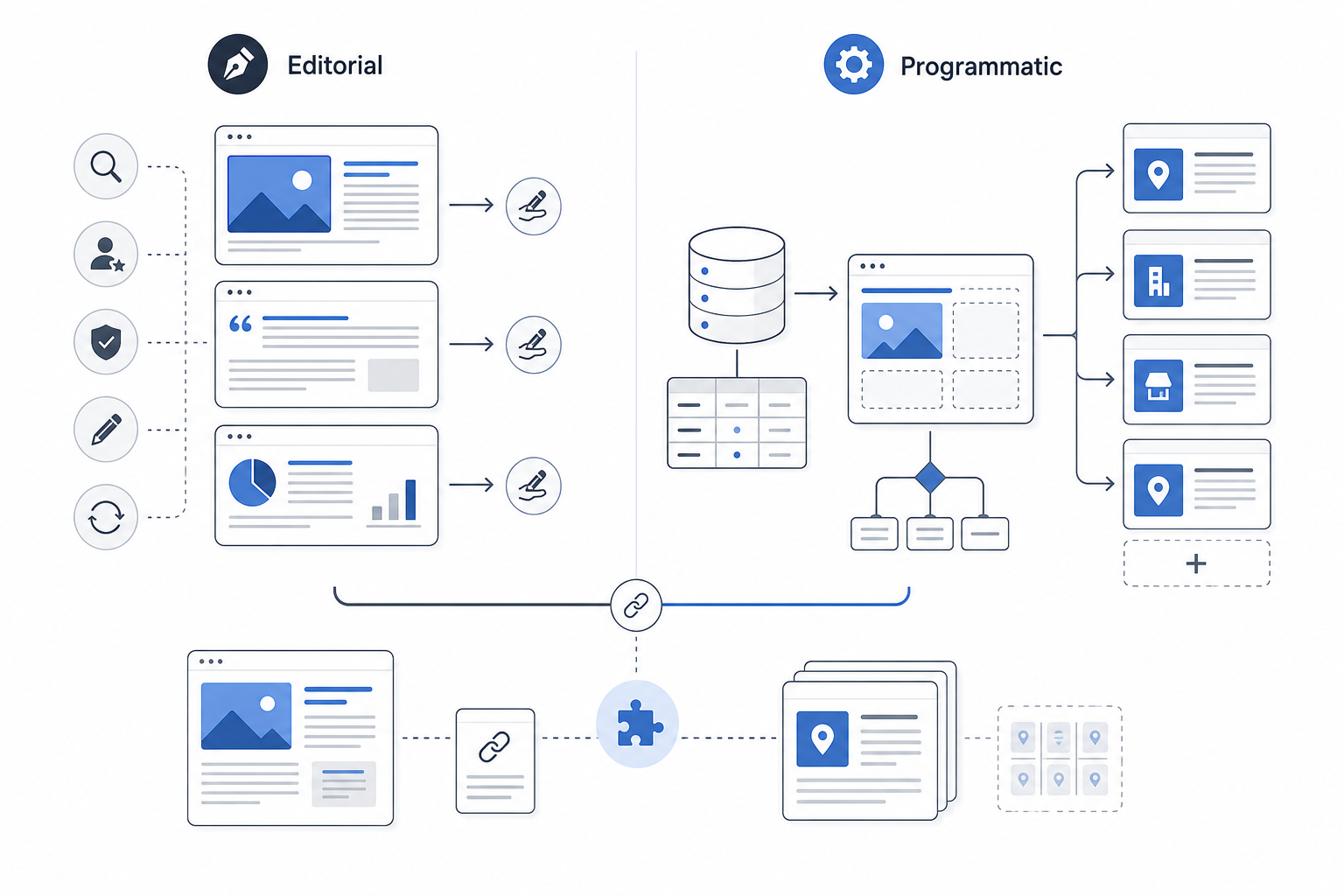
Traditional or editorial SEO generally creates important pages individually through page-specific research and production, while programmatic SEO builds reusable data and page systems that can produce multiple valid pages from recurring search patterns. The two methods are complementary and can operate within the same organic search strategy.
| Attribute | Traditional / Editorial SEO | Programmatic SEO |
|---|---|---|
| Production unit | Individual page or asset | Reusable page system |
| Search pattern | Often bespoke | Repeated intent with changing entities |
| Main input | Research, expertise, evidence | Structured data plus rules |
| Page structure | Can vary substantially | Shared information architecture |
| Variation | Individually produced | Data- or entity-driven |
| Scale | More repeated page-level effort | Lower marginal effort after system build |
| Updates | Often page-by-page | Data/template changes can update many pages |
| Best fit | Explanatory, expert, strategic topics | Repeated entity, location, comparison, or data needs |
| Main risk | High repeated production cost | Weak logic or data multiplied across many pages |
| Search requirements | Useful and technically accessible | Same |
Traditional SEO is usually better when a query requires:
- Deep explanation
- Independent research
- Expert opinion
- Nuanced analysis
- Original narrative
- Thought leadership
Programmatic SEO is stronger when the answer changes predictably with:
- Entity
- Attribute
- Location
- Inventory
- Comparison
- Data record
Programmatic SEO also shifts human judgment upstream. Instead of manually deciding every detail for every page, teams make important decisions about query patterns, data models, templates, conditional rules, page eligibility, and quality controls.
Automation can exist in both approaches. Editorial teams can automate research, reporting, technical checks, or publishing. Programmatic SEO differs because reusable page generation is central to its production architecture.
The economics also differ. Traditional production usually has lower initial system cost but greater repeated page-level effort. Programmatic SEO generally requires more upfront investment in data, engineering, template design, and QA, but additional valid pages can become cheaper to produce and maintain.
A hybrid strategy is often the most practical approach. Editorial content can provide depth around topics requiring expertise, while programmatic pages provide structured coverage for specific recurring needs.
For example, a SaaS company can use editorial SEO for a detailed guide to workflow automation while using programmatic pages for supported application integrations.
How to Implement Programmatic SEO?
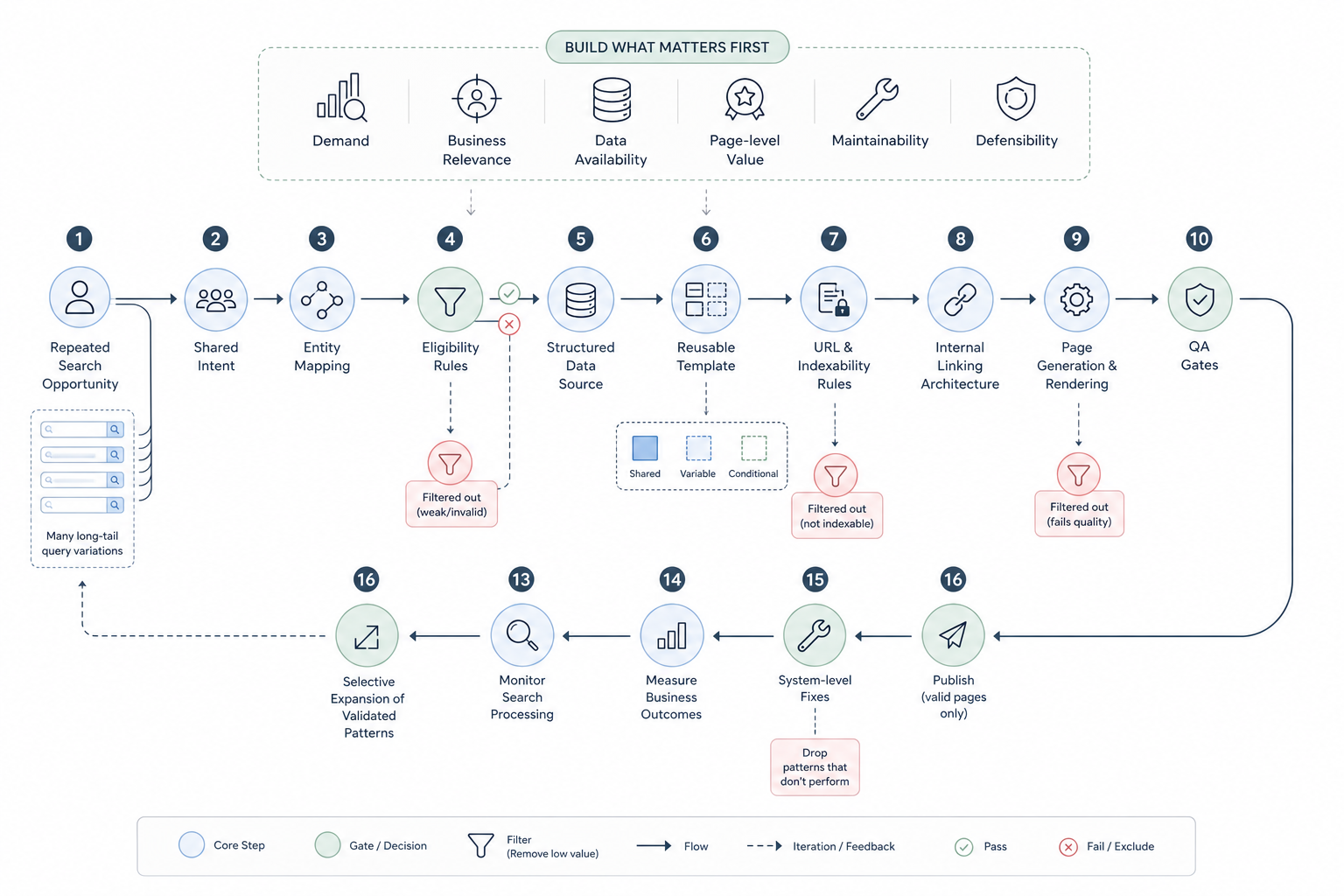
Implementing programmatic SEO means turning a validated repeatable search opportunity into a controlled system of structured data, reusable page logic, site architecture, publishing rules, quality assurance, and measurement. The goal is to build a maintainable page system rather than generate the maximum possible number of URLs.
- Define the repeated user need. Identify the recurring problem, lookup, comparison, transaction, or discovery task the business can genuinely solve.
- Confirm shared intent. Determine whether different query variations can use approximately the same answer structure and page experience.
- Define entities and relationships. Identify what remains constant, what changes, and which combinations are valid.
- Set page-eligibility rules. Require a real relationship, sufficient data, a distinct user need, and meaningfully different output before allowing a URL to become indexable.
- Build the dataset. Organize the required facts in a reliable source such as a database, API, product catalog, CMS, or spreadsheet.
- Design the page model. Separate shared, variable, and conditional modules.
- Define URL and search-state rules. Establish predictable URLs, canonical handling, indexability conditions, and page lifecycle states.
- Build internal architecture. Connect generated pages through meaningful parent, child, category, and related-entity relationships.
- Connect data to generation. Convert valid structured records into rendered page instances.
- Create QA gates. Check required fields, relationships, duplicate states, URLs, rendering, and technical outputs.
- Test representative page states. Include rich-data records, minimum-valid records, category variations, and edge cases.
- Publish valid pages. Do not publish combinations that fail the established usefulness rules.
- Observe search processing. Track discovery, crawling, indexing, impressions, clicks, and query coverage separately.
- Measure business outcomes. Depending on the business, track leads, signups, transactions, bookings, or product usage.
- Fix recurring problems at the system level. Correct data problems in the data layer, template problems in the template, and architectural problems in the architecture.
- Expand only validated patterns. Scale once the family has demonstrated useful output, maintainable operations, and plausible business value.
What's a Good Programmatic SEO Strategy?
A good programmatic SEO strategy identifies which recurring search opportunity is worth systemizing based on search demand, business relevance, data availability, page-level utility, feasibility, maintainability, and defensibility. Strategy determines what should be built and why; implementation determines how it will be built. A broader SEO strategy provides the search, business, technical, content, authority, and measurement framework within which the programmatic page system operates.
A useful strategy evaluates:
- Business goal: Leads, purchases, signups, bookings, product usage, or another meaningful outcome.
- Search universe: Relevant entities, attributes, relationships, categories, locations, and use cases.
- Repeated intent: Similar user tasks that vary through real entity values.
- Aggregate demand: Combined opportunity across many valid variations.
- Business relevance: Whether solving the search need naturally connects to the product or service.
- Data availability: Whether accurate first-party, public, licensed, inventory, or partner data exists.
- Page-level value: What changes meaningfully from page to page.
- Valid page universe: Which theoretical combinations are actually real and useful.
- Answer format: Whether the need requires a directory, calculator, comparison, profile, inventory, local page, or editorial answer.
- Economics: Strategy, development, data, QA, and maintenance costs compared with expected value.
- Maintainability: Whether the underlying information can remain accurate.
- Defensibility: Whether the system gains an advantage from proprietary data, live inventory, unique functionality, customer reviews, or strong product relationships.
- Page-family priority: Which opportunity should be built first.
- Pilot: Test a representative implementation before maximum expansion.
- Success criteria: Separate search indicators from business outcomes.
- Scale decision: Expand, improve, consolidate, or stop based on evidence.
Do not prioritize a programmatic SEO strategy solely by:
- Search volume
- Keyword difficulty
- CPC
- Theoretical page count
- Competitor page count
The strongest opportunity is the one where search demand, real structured variation, useful output, and business value overlap.
Where Do Long-Tail Keywords Fit Into Programmatic SEO?
Long-tail keywords help reveal specific, repeatable search variations that programmatic SEO can serve systematically, but they are evidence of demand rather than the underlying definition of the page system. A long-tail phrase should not automatically produce a separate URL.
Long-tail queries are primarily associated with lower individual search frequency rather than a specific word count.
Programmatic search spaces often produce many such queries because users combine entities and attributes.
Examples include:
| Query Pattern | Underlying Relationship | Potential Page |
|---|---|---|
| App A + App B integration | Software integrates with software | Integration page |
| Job salary in City | Job has salary in location | Salary page |
| Service in City | Service available in location | Local service page |
| Product for Use Case | Product suitable for need | Collection/use-case page |
| Currency A to Currency B | Currency converts to currency | Conversion page |
| A vs B | Entity compared with entity | Comparison page |
The goal is to identify families, not isolated phrases.
For example:
- Slack Trello integration
- connect Slack to Trello
- Trello Slack automation
- use Trello with Slack
can potentially map to one Slack–Trello integration page because the underlying relationship and user task are the same.
Programmatic SEO keyword research should therefore group queries by:
- Search intent
- Entity
- Attribute
- Relationship
- Expected page format
rather than by shared words alone.
A repeated modifier can reveal a meaningful searchable attribute.
For example:
- CRM for nonprofits
- CRM for agencies
- CRM for real estate
suggests that industry or audience may be an important dimension.
Similarly:
- Slack Jira integration
- Slack Asana integration
- Slack Salesforce integration
reveals a recurring relationship between software entities.
Long-tail status does not mean a query is low competition or highly commercial. A specific informational question can have no purchase intent, while a narrow product query can be strongly transactional.
It is also unnecessary for every valid page to have measurable exact-match volume. Other demand evidence can include:
- Search Console queries
- Internal search
- Customer questions
- Product usage
- Sales conversations
- Marketplace filtering behavior
The important distinction is between an independent need and a supporting variation. Independent needs can justify separate pages; alternate phrasings of the same need usually belong on the same page.
What Are the Best Ways to Scale Programmatic SEO Content?
The safest way to scale programmatic SEO content is to expand a page model that already provides useful results by adding valid entities, richer data, stronger page logic, and adequate QA capacity. Scale should extend the useful system rather than simply increase keyword or URL count.
There are two primary forms of scaling.
Horizontal scaling adds more valid records within the existing model.
Examples include:
- More supported integration pairs
- More legitimate service locations
- More current job-location combinations
- More valid product compatibility relationships
Vertical scaling improves existing pages with richer utility.
Examples include:
- Additional data fields
- Calculations
- Charts
- Comparison dimensions
- Better inventory
- More functionality
Scale therefore does not always mean more URLs. From an SEO content perspective, scaling can also mean improving the usefulness, completeness, and differentiation of existing pages rather than producing additional page instances.
Other important scaling practices include:
- Expanding only reliable datasets.
- Using conditional modules for different data states.
- Creating useful hubs and categories.
- Generating internal links from real entity relationships.
- Keeping minimum page-value requirements in place.
- Increasing automated and human QA capacity alongside output.
- Publishing in controllable cohorts where useful.
- Analyzing performance by page family and template.
- Maintaining creation, updating, consolidation, and retirement rules.
If a page family cannot maintain accurate data, useful differentiation, business relevance, or operational viability, increasing its URL count is not useful scale.
How to Automate Programmatic SEO Workflows?
Programmatic SEO automation connects structured data, validation rules, transformation logic, page templates, publishing systems, QA, and updates so recurring operational tasks can run consistently at scale. Automation should execute defined rules rather than decide which search opportunities deserve to exist.
A practical automation system can include:
- Source of truth: Database, API, CMS, catalog, spreadsheet, or product system.
- Trigger: New record, changed record, scheduled refresh, webhook, manual approval, or batch import.
- Validation: Required fields, valid relationships, duplicates, unsupported combinations, and malformed values.
- Transformation: Normalized names, slugs, calculated values, categories, units, and derived fields.
- Optional enrichment: AI or other processing where language or classification is genuinely needed.
- Page mapping: Valid record values mapped into templates and conditional modules.
- SEO rules: URLs, metadata, canonical state, index state, and sitemap eligibility.
- Publishing state: Draft, review, published, or rejected.
- Automated QA: Missing data, broken pages, duplicate states, technical errors, or incorrect index settings.
- Architecture updates: Hubs, related links, categories, and sitemaps updated when page states change.
- Data synchronization: Existing pages updated when source facts change.
- Retirement logic: Redirect, consolidate, remove, update, or exclude obsolete pages where appropriate.
- Error logging: Failed jobs, malformed records, API failures, and publishing problems captured for review.
Automation and AI should remain separate concepts.
A product price changing in a database and automatically updating a webpage is automation.
An AI model classifying an unstructured product description into categories is AI-assisted automation.
Which Platforms Can You Use for Programmatic SEO?
Programmatic SEO can run on CMS platforms such as WordPress and Webflow, commerce platforms such as Shopify, frameworks such as Next.js, headless systems, or fully custom database-driven applications. There is no universally best programmatic SEO platform; the correct choice depends on data complexity, page volume, update frequency, functionality, team skills, and publishing requirements.
| Platform | Strongest Fit | Main Data Model | Main Advantage | Main Trade-Off |
|---|---|---|---|---|
| WordPress | Editorial + structured landing pages | Posts, pages, CPTs, custom fields | CMS flexibility | Plugin/database complexity |
| Webflow | Design-led structured marketing sites | Collections and items | Visual CMS workflow | Relational/scale constraints |
| Shopify | Commerce-driven pSEO | Products, collections, metafields, metaobjects | Native commerce data | Less natural for unrelated directories |
| Next.js | Complex data products | External database/API + routes | High control | Engineering responsibility |
| Headless CMS | Complex structured publishing | CMS schema + API + frontend | Editorial + frontend flexibility | More architecture |
| Custom application | Marketplaces/data platforms | Production database | Maximum control | Highest engineering ownership |
WordPress
Programmatic SEO on WordPress can work well for:
- Content-heavy sites
- Service-location architectures
- Moderate directories
- Editorial-programmatic hybrids
Structured data can populate custom post types, taxonomies, custom fields, or pages, while templates render the final URLs.
Webflow
Webflow programmatic SEO works well where the model maps cleanly into CMS Collections and the team wants strong visual control.
Potential page families include:
- Industries
- Use cases
- Locations
- Resources
- SaaS landing-page libraries
The main consideration is whether relational complexity and volume fit the current CMS architecture.
Shopify
Programmatic SEO on Shopify is particularly suitable when the search architecture is based on:
- Products
- Collections
- Inventory
- Compatibility
- Materials
- Ingredients
- Commerce attributes
Metafields and metaobjects can extend the native product model.
Do not make every filter state indexable merely because Shopify can expose it.
Next.js
Programmatic SEO with Next.js can suit large or complex systems requiring custom:
- Dynamic routes
- Data fetching
- Rendering
- Calculations
- Search interfaces
- Comparison engines
- Application functionality
The framework gives engineering teams extensive control, but that control does not create an inherent ranking advantage.
Headless or Custom Architecture
A headless or database-driven system can be appropriate where:
- Relationships are complex.
- Updates are frequent.
- Frontend functionality matters.
- Marketers still need structured editorial control.
- Page volumes are very large.
The platform should follow the page and data model rather than dictate it.
Which Programmatic SEO Best Practices Should You Follow?
The most important programmatic SEO best practices are to create pages only for legitimate user needs, use reliable data, ensure each indexable URL provides meaningful value, maintain clean technical architecture, test the system before expansion, and continuously manage the page lifecycle. Programmatic scale should multiply useful pages rather than keyword variations.
Search and Intent
- Validate a real recurring search need before building a family.
- Group queries by intent rather than shared words alone.
- Review SERPs as evidence of expected page format.
- Do not create a URL for every keyword variation.
- Separate measurable search demand from page eligibility.
- Do not assume long-tail queries are easy.
Data and Page Value
- Model real entities, attributes, and relationships.
- Generate only valid combinations.
- Define what makes each page useful before scaling.
- Maintain an authoritative source of truth.
- Validate accuracy, completeness, freshness, and duplication.
- Refresh changing fields such as inventory, jobs, prices, rates, integrations, and availability.
- Use proprietary data when it adds value, but do not treat it as mandatory.
- Respect licensing and data-use rights.
Templates and Content
- Build templates around the repeated user task.
- Separate fixed, variable, and conditional components.
- Prioritize information difference over wording difference.
- Do not add generated introductions or FAQs simply to increase word count.
- Use AI only where it improves explanation, classification, or presentation.
- Never fabricate product capabilities, statistics, reviews, location facts, or prices.
- Use human review according to risk and data uncertainty.
Technical Architecture
- Create predictable URLs based on real entities.
- Prevent uncontrolled faceted-URL expansion.
- Use canonicalization for genuinely equivalent URLs rather than as a rescue mechanism for weak page families.
- Keep canonical, indexation, and crawling controls conceptually separate.
- Make important pages discoverable through normal crawlable internal links.
- Generate internal links from real relationships.
- Build useful parent and hub pages.
- Avoid orphaned page populations.
- Keep XML sitemaps synchronized with preferred indexable URLs.
- Remember that a sitemap helps discovery but does not guarantee indexing.
- Keep discovery, crawling, indexing, and ranking separate.
- Test rendered content.
- Use correct HTTP status codes.
- Define how empty result pages should behave.
- Avoid doorway-style location or query pages.
- Avoid scaled content created mainly to manipulate rankings.
QA and Publishing
- Validate required fields before page generation.
- Reject invalid relationships.
- Test representative high-data, low-data, and edge-case records.
- Crawl representative output before broad expansion.
- Publish in cohorts where that makes operational sense.
- Do not invent universal publishing limits such as 50 pages per day.
- Keep automated validation and human sampling working together.
Monitoring and Maintenance
- Analyze pages by template and cohort.
- Monitor discovery, crawling, indexation, impressions, clicks, and business outcomes separately.
- Diagnose “discovered but not indexed” and “crawled but not indexed” at the appropriate technical or page-family level.
- Track broader query families rather than exact keywords alone.
- Maintain lifecycle states for active, changed, unavailable, consolidated, redirected, excluded, and removed records.
- Update pages when source facts change.
- Remove stale URLs from internal links and sitemaps where appropriate.
- Fix systemic problems at the data or template level.
- Version important templates, prompts, and transformation rules.
- Keep error logs and exception queues.
- Do not automatically delete pages because they received no clicks during a short period.
- Consolidate genuine intent overlap.
The central quality test is not whether every page contains different text. It is whether every indexable page represents a real need and provides sufficiently useful information or functionality to justify its own URL.
How Is AI Used in Programmatic SEO?
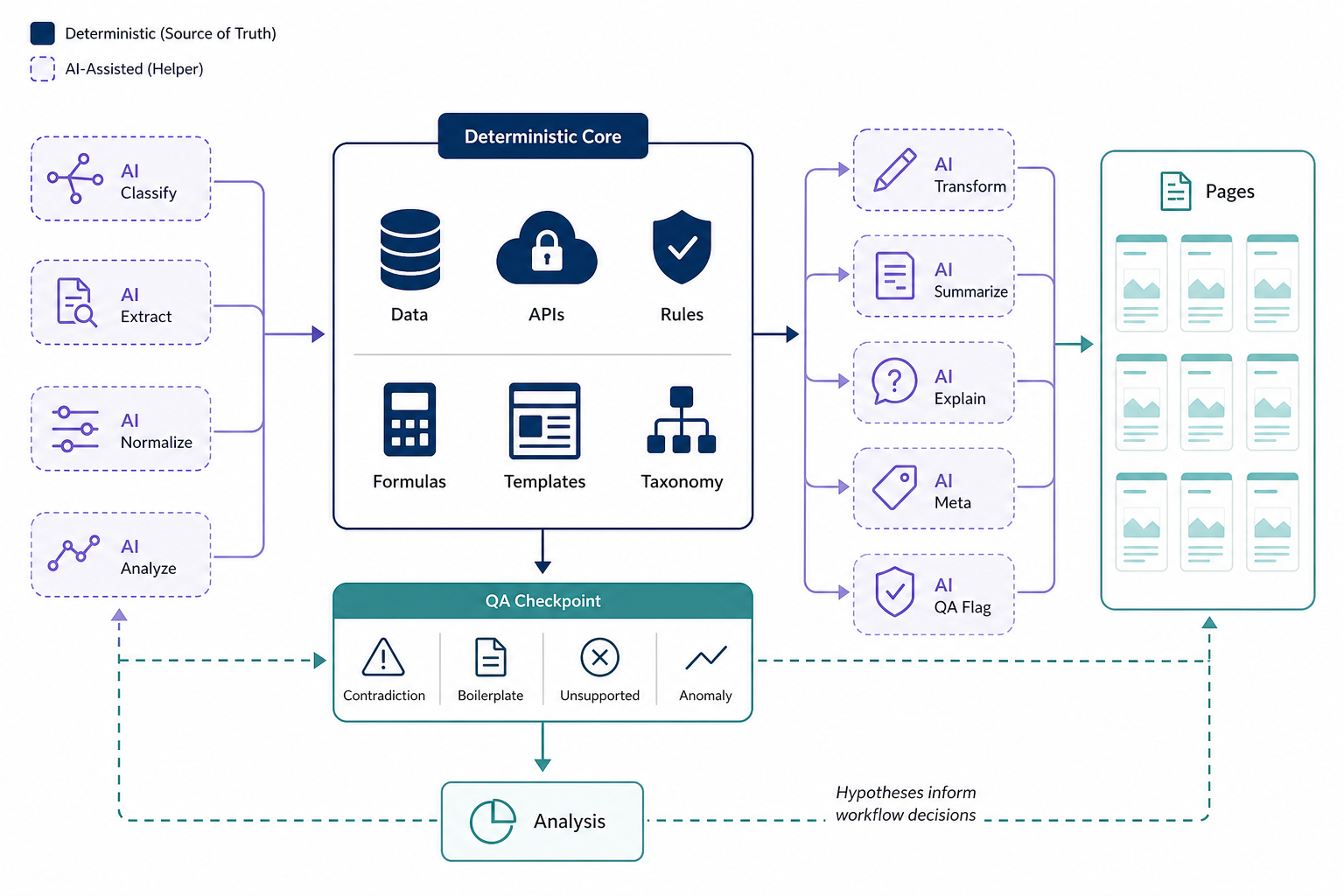
AI can support programmatic SEO by classifying data, identifying patterns, transforming verified facts into readable language, enriching page components, checking generated output, analyzing large datasets, and assisting with workflow decisions. AI is optional; a complete programmatic SEO system can run through databases, deterministic templates, APIs, formulas, and automation without generative AI. Within the broader field of AI SEO, programmatic SEO is one application where AI can assist classification, transformation, enrichment, QA, and analysis without becoming the factual source of the page system.
AI for Query and Pattern Classification
AI can sort large query sets into patterns such as:
- CRM for industry
- CRM for role
- CRM integrations
- CRM alternatives
- CRM comparisons
This can reduce manual classification work.
However, the existence of a pattern does not mean it deserves a page family. Business relevance, data availability, intent, and page utility still need validation.
AI for Entity and Attribute Extraction
AI can extract structured fields from unstructured information.
For example, a product description can be analyzed for:
- Material
- Dimensions
- Compatibility
- Intended use
The extracted values should be validated before they become published factual claims.
AI for Data Normalization
AI can help identify variations such as:
- NYC
- New York City
- New York, NY
that may represent the same location entity.
Deterministic IDs and validated mappings should remain the source of truth where possible.
AI for Content Transformation
One of the stronger applications is converting verified structured facts into readable explanations.
For example, if the database establishes that:
- Product A costs 29.
- Product B costs 49.
- Product A supports feature X.
- Product B does not.
AI can produce a concise comparison from those facts.
The preferred direction is verified data first, language generation second.
AI for Page Summaries
AI can turn structured values into concise summaries.
Examples include:
- City metrics summarized into a short location overview.
- Product comparison fields summarized into key differences.
- Integration capabilities explained in plain language.
The generated explanation should remain grounded in page-specific data.
AI for Conditional Explanations
Different data states can trigger different generation logic.
For example:
If a direct integration exists, explain the direct setup.
If only a third-party workflow exists, explain that alternative.
This is more useful than running every page through one generic prompt.
AI for Metadata
AI can assist with:
- Titles
- Meta descriptions
- Page summaries
- Alt-text drafts
However, predictable metadata can often be generated more reliably through deterministic templates.
AI for QA
AI can flag:
- Unsupported claims
- Repeated boilerplate
- Contradictory statements
- Missing components
- Unnatural wording
- Page similarity
- Anomalous records
AI QA should supplement deterministic checks rather than replace them.
AI for Performance Analysis
Large Search Console, analytics, crawl, and page datasets can be classified and summarized with AI.
It can surface hypotheses such as:
- One template version underperforming another
- Pages missing pricing data receiving fewer clicks
- One category having lower indexation
- One URL pattern causing technical issues
These are investigation hypotheses rather than proof of causality.
What Should Remain Deterministic?
Use code, databases, and rules for objective states such as:
- Pricing
- Inventory
- Compatibility
- Integration status
- Calculations
- Counts
- URL states
- Canonicals
- Indexability
- Structured data derived from known facts
For example, an exchange rate should be calculated from a verified data source rather than estimated by an LLM.
Use AI where language, classification, semantic grouping, summarization, or anomaly analysis genuinely adds value.
Programmatic SEO with AI works best when AI improves a reliable data and page system rather than becoming the system’s factual source.
What Is the Best Tool for Programmatic SEO?
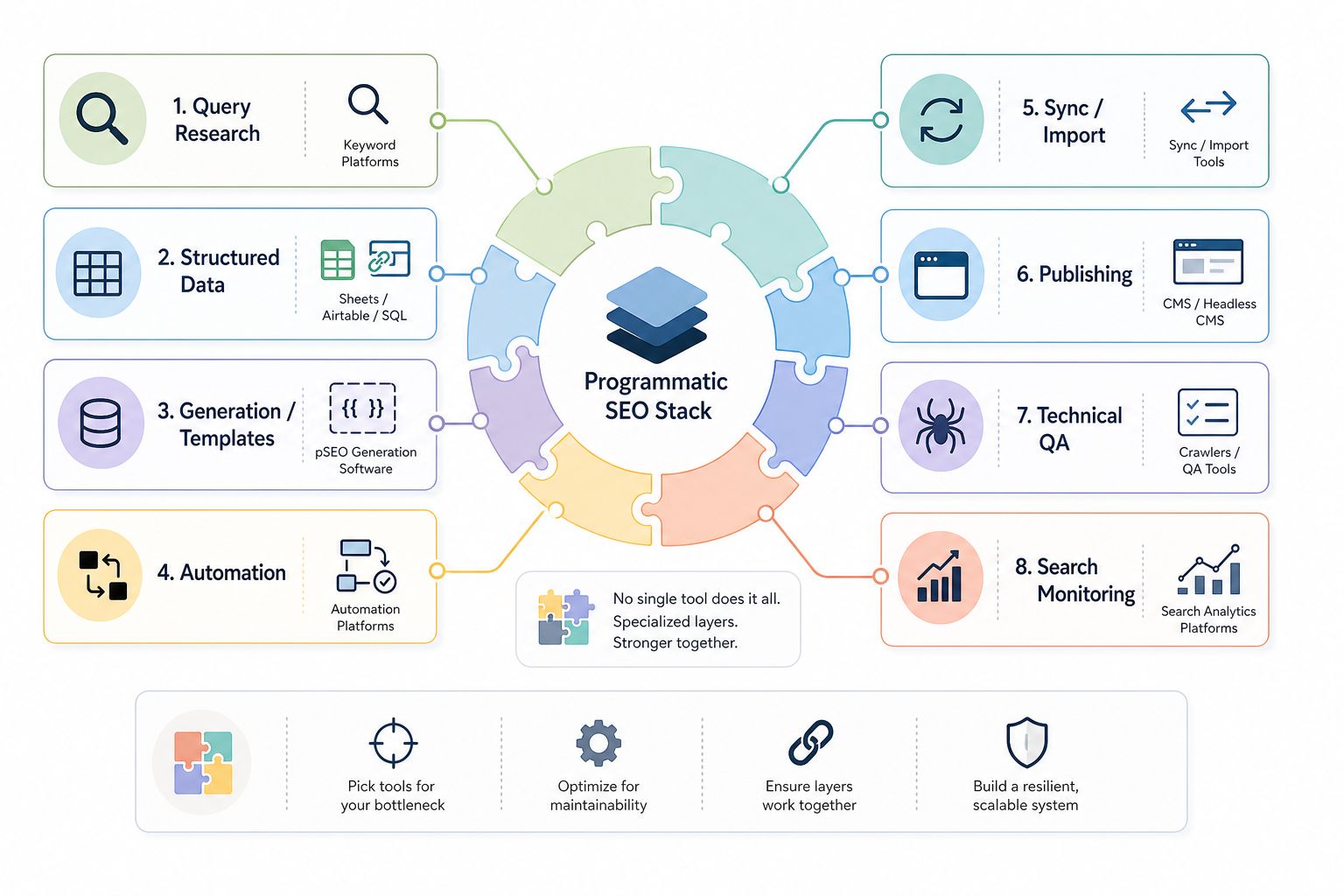
There is no single best tool for programmatic SEO because different tools solve different parts of the system, including opportunity research, structured-data management, generation, synchronization, publishing, quality assurance, and performance monitoring. Many of those functions also sit within the broader ecosystem of SEO tools, especially for keyword research, crawling, technical QA, monitoring, analytics, and reporting. The best tool is the one that solves the actual bottleneck without weakening data control or maintainability.
| Need | Example Tool or Layer | Primary Role | What It Does Not Replace |
|---|---|---|---|
| Query research | Ahrefs / Semrush | Demand and pattern research | Database or publisher |
| Simple data | Google Sheets | Lightweight structured input | Complex relational database |
| Relational no-code data | Airtable | Structured linked records | CMS/frontend |
| Production data | SQL/PostgreSQL | Complex scalable data | Search strategy |
| Dedicated pSEO generation | SEOmatic-type platform | Data/templates/CMS generation | Data quality or strategy |
| Workflow automation | Zapier / Make / n8n | Orchestration | SEO decision-making |
| Webflow synchronization | Sync layer such as Whalesync | Keeps systems aligned | Data strategy |
| WordPress bulk import | WP All Import | Structured imports/updates | Complete pSEO strategy |
| Publishing | WordPress / Webflow / Shopify | Hosts and renders pages | Opportunity research |
| Custom pSEO | Database + Next.js | Maximum functional control | Marketer-friendly workflow by default |
| AI enrichment | LLM/workflow layer | Classification and language | Factual source of truth |
| Technical QA | Crawling software | Detects systemic issues | Publishing |
| Search monitoring | Google Search Console | Search feedback | Crawler or generator |
A typical stack can therefore contain multiple layers.
Keyword Research Tools
Keyword platforms can help identify:
- Query families
- Search demand
- Modifiers
- Competitors
- SERP patterns
- Related topics
Their role is opportunity research, not page generation.
Structured-Data Tools
Simple systems can use:
- Google Sheets
- Airtable
- CMS fields
More complex systems can use:
- SQL
- PostgreSQL
- Product databases
- Custom applications
The correct choice depends on relationship complexity and update requirements.
Dedicated Programmatic SEO Software
Dedicated pSEO platforms can combine functions such as:
- Datasets
- Variables
- Templates
- Bulk generation
- CMS integration
- Publishing
- Internal linking
- Monitoring
These can reduce development requirements when the page model fits the platform.
They do not determine whether the underlying pages deserve to exist.
Automation Tools
Tools such as Zapier, Make, n8n, or custom workflows can coordinate:
- Data changes
- Validation
- Enrichment
- CMS updates
- Logging
- Notifications
They execute workflows rather than design the SEO strategy.
WordPress Import Tools
For WordPress, structured data can be imported into posts, pages, custom post types, fields, and taxonomies through bulk-import systems.
This can be simpler than adopting a dedicated pSEO SaaS when the site already has a suitable WordPress architecture.
Technical QA Tools
Large page populations should be crawled and validated for attributes such as:
- Status codes
- Titles
- H1s
- Canonicals
- Index directives
- Internal links
- Duplicate patterns
- Sitemap state
The objective is to detect systemic issues rather than inspect every URL manually.
Search Monitoring
Google Search Console can provide feedback about:
- Indexing states
- Queries
- Impressions
- Clicks
- Page performance
It is a monitoring layer rather than a page generator.
The best programmatic SEO tools are therefore usually selected as a stack according to actual research, data, generation, publishing, synchronization, QA, and monitoring requirements.
How Long Does It Take to See Results From Programmatic SEO?
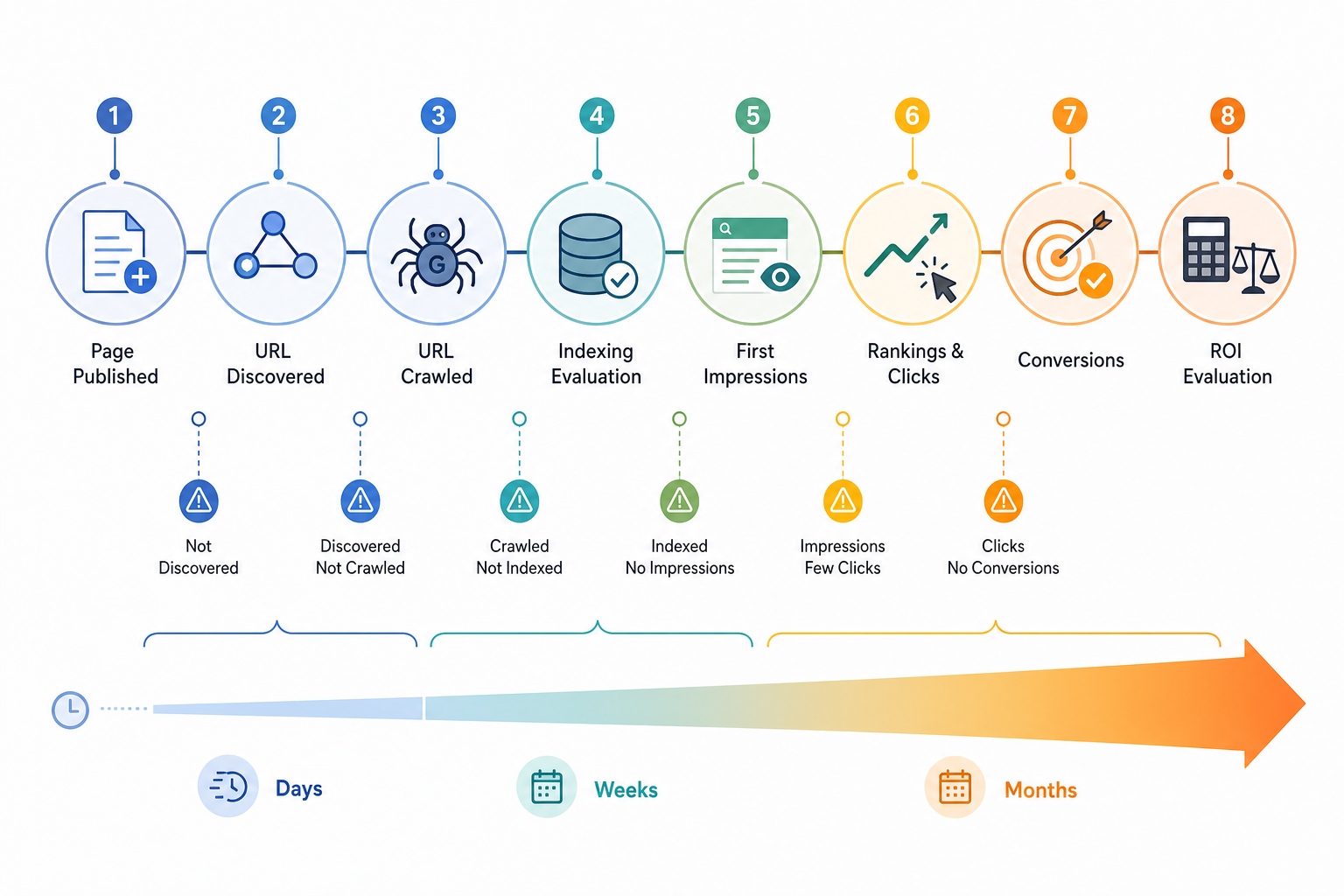
There is no fixed programmatic SEO results timeline. Some URLs can be discovered or crawled within days, while meaningful visibility, traffic, conversions, or ROI can take weeks or months and are never guaranteed. Technical signals generally appear before enough commercial data exists to evaluate the full page family.
The important sequence is:
- Page published
- URL discovered
- URL crawled
- Page evaluated for indexing
- Search impressions appear
- Rankings and clicks develop
- Conversions occur
- ROI can be evaluated
These stages should not be collapsed.
Immediately After Publishing
First confirm that the page:
- Returns the appropriate successful response.
- Is not accidentally noindexed.
- Is crawlable where intended.
- Uses the intended canonical.
- Renders correctly.
- Receives internal links.
- Appears in the sitemap where appropriate.
This establishes technical eligibility, not an SEO result.
Discovery
Search engines need to know the URL exists.
Discovery can happen through:
- Internal links
- Sitemaps
- Existing URLs
- External links
- Other crawling paths
A page that exists only as an isolated database record may not be discoverable.
Crawling
Google can take days to weeks to crawl new or changed URLs, but this varies.
That guidance applies to crawling rather than guaranteed indexing.
Index Evaluation
A crawled page can still remain unindexed.
Programmatic sites need particular attention to:
- Similar pages
- Canonical clustering
- Duplicate intent
- Weak page states
- Empty results
- Insufficient differentiation
There is no fixed indexation deadline.
First Impressions
Once eligible to appear, pages can begin receiving Search Console impressions.
Impressions are an early signal that the URL is entering real query evaluation.
They do not mean the page ranks strongly.
Click Growth
Over subsequent weeks or months, analyze whether page cohorts gain:
- Query coverage
- Impressions
- Clicks
- Qualified sessions
There is no universal month when a programmatic page family should begin generating traffic.
Conversion Evidence
Once qualified traffic arrives, measure outcomes such as:
- Leads
- Signups
- Purchases
- Bookings
- Product activation
- Marketplace actions
Search traffic without business usefulness is not necessarily a successful programmatic SEO system.
ROI
ROI requires enough performance evidence to compare value against:
- Strategy cost
- Data cost
- Development
- Software
- QA
- Maintenance
The observation period should therefore depend on the metric being evaluated.
Technical problems should be diagnosed immediately; commercial outcomes may need a longer sample.
What Affects the Timeline?
Important variables include:
- Existing crawl history
- Site quality
- Number of valid URLs
- Internal linking
- Sitemap coverage
- Infrastructure
- Page similarity
- Page-specific utility
- Search frequency
- Competition
- Intent match
- Existing brand/product demand
- Page-family type
- Domain history
- Publishing volume
- Data freshness
- Technical errors
A useful diagnostic approach is to find the stage where performance stops.
Not discovered: Review architecture and sitemaps.
Discovered but not crawled: Review access, URL proliferation, technical capacity, and page prioritization.
Crawled but not indexed: Review duplication, canonicalization, page utility, and intent overlap.
Indexed but no impressions: Review demand and intent alignment.
Impressions but few clicks: Review ranking position, SERP appearance, and query fit.
Clicks but no conversions: Review traffic quality and task completion.
Programmatic SEO results should therefore be evaluated stage by stage rather than against a universal month-by-month promise.
Who Provides Programmatic SEO Services?
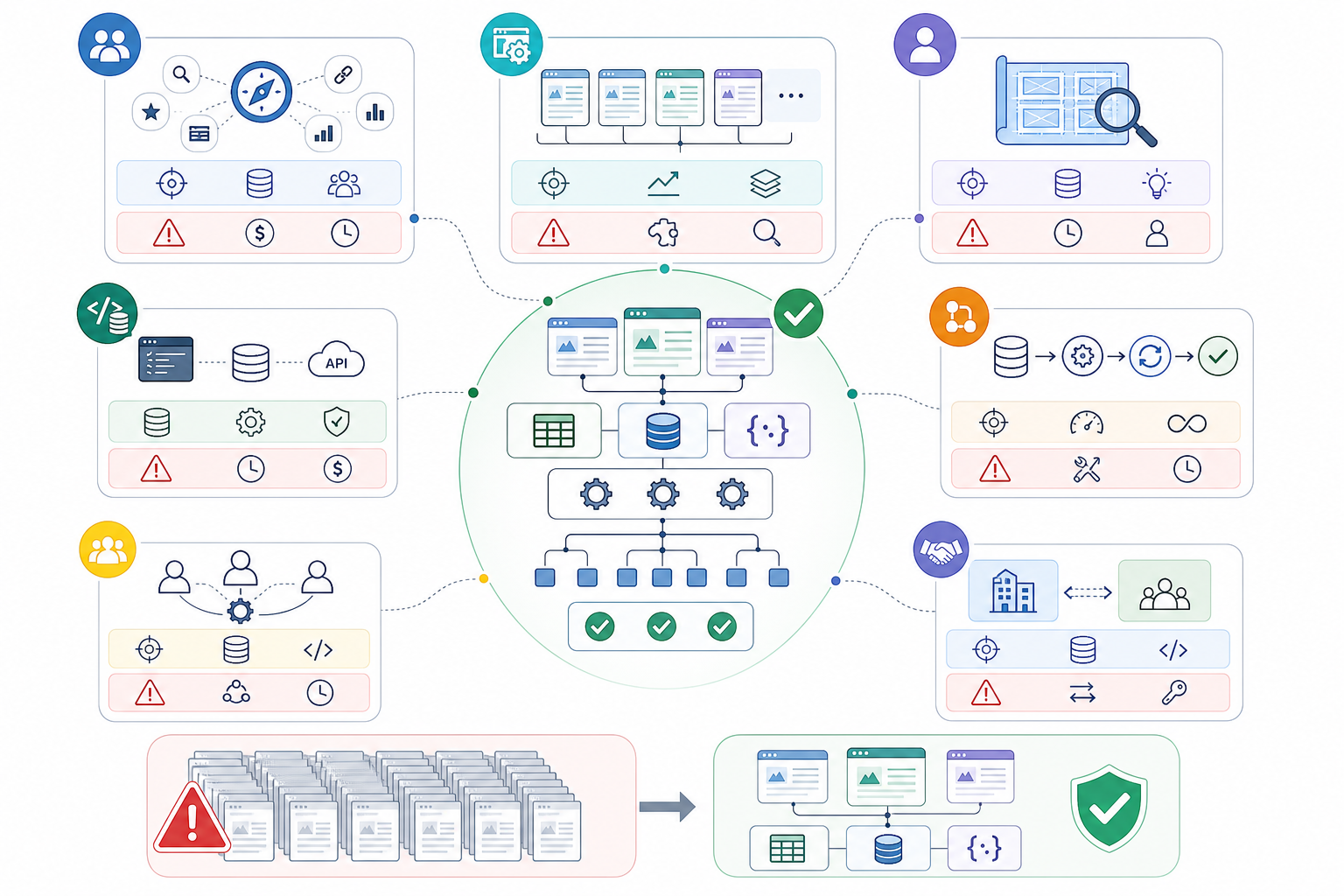
Programmatic SEO services can be provided by specialist pSEO agencies, broader SEO agencies with technical capabilities, consultants, development partners, automation specialists, or in-house cross-functional teams. The right provider depends on whether the business needs opportunity strategy, data modeling, development, automation, technical SEO, content systems, QA, ongoing operations, or several of these together. Dedicated programmatic SEO services can combine several of these capabilities when a business needs outside support to design, build, validate, and maintain the page system.
| Provider Type | Primary Role | Best When | Main Limitation |
|---|---|---|---|
| Full-service SEO agency | Integrates pSEO into broader SEO | Organic strategy spans several workstreams | Technical/data depth varies |
| Specialist pSEO agency | Builds scalable page systems | pSEO is a major growth initiative | May cover fewer other channels |
| Consultant / expert | Strategy, audit, architecture | Internal execution resources exist | Limited production capacity |
| Development partner | Technical implementation | Search model already validated | May lack SEO judgment |
| Automation specialist | Production workflows | Strategy and data model already exist | Not full pSEO strategy |
| In-house team | Long-term ownership | pSEO is central to product/acquisition | High staffing requirement |
| Hybrid | External expertise + internal implementation | Proprietary or complex systems | Requires clear ownership |
Full-Service SEO Agency
A broader agency can connect programmatic SEO with:
- Technical SEO
- Editorial SEO
- Analytics
- Conversion optimization
- Link acquisition
- Content strategy
This can be useful where programmatic pages form only one part of a larger organic acquisition system.
Specialist Programmatic SEO Agency
A specialist programmatic SEO agency can focus on:
- Opportunity audits
- Page-family modeling
- Query mapping
- Data requirements
- Template architecture
- Automation
- Internal linking
- Indexability controls
- QA
- Ongoing optimization
This model fits businesses where pSEO itself is a substantial growth initiative.
Programmatic SEO Consultant
A consultant can provide:
- Opportunity assessment
- Strategy
- Data/page modeling
- Implementation specifications
- Technical audits
- Team coaching
- Governance
This works well when the company already has developers or marketers who can execute the plan.
Development Partner
A technical partner can implement:
- Databases
- APIs
- Dynamic routes
- CMS logic
- Templates
- Sitemaps
- Internal linking
- Automation
However, a developer can perfectly automate a weak search model. The underlying opportunity should therefore be validated first.
Automation Specialist
Automation providers can help with:
- Data synchronization
- AI workflows
- Bulk publishing
- CMS automation
- QA pipelines
- Scheduled updates
This is useful when the page strategy and data architecture already exist.
In-House Team
A mature internal programmatic SEO team can combine:
- SEO strategist
- Product manager
- Developer
- Data specialist
- Content/editorial specialist
- Designer
- Analyst
This can be particularly effective when the pages depend directly on proprietary product or marketplace data.
Hybrid Delivery
Many projects benefit from combining external expertise with internal product knowledge.
For example:
- Consultant or agency owns opportunity design and SEO architecture.
- Internal developers own databases and implementation.
- Marketing owns positioning and conversion.
- Internal analysts own performance measurement.
What Should Programmatic SEO Services Include?
Depending on scope, services can include:
- Opportunity audit
- Search and entity modeling
- Data architecture
- Page/template design
- Programmatic content system
- Technical SEO architecture
- CMS or frontend implementation
- Automation
- Internal-link architecture
- Structured data where appropriate
- QA
- Launch management
- Reporting
- Maintenance
- Training
When selecting a provider, ask whether they can explain:
- Why each page family should exist.
- What underlying data makes the pages different.
- Which combinations should not become pages.
- How invalid or incomplete records are handled.
- How crawling, canonicals, sitemaps, and index controls work.
- What happens when source data changes.
- How AI output is validated.
- How technical problems are detected at scale.
- Which search and business outcomes are measured.
- Who owns the data, code, templates, and automations after the engagement.
A provider promising “10,000 SEO pages” without first validating the search need, data, and page utility is describing production volume rather than a complete programmatic SEO strategy.
How Much Does Programmatic SEO Cost?
Programmatic SEO cost can range from a relatively inexpensive self-managed software and CMS setup to a substantial custom engineering or managed-agency investment. Pricing depends more on strategy, data, page-system complexity, tooling, QA, maintenance, and technical requirements than on raw URL count.
Programmatic SEO has two broad cost categories:
Initial implementation costs, including strategy, data preparation, templates, development, automation, and setup.
Ongoing operating costs, including software, hosting, data feeds, AI usage, monitoring, QA, maintenance, and optimization.
Important cost drivers include:
- Opportunity and strategy work
- Existing versus missing structured data
- Data licensing or acquisition
- Data cleaning
- Relationship complexity
- Number of page families
- Template complexity
- CMS or framework choice
- Software stack
- AI usage
- Custom development
- Automation complexity
- Internal-link architecture
- Canonical and index rules
- Quality assurance
- Human or subject-matter review
- Number of valid pages
- Update frequency
- Hosting
- Rendering architecture
- Technical monitoring
- Provider model
- Localization
- Conversion design
- Analytics requirements
- Security and governance
Raw page count is a weak pricing proxy.
A system generating 100,000 pages from one clean, stable data model can sometimes be simpler to build than a 3,000-page website containing separate systems for integrations, alternatives, comparisons, locations, industries, and use cases.
Likewise, a simple system can use:
- Existing data
- One template family
- Straightforward CMS fields
- Basic automated QA
- Moderate page volumes
while a complex implementation can require:
- Licensed or proprietary datasets
- Many-to-many relationships
- Live APIs
- Dynamic calculations
- Several page families
- Custom application development
- Conditional components
- High-frequency updates
- Advanced QA
- Ongoing engineering support
The cheapest system is not necessarily the most economical if the pages are inaccurate, difficult to maintain, or produce no useful search or business outcome.
Programmatic SEO agency pricing and internal programmatic SEO costs should therefore be evaluated according to the system that must be built and maintained, not according to how many URLs a tool or provider promises to generate.
Need links on real SaaS and business websites?
Links are placed after your approval, on sites with guaranteed DR and traffic, with a 1-year replacement guarantee.

