
SEO Ranking: Google Ranking Process, Ranking Factors, Tracking & Improvement
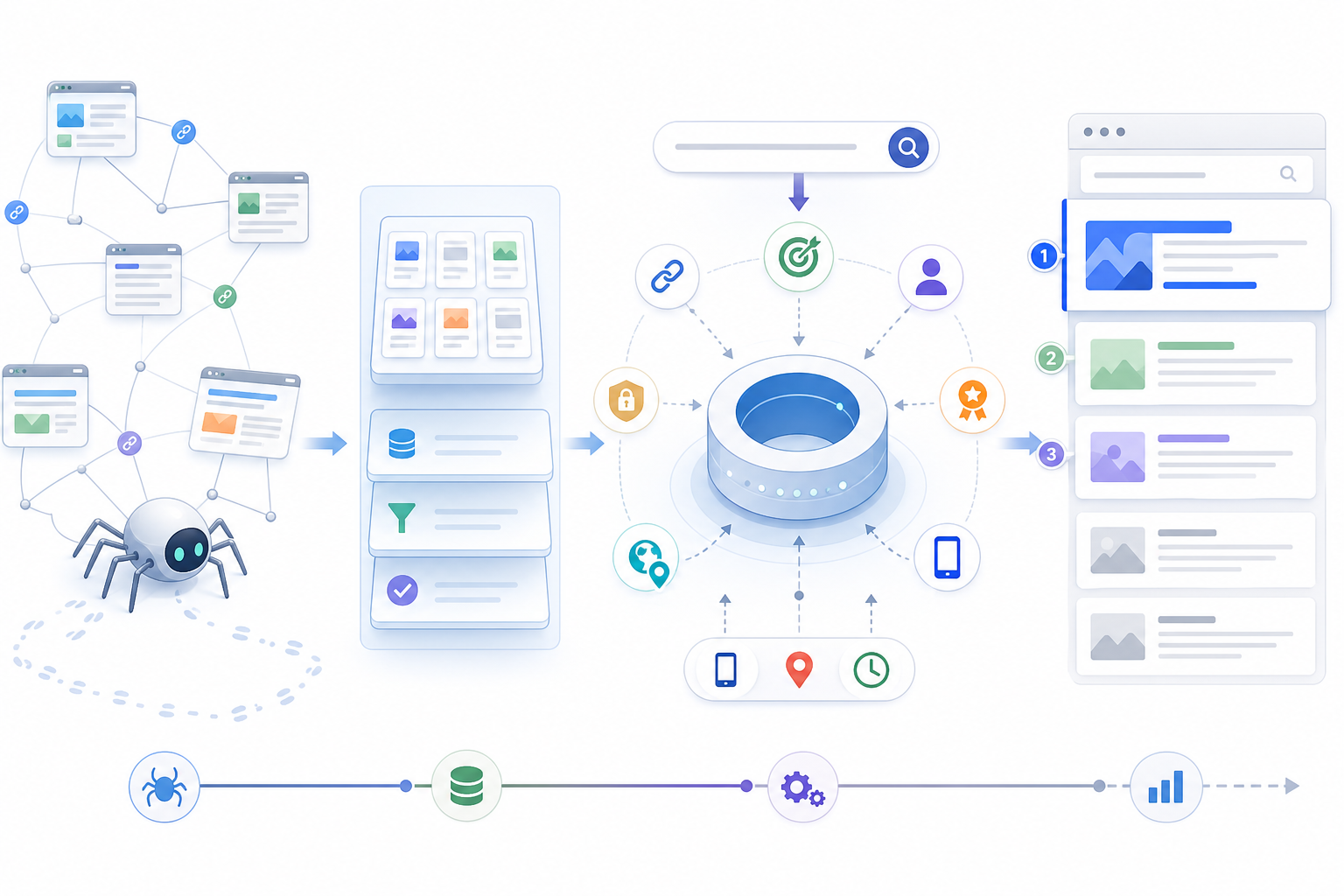
SEO ranking is the position a webpage holds in organic search results for a specific search query. A higher position generally gives a page greater search visibility, although visibility, clicks, traffic, and conversions depend on the query, result format, competition, and search context.
SEO ranking sits at the end of a broader search process. Google Search discovers webpages, processes eligible content for its index, and serves ranked results when users enter queries. Google describes this process through three broad stages: crawling, indexing, and serving search results. Ranking takes place during the serving stage, when Google retrieves and orders relevant indexed content.
A page’s position does not come from one universal ranking signal. Google uses automated ranking systems that evaluate many factors and signals across hundreds of billions of webpages and other indexed content. These systems operate primarily at the page level, while some site-wide signals and classifiers also contribute to how individual pages are understood.
The main evaluation dimensions include relevance to the query, search-intent satisfaction, content quality, authority signals, technical accessibility, usability, and freshness for queries where recency matters. The relative importance of these dimensions changes with the query because Google ranks pages in response to a specific information need rather than assigning one permanent website-wide position.
SEO ranking therefore remains dynamic. A page’s visibility changes as competing pages improve, content changes, search demand shifts, Google’s ranking systems evolve, and the context of individual searches changes.
Measurement connects these ranking changes to actual search performance. Keyword positions, impressions, clicks, click-through rate, organic traffic, and conversions reveal whether stronger visibility produces meaningful results. Ranking data then identifies where content, technical performance, or external authority requires improvement.
Google first discovers and processes webpages. Its ranking systems then evaluate eligible content and determine how prominently those pages appear for relevant searches. The resulting search performance can then be measured to identify weaknesses in relevance, accessibility, authority, or user experience. Those findings guide further optimization designed to strengthen competitiveness and organic visibility.
Understanding this relationship starts with the mechanics behind how Google discovers, indexes, retrieves, and ranks webpages.
How Does Google Rank Websites?
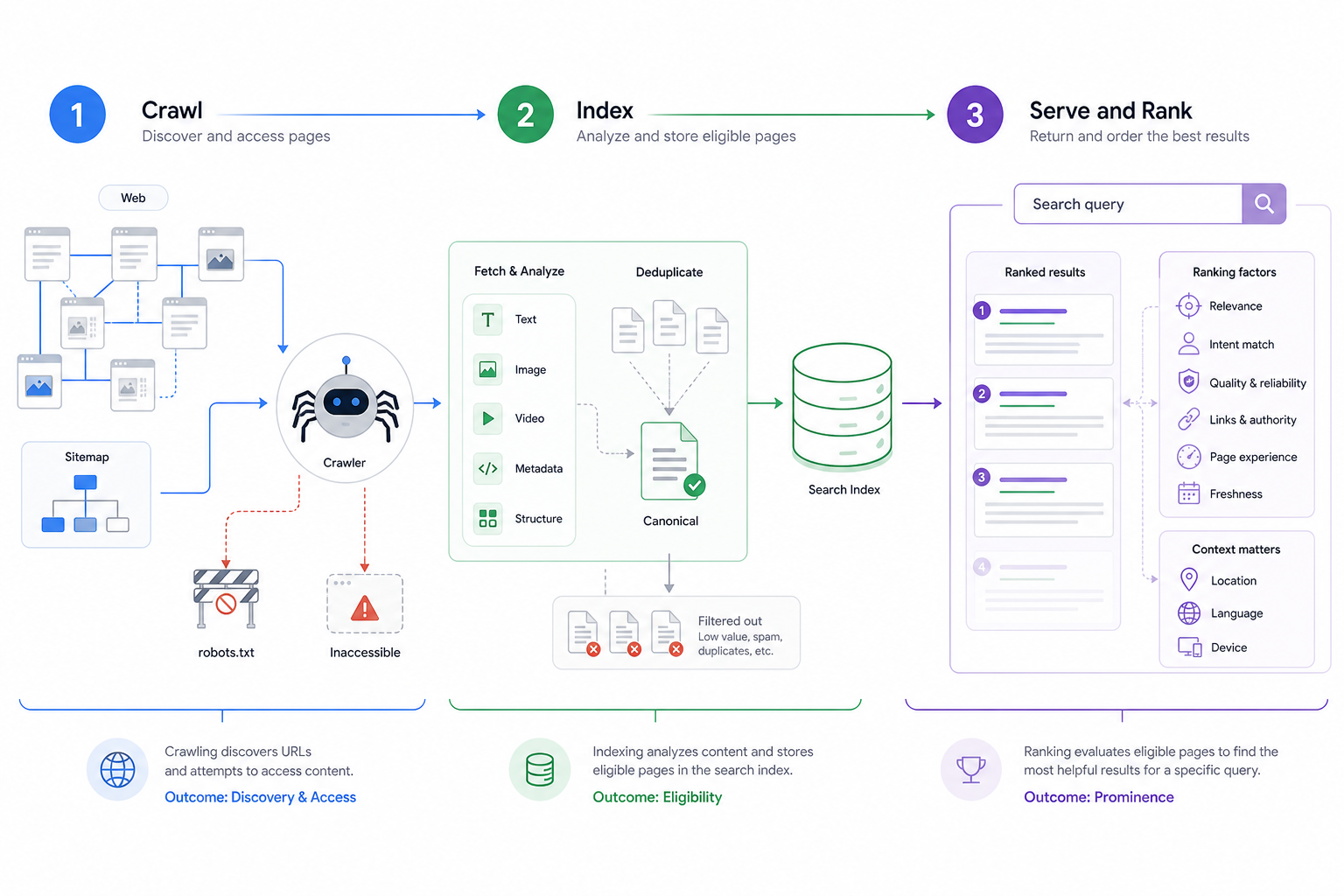
Google ranks webpages by discovering content, indexing eligible information, and evaluating indexed pages against a user’s query when serving search results. Crawling and indexing establish eligibility; ranking systems determine which eligible results appear most prominently.
The search process follows three connected stages:
Crawl Pages
Googlebot discovers new and updated URLs across the web. Links from previously discovered pages form a major discovery path, while sitemaps provide another source of URL discovery. Google then fetches accessible pages and renders their content, including JavaScript where required.
Crawling establishes discoverability. It does not guarantee indexing or visibility in search results. Access restrictions, server problems, network problems, and robots.txt directives directly affect Googlebot’s ability to retrieve content.
Index Eligible Pages
Google processes crawled pages to understand their text, images, videos, metadata, structure, and relationships with other content. It also evaluates duplication and selects representative canonical URLs when multiple pages contain substantially similar information.
Eligible information enters the Google index, where it becomes available for retrieval during relevant searches. Crawling does not guarantee indexing. Google explicitly states that not every processed page enters its index.
Serve and Rank Results for a Query
When a search occurs, Google retrieves matching information from its index and orders results according to relevance and quality. Its systems evaluate hundreds of factors, including contextual information such as language, location, and device.
Ranking therefore exists at the query level. The same webpage occupies different positions for different queries, locations, devices, and search contexts.
Crawling and indexing determine whether content participates in Google Search. Ranking determines how competitive that eligible content becomes for a particular search.
Google’s ranking systems evaluate multiple dimensions together. Relevance connects page content with the meaning of a query. Intent alignment determines whether the type of content matches the searcher’s objective. Quality and reliability affect how useful the information is. Link analysis helps Google understand relationships and importance between pages. Page experience affects usability. Freshness systems increase the prominence of recent information for searches where current information forms part of the intent.
This distinction separates ranking mechanics from ranking factors. The process explains how content moves from discovery to search-result eligibility; ranking factors explain what influences competitiveness after eligibility exists.
What Are the Main SEO Ranking Factors?
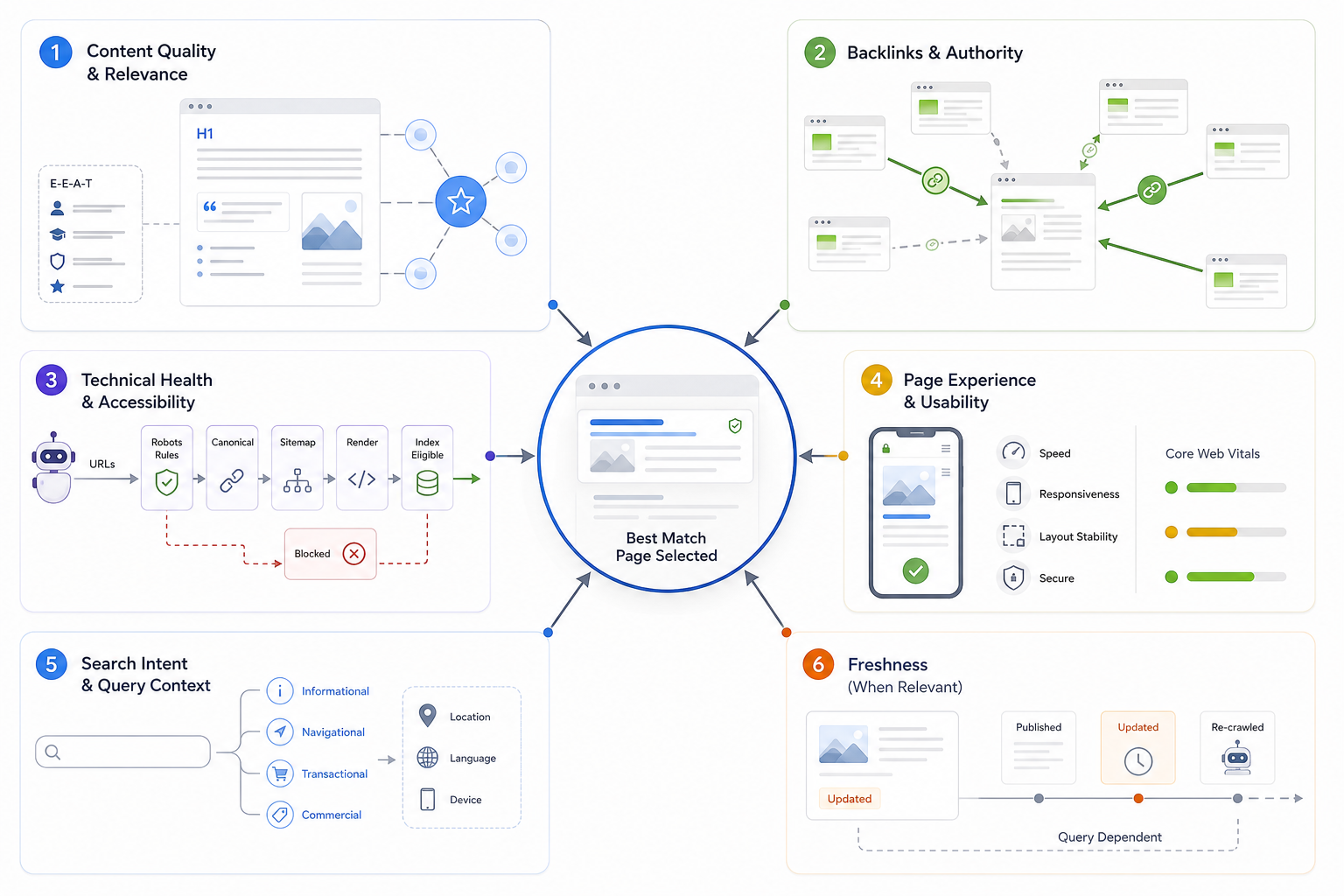
SEO ranking factors are the signals, characteristics, and contextual attributes Google’s systems evaluate when determining which eligible pages best satisfy a search query. No single factor controls every result because Google uses multiple ranking systems and signals together.
The main factor groups include:
- Content quality and relevance
- Content establishes relevance by addressing the topic, entities, concepts, and information demanded by the query.
- Useful content provides original information, substantial coverage, clear sourcing, factual accuracy, and additional value rather than reproducing existing search results.
- Search intent determines the form of information required. A page targeting an informational query performs a different function from a product page targeting transactional demand.
- Titles, headings, body content, internal relationships, and supporting concepts clarify what a page represents.
- Experience, expertise, authoritativeness, and trustworthiness form Google’s E-E-A-T framework for evaluating qualities associated with reliable content. E-E-A-T itself is not a single ranking factor. Google states that its systems use a mixture of factors capable of identifying content that demonstrates these characteristics.
- Backlinks and authority
- Links connect webpages and provide Google with information about relationships between resources.
- Google maintains link-analysis systems that evaluate how pages link to one another. PageRank remains part of Google’s core ranking systems, although its implementation has evolved substantially since the original system.
- Relevant editorial links from credible sources carry more contextual meaning than indiscriminate link accumulation.
- Anchor text also gives users and search engines information about the destination page.
- Domain Authority and Domain Rating are third-party comparative SEO metrics rather than Google-owned ranking scores.
- Technical health and accessibility
- Search engines require reliable access to content before that content becomes eligible to compete in organic results.
- Crawlability determines whether Googlebot retrieves a URL.
- Indexability determines whether processed information enters the search index.
- Robots directives, canonicalization, HTTP responses, internal architecture, accessible links, rendering, and sitemap configuration affect discovery and processing.
- Serious technical barriers restrict organic visibility regardless of the quality of inaccessible content. Google Search Console provides crawling and indexing information specifically for identifying these constraints.
- Page experience and usability
- Google’s core ranking systems reward content associated with a strong overall page experience rather than treating one isolated experience metric as the entire ranking model.
- Core Web Vitals quantify three major aspects of real-world experience:
- Largest Contentful Paint measures loading performance. Google defines a good LCP as 2.5 seconds or less.
- Interaction to Next Paint measures responsiveness. Google defines a good INP as under 200 milliseconds.
- Cumulative Layout Shift measures visual stability. Google defines a good CLS as under 0.1.
- Mobile presentation also affects how Google processes websites. Google uses the mobile version of site content for indexing and ranking under mobile-first indexing.
- Secure delivery, mobile usability, non-intrusive page design, and clear access to primary content contribute to overall page experience.
- Search intent and query context
- Ranking depends on what the searcher seeks to accomplish.
- Informational, commercial, transactional, navigational, and local queries produce different result requirements.
- Location, language, device, and query wording alter the context used during result selection. Google explicitly lists location, language, and device among the factors involved in determining relevance.
- Relevance therefore extends beyond exact keyword matching. Google systems such as neural matching and RankBrain connect words, concepts, and meanings even when a page does not contain every exact term used in the query.
- Freshness where relevant
- Freshness carries greater importance when current information forms part of search intent.
- News, recent events, changing statistics, prices, schedules, product updates, and evolving software topics contain stronger time sensitivity than stable evergreen subjects.
- Google operates query-dependent freshness systems specifically designed to surface newer information when users expect recent content.
- Updating publication dates without substantive content changes does not create meaningful freshness. Google’s people-first content guidance explicitly rejects changing dates simply to make unchanged content appear recent.
SEO rankings therefore emerge from the combined strength of relevance, usefulness, reliability, authority, accessibility, experience, and query context. Google does not publish one fixed weighting formula that applies identically across every search.
The practical effect of these factors appears in performance data. Keyword positions, impressions, clicks, search visibility, organic sessions, and conversions reveal whether a page’s competitiveness is improving or declining.
That makes measurement the next part of the ranking process.
How Do You Measure and Track SEO Rankings?
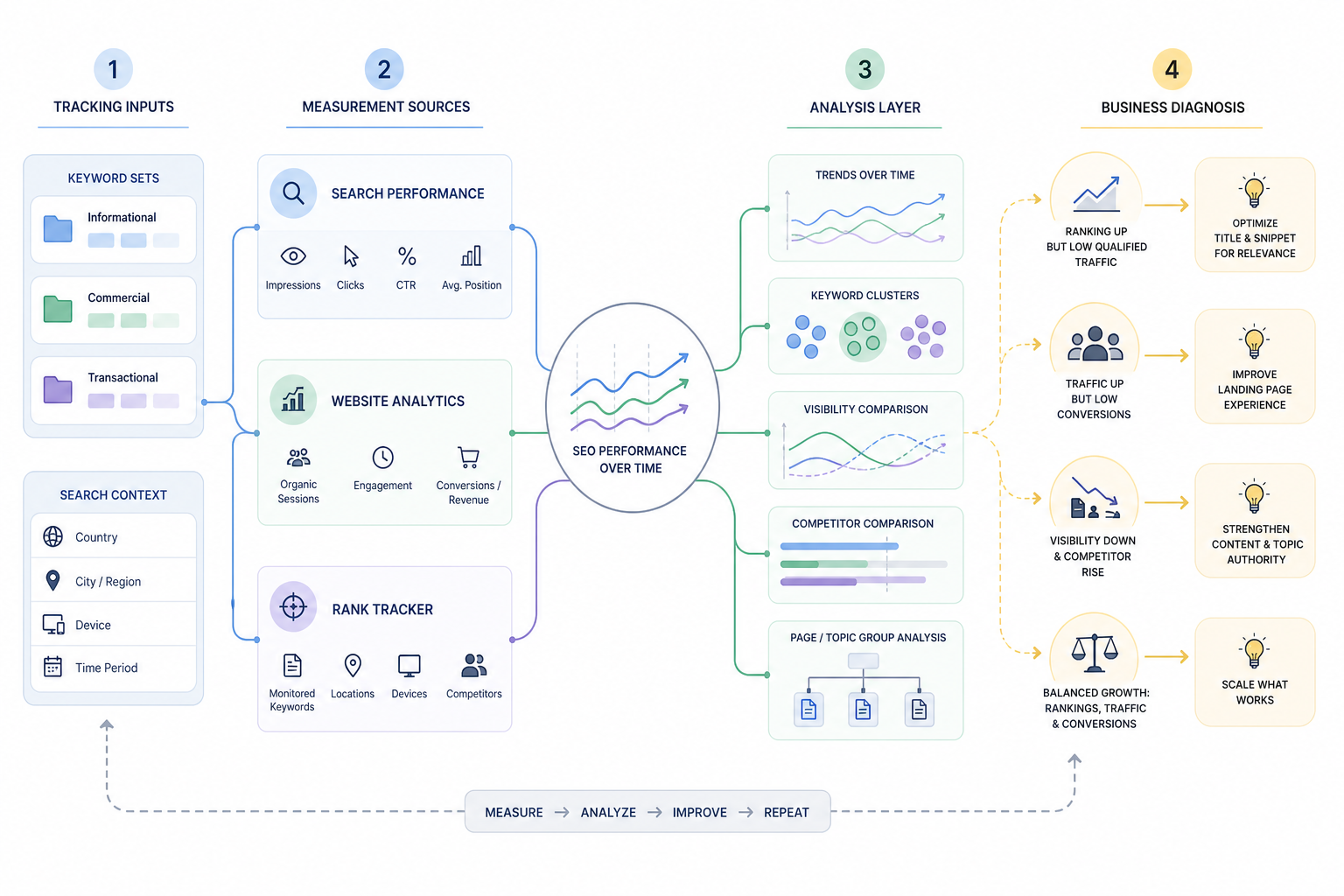
SEO ranking tracking is the consistent measurement of search positions, visibility, organic traffic, and business outcomes across defined queries and time periods. Ranking data becomes useful when it is evaluated as a trend rather than treated as one isolated position.
A keyword position represents where a result appears for a search under a particular set of conditions. Google Search Console reports average position as the average topmost position recorded for a property or page across impressions. Position 1 represents the topmost recorded position.
Individual rankings fluctuate across location, device, query interpretation, SERP composition, and other contextual conditions. Google therefore recommends focusing on changes over time, while its current Search Console guidance places particular emphasis on impressions and clicks rather than position alone.
The primary measurement tools perform different functions:
- Google Search Console
- Reports impressions, clicks, click-through rate, and average position from Google Search.
- Breaks performance down by queries, pages, countries, devices, dates, and other supported dimensions.
- Defines CTR as clicks divided by impressions.
- Connects ranking visibility directly with actual Google Search exposure.
- Google Analytics 4
- Measures user activity after organic visitors reach the website.
- Separates Organic Search as a traffic channel and connects acquisition data with engagement, events, key events, and revenue.
- Adds the business-performance layer that ranking reports alone do not provide.
- Linking Search Console with Google Analytics connects search queries and ranking-related metrics with landing-page engagement and downstream user behavior.
- Rank-tracking platforms
- Platforms such as Semrush and Ahrefs track selected keywords at defined intervals.
- They support structured monitoring across keyword groups, devices, countries, locations, competitors, and SERP environments.
- These platforms complement first-party Google data by providing controlled keyword tracking and competitive datasets.
Effective ranking measurement starts with selecting target keywords that reflect actual search and business priorities. The set can include branded terms, commercial queries, transactional terms, product or service queries, category terms, and supporting informational searches.
Related keywords should be grouped by page, topic, intent, funnel stage, or business objective. Search volume alone does not establish strategic value. A lower-volume transactional query can have greater commercial importance than a high-volume query with weak business relevance.
Tracking parameters should then be defined consistently. Country, region, city, device, and other relevant search conditions influence how rankings appear. Local businesses require geographic tracking because result composition can change significantly across locations, while mobile and desktop tracking can expose device-specific differences.
Rankings should be monitored together with search visibility, impressions, clicks, CTR, and broader performance signals. Search Console defines an impression as an eligible appearance of a link or search element in results and a click as an interaction that sends the user to the tracked property. Average position reflects the topmost recorded result under Google’s reporting methodology.
Group-level analysis provides a more reliable view than a single keyword. A cluster of related terms shows whether topical visibility expands, contracts, or remains unchanged.
Organic traffic and conversions then show whether stronger search visibility produces meaningful business outcomes. Organic sessions reveal whether search exposure generates actual visits. Engagement data shows whether visitors interact with the content. Key events, leads, sign-ups, demos, transactions, and revenue show whether that traffic creates business value.
A ranking gain without qualified traffic has limited business value. A traffic increase without conversions points to a different performance problem than a visibility decline.
Competitor visibility should also be compared across priority keyword groups. Competitor gains can expose content gaps, authority gaps, intent mismatches, SERP-format changes, and areas where competing pages provide stronger information.
Competitive analysis works best at topic and page-group level rather than through isolated keyword comparisons.
Finally, ranking and visibility trends should be reviewed over meaningful periods such as week over week, month over month, quarter over quarter, and year over year.
Search Console itself provides weekly and monthly views to smooth daily fluctuation and make broader growth or decline easier to evaluate.
Significant changes should be compared with content revisions, technical releases, internal-link changes, backlink activity, competitor movements, search-demand patterns, and documented Google ranking updates.
Ranking measurement becomes valuable when it produces a diagnosis rather than a report.
Different performance patterns point to different constraints:
- Falling positions together with falling impressions indicate weaker search visibility or reduced demand across the affected query set.
- Growing impressions with weak CTR indicate that Google displays the page more frequently while searchers click it at a lower rate. Google specifically identifies low CTR pages as candidates for evaluating title, description, content alignment, and query relevance.
- Growing organic traffic without business outcomes identifies a gap between search acquisition and commercial relevance, landing-page effectiveness, or conversion performance.
- Stable positions after substantial optimization direct analysis toward competing pages, insufficient authority, technical constraints, intent satisfaction, or the time required for search systems to process changed content.
SEO ranking tracking therefore does more than record positions. It connects search visibility with traffic and business performance, identifies the constraint limiting growth, and determines the next optimization priority.
How Do You Improve SEO Rankings?
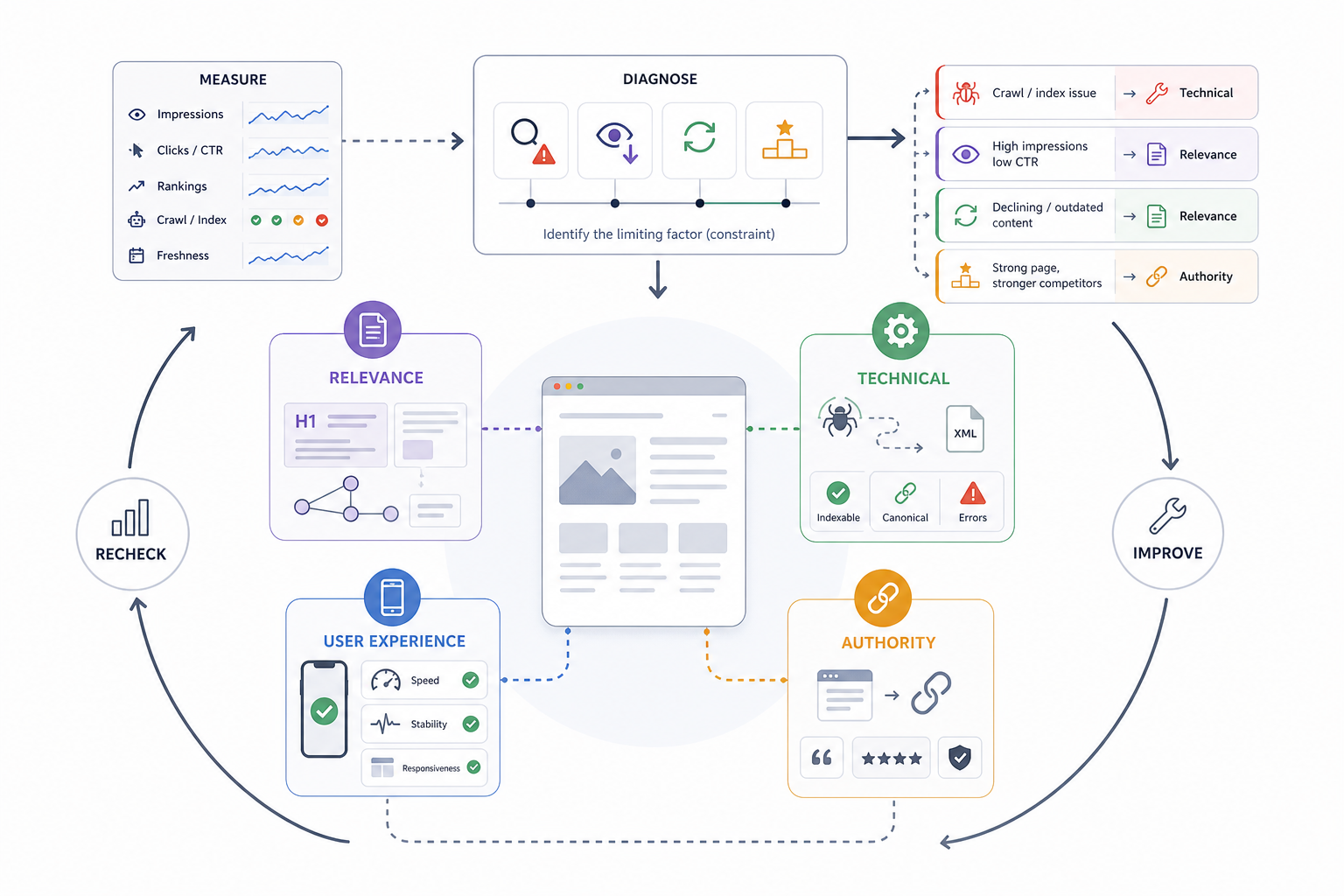
Improving SEO rankings requires strengthening page relevance, technical accessibility, user experience, and external authority according to the weaknesses revealed by search-performance data. Sustainable growth comes from improving the areas that limit a page’s competitiveness rather than applying every SEO tactic indiscriminately.
The primary optimization areas include:
- Improve on-page SEO
- Align each page with a clearly defined search intent and primary topic.
- Use descriptive titles and headings that communicate page meaning accurately.
- Cover the entities, subtopics, attributes, and questions required to satisfy the searcher’s information need.
- Place the core answer early rather than forcing users to navigate through unnecessary introductory text.
- Replace thin, repetitive, inaccurate, or outdated information with original and substantial content.
- Add firsthand evidence, data, examples, methodology, sources, or expert review where the subject requires stronger reliability.
- Strengthen internal links between contextually related pages using descriptive anchor text.
- Use descriptive image text and alt attributes where they clarify image meaning and accessibility.
- Preserve a people-first purpose. Google’s current guidance explicitly prioritizes helpful, reliable content created primarily for users rather than content produced mainly to manipulate rankings.
- Improve technical SEO
- Remove crawling barriers that prevent Googlebot from accessing important pages.
- Resolve unintended noindex directives and other controls that prevent eligible pages from entering Search.
- Establish consistent canonical signals for duplicate or near-duplicate URLs.
- Maintain crawlable internal links and logical site architecture so search engines discover important pages efficiently.
- Use sitemaps to communicate new and updated URLs, especially across larger websites.
- Fix broken internal links, server errors, rendering failures, redirect problems, and inaccessible resources.
- Keep important mobile content equivalent to desktop content because Google uses the mobile version for indexing and ranking.
- Improve real-world performance around Core Web Vitals, including LCP at 2.5 seconds or less, INP below 200 milliseconds, and CLS below 0.1.
- Improve off-page SEO
- Earn relevant editorial backlinks from credible pages and websites.
- Build links through useful assets, research, expert contributions, partnerships, digital PR, original data, and resources that other publishers have a genuine reason to reference.
- Prioritize topical relevance, editorial context, source credibility, and natural placement over raw link volume.
- Strengthen legitimate brand citations and mentions across authoritative industry environments.
- Protect the backlink profile from manipulative practices designed primarily to distort rankings.
- Strengthen local authority through accurate business information, relevant local citations, reviews, and a complete Google Business Profile when local search forms part of the business model.
These workstreams operate together rather than as a rigid sequence. A technically inaccessible page gains little from additional content. A weak page does not become useful solely because it gains backlinks. Strong content with no competitive authority faces limitations in markets where established sources dominate. Excellent rankings that attract irrelevant users fail to create meaningful business performance.
Optimization priority therefore comes from diagnosis.
A crawling or indexing problem receives technical attention first. Strong impressions combined with low CTR place greater emphasis on SERP presentation and intent alignment. Ranking declines across outdated pages place greater emphasis on content quality and freshness. High-quality pages competing against substantially more authoritative sources place greater emphasis on authority acquisition and differentiation.
The operating process remains consistent. Performance should first be measured so the primary constraint can be identified. The relevant SEO dimension can then be improved, after which the result should be measured again. That new evidence determines whether the change worked and what should be prioritized next.
Sustainable organic visibility comes from repeatedly improving relevance, accessibility, usefulness, experience, and authority rather than relying on one isolated ranking tactic.
Need links on real SaaS and business websites?
Links are placed after your approval, on sites with guaranteed DR and traffic, with a 1-year replacement guarantee.

