
Off-Page SEO: On-Page Comparison, Marketing, Strategy, Tools, Measurement & Services
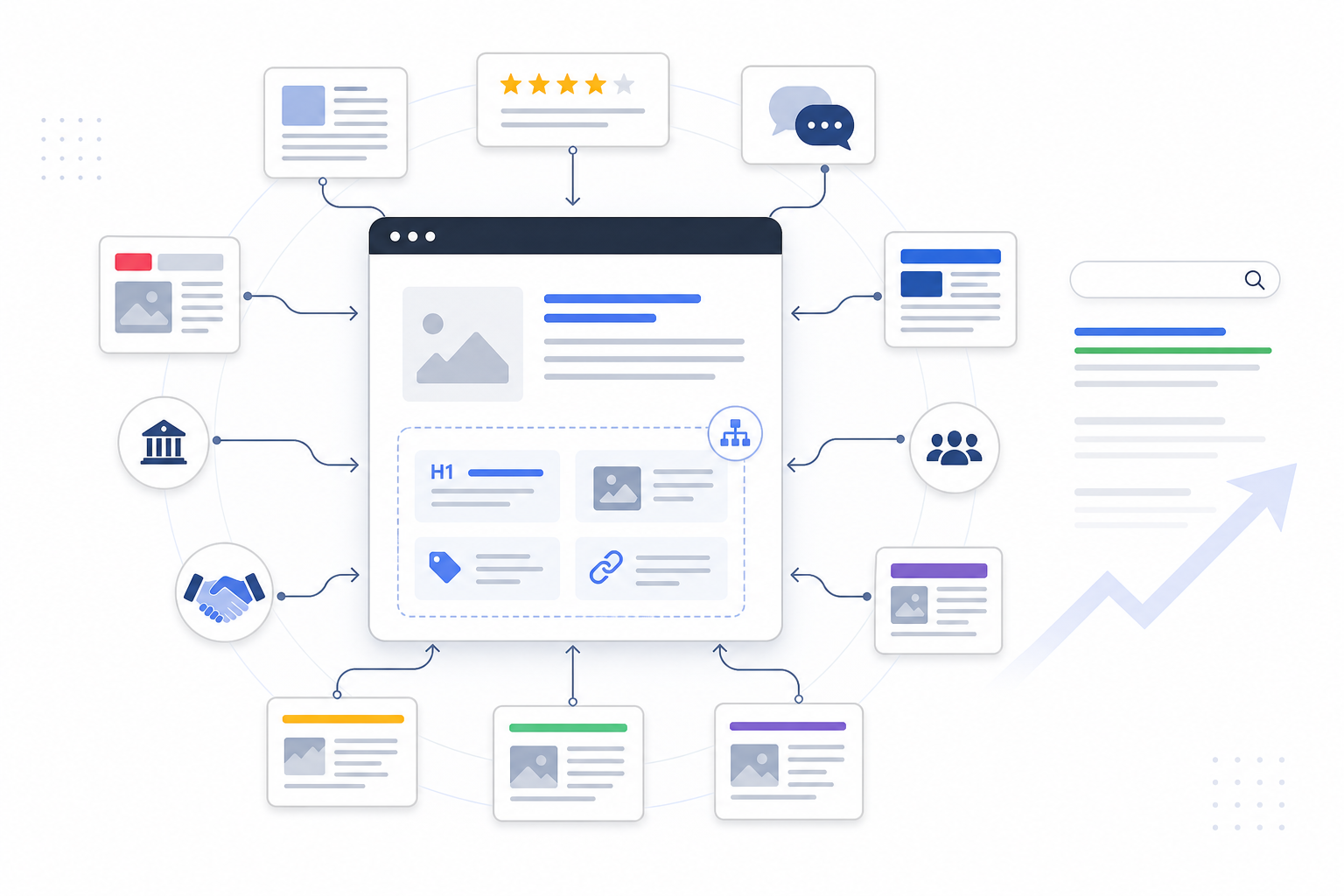
Off-page SEO is the set of optimization activities and external signals that occur beyond a website and help strengthen its authority, reputation, visibility, and competitiveness in organic search. It focuses on how other websites, publishers, platforms, communities, and users reference or interact with a brand or website rather than on changes made directly to its pages.
Backlinks are one of the most important off-page SEO signals, but off-page SEO is broader than link building alone. External references can also include editorial mentions, digital PR coverage, brand mentions, partnerships, citations, reviews, community visibility, and other third-party references where they are relevant to the business.
These signals provide something a website cannot create entirely for itself: independent external recognition. A company can describe its own expertise, products, and value on its website, but links, mentions, coverage, reviews, and references from third parties provide outside evidence that the company or its content is being noticed and referenced elsewhere.
Off-page SEO works alongside on-page and technical SEO. On-page SEO establishes the relevance, quality, and search intent of the page itself. Technical SEO helps search engines access and process the website. Off-page SEO adds external authority and reputation signals that can strengthen the ability of relevant pages to compete in search.
Its role also extends beyond rankings. External coverage can create referral traffic, brand awareness, content distribution, industry recognition, partnership opportunities, and future link earning. Some activities have a direct link-building objective, while others contribute more indirectly through brand visibility, reputation, relationships, and discovery.
Off-page SEO is most effective when it earns credible references through useful content, genuine expertise, strong relationships, original assets, reputation, and external value. Large numbers of links or mentions are not automatically valuable if they come from irrelevant, low-quality, or artificial sources.
The distinction becomes clearer by comparing off-page SEO with optimization performed directly on the website.
How Does Off-Page SEO Differ From On-Page SEO?
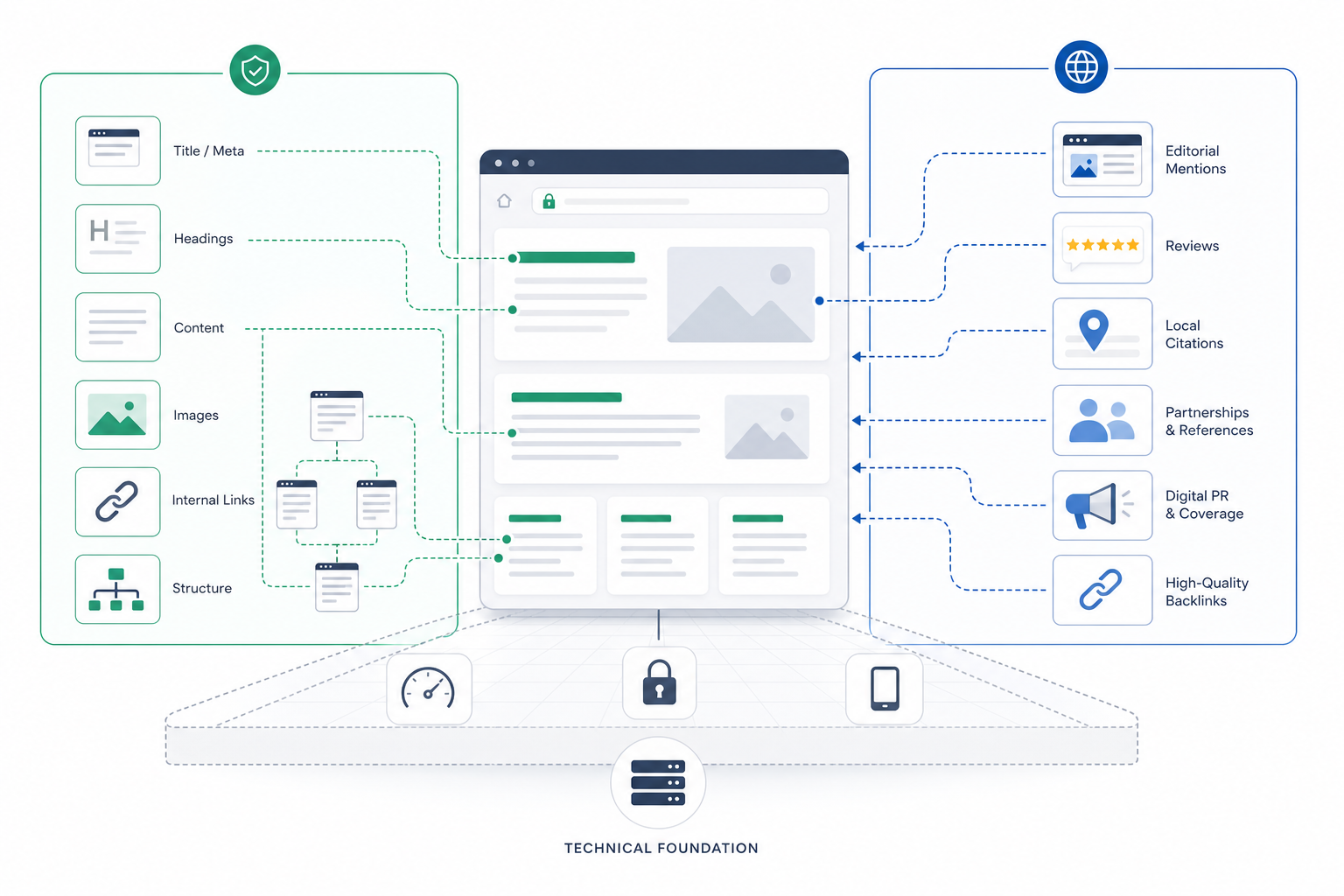
On-page SEO optimizes content, structure, and page-level signals within the website, while off-page SEO strengthens external authority, reputation, and references from other websites and platforms.
| Dimension | On-Page SEO | Off-Page SEO |
|---|---|---|
| Optimization Scope | Individual pages and content within the website | Activities and signals beyond the website |
| Primary Objective | Improve relevance, search-intent alignment, content quality, and page clarity | Strengthen authority, reputation, and external validation |
| Level of Control | Mostly controlled directly by the website owner | Influenced by the business but dependent on third parties |
| Typical Elements | Content, titles, headings, internal links, images, URLs, metadata | Backlinks, referring domains, digital PR, brand mentions, reviews, citations, partnerships |
| Main Evidence | Page relevance, content structure, internal linking, search performance | Link quality, referring domains, external coverage, mentions, reputation signals |
| Typical SEO Question | Is this page relevant, useful, and well structured for the search intent? | Does this page or website have sufficient credible external support? |
| Common Activities | Content optimization, metadata improvements, keyword alignment, internal linking | Link earning, PR, guest contributions, brand promotion, outreach, citations |
| Primary Dependency | Owned website assets | Publishers, websites, communities, platforms, relationships, editorial decisions |
| Main Risk | A page can remain poorly aligned with the intended search even with strong authority | A relevant page can struggle competitively when external authority is weak |
The two approaches solve different problems. On-page SEO deals with the relevance and structure of the page itself, while off-page SEO addresses the external authority and references supporting that page or website.
A useful, well-structured page provides a relevant destination for the searcher. External links, mentions, coverage, and references can then strengthen the authority and visibility associated with that page or website.
This does not mean every backlink is valuable. Link relevance, editorial context, source quality, placement, and the way the reference was acquired all influence its practical value.
On-page and off-page SEO therefore complement one another rather than compete with each other. Technical SEO provides the underlying accessibility needed for both to contribute effectively.
Where Does Off-Page SEO Fit Into Digital Marketing?
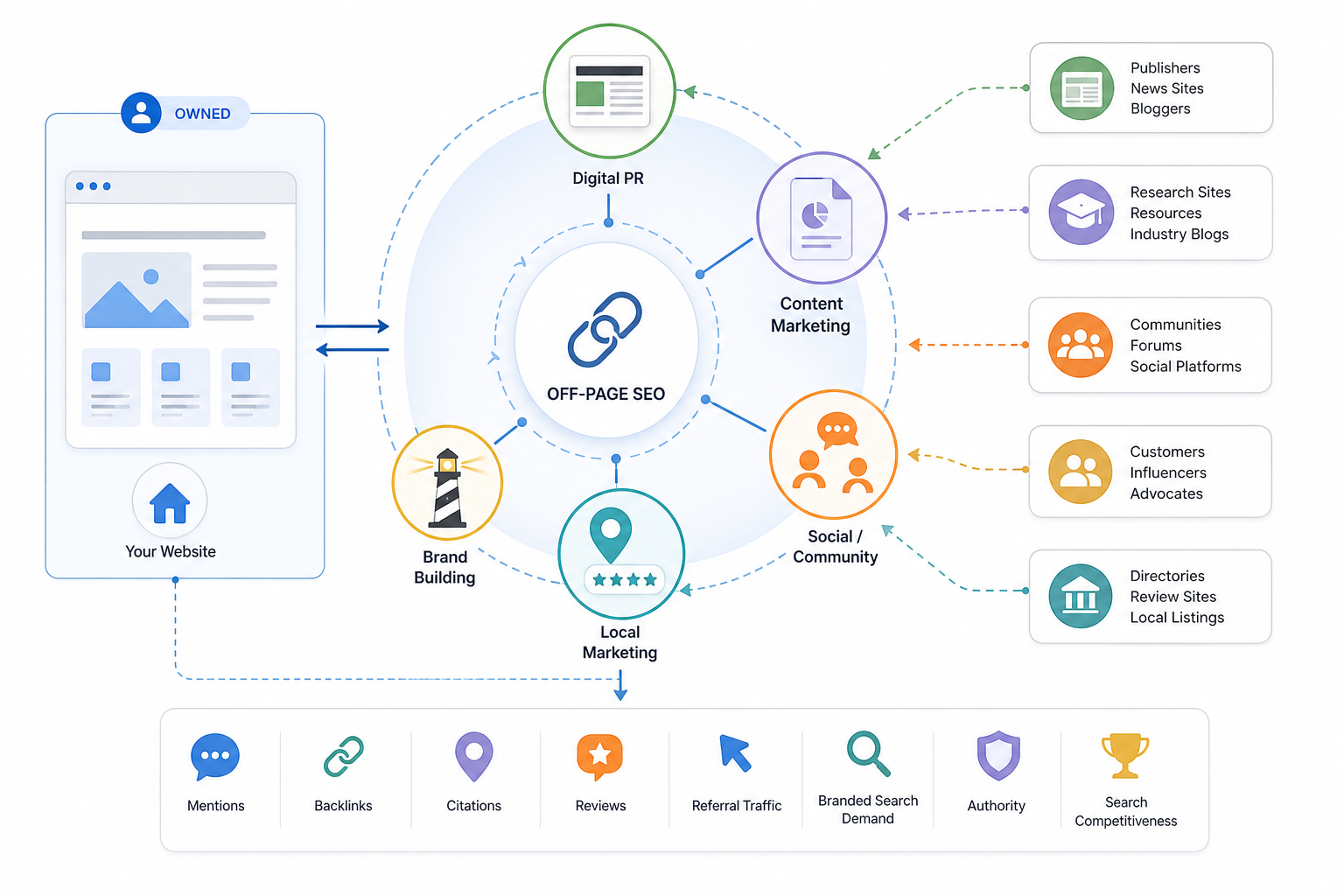
Off-page SEO is the external authority and reputation layer of organic search marketing, using signals beyond the website to strengthen how a brand, domain, or page is referenced and perceived across the web.
Digital marketing includes owned, earned, and paid activity. Off-page SEO sits mainly within the earned and external visibility side because many of its strongest outcomes depend on other websites, publications, communities, customers, and organizations choosing to reference or discuss the brand.
Its role is closely connected with several marketing disciplines.
Digital PR can generate editorial coverage, branded mentions, expert commentary, and backlinks when a campaign earns genuine publication interest.
Content marketing can support off-page SEO by producing assets other websites have a reason to reference. Original research, statistics, tools, studies, guides, templates, and useful resources can attract citations and editorial links.
Brand building also contributes because stronger recognition can create more mentions, partnerships, searches, publisher interest, and referral exposure over time.
Social and community distribution can increase content discovery and expose assets to relevant audiences. Social engagement itself should not be treated as a direct Google ranking factor, but wider distribution can create opportunities for mentions, relationships, links, and branded search demand.
For location-dependent businesses, local marketing can also overlap with off-page SEO through reviews, relevant citations, directory consistency, partnerships, and business-profile activity.
Not every external marketing activity is automatically off-page SEO. It becomes relevant when it meaningfully contributes to external authority, reputation, discovery, referral exposure, or search competitiveness.
Backlinks remain one of the clearest SEO-specific external signals, but the broader role of off-page SEO is to connect organic search with the wider reputation and visibility a brand develops outside its own website.
Why Is Off-Page SEO Important?
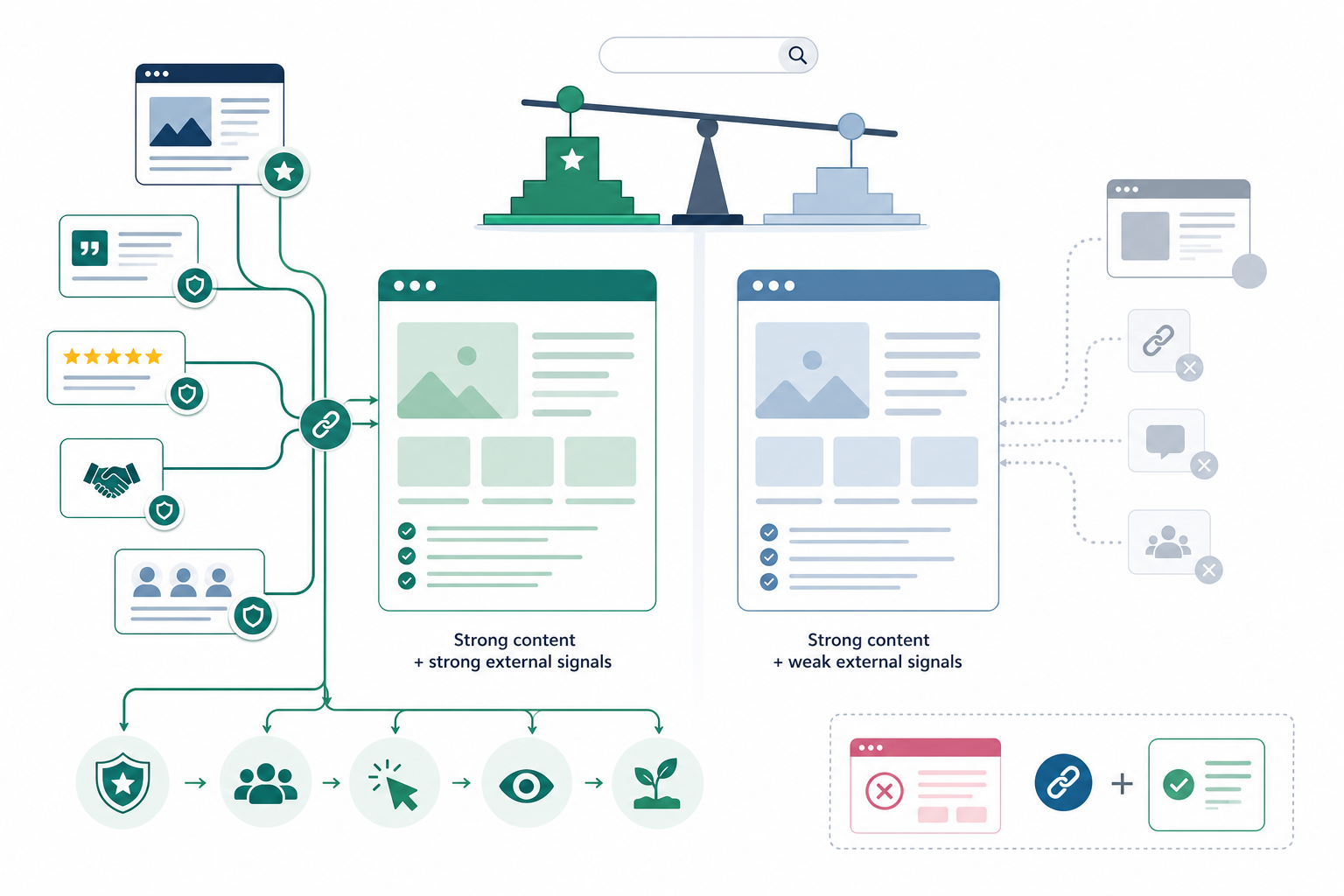
Off-page SEO is important because external links, mentions, coverage, reviews, and other third-party references can strengthen the authority, reputation, and competitiveness of a website beyond what on-site optimization alone can provide.
Its main benefits include:
- Strengthen external authority
- Relevant editorial backlinks show that other websites consider the page, resource, brand, or information worth referencing.
- Relevance, context, and source quality matter more than raw backlink quantity.
- Support competitive rankings
- External authority can strengthen the ability of relevant pages to compete in search results.
- This becomes particularly important where several competing pages already satisfy similar search intent and content requirements.
- Backlinks alone do not determine rankings.
- Build brand reputation
- Industry mentions, editorial coverage, partnerships, reviews, and other third-party references can reinforce how a company is perceived in its market.
- These broader reputation benefits should remain separate from direct ranking claims where the relationship is unclear.
- Expand search visibility
- Strong external references can support the competitive position of important pages and strengthen the wider organic presence of the website.
- Their effect still depends on page relevance and technical accessibility.
- Drive referral traffic
- Relevant external links can send visitors directly to the website.
- Referral value depends on the audience and relevance of the referring source.
- Increase brand awareness
- Media coverage, partnerships, external publications, communities, and PR can introduce the brand to people who have not previously encountered it.
- Greater awareness can also create future search demand and link opportunities.
- Support content distribution
- Useful assets gain more reach when third parties reference, cite, mention, or distribute them.
- Wider discovery increases opportunities for additional references and links.
- Create third-party validation
- Independent external references provide credibility that a business cannot establish entirely through claims published on its own website.
- Credibility depends on the quality and legitimacy of the source.
- Strengthen competitive positioning
- Comparing backlink profiles, media coverage, and external mentions can reveal where competitors have stronger authority or market presence.
- These gaps can guide opportunity research without requiring the business to copy every competitor backlink.
- Support long-term organic growth
- Strong resources and reputable brands can continue attracting links, mentions, referrals, and branded searches over time.
- Organic performance still changes with competition, search demand, algorithms, and website conditions.
Authority is not the same as popularity. A website can accumulate many links or mentions without gaining meaningful SEO value if those references are irrelevant or low quality.
Off-page SEO also cannot compensate for serious weaknesses in content, search-intent alignment, crawling, or indexing. Its value is strongest when external authority supports a website that already provides useful and accessible pages.
Which Activities Make Up an Off-Page SEO Strategy?
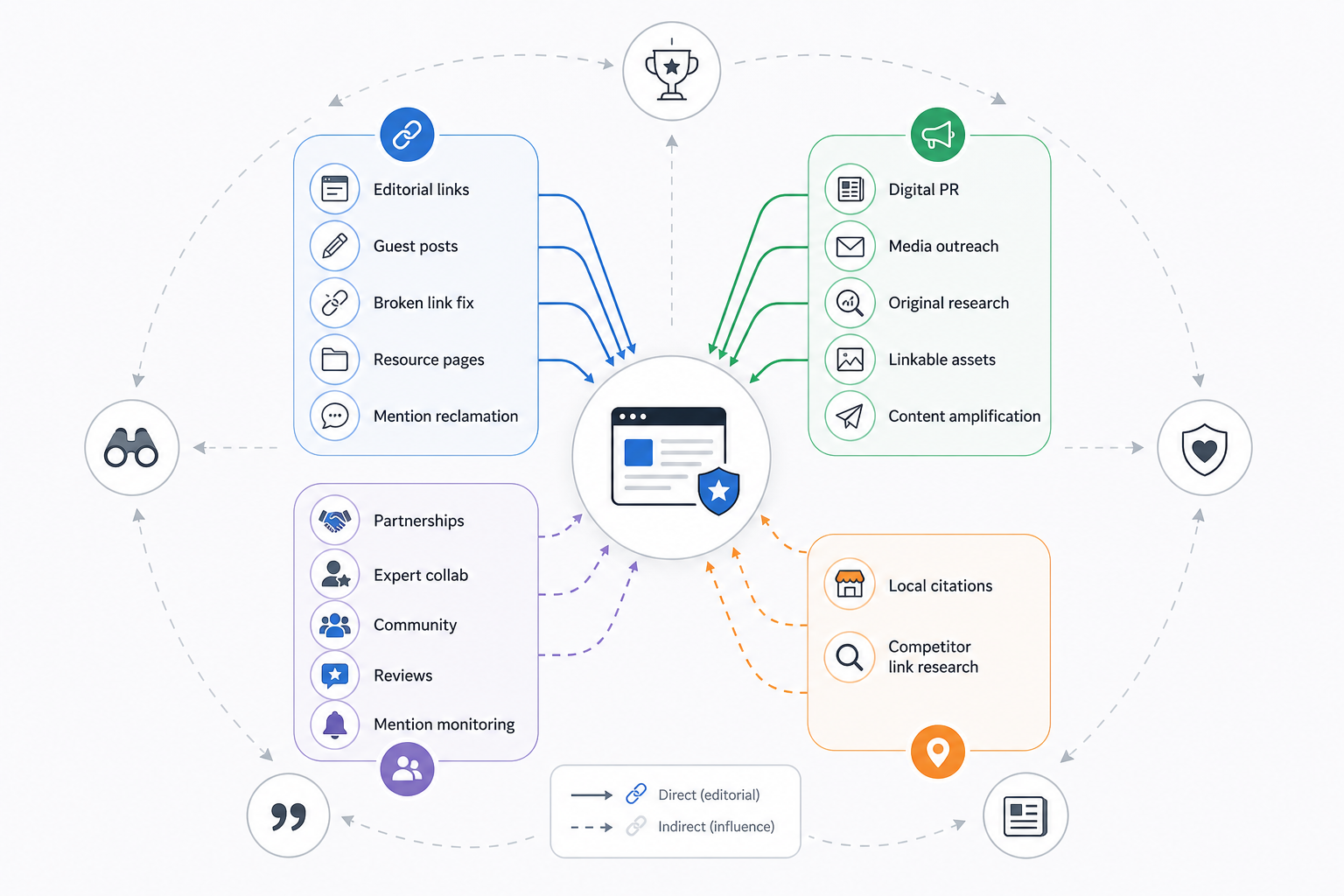
An off-page SEO strategy combines external activities designed to earn links, mentions, coverage, citations, relationships, and other forms of third-party visibility that can strengthen authority, reputation, and discovery.
The main activities include:
- Link building and link earning
- Acquire relevant editorial backlinks from credible external websites.
- Links can come through useful assets, publisher outreach, partnerships, resource inclusion, or naturally earned references.
- Prioritize relevance and editorial context over backlink quantity.
- Digital PR and media outreach
- Create stories, original data, research, expert commentary, or campaigns that can earn media coverage.
- PR can generate both brand discovery and editorial backlinks.
- Guest contributions
- Contribute useful expert content to relevant publications with genuine audience fit and editorial standards.
- Treat guest contributions as an expertise and visibility activity rather than a mass link-production tactic.
- Brand mention monitoring
- Track references to the company, products, founders, experts, or proprietary assets.
- Mention monitoring helps measure visibility and identify potential relationship or link opportunities.
- Unlinked mention reclamation
- Find credible existing mentions that do not link to the relevant website.
- Request a link where it genuinely improves attribution or helps the reader reach the referenced source.
- Broken-link building
- Identify broken resources on relevant external pages.
- Suggest a suitable replacement only when the website already has a genuinely useful alternative resource.
- Resource-page and editorial outreach
- Find industry guides, directories, reference pages, roundups, and resource collections where the website or asset provides clear value.
- Editorial fit matters more than placement volume.
- Partnership and relationship building
- Build relationships with complementary businesses, publishers, experts, associations, and communities.
- Legitimate relationships can create co-marketing, references, partnerships, and external exposure.
- Reciprocal linking should not be the primary objective.
- Community participation
- Contribute useful expertise in relevant forums, communities, professional groups, and Q&A environments.
- The primary objective is reputation and discovery rather than inserting links.
- Influencer and expert collaboration
- Work with relevant specialists or creators on research, interviews, events, campaigns, and content.
- These collaborations can expand reach and generate organic references.
- Influencer links should not automatically be assumed to provide ranking value.
- Local citations and business profiles
- Location-based businesses can maintain accurate information across relevant directories, review platforms, industry listings, and Google Business Profile.
- This activity is conditional on local search being relevant to the business.
- Review and reputation activity
- Encourage legitimate customer reviews and monitor relevant review environments.
- Reviews mainly support reputation, trust, and local visibility rather than acting as one universal direct ranking signal.
- Content amplification
- Distribute useful content through newsletters, partnerships, communities, social channels, and outreach.
- Wider exposure can increase the chance of future links and mentions even when the distribution activity itself is not a ranking factor.
- Original research and linkable assets
- Create studies, statistics, datasets, calculators, templates, tools, visual resources, and reference material that publishers have a genuine reason to cite.
- These owned assets often provide the foundation for link earning.
- Competitor backlink opportunity research
- Analyze relevant competitor links to discover publishers, asset types, industry resources, partnerships, and content formats.
- Use competitor data for opportunity discovery rather than reproducing every backlink.
Some of these activities are directly designed to earn links. Others primarily improve visibility, relationships, reputation, referral exposure, or future link potential.
Earned editorial references also differ from sponsored, affiliate, paid, or otherwise controlled placements. The nature of the relationship and placement matters when evaluating SEO value.
A strong offpage SEO strategy therefore uses several forms of credible external visibility instead of relying on one repetitive link-acquisition tactic.
Which Tools Can Support Off-Page SEO?
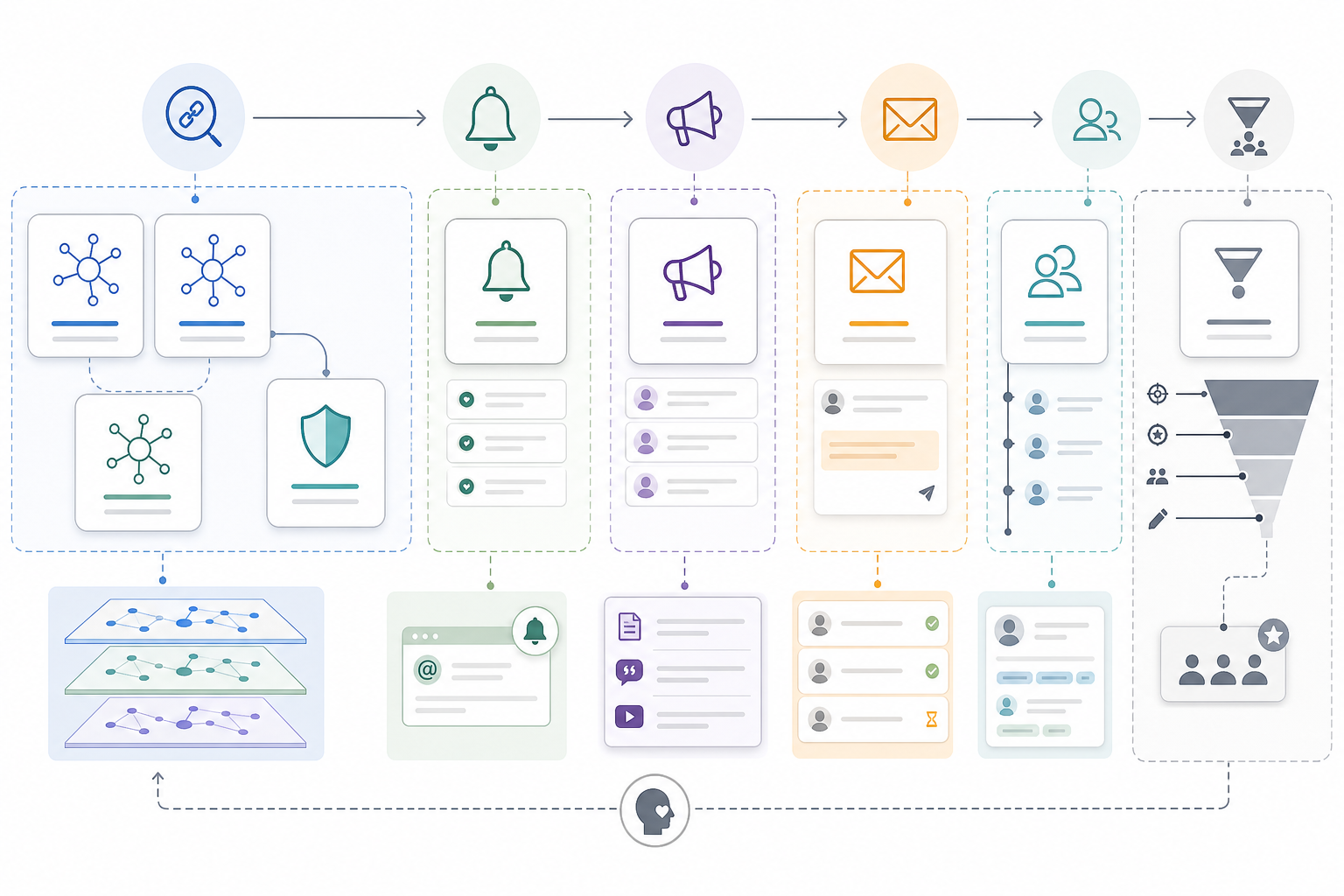
Off-page SEO tools support backlink analysis, competitor research, brand monitoring, digital PR, prospect discovery, outreach, and relationship management.
No single platform covers every off-page requirement.The broader range of SEO tools also supports keyword research, technical analysis, content evaluation, rankings, analytics, and reporting beyond off-page work.
| Tool | Best For | Main Off-Page Capability | Evidence / Output | When to Use It |
|---|---|---|---|---|
| Ahrefs | Backlink research | Referring domains, competitor links, lost links, broken links | Backlink database and comparative evidence | Link analysis and prospect discovery |
| Semrush | Backlink and competitor analysis | Backlink gaps, link monitoring, referring domains | Third-party backlink and competitor data | Competitive off-page research |
| Moz Link Explorer | Link comparison | Backlink discovery and authority metrics | Link index and modeled metrics | Comparative link research |
| Brand24 | Mention monitoring | Web, news, and social mentions | Brand-reference monitoring | Reputation and unlinked mention discovery |
| BuzzSumo | PR and content research | Publisher, journalist, influencer, content discovery | External content and amplification data | Digital PR and content promotion |
| BuzzStream | Outreach management | Prospect tracking, follow-ups, relationship history | Outreach CRM | Publisher and relationship management |
| Respona | Prospecting and outreach | Campaign organization, prospect discovery, communication | Outreach workflow | Link building and digital PR execution |
Ahrefs
Ahrefs is particularly useful for:
- Referring-domain research
- Backlink analysis
- Competitor links
- Lost backlinks
- Broken links
- Linked-page analysis
Its primary role in off-page SEO is research and evidence rather than outreach management.
Semrush
Semrush can support:
- Backlink analysis
- Backlink-gap research
- Link monitoring
- Competitor research
- Referring-domain analysis
Proprietary authority and toxicity metrics remain third-party indicators rather than Google metrics.
Moz Link Explorer
Moz Link Explorer provides:
- Backlink discovery
- Competitor comparison
- Linking-domain data
- Modeled authority metrics
Domain Authority can provide comparative context, but it is not a Google ranking score.
Brand24
Brand24 supports mention monitoring across external sources.
Use it to identify:
- Brand mentions
- Product mentions
- Reputation changes
- PR opportunities
- Potential unlinked mentions
Mention monitoring is useful even when the reference does not create a backlink.
BuzzSumo
BuzzSumo can help identify:
- Popular external content
- Publishers
- Journalists
- Influencers
- Content amplification opportunities
Its strongest role is content and PR discovery rather than backlink measurement alone.
BuzzStream
BuzzStream acts as an outreach and relationship-management system.
Use it for:
- Prospect organization
- Communication history
- Follow-ups
- Publisher relationships
- Campaign tracking
It complements backlink research tools rather than replacing them.
Respona
Respona supports:
- Prospect discovery
- Outreach workflows
- Digital PR campaigns
- Link-building communication
- Campaign organization
AI-assisted outreach features can increase workflow efficiency, but they do not guarantee editorial interest or successful placement.
A practical off-page tool setup usually combines research, monitoring, prospect discovery, outreach management, and relationship tracking.
Different backlink databases also produce different results because each provider operates its own index and methodology. No single database contains every link on the web.
Tool-generated metrics should support evaluation rather than replace it. A high authority score does not automatically make a website a strong prospect if its content, audience, editorial quality, or topical relevance is poor.
How Should Off-Page SEO Performance Be Measured?
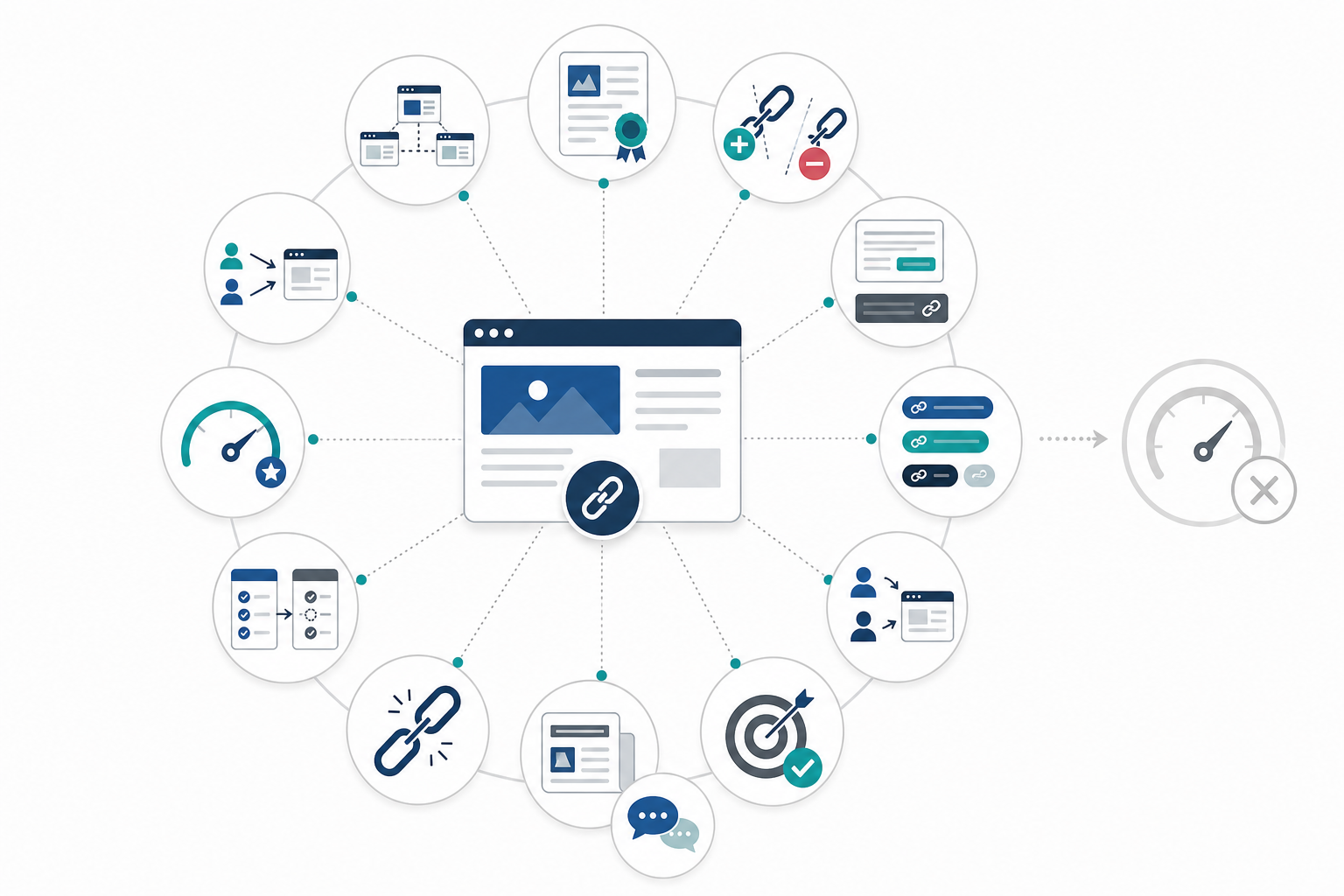
Off-page SEO performance should be measured through the quality, relevance, growth, and impact of external signals rather than through backlink quantity alone.
No single off page SEO score can represent external authority, brand visibility, referral value, competitive strength, and business impact simultaneously.
| Metric | What It Measures | Why It Matters | Main Interpretation Caution |
|---|---|---|---|
| Referring Domains | Unique websites linking to the site | Shows breadth of external link support | Relevance matters more than raw count |
| Backlink Quality and Relevance | Credibility and topical fit of links | Helps evaluate link value | Cannot be reduced to one authority score |
| New and Lost Links | Changes in external support | Shows whether link profile is strengthening or weakening | Normal fluctuations occur |
| Link Placement and Context | Where and how a link appears | Helps distinguish strong editorial references | Placement quality varies substantially |
| Anchor Text | Language used in links | Provides topical context | Arbitrary ratio targets are unnecessary |
| Referral Traffic | Visitors arriving through links | Measures audience value | Some strong links produce limited traffic |
| Referral Conversions | Business outcomes from referrals | Measures commercial value | Depends on attribution quality |
| Brand Mentions | Linked and unlinked references | Shows external visibility and reputation | Mentions are not automatically ranking signals |
| Digital PR Coverage | Relevant media exposure | Measures earned reach and authority | Article quantity alone has limited value |
| Link Reclamation | Recovered links or mentions | Measures successful recovery | Evaluate against meaningful opportunities |
| Competitive Link Gap | Difference in relevant external support | Identifies authority opportunities | Do not reproduce every competitor link |
| Third-Party Authority Metrics | Modeled domain or page strength | Useful for comparison | Not Google ranking scores |
Referring Domains
Track the number and quality of unique websites linking to the website.
Growth in relevant referring domains often provides more useful context than backlink count because one domain can create many individual links.
Evaluate:
- Topical relevance
- Editorial quality
- Website legitimacy
- Link context
- Audience fit
Backlink Quality and Relevance
Review whether links come from credible and relevant sources.
A useful editorial reference from an industry publication can have greater strategic value than many low-quality links from unrelated websites.
Avoid reducing link quality to Domain Rating, Domain Authority, or another proprietary metric.
New and Lost Links
Monitor meaningful gains and losses over time.
Investigate important lost links when they:
- Pointed to strategic pages
- Came from credible sources
- Produced referral traffic
- Represented strong editorial references
Do not react to every routine backlink fluctuation.
Link Placement and Context
Evaluate where the link appears.
Examples include:
- Editorial body content
- Resource pages
- Navigation
- Directories
- Author bios
- Partner pages
A contextual editorial link inside relevant content differs from a controlled or low-value placement.
Anchor Text Distribution
Review anchor patterns where link-profile analysis requires it.
Anchor text can provide useful topical context and expose unnatural concentration, but there is no universal ideal ratio for branded, exact-match, partial-match, or generic anchors.
Referral Traffic
Measure visitors arriving through external links.
This identifies websites and publications that create direct audience value independent of potential search impact.
Referral Conversions
Track whether referral visitors generate:
- Leads
- Purchases
- Sign-ups
- Bookings
- Other business outcomes
This helps distinguish links that contribute commercially from links that only increase the size of the backlink profile.
Brand Mentions
Monitor linked and unlinked references to:
- Company name
- Products
- Founders
- Experts
- Proprietary assets
Mention growth can support reputation and brand visibility without necessarily providing a direct ranking signal.
Digital PR and Media Coverage
Evaluate:
- Relevant publications
- Earned mentions
- Editorial links
- Referral reach
- Campaign exposure
Avoid measuring PR success only through article volume.
Link Reclamation Performance
Where link recovery forms part of the strategy, monitor:
- Lost links recovered
- Unlinked mentions converted
- Broken references updated
Measure performance against relevant opportunities rather than outreach volume.
Competitive Link Gaps
Compare relevant referring-domain and backlink support with important competitors.
This can reveal:
- Publishers already linking within the industry
- Missing authority sources
- Strong competitor assets
- Partnership opportunities
Use the comparison to identify realistic opportunities rather than match competitor link counts mechanically.
Third-Party Authority Metrics
Metrics such as:
- Domain Authority
- Domain Rating
- Authority Score
can provide comparative context.
They are proprietary tool metrics and should not be presented as Google ranking scores.
Off-page performance also needs to distinguish SEO value from wider marketing value. PR coverage, social amplification, reviews, communities, and mentions can create awareness, referral traffic, reputation, and future link opportunities even when their direct search impact cannot be isolated.
The strongest measurement framework therefore combines external authority, referral value, brand visibility, competitive position, and business outcomes.
When Should You Use Off-Page SEO Services?
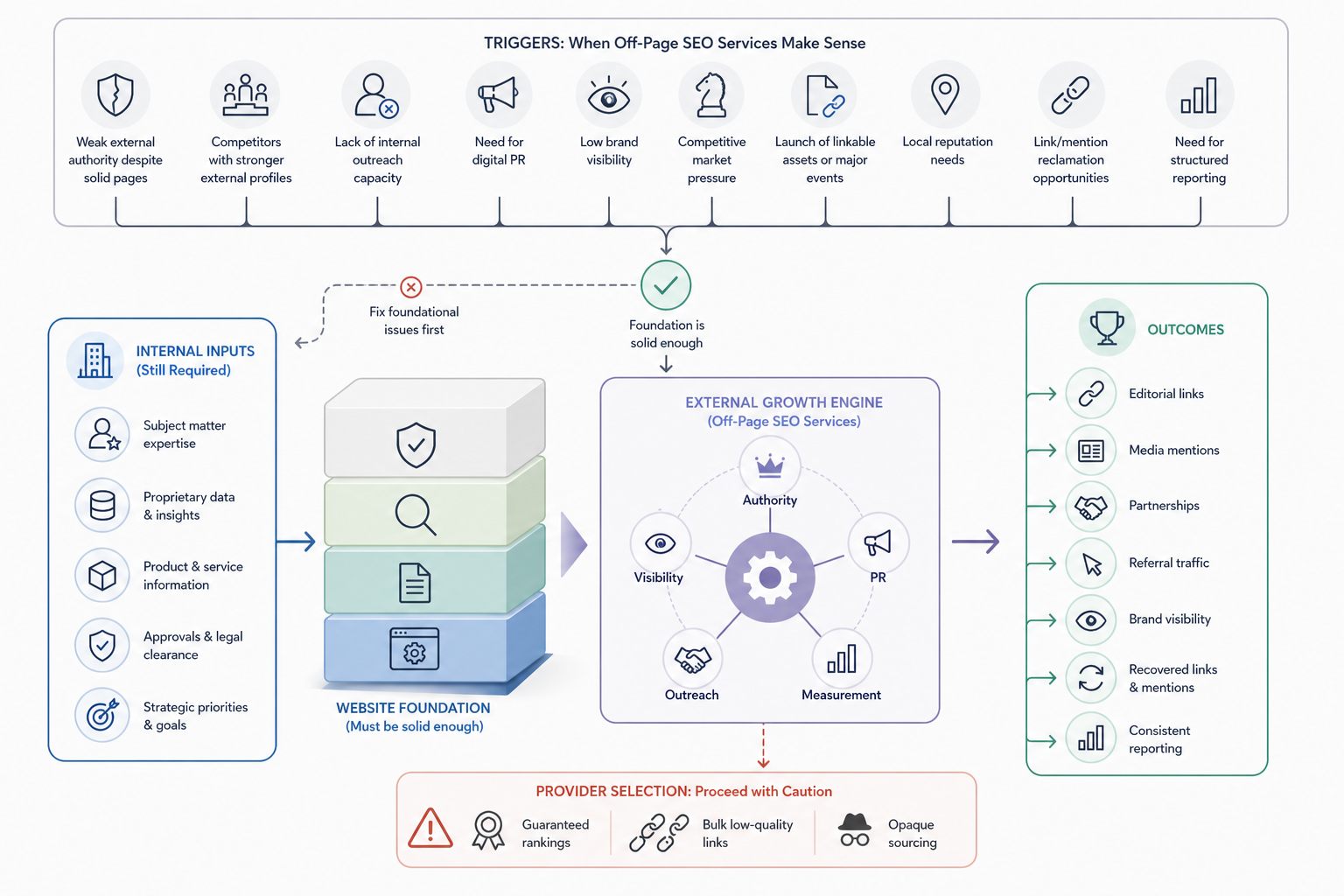
Off-page SEO services are most useful when external authority, visibility, PR capability, or execution capacity has become a genuine growth constraint and the website already has a sufficiently sound technical, indexing, content, and on-page foundation.
The website does not have to be perfectly optimized before off-page work begins. Major crawl, indexation, content-quality, or search-intent problems still deserve attention, while relevant on-site and external work can progress together.
Common reasons to use specialist support include:
- Use services when external authority is the main constraint
- Important pages can be technically accessible, relevant, and useful but still lack enough credible external references to compete strongly.
- Validate relevance, intent, indexing, and competition before assuming that every ranking problem is caused by backlinks.
- Use services when competitors have substantially stronger external profiles
- Relevant competitors can have stronger editorial links, industry references, partnerships, or media coverage.
- Specialist research can identify realistic authority gaps without trying to copy every competitor backlink.
- Use services when link building requires dedicated expertise
- Prospecting, publisher evaluation, communication, follow-ups, negotiation, placement review, and relationship management require consistent execution.
- Internal SEO teams may not have sufficient capacity for these tasks.
- Use services when digital PR is required
- Specialist support can help with:
- Campaign concepts
- Media research
- Journalist outreach
- Expert commentary
- Research promotion
- Reactive PR
- Media relationships
- Specialist support can help with:
- Use services when external brand visibility is weak
- Strong businesses can remain underrepresented across relevant publications, communities, and industry websites.
- PR and outreach can increase external recognition and create future link opportunities.
- Use services when internal outreach is inconsistent
- Outsourcing can provide dedicated prospect research, follow-up, relationship tracking, and campaign management.
- Evaluate quality of relationships and editorial outcomes rather than email volume.
- Use services in highly competitive search markets
- Competitive industries can require sustained authority building through links, expert contributions, PR, and industry visibility.
- The objective is not simply to match a competitor’s backlink count.
- Use services when launching linkable assets
- Original research, data, tools, calculators, reports, and guides often require promotion before relevant publishers discover them.
- Specialist outreach can increase their exposure.
- Use services during important launches
- Product launches, rebrands, new-market entry, category expansion, research releases, and other notable events can create temporary PR opportunities.
- Use services for local reputation growth where relevant
- Local businesses can benefit from citation work, review strategy, local partnerships, directories, and local PR.
- These services are not necessary for businesses without a local-search objective.
- Use services when mentions and links need systematic recovery
- Specialists can monitor:
- Lost editorial links
- Broken destination URLs
- Unlinked mentions
- Outdated citations
- Reclaimable references
- Specialists can monitor:
- Use services when measurement requires stronger structure
- Agencies and specialists can monitor relevant referring domains, brand mentions, media coverage, referral traffic, competitive gaps, and campaign outcomes consistently.
Typical off-page SEO services can include link opportunity research, editorial outreach, digital PR, asset promotion, brand monitoring, link reclamation, broken-link opportunities, competitor research, publisher discovery, partnership development, outreach management, and reporting. When link acquisition is the primary requirement, dedicated link building services narrow that broader scope to prospect research, publisher evaluation, outreach, placement management, and link-focused reporting.
Outsourcing does not eliminate the need for internal involvement. External teams can still require:
- Subject-matter expertise
- Original company data
- Content assets
- Brand positioning
- Approvals
- Product information
- Campaign priorities
Provider selection also matters.
Evaluate an off-page SEO company according to:
- Relevance standards
- Editorial quality
- Transparency
- Outreach methodology
- Publisher evaluation
- Reporting
- Risk controls
- Relationship quality
Be cautious with providers that guarantee rankings, sell fixed volumes of “high-DA” backlinks without context, depend heavily on low-quality publishing networks, or cannot explain where links come from.
Domain Authority, Domain Rating, and similar metrics should not be the sole criteria for judging a publisher or link opportunity.
Off-page SEO services make the most sense when external authority or execution capacity has become a genuine growth constraint and specialist support can improve the quality, consistency, and measurability of external visibility efforts.
Need links on real SaaS and business websites?
Links are placed after your approval, on sites with guaranteed DR and traffic, with a 1-year replacement guarantee.

