
Ecommerce SEO: Search Marketing, Importance, Strategy, Large-Site SEO & Tools
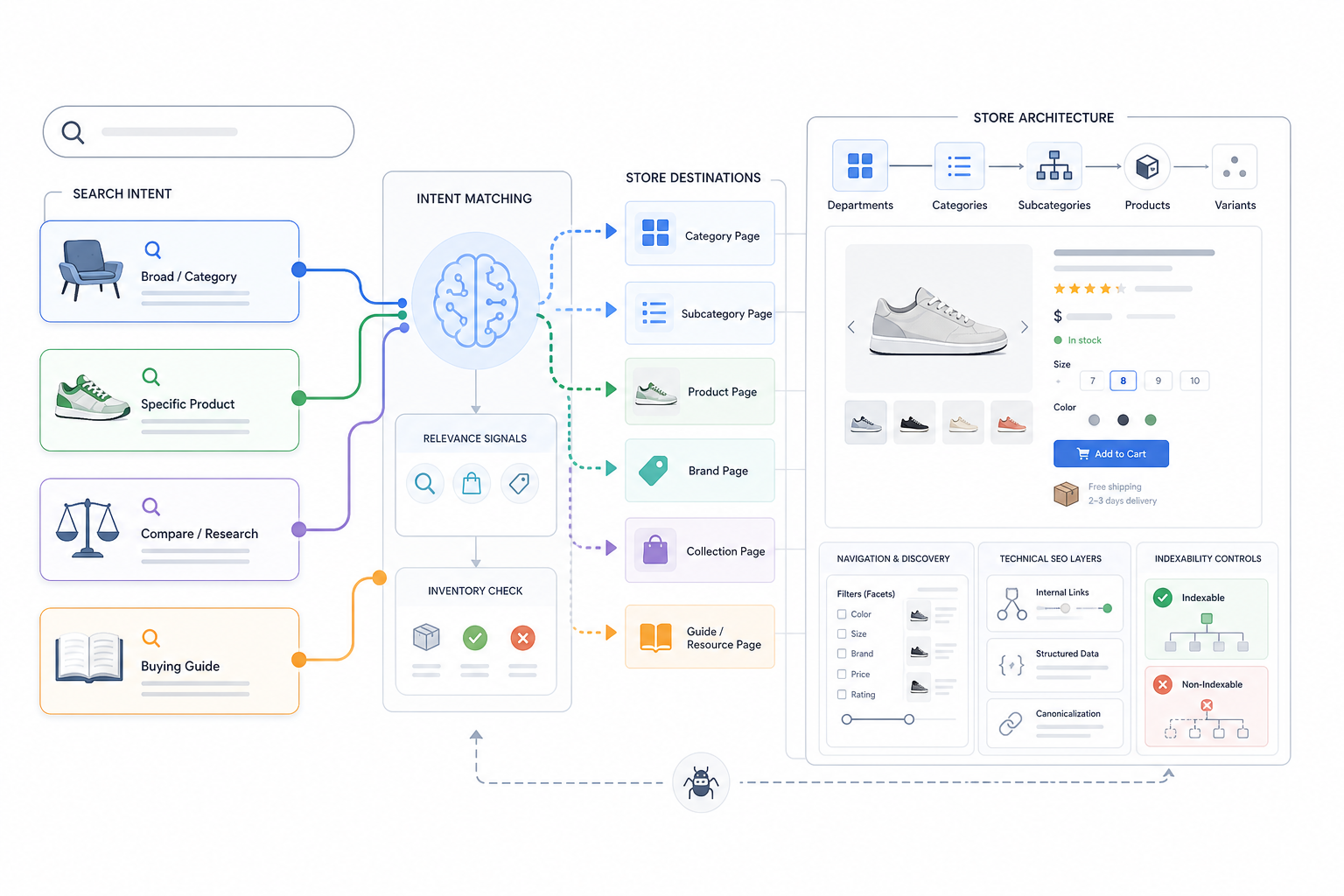
Ecommerce SEO is the process of improving an online store’s organic search visibility so relevant product, category, brand, collection, and informational pages can appear when shoppers search for products or purchasing information. It applies general SEO principles to online stores, where organic visibility is directly connected with inventory, product information, category structure, availability, merchandising, and shopper demand.
Ecommerce SEO is not limited to ranking individual product pages. Searchable store assets can include category pages such as running shoes, subcategory pages such as trail running shoes, product pages such as Nike Pegasus 41, brand pages such as Nike, collection pages such as waterproof running shoes, comparison pages such as trail shoes vs road shoes, buying guides such as how to choose running shoes, and informational resources such as shoe-sizing guides.
The correct landing page depends on what the shopper wants to accomplish. A broad search such as “men’s running shoes” can require a category page containing multiple relevant products, while a specific search such as “Nike Pegasus 41 men’s size 10” can require an individual product page containing that model, size availability, price, images, specifications, and purchase information.
Ecommerce SEO therefore has to connect search demand with inventory the store can actually supply. A keyword can have measurable search volume but limited business value when the store does not carry an appropriate product, cannot ship to the searcher’s market, or cannot satisfy the expected purchasing requirement.
Search intent across ecommerce can include several tasks, such as browsing a product category, finding a specific model, comparing brands, checking specifications, researching product suitability, finding a local retailer, checking availability, or purchasing an item. Commercial searches are not automatically immediate purchase searches. A shopper searching for “best office chairs” can still be evaluating options, while someone searching for an exact model and SKU can have a much narrower product-discovery need.
The main components of ecommerce SEO include keyword and intent research, site architecture, on-page SEO, product-page SEO, technical SEO, internal linking, structured data, content, external authority, and measurement. These components support one central objective: making the most relevant store resource accessible and competitive for a search need the business can genuinely satisfy.
Store architecture has particular importance because ecommerce websites can contain interconnected entities such as departments, categories, subcategories, brands, products, variants, attributes, filters, and collections. A footwear store, for example, can contain shoes as a department, running shoes as a category, trail running shoes as a subcategory, Nike as a brand, Pegasus Trail as a product, black as a color attribute, size 10 as a variant, and waterproof running shoes as a useful collection.
Filters also create additional technical complexity. Attributes such as size, color, brand, material, price, rating, compatibility, and availability can generate many URL combinations. Some combinations can represent useful search landing pages, while others exist only to help shoppers filter inventory and do not require independent organic visibility.
Product pages require clear product identity and accurate commerce information. Important attributes can include product name, brand, model, specifications, dimensions, material, color, variants, images, price, availability, shipping, reviews, compatibility, and warranty information. Complete product information helps search systems distinguish the entity and helps shoppers evaluate whether the item satisfies their requirement.
Content also extends beyond blogging. Ecommerce content can exist on product descriptions, category introductions, comparison pages, buying guides, FAQs, brand pages, collection pages, sizing resources, installation guides, and product-care articles. Its role is to help shoppers understand products, categories, differences, applications, and purchasing considerations.
Technical ecommerce SEO manages website conditions affecting discovery, crawling, rendering, indexation, canonicalization, duplicate URLs, faceted navigation, pagination, structured data, product lifecycle changes, and JavaScript-driven interfaces. Making a URL indexable does not mean it will automatically rank, and making more URLs indexable does not automatically increase search visibility.
Internal links connect related ecommerce resources, such as categories with subcategories, categories with products, products with alternatives, brands with products, buying guides with categories, and comparison pages with relevant product pages. These connections support navigation, discovery, hierarchy, context, and internal PageRank distribution.
Structured data can represent eligible commerce information, such as product identity, offers, price, currency, availability, reviews, ratings, and breadcrumbs, when the markup accurately reflects the visible page. Correct structured data can establish eligibility for supported search features, but it does not guarantee rich results or higher rankings.
Ecommerce SEO also differs from conversion-rate optimization. SEO focuses primarily on whether relevant store pages can be discovered and compete for appropriate searches, while conversion-rate optimization focuses on what happens after shoppers arrive. Conversion can depend on factors such as price, product fit, stock availability, shipping, reviews, return policies, payment methods, trust, mobile usability, and checkout design.
It also differs from merchandising. Merchandising determines how products are commercially organized and presented through elements such as categories, collections, promotions, recommendations, and assortment decisions. SEO evaluates which of those structures correspond with identifiable search demand and how useful versions should be exposed to search engines.
Organic clicks do not carry a direct advertising cost per click, but ecommerce SEO is not free. Stores can invest in SEO specialists, developers, product data, content, digital PR, software, technical maintenance, merchandising resources, and analytics.
The purpose of ecommerce SEO is therefore to connect shopper search demand with the most relevant store page while ensuring that the page is accessible, understandable, useful, commercially accurate, and capable of supporting product discovery and ecommerce outcomes.
Where Does Ecommerce SEO Fit Into Search Marketing?
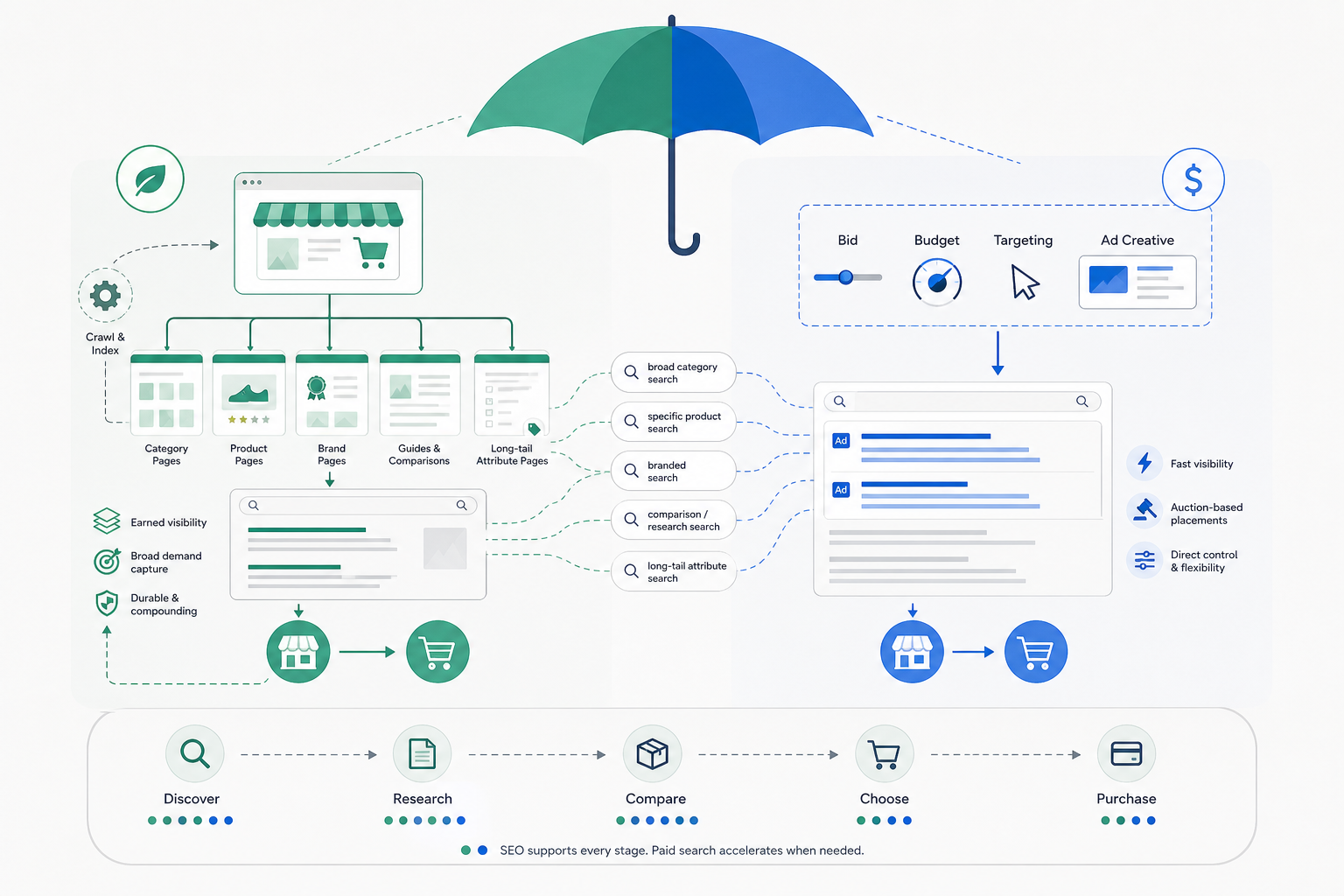
Ecommerce SEO is the organic-search component of search marketing, helping stores earn visibility for product, category, brand, comparison, and informational searches without paying a direct advertising fee for each organic click. Paid search can target many of the same shopper needs through sponsored placements controlled by advertising campaigns.
The term “search marketing” can be used differently across organizations. In this article, it includes both organic search optimization and paid search activity so their roles in ecommerce acquisition can be compared directly.
| Search Marketing Attribute | Ecommerce SEO | Paid Search | Ecommerce Implication |
|---|---|---|---|
| Visibility Method | Earns organic visibility through relevant, accessible, competitive pages | Gains sponsored visibility through advertising auctions | Stores can appear organically, through ads, or through both |
| Cost Model | No direct charge for each organic click, but SEO requires operating investment | Usually requires ongoing media spend for paid traffic | Both channels have acquisition costs |
| Speed | Depends on crawling, indexing, competition, page quality, and search demand | Visibility can begin after campaigns become active | Paid search can support faster campaign activation |
| Search Demand Coverage | Can cover categories, products, brands, comparisons, guides, and long-tail searches | Can target queries permitted by campaign structure and advertising systems | Channel coverage can overlap substantially |
| Landing Pages | Commonly uses category, product, brand, collection, comparison, and informational pages | Can use store pages or dedicated campaign landing pages | Landing-page suitability matters in both channels |
| Control | Rankings are determined by search systems | Advertisers control bids, budgets, targeting, and ads within platform rules | Paid search provides greater direct campaign control |
| Durability | Pages can retain visibility while they remain relevant and competitive | Paid visibility generally depends on campaign participation and spend | Organic visibility can persist without per-click media cost |
| Measurement | Clicks, impressions, rankings, sessions, transactions, revenue | Clicks, impressions, CPC, spend, conversions, ROAS, revenue | Business outcomes should be measured beyond visibility |
Organic Demand Capture
Ecommerce SEO helps stores capture searches involving products, product categories, brands, attributes, specifications, comparisons, use cases, and purchasing questions.
For example, an outdoor retailer can create organic entry points for:
- “hiking boots”
- “waterproof hiking boots”
- “Salomon hiking boots”
- “Salomon Quest 4 GTX”
- “best hiking boots for winter”
- “how should hiking boots fit”
Each search represents a different information requirement and can require a different ecommerce page.
Category Discovery
Category and subcategory pages can match broader product-class searches.
A query such as “women’s running shoes” can be better served by a page containing multiple applicable products, filters, brands, price ranges, sizes, and merchandising options than by one individual shoe.
Category SEO therefore supports both organic discovery and product exploration.
Product Discovery
Product pages can match narrower searches involving product names, models, SKUs, specifications, colors, configurations, sizes, or other defining attributes.
For example, “Sony WH-1000XM6 black” identifies a much more specific product requirement than “noise cancelling headphones.”
Commercial Research
Shoppers can use search before they are ready to transact.
Relevant assets include buying guides, comparison pages, category explanations, product FAQs, sizing resources, technical guides, and educational articles.
A search for “OLED vs Mini LED TV” can help a shopper decide which product category better suits their requirements before choosing an individual television.
Branded Search Support
Organic search can connect brand-oriented queries with the correct resources.
Examples include:
- Store homepage
- Brand category
- Product page
- Store location
- Returns page
- Support page
- Order information
Branded visibility improves navigation and discovery, but a ranking itself does not establish brand trust.
Long-Tail Demand Capture
Ecommerce catalogs naturally contain many combinations of entities and attributes.
Examples include:
- Brand + product type
- Product type + material
- Product type + size
- Model + specification
- Product type + audience
- Product type + use case
- Product + compatibility
A query such as “men’s waterproof leather hiking boots size 10” can have substantially less demand than “hiking boots” while representing a more specific inventory requirement.
This does not mean every attribute combination needs an indexable page. A filtered URL should become a search landing page only when the combination has sufficient search value, unique inventory, usefulness, and technical justification.
Search and Merchandising Alignment
SEO and ecommerce merchandising intersect where stores define category names, collection structures, product naming, filters, navigation, product relationships, and availability.
If shoppers consistently search for “waterproof trail running shoes” and the store has substantial matching inventory, a dedicated collection or subcategory can be more useful than forcing searchers into a generic running-shoes category and asking them to apply several filters.
Paid Search Support
Organic and paid search can coexist for the same queries.
Paid search data can help identify:
- Queries generating transactions
- High-value product categories
- Landing pages with weak conversion
- Search terms with strong commercial intent
Organic data can help identify:
- Pages already receiving visibility
- Queries receiving impressions without sufficient clicks
- Product categories with growing demand
- Landing pages with long-term organic opportunity
These datasets can inform one another without making the channels interchangeable.
Search-Result Coverage
Ecommerce stores can appear across several search surfaces, including organic results, sponsored search ads, Shopping results, images, videos, local listings, and other supported search features.
The exact result composition depends on the query and search engine.
Ecommerce SEO is responsible primarily for organic-search eligibility, relevance, and competitiveness. Paid-search and Shopping advertising depend on advertising systems, campaign settings, product feeds, bids, budgets, and related controls.
Acquisition Diversification
Organic search can add another acquisition source alongside channels such as paid search, paid social, marketplaces, affiliate marketing, email, direct traffic, and referral partnerships.
Diversification can reduce dependence on one channel, but it does not automatically reduce overall customer acquisition cost.
Revenue Contribution
Organic search becomes commercially meaningful when organic entry pages contribute to outcomes such as:
- Product views
- Add-to-cart events
- Transactions
- Average order value
- Revenue
- Repeat purchases
Revenue attribution can still involve several channels. A shopper can first discover a category organically, return through email, and later purchase through direct navigation.
Organic search should therefore be evaluated as part of the wider ecommerce acquisition system rather than as an isolated ranking exercise.
Why Is SEO Important for Ecommerce?
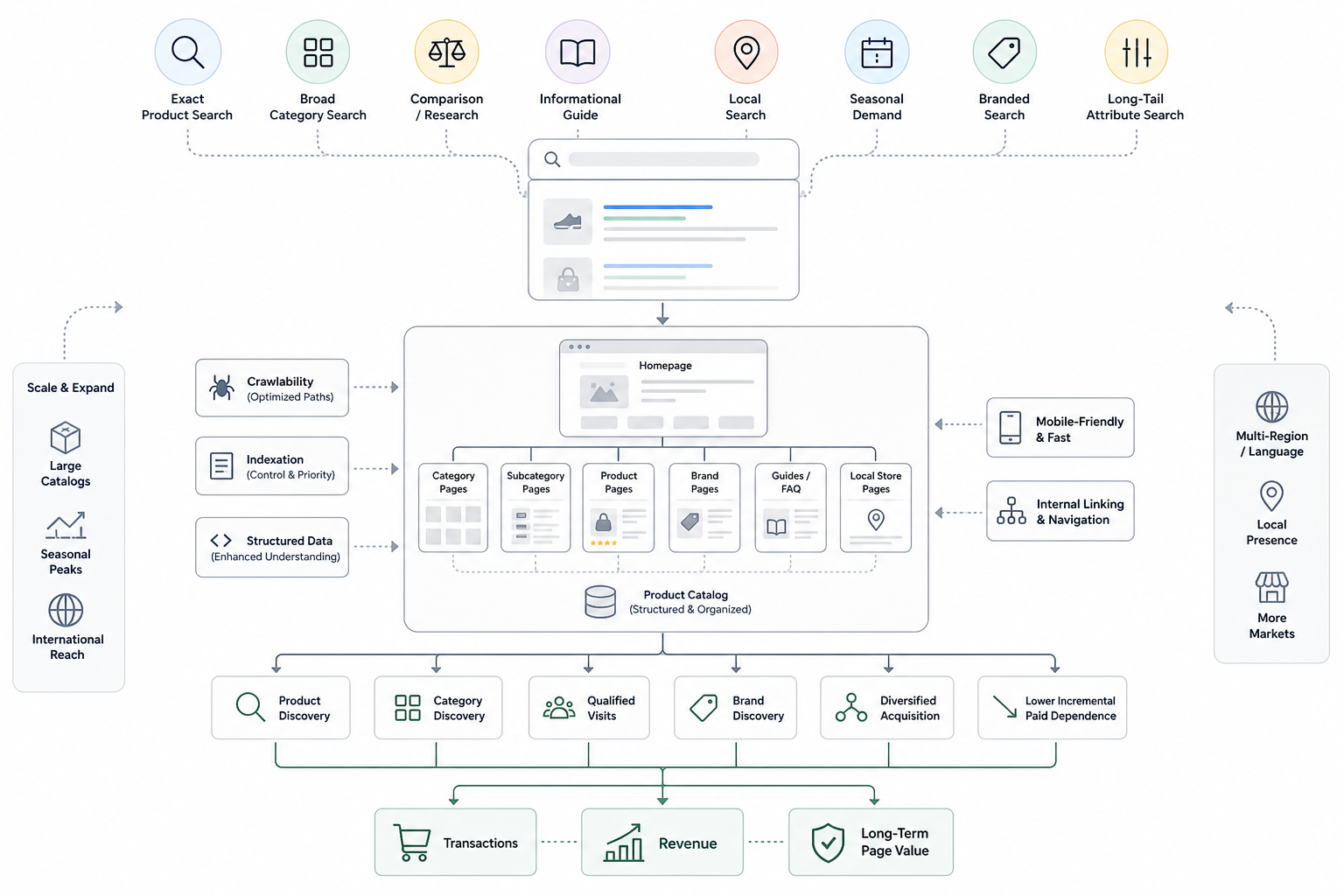
SEO is important for ecommerce because it allows online stores to appear when shoppers search for products, categories, brands, specifications, comparisons, and purchasing information that match the store’s inventory. Relevant organic visibility can contribute to product discovery, category discovery, qualified visits, transactions, and revenue without charging a direct media fee for each organic click.
Its ecommerce value can appear in several ways.
- Product Discovery: SEO can expose specific products through searches involving product names, models, attributes, specifications, sizes, colors, variants, or compatible devices. A shopper searching “Canon EOS R6 Mark II body” can discover retailers stocking that exact camera.
- Category Discovery: Category and subcategory pages can capture broader searches, such as “mirrorless cameras” or “full-frame mirrorless cameras,” and help shoppers explore multiple products.
- Commercial Demand Capture: Commercial and transactional queries, such as “best office chair for back pain” or “buy Herman Miller Aeron,” can connect the store with people actively evaluating or seeking products.
- Informational Demand Capture: Buying guides, comparison pages, tutorials, FAQs, sizing guides, compatibility resources, and maintenance content can attract shoppers who need information before selecting a product.
- Organic Customer Acquisition: Search can generate qualified store visits without a direct media charge for every click. The store still incurs SEO costs through people, software, development, product data, content, and ongoing maintenance.
- Acquisition Diversification: Organic search can operate alongside channels such as Google Ads, social advertising, Amazon, affiliates, marketplaces, email, and direct traffic rather than requiring one channel to supply all customer acquisition.
- Potential Acquisition-Cost Efficiency: Established pages can continue receiving organic visits without incremental CPC charges. Whether this improves customer acquisition economics depends on SEO operating costs and the commercial value of the resulting traffic.
- Long-Term Page Value: Category pages, brand pages, product pages, and buying resources can continue earning visibility after their initial creation while they remain relevant, available, technically accessible, and competitive.
- Revenue Contribution: Organic landing pages can generate transactions and revenue when the store provides the right product, price, stock, shipping, trust, and checkout experience.
- Brand Discovery: Non-branded searches, such as “organic cotton bedsheets,” can expose shoppers to retailers they did not already know.
- Branded Search Visibility: SEO can help searchers reach the correct brand, category, product, support, or location page after they already know the business.
- Competitive Search Presence: Product, category, comparison, alternative, and brand searches create opportunities to appear alongside other retailers or marketplaces competing for the same shopper demand.
- Long-Tail Product Demand: Catalog attributes such as brands, colors, sizes, specifications, materials, compatibility, and use cases can correspond with highly specific searches.
- Inventory Visibility: Search research can reveal demand for categories, products, attributes, or collections that already exist in the catalog but are difficult to find organically.
- Search Coverage at Scale: Larger catalogs can potentially create organic entry points across many categories, products, brands, models, and attributes when URL creation and indexation are controlled properly.
- Seasonal Demand: Recurring events such as Christmas, Diwali, Valentine’s Day, Black Friday, back-to-school periods, and seasonal weather can generate predictable search demand for relevant products.
- Local Ecommerce Visibility: Retailers with physical stores, pickup points, or local inventory can also serve geographic searches such as “running shoes near me” or “laptop store in Surat.”
- International Growth: Stores serving multiple markets can create localized experiences involving language, currency, inventory, delivery, and regional search demand.
- Site Usability Support: Ecommerce SEO can overlap with useful UX improvements through clearer navigation, understandable category structures, accurate product information, mobile usability, and efficient delivery.
- Crawl and Indexation Efficiency: Technical controls can help search engines focus on important products and categories while managing duplicate, parameterized, temporary, and low-value URLs.
- Structured Product Information: Accurate structured data can communicate supported commerce attributes, such as price, availability, rating information, and product offers.
- Search-Merchandising Alignment: Query data can show how shoppers describe categories, attributes, use cases, product types, and brands, informing commercially appropriate naming and landing-page decisions.
- Product-Demand Measurement: Search data can reveal impressions, clicks, query patterns, page visibility, and category demand that complement sales, onsite-search, merchandising, and market-research data.
These benefits can be grouped into three practical outcomes.
Demand Capture
SEO connects relevant shopper searches with products, categories, brands, collections, comparisons, and useful purchasing information.
Acquisition Diversification
Organic search becomes another acquisition source alongside paid media, marketplaces, email, social, affiliates, referrals, and direct traffic.
Commercial Value
Relevant organic visibility can contribute to product views, carts, transactions, revenue, repeat purchases, and other defined ecommerce outcomes.
Traffic volume alone is not the objective.
A store receiving 500 visits from shoppers looking for a product it sells can have more ecommerce value than a store receiving 20,000 visits from informational queries unrelated to its catalog.
Search visibility should also remain separate from conversion. Ranking a product or category creates an opportunity to attract the shopper. Purchase decisions still depend on attributes such as product fit, price, stock, delivery, reviews, policies, payment options, trust, UX, and checkout performance.
How to Do SEO for Ecommerce Websites?
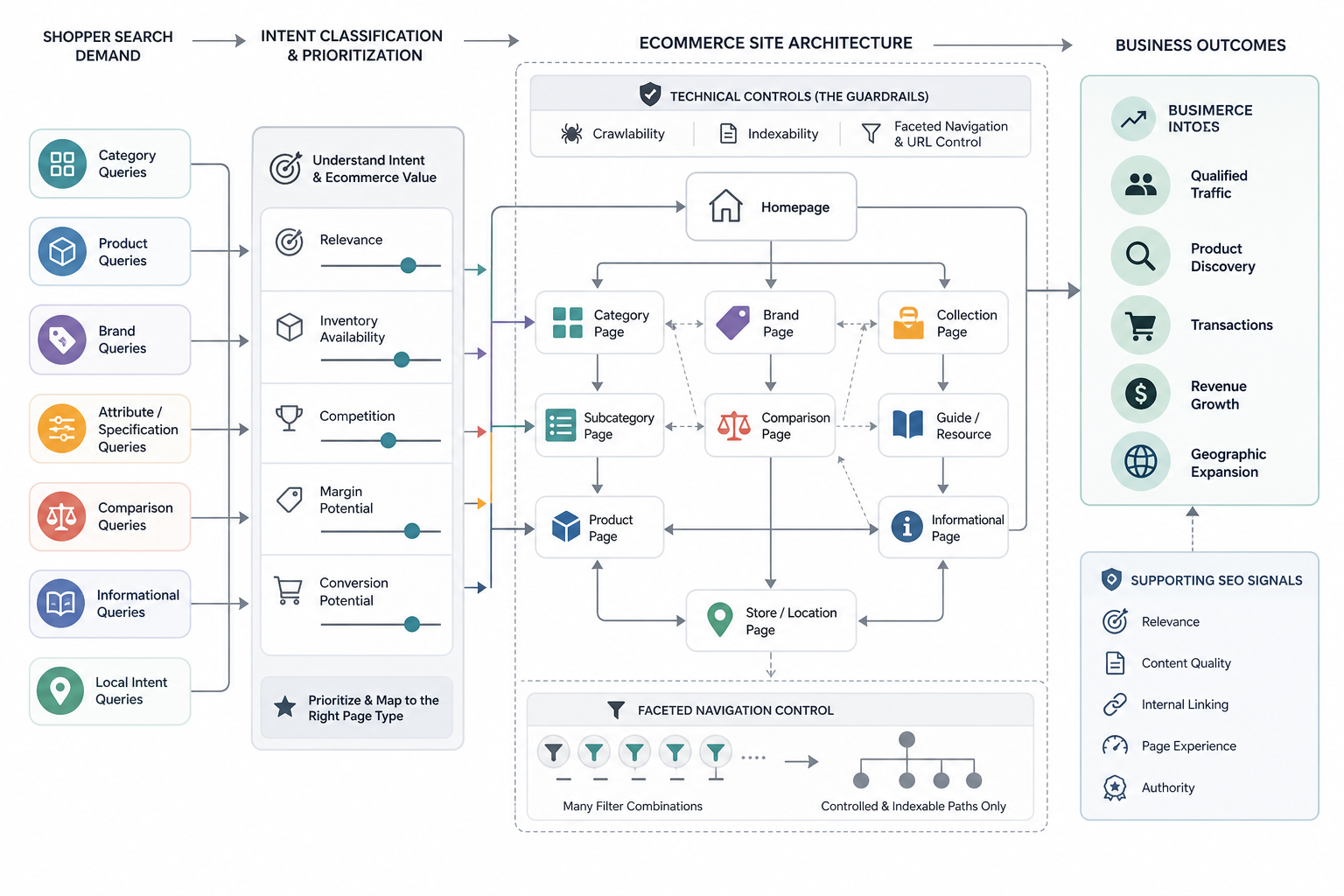
SEO for an ecommerce website is done by matching shopper search demand with the appropriate category, product, brand, collection, and informational pages while keeping the store technically accessible, logically structured, internally connected, useful, and measurable. The strategy must coordinate inventory, intent, architecture, page optimization, technical SEO, content, authority, conversion, and measurement instead of optimizing isolated products. A broader SEO strategy provides the framework for coordinating those areas, while ecommerce SEO adapts it to catalog structure, shopper demand, inventory, and commercial outcomes.
1. Define Ecommerce SEO Goals
Define the business outcomes SEO should support.
Examples include:
- Qualified organic visits
- Product discovery
- Category visibility
- Transactions
- Revenue
- Geographic expansion
- Reduced reliance on individual acquisition channels
Keep those business outcomes separate from supporting SEO indicators.
Supporting indicators include:
- Impressions
- Clicks
- Rankings
- Indexed URLs
- Organic sessions
- Referring domains
A strategy built only around “increase traffic” can prioritize searches that have little relationship with inventory or revenue.
2. Understand the Store, Inventory, and Shopper Context
Document what the store can actually sell.
Relevant inventory attributes include:
- Departments
- Categories
- Subcategories
- Brands
- Product types
- Models
- Variants
- Sizes
- Colors
- Materials
- Specifications
- Price ranges
- Use cases
- Seasonal products
- Geographic availability
Also document how customers describe those products.
A retailer can internally call a product “performance hydration vessel,” while shoppers can simply search for “insulated water bottle.”
Search language needs to reflect actual shopper behavior rather than internal merchandising terminology alone.
3. Research Ecommerce Search Demand
Research queries connected with the inventory.
Examples include:
- Category queries, such as “gaming laptops”
- Product queries, such as “MacBook Air M4 15 inch”
- Brand queries, such as “Lenovo laptops”
- Attribute queries, such as “32GB RAM laptop”
- Specification queries, such as “4K 144Hz monitor”
- Use-case queries, such as “laptop for video editing”
- Comparison queries, such as “OLED vs QLED”
- Alternative queries, such as “AirPods alternatives”
- Informational queries, such as “how to choose a mechanical keyboard”
- Local queries, such as “laptop shop near me”
Do not restrict ecommerce research to terms containing words such as “buy,” “shop,” or “price.”
4. Classify Search Intent
Determine what the user wants the result to provide.
Common ecommerce search needs include:
- Browse a category
- Find a particular product
- Compare options
- Review specifications
- Solve a product-related problem
- Find a brand
- Check availability
- Find a local seller
- Make a purchase
Validate the intent through the actual SERP.
If “running shoes” returns category and marketplace pages, a category experience can be appropriate.
If “Nike Pegasus 41” returns individual product pages, a product page can be appropriate.
Mixed SERPs can indicate more than one valid need.
5. Prioritize Keywords by Ecommerce Value
Evaluate queries using factors such as:
- Product relevance
- Category fit
- Inventory availability
- Search intent
- Search demand
- Competition
- Product margin
- Conversion potential
- Strategic importance
A query with high search volume should not receive priority when the store has weak inventory or cannot provide the result users expect.
Long-tail terms are not universally easier to rank for or more likely to convert. Their value depends on the individual search and product relationship.
6. Map Search Demand to the Correct Page Type
Assign related query groups to the page type most capable of satisfying them.
Examples include:
| Search Need | Appropriate Ecommerce Page |
|---|---|
| Broad product class | Category or subcategory |
| Specific manufacturer | Brand page |
| Specific item or model | Product page |
| Curated product group | Collection page |
| Product comparison | Comparison page |
| Purchase-selection question | Buying guide |
| Product-use question | Informational resource |
| Geographic purchase need | Store/location page |
Finding a keyword does not automatically justify creating a new URL.
Several related queries can belong to one page when they represent the same underlying task.
7. Build the Ecommerce Site Architecture
Create understandable relationships between store resources.
A common hierarchy can include:
- Homepage
- Category
- Subcategory
- Product
Additional relationships can connect:
- Brands
- Collections
- Use cases
- Buying guides
- Related products
- Comparisons
The correct hierarchy depends on the store.
A URL does not need to sit within an arbitrary three-click rule to succeed, but important inventory should have logical navigation and internal linking.
8. Control Faceted Navigation and Filter URLs
Filters can create large numbers of URLs.
Examples include combinations of:
- Brand
- Color
- Size
- Price
- Material
- Rating
- Capacity
- Compatibility
- Features
Evaluate whether each URL type should be:
- Crawlable
- Indexable
- Canonicalized
- Noindexed
- Blocked from crawling
- Consolidated
- Left purely as a user-interface state
A filtered page can deserve organic visibility when it represents meaningful demand and provides useful, sufficiently distinct inventory.
A filter does not need to become indexable simply because it creates a readable URL.
9. Optimize Category and Subcategory Pages
Category pages should satisfy product-browsing intent.
Useful category elements can include:
- Relevant product inventory
- Category name
- Filters
- Sorting
- Subcategories
- Brands
- Product attributes
- Supporting category context
- Internal links
A category page should remain primarily a shopping experience rather than becoming a long informational article.
10. Apply On-Page SEO Across Store Pages
Ensure that page-level elements accurately describe the resource.
Examples include:
- Titles
- Main headings
- Supporting headings
- Page copy
- Images
- Metadata
- Internal links
- Product attributes
- Structured data
- Commercial information
The required implementation differs between a category page, a product page, a brand page, and a buying guide.
Avoid fixed formulas for exact-match keywords, title lengths, keyword density, or word count.
11. Optimize Product Pages
Product pages should clearly communicate the individual product entity.
Important information can include:
- Product name
- Brand
- Model
- Description
- Specifications
- Price
- Availability
- Images
- Variants
- Reviews
- Shipping
- Returns
- Related products
The page should help both shoppers and search systems distinguish the product from similar inventory.
12. Build the Technical SEO Foundation
Review technical systems affecting important store URLs.
These include:
- Status codes
- Redirects
- Canonicals
- Robots directives
- XML sitemaps
- Duplicate URLs
- JavaScript rendering
- Pagination
- Mobile usability
- Website performance
- Inventory-driven URL changes
Technical accessibility allows pages to participate in organic search. It does not guarantee indexation or rankings.
13. Manage Product Availability and URL Lifecycle
Define how the site handles changing inventory.
Common states include:
- Temporarily out of stock
- Discontinued
- Replaced
- Seasonal
- Permanently removed
A temporarily unavailable product expected to return can remain useful with restock information and alternatives.
A discontinued item with a genuine replacement can sometimes redirect to that replacement.
An obsolete product without demand, links, or a useful replacement can eventually be removed appropriately.
One universal rule does not fit every product lifecycle.
14. Implement Structured Data Where Appropriate
Use supported structured data only when it accurately represents visible page information.
Relevant types and attributes can include:
- Product
- Offer
- Breadcrumb
- Organization
- Review
- Price
- Currency
- Availability
Structured data should remain synchronized with visible product and commercial information.
Valid markup creates eligibility for supported search features but does not guarantee their appearance.
15. Optimize Product Images
Images should represent the actual product clearly and load efficiently.
Review:
- Dimensions
- Compression
- Responsive delivery
- Suitable image formats
- Alt text
- Filenames where operationally useful
Alt text should accurately describe meaningful imagery for accessibility and image understanding.
Do not add keywords mechanically.
16. Build Internal Links Around Product Relationships
Connect relevant ecommerce entities.
Examples include:
- Category to subcategory
- Category to product
- Brand to product
- Buying guide to category
- Comparison to products
- Product to accessories
- Product to related alternatives
- Product to relevant collection
Internal linking should support navigation, discovery, hierarchy, context, and prioritization.
Avoid fixed link-count formulas.
17. Use Content to Support Ecommerce Search Demand
Create content where shoppers genuinely need information.
Useful content can include:
- Buying guides
- Comparisons
- Product-selection resources
- Sizing guides
- Installation guides
- Tutorials
- FAQs
- Care guides
- Compatibility resources
The store does not need a high-volume blog strategy if informational content has little connection with its products or shopper needs.
18. Build External Authority and Product References
Relevant external signals can include:
- Editorial backlinks
- Product mentions
- Manufacturer references
- Supplier references
- Industry citations
- Digital PR coverage
- Product reviews from independent publications
Evaluate opportunities according to relevance and editorial legitimacy rather than raw backlink count or proprietary authority scores.
19. Align SEO With Merchandising and Conversion
Organic landing pages still need to work commercially.
Ensure important information is accurate, including:
- Inventory
- Price
- Shipping
- Variants
- Reviews
- Product details
- Payment options
- Returns
- Calls to action
SEO creates the visit opportunity. Merchandising and conversion design influence what happens after arrival.
20. Measure Organic Search Performance
Track both SEO indicators and ecommerce outcomes.
SEO indicators include:
- Impressions
- Clicks
- Rankings
- Organic sessions
- Indexed URLs
- Technical issues
Commerce outcomes include:
- Product views
- Add-to-cart events
- Transactions
- Revenue
- Assisted conversions
Keep diagnostic SEO metrics separate from final commercial outcomes.
21. Measure Performance by Page Type
Different ecommerce pages perform different jobs.
Category pages can be measured through:
- Organic clicks
- Product exploration
- Revenue
- Conversion
Product pages can be measured through:
- Product visibility
- Transactions
- Revenue
- Stock-related performance
Buying guides can be measured through:
- Search visibility
- Product-page progression
- Assisted conversions
- Related category engagement
Do not expect every informational URL to generate direct transactions.
22. Audit Indexation and Search Coverage
Review the relationship between important inventory and organic visibility.
Questions include:
- Which priority categories are indexed?
- Which important products receive no impressions?
- Which low-value parameter URLs are being indexed?
- Which pages compete for the same search demand?
- Which product classes create duplication?
- Which category pages are missing?
Diagnose the reason before creating additional pages or changing technical directives.
23. Refresh the Store as Inventory and Demand Change
Ecommerce SEO changes with the catalog.
Update relevant:
- Categories
- Products
- Structured data
- Internal links
- Search targeting
- Collections
- Content
- Canonicals
- Redirects
Changes can be triggered by new products, discontinued products, new terminology, market expansion, seasonality, competitor changes, or search-demand shifts.
An effective ecommerce SEO strategy treats the store as an evolving inventory and information system rather than a fixed set of webpages.
How Should Ecommerce URLs Be Structured for SEO?
Ecommerce URLs should be readable, stable, descriptive, and consistent with the store architecture while clearly identifying categories, products, brands, collections, or other useful landing pages. The goal is not to produce the shortest possible URL; it is to create a stable resource identifier without unnecessary duplication or unstable merchandising dependencies.
| Page Type | Preferred Example | Review / Avoid | Why |
|---|---|---|---|
| Category | /running-shoes/ | /category?id=27 | Clearly identifies the category |
| Subcategory | /running-shoes/trail/ | Unstable autogenerated paths | Can represent a genuine hierarchy |
| Product | /products/nike-pegasus-41/ | URLs changing whenever category changes | Keeps product identity stable |
| Brand | /brands/nike/ | Thin automatically generated brand URL | Useful only when the page has inventory and search value |
| Collection | /mens-waterproof-running-shoes/ | Every possible filter combination | Dedicated landing pages need genuine search value |
| Filter State | /running-shoes?size=10&color=black | Automatically indexing all parameter states | Often exists primarily for shopping navigation |
Category URLs
A category URL should identify the category shoppers encounter.
Examples include:
- /running-shoes/
- /office-chairs/
- /mirrorless-cameras/
An opaque URL such as /category?id=27 can still technically function, but a descriptive structure is easier to understand and manage.
Subcategory URLs
Folders can represent meaningful parent-child relationships.
For example:
/running-shoes/trail/
can indicate that trail running shoes belong within running shoes.
Folders should reflect actual architecture rather than being added only to make URLs appear optimized.
Product URLs
Product URLs should remain stable when possible.
For example:
/products/nike-pegasus-41/
can remain unchanged even if the product appears in several collections, such as:
- Men’s Running Shoes
- Nike Shoes
- Road Running
- New Arrivals
This prevents merchandising changes from unnecessarily changing the canonical product URL.
Brand URLs
Brand pages can use structures such as:
/brands/nike/
when brand demand exists and the page contains useful product inventory.
Do not create indexable brand pages automatically for every manufacturer if the resulting pages are empty, thin, duplicated, or commercially irrelevant.
Attribute and Collection URLs
A deliberate landing page can represent a valuable attribute combination.
Example:
/mens-waterproof-running-shoes/
This can be preferable to relying entirely on an uncontrolled filter URL when meaningful search demand and sufficient inventory justify the page.
Slug Formatting
Use human-readable wording and consistent separators.
Hyphens are suitable for multi-word slugs:
/waterproof-running-shoes/
Keep capitalization consistent, commonly lowercase where supported.
Avoid unnecessary words while retaining enough information to identify the resource.
There is no universal SEO character limit.
URL Stability
Do not repeatedly rewrite established URLs to make them shorter or add keywords.
If an important URL must change:
- Redirect the old URL to the relevant replacement where appropriate.
- Update internal links.
- Update canonicals.
- Update sitemaps.
- Update navigation.
- Update product feeds or other references where relevant.
Migration risk can exceed any minor perceived benefit of rewriting an already appropriate URL.
Parameter URLs
Ecommerce platforms can create parameters for:
- Filters
- Sorting
- Tracking
- Pagination
- Sessions
- Variants
Example:
/running-shoes?color=black&size=10
The key question is whether the URL represents a meaningful search landing page or only a temporary user-interface state.
Not every parameter URL is a problem.
Faceted Navigation URLs
Faceted navigation can generate combinations based on attributes such as:
- Size
- Color
- Brand
- Material
- Price
- Rating
- Compatibility
A useful combination with identifiable demand and substantial inventory can justify a deliberate landing page.
A combination that only changes the browsing state should not automatically become an independently indexable page.
Canonicals, Robots, and Indexation Controls
These controls have different purposes.
Canonical tags identify a preferred representative among sufficiently similar URLs.
Robots.txt primarily controls crawling.
Noindex directives tell search engines not to keep an accessible page in the index when the directive can be crawled and processed.
Do not treat these mechanisms as interchangeable.
Blocking crawling can prevent the crawler from seeing page-level directives such as noindex or canonical signals.
Sorting URLs
Sorting states commonly include:
- Price low to high
- Price high to low
- Newest
- Popularity
These often reorder the same inventory rather than create a new search destination.
They generally require different treatment from a genuinely useful product attribute landing page.
Tracking Parameters
Campaign parameters should not create competing canonical versions of the same product or category page.
The clean URL should normally remain the primary resource identifier.
Variant URLs
Variants can include:
- Size
- Color
- Model
- Pack size
- Configuration
One product URL can work when variants are minor choices within the same product.
Separate URLs can be appropriate where variants represent meaningfully distinct products, content, search demand, or inventory.
There is no universal variant rule.
Pagination URLs
Paginated category pages can remain crawlable and internally connected when search engines need them to discover deeper inventory.
Do not automatically canonicalize every paginated page to page one when each pagination URL exposes distinct products.
Breadcrumbs and URLs
Breadcrumbs and URL paths can reinforce the same architecture without being identical.
A breadcrumb shows navigational relationships.
A URL identifies the resource.
Protocol and Host Consistency
Use HTTPS consistently.
Choose one preferred hostname, such as:
- www.example.com
- example.com
Redirect alternative protocol or hostname versions to the preferred version.
This is primarily a security, canonicalization, and consistency requirement rather than a keyword optimization tactic.
A good ecommerce URL is therefore stable enough to survive merchandising changes, descriptive enough to identify the resource, and controlled enough to prevent unnecessary competing versions.
What Does On-Page SEO for Ecommerce Cover?
Ecommerce on-page SEO covers the page-level elements that can be optimized directly so shoppers and search systems can understand a page’s topic, products, attributes, relationships, and purpose. It applies to store pages such as the homepage, categories, subcategories, brands, collections, products, comparisons, buying guides, and informational resources.
- Page Topic and Search Intent: Give each URL one clear primary purpose. A category page should support product browsing, while a product page should support evaluation of a specific item.
- Title Element: Identify the product, category, brand, collection, or topic accurately. Use distinguishing attributes where useful without following a rigid character count or exact-match formula.
- Meta Description: Summarize the page and relevant offering information. It can influence how a result is presented and clicked when used by the search engine, but it is not a direct ranking factor.
- Main Heading: Make the page subject clear. Examples include “Men’s Running Shoes” for a category or “Nike Pegasus 41” for a product.
- Supporting Headings: Organize useful page sections, such as specifications, shipping information, sizing, comparisons, FAQs, or product-care instructions.
- Page Copy: Provide enough information for the shopper to understand what the page offers. Required depth depends on the page rather than a predetermined word count.
- Category and Collection Content: Use concise category context, relevant filters, subcategories, product listings, and useful buying information without turning every category into an article.
- Product Information: Expose relevant attributes, such as product name, dimensions, material, model, compatibility, benefits, price, variants, availability, shipping, and reviews.
- Unique Information: Add useful original information where possible to distinguish store pages from manufacturer feeds or near-identical retailer pages.
- Keywords and Entities: Use actual product, brand, category, specification, material, model, and attribute terminology naturally rather than targeting a keyword-density percentage.
- Images: Use accurate product photography, appropriate image dimensions, compression, responsive delivery, and descriptive alt text.
- Video and Rich Media: Product demonstrations, installation videos, sizing videos, 360-degree views, and similar media can help shoppers evaluate products where relevant.
- Internal Links: Connect related categories, products, brands, collections, guides, comparisons, and other useful resources.
- Breadcrumbs: Show navigational relationships between broader and narrower ecommerce areas.
- Structured Data: Represent supported visible information such as product identity, offers, availability, reviews, and breadcrumbs where appropriate.
- Price and Availability: Keep commercial information accurate and consistent across visible content, structured data, and product feeds where applicable.
- Reviews and User-Generated Content: Genuine ratings, reviews, questions, answers, and customer photos can provide additional product-specific information.
- Product Attributes and Specifications: Present meaningful category-specific attributes, such as size, material, compatibility, processor, capacity, voltage, or ingredients.
- Variants: Represent options such as size, color, model, configuration, or pack size consistently.
- Canonical References: Use canonicals where sufficiently similar versions require a preferred representative.
- Indexing Directives: Use page-level directives appropriately when certain URLs should not appear in search.
- Page Experience: Keep pages understandable and usable across devices, particularly where product selection, images, variants, or purchase controls are interactive.
- Shipping and Delivery: Display useful delivery costs, timeframes, pickup options, and geographic limitations where these affect purchasing.
- Returns and Policies: Provide relevant warranty, refund, exchange, and return information without treating policy pages as keyword targets.
- Calls to Action: Align actions such as Add to Cart, Buy Now, Check Availability, Select Size, Request Quote, or Preorder with the page’s commercial purpose.
- Related Products and Categories: Use relevant recommendation systems to support further product discovery.
- Accuracy: Keep changing information, such as inventory, price, product specifications, and availability, current.
- Duplicate and Near-Duplicate Signals: Differentiate genuinely distinct products and technically consolidate URLs that represent substantially the same resource.
- Homepage Context: Make the store’s brand, major categories, and navigation clear without attempting to make the homepage target every category and product query.
These elements can be understood through four page-level objectives.
Relevance comes from attributes such as the page topic, intent, title, headings, copy, products, and specifications.
Understanding comes from elements such as structured data, internal relationships, breadcrumbs, entities, and links.
Usability comes from information such as images, navigation, variants, shipping, policies, mobile access, and purchasing details.
Differentiation comes from store-specific information such as unique product details, reviews, inventory, evidence, and page-specific value.
On-page SEO and technical SEO overlap in areas such as canonicals, schema, performance, and internal links, but their scopes differ. On-page SEO focuses primarily on what an individual page communicates, while technical SEO manages wider crawling, rendering, indexation, templates, architecture, and platform behavior.
How Should Ecommerce Product Pages Be Optimized for SEO?
Ecommerce product pages should clearly identify one purchasable product, satisfy product-specific search intent, expose complete product attributes, and provide the commercial information shoppers need to evaluate that item. Product-page SEO applies general on-page principles specifically to the product entity.
- Product Name and Main Heading: Use the real product name, brand, model, and defining attributes required to identify the item. Example: “Apple MacBook Air 15-inch M4, 16GB RAM, 512GB SSD.”
- Title Element: Differentiate the product using relevant identifying information, such as brand, model, product type, or specification.
- Meta Description: Summarize the product and useful purchasing context, such as defining attributes or availability, when accurate.
- Product URL: Use a stable descriptive canonical URL that does not change unnecessarily with merchandising.
- Product Description: Explain what the item is, who it is for, what it does, and which attributes matter to the buying decision.
- Product Specifications: Expose relevant characteristics, such as dimensions, material, capacity, processor, compatibility, ingredients, voltage, model, or technical specification.
- Benefits and Use Context: Explain how real attributes affect practical use without introducing unsupported marketing claims.
- Price: Display accurate pricing clearly where the item can be purchased online.
- Availability: Communicate states such as in stock, out of stock, preorder, backorder, or unavailable accurately.
- Shipping: Include useful delivery estimates, shipping costs, pickup availability, and geographic restrictions where relevant.
- Returns and Warranty: Surface return windows, warranties, guarantees, exchanges, or other applicable purchase policies.
- Product Images: Provide accurate images of the item and meaningful variations.
- Alt Text: Describe product images accurately for accessibility and image understanding.
- Image Filenames: Use understandable filenames where operationally practical without treating them as a major ranking lever.
- Videos and Demonstrations: Add installation demonstrations, 360-degree views, sizing guidance, setup videos, or usage examples where they help shoppers evaluate the product.
- Customer Reviews: Genuine reviews can provide additional evidence about fit, quality, sizing, compatibility, durability, or other buyer concerns.
- Product Q&A: Answer recurring product-specific questions about sizing, installation, compatibility, materials, care, warranty, or other attributes.
- Product Structured Data: Mark up eligible visible information accurately, including product identity, offers, currency, price, availability, ratings, or reviews where supported.
- Variants: Represent colors, sizes, packs, models, and configurations consistently.
- Canonicalization: Select a preferred representative when several URLs contain substantially the same product information.
- Temporary Stockouts: Keep useful pages when inventory is expected to return and provide information such as restock status, alternatives, or notifications where appropriate.
- Discontinued Products: Decide whether to retain, redirect, replace, or remove the URL according to demand, backlinks, replacement products, and ongoing user value.
- Related Products: Link to useful alternatives, accessories, upgrades, complementary items, or related categories.
- Breadcrumbs: Show the product’s navigational relationship with relevant categories or collections.
- Incoming Internal Links: Connect priority products from relevant categories, brands, buying guides, collections, comparisons, and supporting pages.
- Category Relationship: Ensure the product belongs to appropriate categories, subcategories, brands, or collections.
- Product Differentiation: Make similar SKUs distinguishable through actual differences, such as size, material, compatibility, specification, feature set, or intended use.
- Manufacturer Content: Where many sellers use the same manufacturer description, add useful store-specific information instead of assuming duplicated text creates an automatic penalty.
- Trust Information: Include relevant certifications, authenticity evidence, safety information, testing, guarantees, or seller details where applicable.
- Primary CTA: Make the commerce action clear through controls such as Add to Cart, Buy Now, Select Variant, Preorder, Check Availability, or Enquire.
- Mobile Product Experience: Keep price, images, variants, specifications, availability, and purchase actions accessible on smaller screens.
- Performance: Optimize heavy elements such as high-resolution images, third-party reviews, scripts, recommendation modules, and interactive widgets when they create real performance problems.
- Accuracy: Keep price, specifications, inventory, variants, structured data, and product descriptions synchronized with the catalog.
- Search Intent: Confirm that the query actually expects an individual product page. Do not force product URLs to target broader category searches when the SERP consistently favors product-listing experiences.
- Keyword Usage: Use actual product entities and attributes, such as brand, model, material, size, compatibility, and specification, where they improve identification. Avoid repetitive phrases such as “buy,” “best,” or exact-match variants.
The product page can be evaluated across five layers.
Product Identification: Product name, brand, model, title, heading, and URL.
Product Understanding: Description, specifications, variants, images, and structured data.
Purchase Evaluation: Price, availability, shipping, policies, reviews, and product questions.
Page Relationships: Categories, breadcrumbs, related products, alternatives, and incoming internal links.
Technical Consistency: Canonicals, indexation, inventory lifecycle, structured data, and page performance.
A product page becomes more useful through complete and accurate product information, not through a predetermined description length or repeated transactional keywords.
Where Does Content Fit Into Ecommerce SEO?
Content supports ecommerce SEO across both commercial and informational pages by helping shoppers understand products, categories, uses, differences, and purchasing considerations. This makes SEO content part of both product discovery and purchase research, rather than something limited to blog publishing. Ecommerce content is therefore broader than blog articles and can exist on product pages, category pages, brand pages, collection pages, buying guides, comparison pages, FAQs, and other search landing pages.
| Page / Content Type | Search Need | Content Role | Related Commercial Asset |
|---|---|---|---|
| Product Page | Understand one product | Explain specifications, variants, price, compatibility, and purchase information | Product |
| Category Page | Explore a product class | Explain range, attributes, subcategories, and buying context | Category inventory |
| Collection Page | Browse a narrower product group | Distinguish a use case, attribute, season, or audience | Curated inventory |
| Brand Page | Explore one brand | Explain brand range and relevant product categories | Brand inventory |
| Comparison Page | Compare options | Present factual criteria, differences, specifications | Compared products |
| Buying Guide | Choose the right product type | Explain selection factors | Categories and products |
| How-To Resource | Use or maintain a product | Provide instructions and troubleshooting | Relevant products |
| FAQ Content | Resolve recurring uncertainty | Answer sizing, compatibility, shipping, care, or purchasing questions | Relevant page |
| Seasonal Page | Shop for an event or season | Connect temporary demand with current inventory | Seasonal collection |
| Local Store Content | Find nearby inventory or pickup | Explain location-specific availability and services | Store/location |
Product Page Content
Product content can include:
- Description
- Specifications
- Compatibility
- Materials
- Sizing
- Usage
- Price
- Availability
- Reviews
- FAQs
- Shipping information
Its job is to help the shopper understand and evaluate one product.
Category Page Content
Category content can explain:
- What products the category contains
- Important attributes
- Differences between subtypes
- Intended uses
- Buying considerations
- Relevant subcategories
This content should support product browsing rather than replacing the product inventory.
Subcategory and Collection Content
Narrower commercial pages can provide context around specific:
- Product types
- Audiences
- Attributes
- Styles
- Seasons
- Use cases
For example, “waterproof trail running shoes” can explain the collection’s defining features without repeating generic running-shoe copy.
Brand Page Content
A useful brand page can combine:
- Brand information
- Relevant inventory
- Product range
- Important distinctions
- Related categories
Brand pages should not be created as thin indexable URLs merely because a manufacturer appears in the catalog.
Comparison Content
Comparison pages can help shoppers evaluate:
- Products
- Brands
- Models
- Features
- Product types
Use consistent factual criteria, such as:
- Price
- Dimensions
- Specifications
- Materials
- Compatibility
- Warranty
- Use-case fit
Avoid unsupported claims designed only to favor the store’s preferred product.
Buying Guides
Buying guides can explain how to choose between:
- Product types
- Sizes
- Materials
- Specifications
- Features
- Use cases
- Price levels
A guide about choosing a mattress, for example, can explain firmness, material, sleeping position, size, temperature considerations, and budget while linking to relevant mattress categories where useful.
How-To and Educational Content
Educational resources can address:
- Product use
- Setup
- Installation
- Maintenance
- Styling
- Compatibility
- Troubleshooting
- Care
Topics should remain connected with products or categories the store can genuinely serve.
Problem-Solution Content
Some shoppers begin with a problem rather than a product.
Examples include:
- “how to reduce echo in home office”
- “how to keep food cold while camping”
- “how to remove pet hair from sofa”
Useful content can explain the problem and appropriate solution types, then link to commercial resources when that relationship genuinely helps.
FAQ Content
FAQs can answer real recurring questions about:
- Sizing
- Compatibility
- Materials
- Shipping
- Returns
- Product care
- Installation
- Purchasing
Do not add FAQs merely to increase keyword coverage or obtain search features.
User-Generated Content
User-generated content can include:
- Reviews
- Questions
- Answers
- Photos
- Customer feedback
When moderated accurately, these can add product-specific details not covered by the store’s primary description.
They should not be treated as automatically beneficial simply because they create new text.
Homepage Content
Homepage content should establish:
- Store brand
- Main product categories
- Core commercial context
- Primary navigation
The homepage should not become a container for every keyword targeted by the store.
Seasonal Content
Seasonal resources can include:
- Gift guides
- Holiday collections
- Festival collections
- Summer products
- Winter products
- Back-to-school pages
Their value depends on actual demand, timing, and inventory availability.
Local Ecommerce Content
Stores with physical locations can publish useful information about:
- Store addresses
- Pickup
- Opening hours
- Local inventory
- Services
- Geographic delivery
This is relevant only when local search forms part of the business model.
Ecommerce content can be grouped by three broad search needs.
Product-Specific Content helps shoppers understand and purchase one product.
Commercial Investigation Content helps shoppers compare categories, products, brands, specifications, and purchase options.
Informational Content helps shoppers understand problems, selection criteria, use, care, compatibility, maintenance, and related questions.
These are intent categories rather than fixed funnel stages. An existing customer can read an installation guide after purchasing, while a first-time visitor can enter through a high-intent category page.
Content quality also differs from content volume. Adding 1,500 words to a category does not automatically make the page more useful than a concise page with clear products, filters, attributes, and purchasing context.
The purpose of ecommerce SEO content is to provide the information necessary for the relevant shopping or search task and connect users with another resource only when that next resource genuinely helps.
How Does SEO Change for Large Ecommerce Sites?
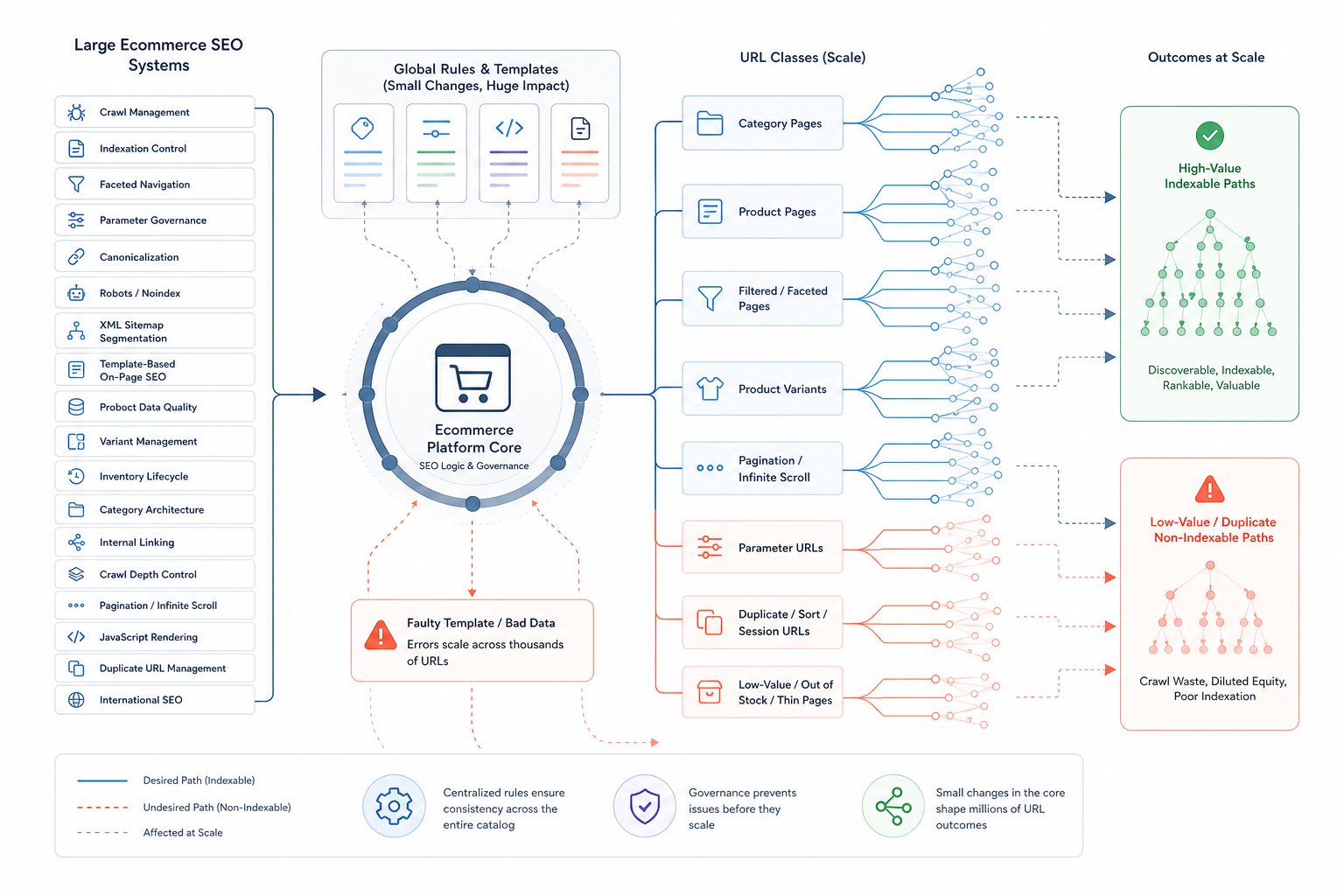
SEO for large ecommerce sites shifts from manually optimizing individual pages toward controlling systems that affect thousands or millions of product, category, filter, variant, pagination, and parameter URLs at once. The underlying SEO principles remain the same, but architecture, templates, automation, crawling, indexation, inventory, rendering, deployment, and governance have much larger consequences.
The main changes include:
- Crawl Management: Large catalogs can expose crawlers to product URLs, categories, pagination, faceted combinations, sorting states, site-search URLs, tracking parameters, variants, and other generated resources. SEO needs to keep strategically important URLs discoverable without allowing low-value URL spaces to expand without control.
- Indexation Control: Large sites need explicit rules for indexable URL classes. Useful categories, products, brands, or collections can deserve indexation, while duplicate filters, tracking URLs, temporary states, and low-value variations often do not.
- Faceted Navigation: Filters based on brand, size, color, material, price, compatibility, rating, or other attributes can produce huge numbers of combinations. Each useful landing-page class should be evaluated according to demand, inventory, uniqueness, usefulness, duplication, and crawl impact.
- Parameter Governance: Sorting, tracking, filtering, pagination, session, and other parameters need consistent platform-level treatment.
- Canonicalization at Scale: Canonical rules commonly need to be produced through platform logic or templates. One faulty canonical template can affect thousands of products.
- Robots and Noindex Controls: Large websites need a clear separation between crawl controls and index controls. Robots.txt, noindex, canonicals, navigation, and internal linking solve different problems.
- XML Sitemap Segmentation: Large sites can separate sitemaps into meaningful groups, such as products, categories, brands, countries, or other URL classes. Segmentation makes submitted URL sets easier to evaluate.
- Template-Based On-Page SEO: Titles, headings, breadcrumbs, metadata, structured data, and internal modules are often generated at template level. Templates should use reliable catalog attributes instead of generic keyword formulas.
- Template Quality Control: Errors in generated titles, canonicals, schema, robots directives, headings, or links can propagate across entire URL classes. Broad release testing therefore becomes essential.
- Content Automation: Structured catalog data can generate useful portions of product or category content when the underlying information is accurate. Automatically generating text or metadata does not by itself make a page useful.
- Product Data Quality: Source attributes, such as brand, model, SKU, material, size, capacity, compatibility, price, and availability, can feed titles, filters, schema, page copy, URLs, and merchandising systems. Bad source data can therefore produce sitewide SEO problems.
- Variant Management: Large stores need consistent treatment for colors, sizes, models, packs, configurations, and other variations. The correct URL model depends on whether variants have distinct inventory, content, and search demand.
- Inventory Lifecycle Management: Temporary stockouts, discontinued SKUs, replacements, seasonal products, and deleted categories require repeatable business rules instead of manual case-by-case decisions.
- Category Architecture: Departments, categories, subcategories, brands, collections, attributes, and products need coherent relationships that serve browsing, merchandising, search demand, and crawler discovery.
- Internal Linking at Scale: Navigation menus, breadcrumbs, category grids, brand pages, related-product modules, buying guides, and contextual links become scalable mechanisms for connecting large inventories.
- Orphan Detection: Products can become poorly connected when they drop from categories, collections, recommendations, or navigation. Crawls can identify commercially important URLs with insufficient internal connections.
- Crawl Depth Analysis: Measure how users and crawlers reach pages rather than judging architecture by URL folder count alone.
- Pagination and Infinite Scroll: Large collections need crawlable discovery mechanisms where deeper products otherwise depend only on interaction states.
- JavaScript Rendering: Dynamic merchandising, personalization, lazy loading, and client-side applications need validation to ensure critical content, links, metadata, canonicals, and structured data can be processed as intended.
- Duplicate URL Management: Large stores can produce duplication through product variants, manufacturer descriptions, filters, category overlap, sorting, parameters, localization, and repeated templates. The treatment depends on the actual cause.
- International SEO: Multi-country and multilingual stores can introduce regional inventory, currencies, language localization, hreflang, canonicals, and market-specific architecture.
- Structured Data at Scale: Product markup commonly draws from commerce databases. Price, availability, reviews, currencies, and product information need to stay synchronized with the visible page.
- Performance at Scale: Large sites can accumulate images, scripts, analytics, review platforms, ads, personalization, recommendation engines, and third-party applications. Template-level monitoring can identify systemic performance problems.
- Log Analysis: Server logs can show which URL classes search-engine crawlers request and where crawl activity is concentrated. This becomes particularly useful for sufficiently large and complex websites.
- Indexation Analysis by URL Class: Evaluate products, categories, brands, filters, and regions separately. One sitewide indexed-page total can conceal substantial problems inside one section.
- Monitoring and Alerts: Automate monitoring for changes to status codes, canonicals, robots directives, noindex tags, sitemap counts, structured data, internal links, and templates where practical.
- Automation With Validation: Automation improves consistency and operating speed but also increases the number of URLs affected by one mistake. Automated rules therefore require testing, monitoring, and rollback procedures.
- Engineering Collaboration: Large ecommerce SEO frequently involves engineers, product managers, merchandisers, UX teams, analytics teams, platform owners, and content teams because many SEO changes happen inside shared systems.
- SEO Governance: Document rules for category creation, URL generation, filters, product launches, redirects, migrations, schema, pagination, and international pages so teams do not create conflicting behavior.
- Release Testing: Check releases for unexpected changes to metadata, navigation, canonicals, rendering, structured data, robots controls, redirects, and status codes.
- Impact Prioritization: Large websites cannot fix every issue simultaneously. Prioritize according to the number and importance of affected URLs, issue severity, expected search impact, commercial value, effort, and dependencies.
- Segmentation: Analyze performance by page type, market, category, template, indexation state, traffic group, and commercial importance rather than relying on sitewide averages.
- Enterprise Measurement: Track search visibility, clicks, category performance, product visibility, crawl behavior, indexed URLs, technical health, conversions, transactions, and revenue across meaningful segments.
Large-site ecommerce SEO can therefore be understood through four control areas.
URL Control
Manage:
- Crawling
- Indexation
- Parameters
- Facets
- Canonicals
- Inventory lifecycle
System Control
Manage:
- Templates
- Structured data
- Automation
- Rendering
- Product data
- Architecture
Operational Control
Manage:
- Engineering collaboration
- QA
- Governance
- Releases
- Monitoring
Performance Control
Manage:
- Segmented analysis
- Prioritization
- Organic visibility
- Transactions
- Revenue
Having many indexed pages is not automatically an index-bloat problem. A large retailer can legitimately have a substantial indexed inventory when each URL represents a useful and differentiated search landing page.
Likewise, automation is neither inherently good nor bad. Its value depends on the quality, accuracy, usefulness, and consistency of the output.
SEO for large ecommerce sites therefore remains the same discipline, but page-level decisions increasingly need to become system rules that can be applied, tested, monitored, and governed at catalog scale.
Which SEO Tools Are Best for Ecommerce?
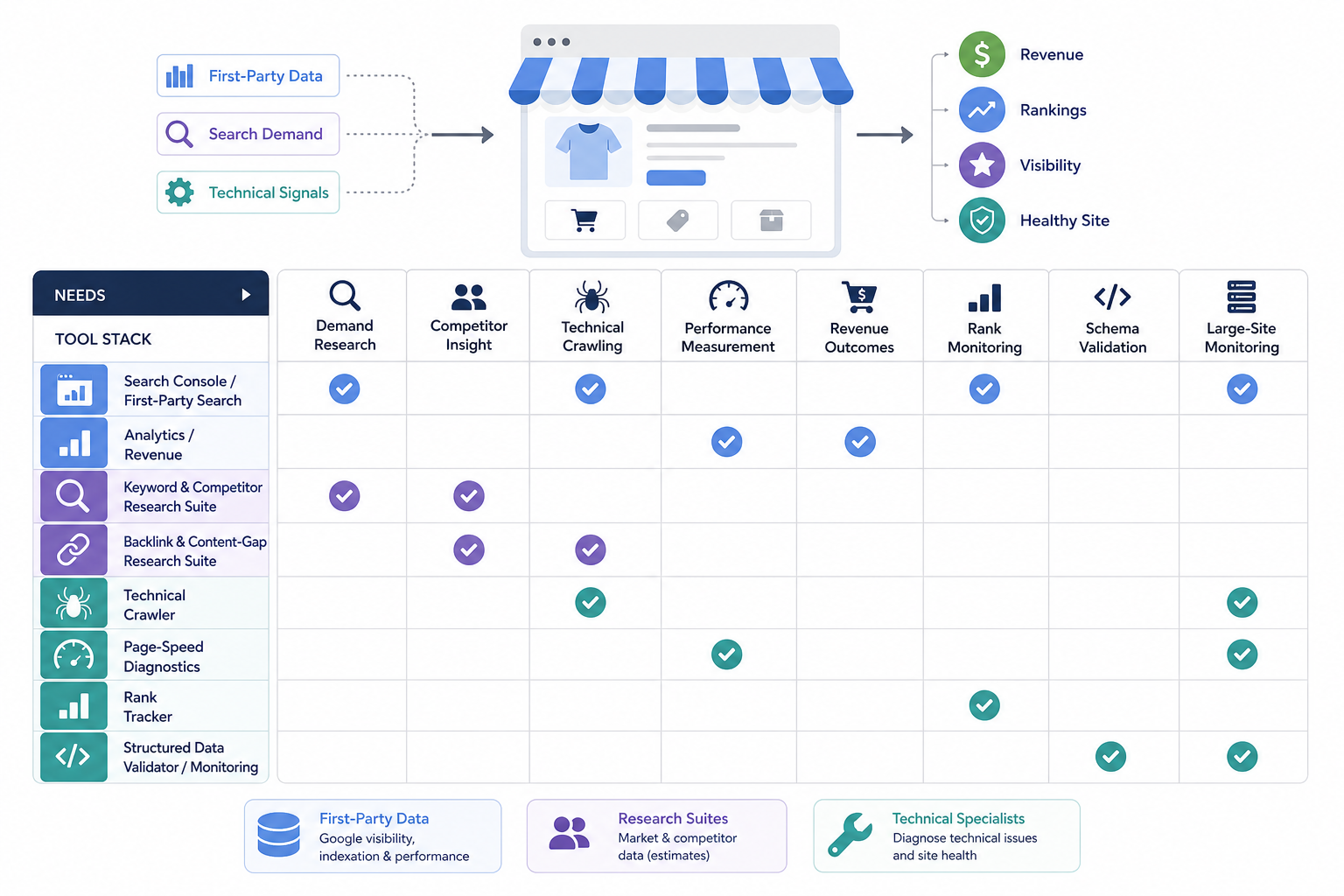
The best SEO tools for ecommerce depend on the specific requirement, such as shopper-demand research, competitor analysis, technical crawling, search-performance measurement, revenue analytics, rank tracking, structured-data validation, or large-site monitoring. Most ecommerce teams benefit from combining first-party data with third-party research and specialist technical tools instead of expecting one platform to handle every requirement equally well. A broader SEO tools list can then be used to compare platforms by function, including keyword research, crawling, analytics, rank tracking, backlinks, content optimization, and reporting.
| Tool | Ecommerce SEO Function | Main Data / Output | Best Fit | Main Limitation |
|---|---|---|---|---|
| Google Search Console | Search performance and indexation | Queries, pages, impressions, clicks, position, indexing evidence | Every ecommerce site using Google Search | No competitor SEO dataset |
| Google Analytics 4 | Traffic, conversion, and revenue measurement | Sessions, events, transactions, revenue, landing pages | Stores measuring post-click outcomes | Not a keyword-ranking or indexing platform |
| Semrush | Keyword, competitor, backlink, rank, and audit research | Third-party keyword, competitor, backlink, and visibility data | Teams wanting broad research coverage | Modeled data differs from first-party measurements |
| Ahrefs | Keyword, competitor-page, backlink, and content-gap research | Keywords, pages, backlinks, referring domains, rankings | Competitor and authority research | Third-party estimates and database-dependent coverage |
| Screaming Frog | Technical crawling | Status codes, canonicals, links, directives, metadata, schema | Technical analysis of catalogs and filters | Requires interpretation and computing resources |
| PageSpeed Insights | Page-performance diagnostics | Field and laboratory performance information where available | Product/category template performance | Does not predict exact ranking gains |
| SE Ranking / Rank Trackers | Recurring rank monitoring | Position and visibility trends | Ongoing category and product keyword monitoring | Tracks selected queries rather than total search demand |
| Structured Data Validators | Schema validation | Product, Offer, Breadcrumb, Review markup diagnostics | Stores implementing structured data | Validation does not guarantee rich results |
| Enterprise Crawlers | Large-scale crawling and monitoring | URL-class diagnostics, crawl data, sometimes logs | Very large or complex stores | Usually unnecessary for smaller catalogs |
Google Search Console
Google Search Console provides first-party evidence about a verified store’s presence in Google Search.
Useful ecommerce data includes:
- Search queries
- Landing pages
- Clicks
- Impressions
- Average position
- Search appearance
- Indexation information
It can reveal whether categories, products, brands, collections, and informational pages are receiving search visibility.
It does not provide the complete competitor research available from commercial SEO platforms.
Google Analytics 4
Google Analytics 4 helps measure what shoppers do after reaching the store.
Useful ecommerce outcomes include:
- Sessions
- Product views
- Add-to-cart events
- Checkout activity
- Transactions
- Revenue
It should not be treated as a keyword-ranking system or a substitute for search-engine indexation data.
Semrush
Semrush can support:
- Keyword research
- Product and category demand research
- Competitor analysis
- Backlink analysis
- Rank tracking
- Site auditing
- SERP research
Its strongest role is broader market and competitive analysis using third-party datasets.
Search volumes, difficulty metrics, traffic estimates, and authority metrics remain estimates rather than exact search-engine measurements.
Ahrefs
Ahrefs can support:
- Keyword research
- Competitor ranking-page analysis
- Backlink research
- Referring-domain analysis
- Content gaps
- Site auditing
- Rank monitoring
It can be particularly useful when a store wants to understand which competitor product or category pages receive organic visibility and which external sources link to them.
Commercial backlink databases do not capture every link on the web.
Screaming Frog SEO Spider
Screaming Frog can crawl large sets of ecommerce URLs and inspect attributes such as:
- Status codes
- Redirects
- Canonicals
- Titles
- Headings
- Internal links
- Robots directives
- Structured data
- Indexability
It is particularly useful for diagnosing ecommerce issues involving products, categories, filters, pagination, redirects, and changing inventory.
PageSpeed Insights
PageSpeed Insights can help evaluate store templates containing heavy elements such as:
- Product images
- JavaScript
- Review widgets
- Recommendation systems
- Tracking scripts
- Third-party applications
Performance reports help identify technical issues, but the scores should not be interpreted as a direct prediction of how many ranking positions a page will gain.
Rank-Tracking Tools
Tools such as Semrush, Ahrefs, SE Ranking, AccuRanker, or other specialist rank trackers can monitor selected searches over time.
Useful ecommerce segments include:
- Categories
- Brands
- Products
- Countries
- Devices
- Competitors
Rank tracking is most useful for strategically selected query sets rather than attempting to represent every possible product search.
Keyword-Research Tools
Keyword-research platforms can help identify searches involving:
- Products
- Categories
- Brands
- Attributes
- Models
- Long-tail terms
- Comparisons
- Informational topics
Evaluate platforms according to:
- Country coverage
- Database size
- SERP information
- Filtering
- Competitor data
- Export capability
Search-volume estimates should remain one input rather than the only prioritization criterion.
Competitor-Analysis Tools
Competitive SEO tools can reveal:
- Ranking keywords
- Top organic pages
- Category coverage
- Product visibility
- Backlink patterns
- Search gaps
Competitor traffic figures from third-party platforms remain estimates rather than the competitor’s private analytics data.
Backlink-Analysis Tools
Backlink platforms can provide evidence about:
- Referring domains
- Backlinks
- Anchors
- New links
- Lost links
- Competitor link patterns
These datasets support authority research without representing every link that exists on the web.
Structured-Data Validation Tools
Validation is useful when implementing markup for:
- Product
- Offer
- Review
- Breadcrumb
- Organization
The purpose is to verify syntax and data consistency.
Passing validation does not guarantee a supported rich result will appear.
Content and On-Page Tools
Content software can support:
- SERP research
- Content briefs
- Topic coverage
- Page-level comparisons
These tools should remain secondary to accurate product information, search intent, category structure, technical accessibility, inventory, and first-party performance data.
A proprietary content score is not a Google ranking score.
Enterprise Crawlers and Log Platforms
Large stores can require more scalable tools when they manage:
- Millions of URLs
- Faceted URL spaces
- Multiple markets
- Large inventory changes
- Dynamic rendering
- Crawl-log analysis
- APIs
- Automated monitoring
The site’s operational scale should justify enterprise software rather than its brand name alone.
What Tool Stack Does an Ecommerce Store Need?
A practical stack can often start with:
- First-party search data: Google Search Console
- Website and commerce analytics: Google Analytics 4
- Third-party SEO research: Semrush, Ahrefs, or another suitable research platform
- Technical crawler: Screaming Frog, Sitebulb, or another suitable crawler
Additional specialist software can be added for:
- Rank tracking
- Backlink analysis
- Content optimization
- Structured-data validation
- Log analysis
- Local SEO
- International monitoring
- Enterprise crawling
A small store can often operate effectively with free first-party platforms and one research or crawling tool.
A growing store can require broader keyword, competitor, rank, technical, and reporting capabilities.
A large ecommerce platform can place greater emphasis on crawl scale, API access, segmentation, automation, logs, alerting, and team workflows.
Tool selection should evaluate:
- Ecommerce task coverage
- Data source
- Catalog scalability
- URL limits
- Market coverage
- Export capability
- API access
- Automation
- Reporting
- Team usability
- Pricing and usage limits
The best SEO tools for ecommerce are therefore the smallest complementary set of platforms that provides reliable shopper-demand research, catalog diagnostics, search-performance evidence, conversion measurement, and monitoring at the scale the store actually operates.
Need links on real SaaS and business websites?
Links are placed after your approval, on sites with guaranteed DR and traffic, with a 1-year replacement guarantee.

