
SEO Strategy: Process, Template, Marketing & Content Strategy
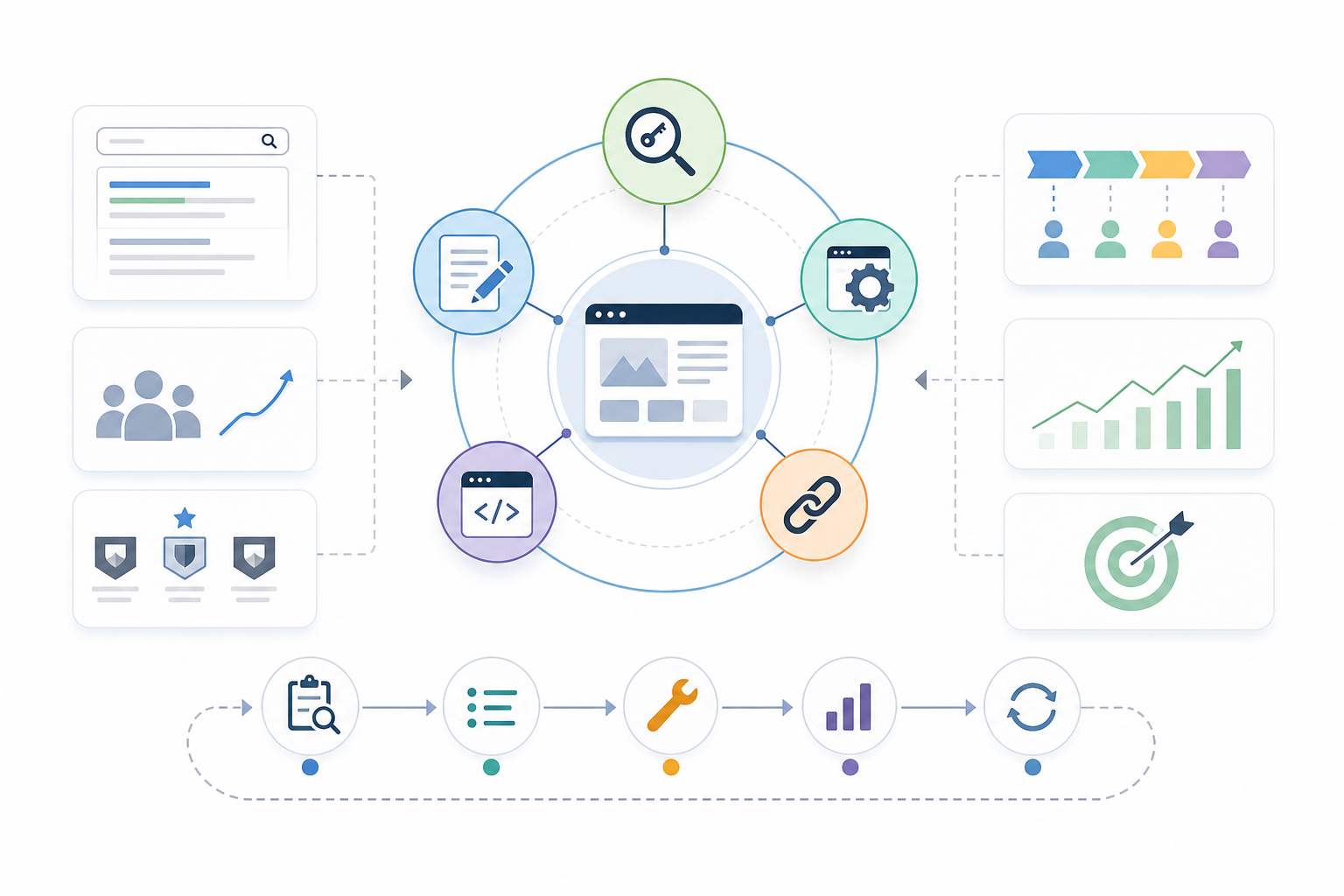
An SEO strategy is a coordinated plan for increasing organic search visibility, attracting qualified traffic, and turning that visibility into meaningful business outcomes. Rather than treating SEO as a collection of isolated optimization tasks, an effective strategy connects business goals with what the target audience searches for and how a website can satisfy that demand better than competing results.
Building that strategy requires several inputs. You need to understand the website's current organic performance, audience demand, keywords and search intent, competitors, existing content opportunities, technical health, and authority. These insights are then converted into priorities across content creation, on-page SEO, technical SEO, internal linking, and link building.
The overall process moves from research and auditing to prioritization, implementation, measurement, and continuous refinement. Rankings alone are not enough to determine whether that process is working. An SEO strategy should ultimately improve relevant search visibility, qualified organic traffic, conversions, and the business outcomes those conversions support.
It also cannot remain static. Competitors publish new content, search behavior changes, existing pages decline, business priorities shift, and search engines continuously change how information is discovered and presented. A strong SEO strategy uses performance data to respond to those changes rather than following the same plan indefinitely.
SEO also exists within a wider marketing system. Organic search can strengthen content marketing, improve brand discoverability, support different stages of the buyer journey, contribute to demand generation, and create a sustainable acquisition channel alongside other marketing activities.
Before building that process, however, it is important to understand exactly what an SEO strategy includes and how its different components work together.
What Is an SEO Strategy?
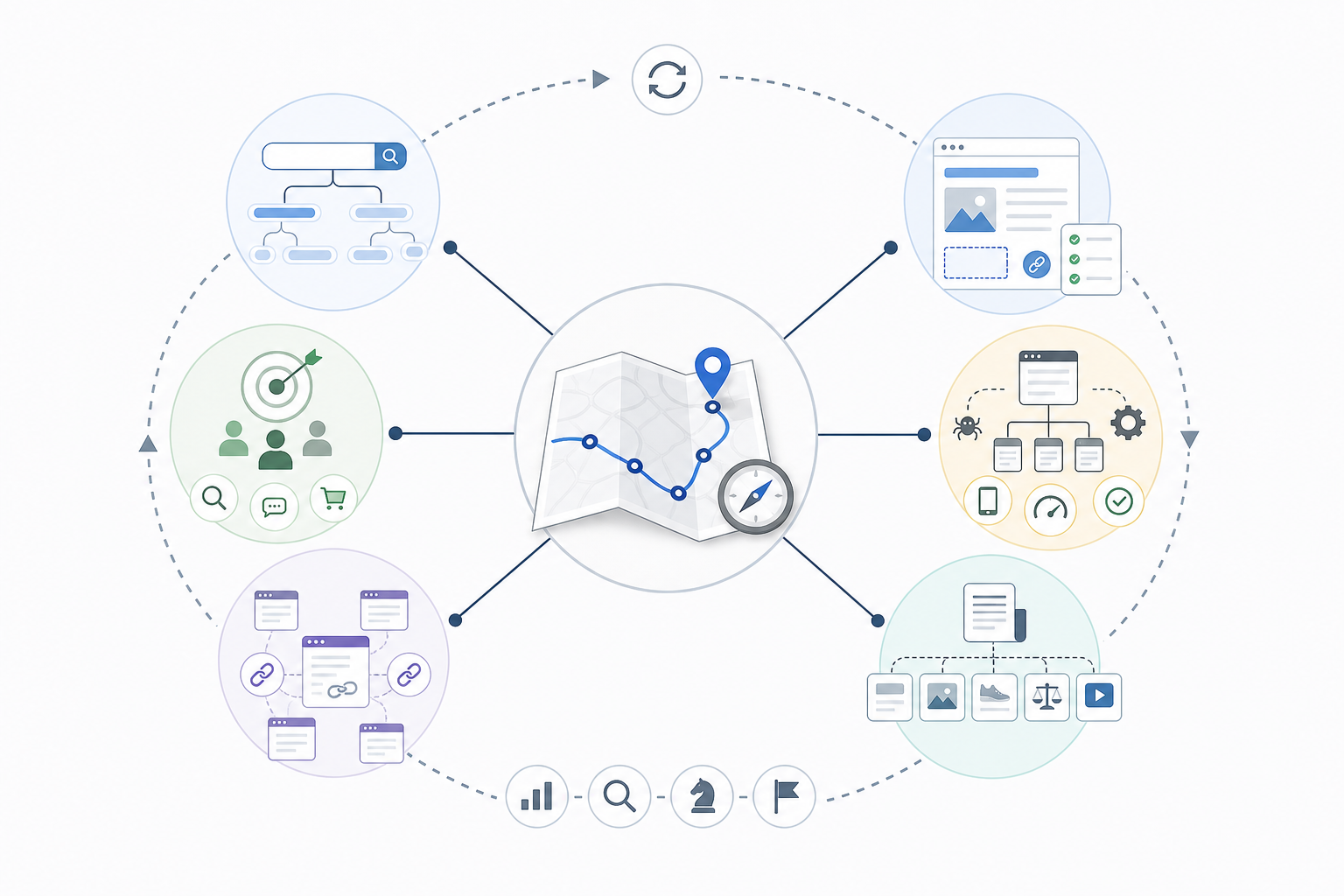
An SEO strategy is a structured roadmap that organizes search optimization activities around defined priorities, audience demand, and business goals. Its purpose is to ensure that keyword research, content, technical improvements, on-page optimization, internal linking, and authority building contribute toward the same organic growth objectives.
Keyword research provides one of the primary inputs. It identifies the terms, topics, questions, products, services, and problems that potential customers search for. But identifying keywords is only useful when the strategy also considers why people search for them and which queries are relevant to the business.
On-page SEO turns that understanding into better individual pages. This includes optimizing content, titles, headings, images, internal links, page structure, and overall relevance so that each page clearly addresses its intended topic and search intent.
Technical SEO supports those pages by making the website easier for search engines to crawl, render, understand, and index. Site structure, mobile usability, page speed, crawlability, indexation, canonicalization, and other technical factors can determine whether strong content is accessible enough to perform in organic search.
Content creation expands the website's ability to satisfy relevant search demand. Depending on the business and audience, this can include educational resources, landing pages, product or service pages, comparison content, category pages, tools, case studies, and other formats aligned with user needs.
Link building contributes external authority. Relevant backlinks, digital PR, brand mentions, partnerships, and other off-page signals can strengthen the credibility and authority of important pages and the website as a whole.
These components should not operate independently. Publishing more content while ignoring technical problems, building backlinks to pages with weak intent alignment, or optimizing isolated pages without a broader site structure can limit results. An SEO strategy coordinates these activities around a shared roadmap.
That roadmap should also evolve as rankings, competitors, search behavior, search results, and business priorities change. Consistent execution combined with continuous adaptation is what turns individual SEO activities into stronger visibility and measurable organic growth.
How Do You Create an SEO Strategy?
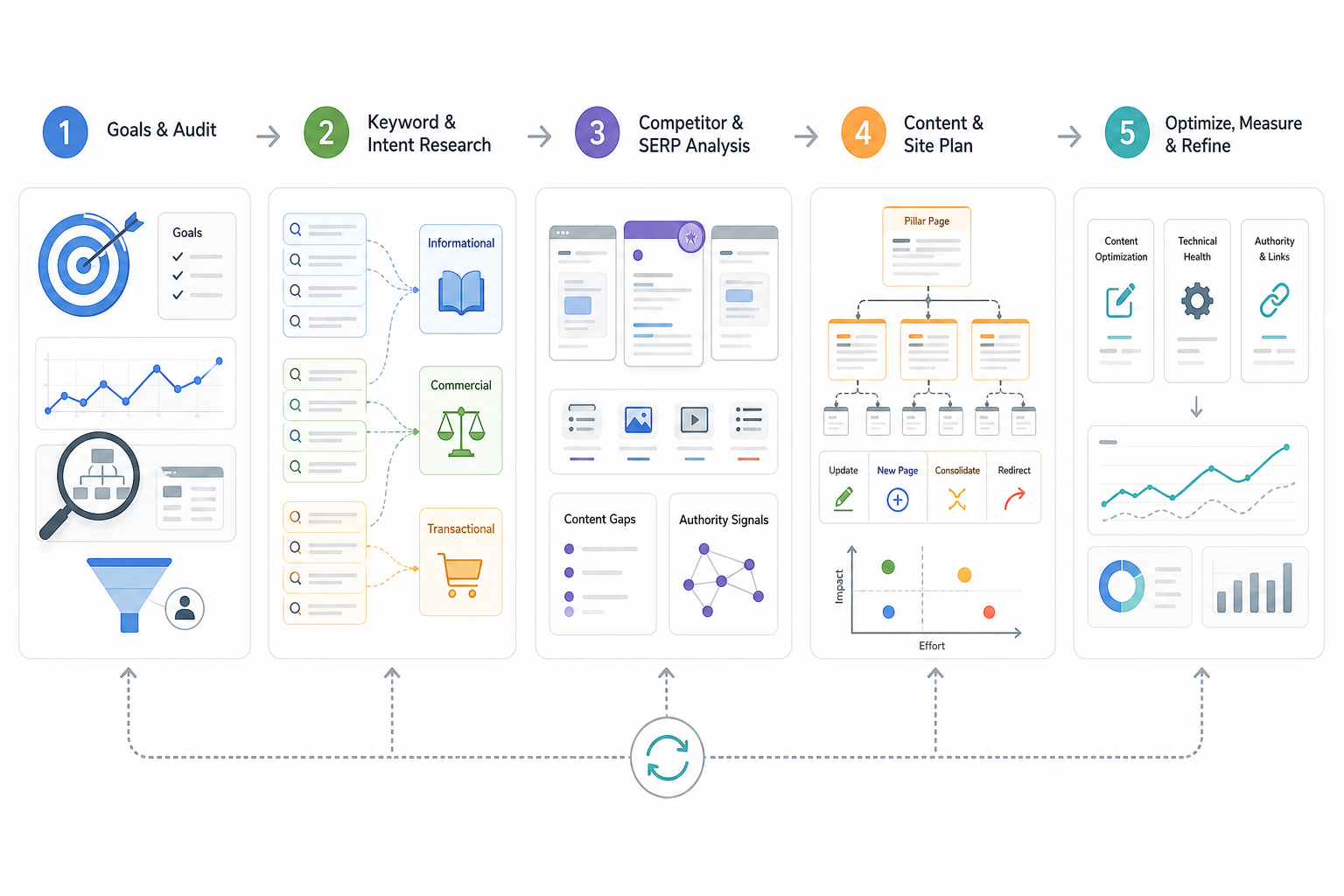
Creating an SEO strategy is a structured process of researching the current environment, prioritizing opportunities, executing improvements, measuring performance, and refining decisions around business goals. The process should begin with evidence about current performance and search demand before deciding what content, pages, technical improvements, or authority-building activities deserve investment.
1. Define Goals and Audit Current Performance
Start by establishing what SEO is expected to achieve for the business. Organic traffic may be useful, but traffic by itself is rarely the final objective.
Define outcomes such as:
- Qualified organic traffic
- Leads or demo requests
- Product purchases
- Sign-ups or registrations
- Revenue
- Visibility for strategically important topics
These objectives should then be connected with appropriate SEO KPIs.
Audit the website's existing performance across rankings, impressions, clicks, CTR, organic traffic, conversions, content performance, backlinks, crawlability, indexation, architecture, site speed, and mobile usability.
The purpose of the audit is not simply to produce a list of issues. It should identify what is already working, what is preventing growth, and where the strongest opportunities exist.
A page ranking between positions 6 and 10 for commercially important queries, for example, may represent a more immediate opportunity than creating an entirely new page for a low-priority topic.
2. Research Keywords and Search Intent
Next, identify what the target audience actually searches for.
Keyword research should cover the questions, problems, products, services, features, comparisons, and broader topics connected with the business. Search volume can help estimate demand, but it should not be the only factor used to prioritize keywords.
Evaluate each opportunity according to:
- Search demand
- Business relevance
- Commercial value
- Ranking feasibility
- Search intent
- Existing site performance
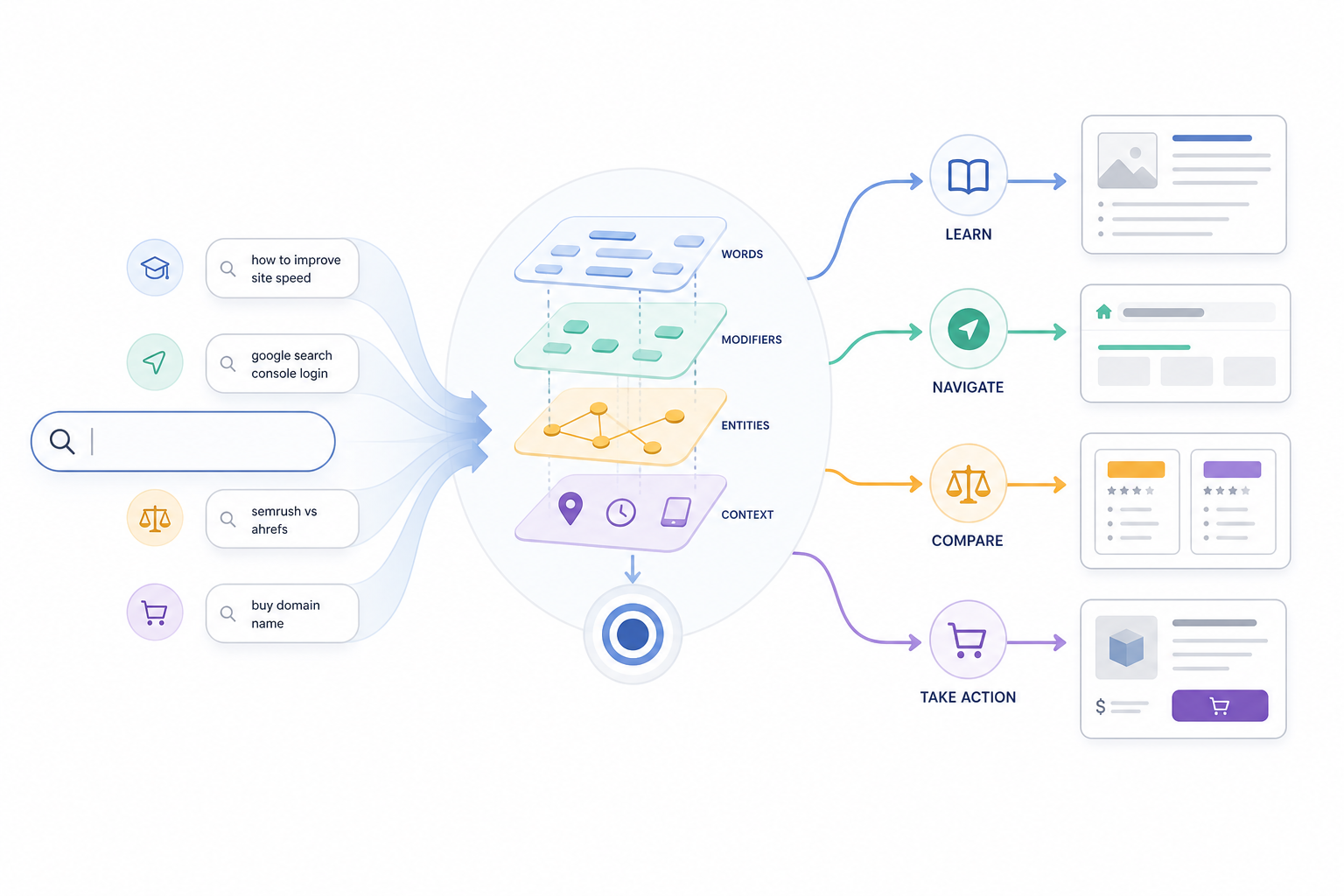
Understanding search intent is particularly important because similar keywords can require completely different pages.
A query may be informational, commercial, transactional, navigational, or mixed. The page created or optimized for that query needs to reflect what the searcher is actually trying to accomplish.
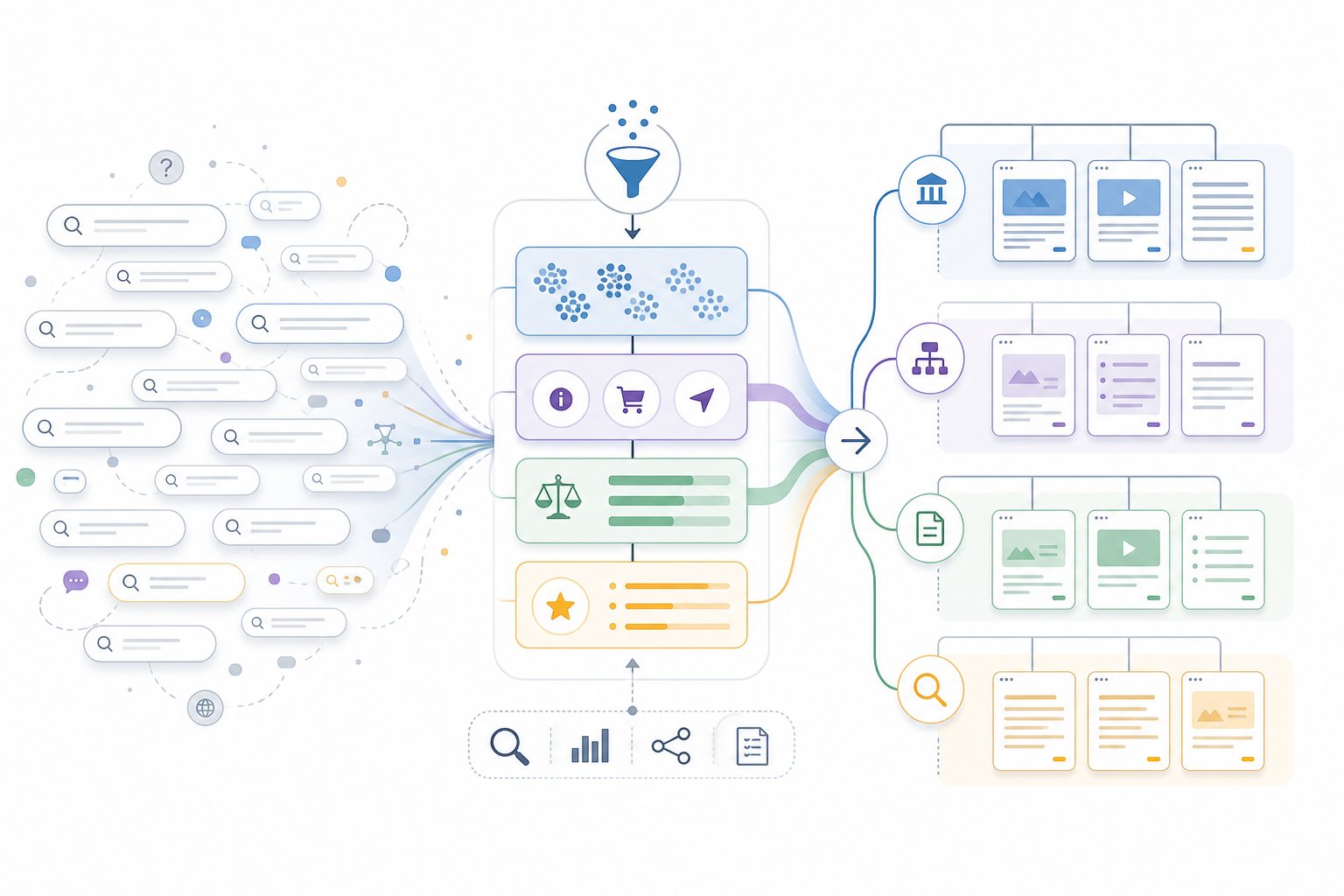
Related queries should also be grouped around common topics and intent rather than treated as separate SEO targets. This makes it easier to build pages around complete search needs instead of producing several thin pages competing for nearly identical queries.
3. Analyze Competitors and Search Results
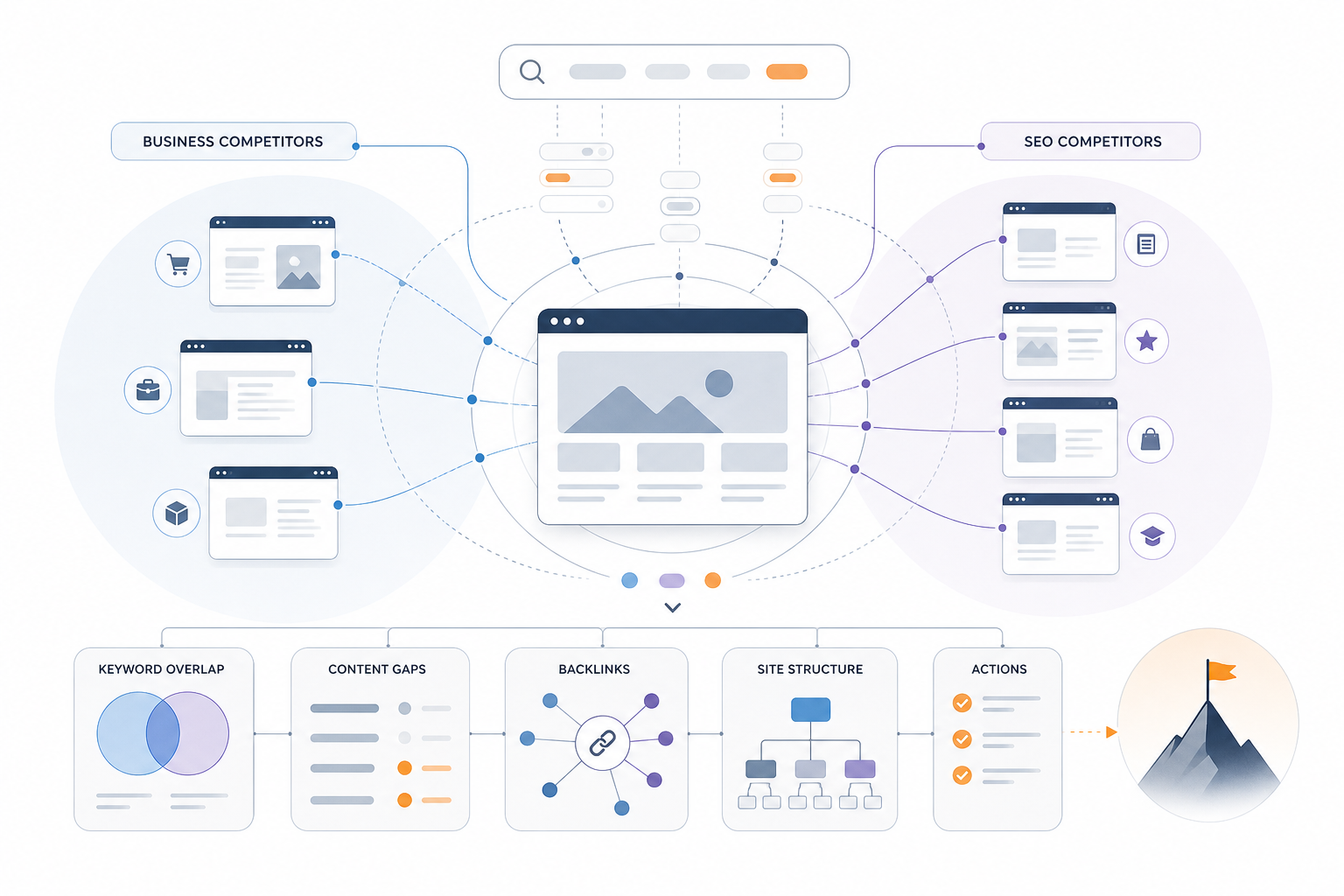
SEO competitors are not always the same companies considered competitors by the sales or product team. Your organic competitors are the websites repeatedly competing for the search demand you want to capture.
Analyze which websites rank for strategically important topics and investigate:
- Keyword gaps
- Content gaps
- Topic coverage
- Backlink differences
- Page formats
- SERP features
- Internal site structures
- Ranking patterns
The search results themselves provide important information about what search engines currently interpret as the most appropriate response to a query.
Some queries may favor long-form guides. Others may primarily return product pages, category pages, comparison pages, tools, directories, videos, or other formats.
That does not mean copying the existing results. It means understanding the dominant intent and format before deciding how your page can provide stronger relevance, usefulness, coverage, authority, or differentiation.
4. Build the Content and Site Plan
Once search demand and competitive opportunities are understood, map them to the website.
Determine which queries and search intents should be served by existing pages and which require new pages. Existing content may need to be improved, consolidated, redirected, repositioned, or retained without major changes.
Organize related pages around logical topic relationships. Where appropriate, broader pages can act as central resources while supporting pages address narrower subtopics and related intents.
Each important search intent should have a clear destination. Creating multiple pages for the same intent can cause unnecessary overlap and keyword cannibalization.
Internal linking should also be planned rather than added randomly. Relevant supporting pages can reinforce important commercial, category, parent, product, or conversion pages through contextual internal links.
Not every opportunity should be executed immediately. Prioritize initiatives according to factors such as:
- Business value
- Search demand
- Current rankings
- Competitive difficulty
- Required effort
- Resource availability
- Expected SEO impact
The result should be a practical roadmap rather than an unranked list of everything that could theoretically be improved.
5. Optimize Content, Technical SEO, and Authority
Execution should combine several SEO disciplines rather than treating them as disconnected workstreams.
Existing and newly created pages should clearly satisfy their intended search intent. Improve the content itself as well as titles, headings, internal links, page structure, images, contextual relevance, and other important on-page elements.
Technical issues that limit search performance should be addressed alongside content improvements. Depending on the website, this may involve crawlability, rendering, indexation, canonicalization, architecture, structured data, page speed, or mobile usability.
Internal authority should also be distributed intentionally. Contextual links between semantically related pages help users navigate the website while reinforcing relationships between topics and strategically important pages.
External authority can be developed through relevant backlinks, outreach, digital PR, partnerships, brand mentions, and other appropriate off-page activities.
The important point is coordination. Strong SEO usually requires content, on-page optimization, technical health, internal linking, and external authority to support the same priorities.
6. Measure, Refine, and Repeat
SEO strategy does not end when changes are published.
Track rankings, impressions, clicks, CTR, organic traffic, conversions, and business outcomes against the goals established at the beginning of the strategy.
Performance should be evaluated at several levels, including:
- Query
- Page
- Topic
- Directory or site section
- Entire website
Different performance patterns require different responses.
A page gaining impressions but receiving few clicks may have a CTR or SERP-positioning problem. A page attracting traffic but generating few conversions may need stronger intent alignment or conversion optimization. A strategically important page that is not gaining visibility may require content, internal linking, technical, or authority improvements.
Declining content should be refreshed when necessary. Underperforming pages should be reevaluated. Technical problems should be resolved as they appear, and priorities should change when new opportunities become more valuable.
Competitors, search behavior, SERPs, business priorities, and search-engine environments should also be reassessed periodically.
SEO strategy is therefore a cycle:
Business goals and current performance → search demand and intent → competitive analysis → content and site planning → optimization and authority → measurement and refinement.
Once those decisions are established, they should be converted into a documented framework that teams can consistently execute and update. An SEO strategy template provides that structure by recording goals, audience insights, keyword research, priorities, actions, responsibilities, timelines, and measurement criteria.
Documenting the strategy makes it easier to communicate what matters, assign ownership, track progress, and adjust priorities as performance changes.
What Should an SEO Strategy Template Include?
An SEO strategy template should organize the goals, research, priorities, execution requirements, and measurement needed to guide organic growth. A useful template typically contains six core sections.
1. Strategy Brief and Goals
The strategy brief establishes why the SEO program exists and what it is expected to accomplish.
Include:
- Business objectives such as leads, sales, demos, sign-ups, or revenue
- Target audience
- Customer needs and problems
- Relevant search behavior
- Brand differentiation or competitive advantages
- SEO objectives and success criteria
This section gives the rest of the strategy a clear business context.
2. Keyword and Search Intent Matrix
The keyword and search-intent matrix organizes relevant organic demand.
Include:
- Primary keywords
- Secondary keywords
- Related topics and queries
- Search intent
- Target page
- Business value
- Search demand
- Ranking feasibility
- Priority
Rather than automatically prioritizing high-volume keywords, the matrix should help identify the opportunities with the strongest combination of demand, relevance, value, and realistic ranking potential.
3. Content Roadmap
The content roadmap translates search opportunities into planned website assets.
Include:
- Target topics
- Pillar and supporting pages
- Existing pages requiring optimization
- New content requirements
- Funnel stages
- Content formats
- Publishing dates
- Owners
- Refresh schedules
The roadmap should make it clear what needs to be created or improved and why each asset exists.
4. Technical SEO Checklist
The technical SEO section documents issues and requirements that could affect crawling, indexation, performance, or search-engine understanding.
Include areas such as:
- Crawlability
- Indexation
- Site architecture
- Canonicalization
- Mobile performance
- Page speed
- Structured data
- Other implementation priorities
These items can then be prioritized according to their potential impact and implementation effort.
5. Authority and Link Building Plan
The authority plan should cover both internal and external signals.
Include:
- Internal-link relationships
- Priority pages requiring authority
- Relevant backlink opportunities
- Outreach campaigns
- Digital PR opportunities
- Partnerships
- External brand mentions
- AI-search or external brand-visibility initiatives where relevant
The objective is not simply to accumulate links. Authority-building efforts should reinforce strategically important topics and pages.
6. Measurement Dashboard
The measurement section determines how progress will be evaluated.
Include business outcomes such as:
- Leads
- Purchases
- Sign-ups
- Revenue
- Qualified conversions
Also track leading SEO indicators such as:
- Rankings
- Impressions
- Clicks
- CTR
- Organic traffic
- Search visibility
Where AI-search visibility forms part of the strategy, relevant citation or answer-engine visibility metrics can also be included.
A usable template can additionally organize these elements into a consistent structure:
| Template Section | Information to Record | Example / KPI |
|---|---|---|
| Strategy Brief and Goals | Objectives, audience, priorities | Qualified organic leads |
| Keyword and Intent Matrix | Queries, intent, target pages, priority | Commercial keyword visibility |
| Content Roadmap | Pages, clusters, dates, owners | Publishing and refresh completion |
| Technical SEO Checklist | Issues, priority, owner, status | Indexed pages, Core Web performance |
| Authority Plan | Internal links, backlinks, PR opportunities | Referring domains to priority pages |
| Measurement Dashboard | SEO and business performance | Clicks, conversions, revenue |
The exact SEO strategy template should be customized according to the website's business model, audience, available resources, competitive environment, and current level of SEO maturity.
How Does SEO Fit Into a Marketing Strategy?
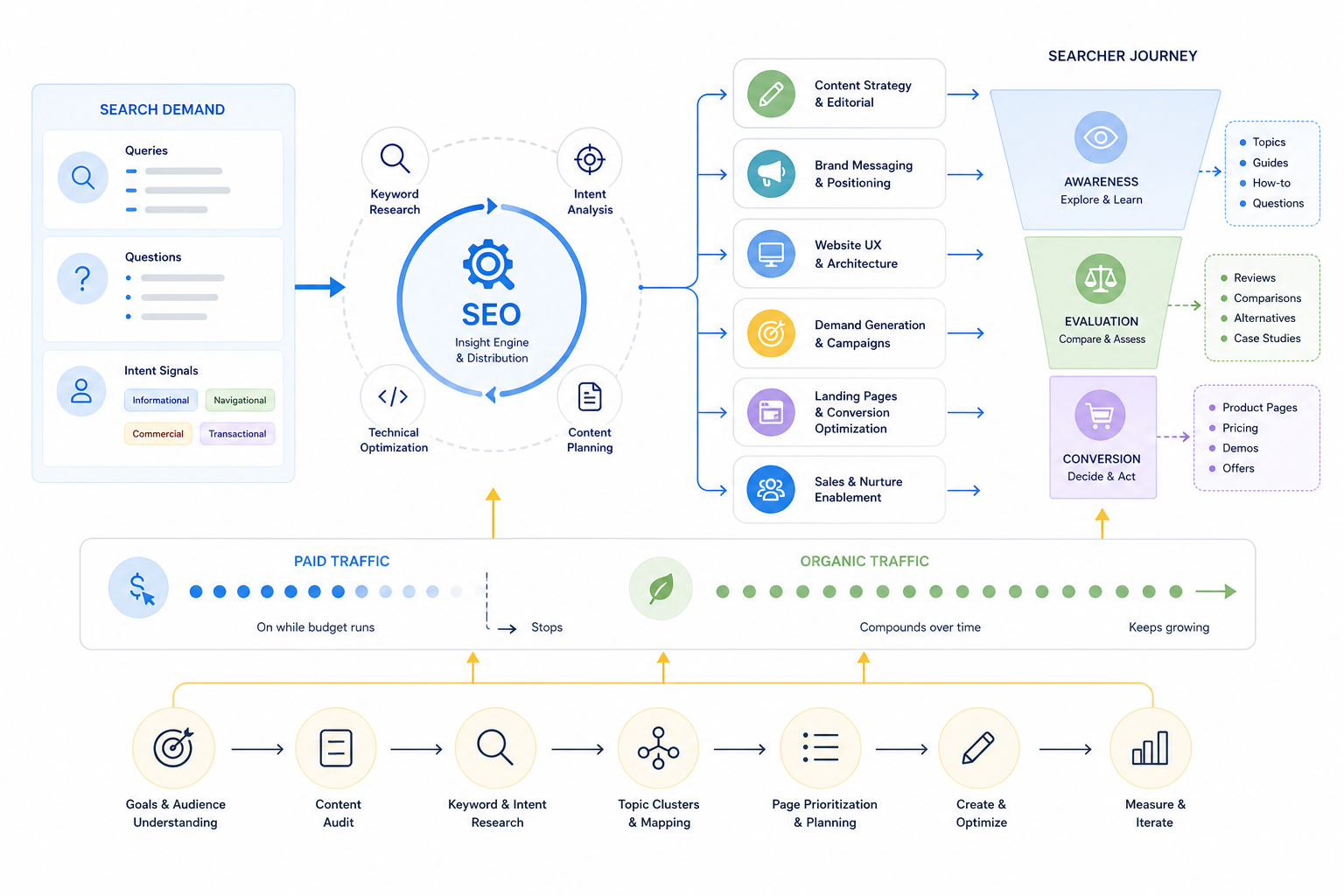
SEO fits into a broader marketing strategy by creating sustained organic visibility and connecting existing search demand with business goals. Instead of functioning as an isolated acquisition channel, SEO can inform content, customer journeys, brand visibility, demand generation, and conversion activities.
SEO supports marketing in several complementary ways:
- Enhance discoverability: SEO helps a brand appear when potential customers actively search for relevant products, services, information, questions, or problems.
- Amplify content marketing: Keyword research and search-intent analysis reveal what audiences are actively interested in, helping marketers decide which topics and content formats deserve investment.
- Support the sales funnel: Informational queries can attract audiences during awareness and education, commercial queries can support evaluation, and transactional queries can capture users closer to purchase or conversion.
- Generate sustainable organic returns: Paid campaigns stop generating traffic when spending stops, while well-performing organic pages can continue attracting qualified visitors over longer periods when their relevance and rankings are maintained.
- Improve user experience: Technical SEO, mobile usability, site performance, navigation, and information architecture improve how both search engines and people access and use a website.
SEO can also strengthen other marketing channels. Search data can reveal common audience questions, emerging demand, commercial priorities, and language customers use when describing their needs. Those insights can influence content marketing, brand messaging, landing pages, campaign planning, and demand-generation activities.
One of the clearest connections between SEO and the broader marketing strategy is content.
SEO helps determine what people are searching for, while content strategy determines what should be created, organized, published, and improved to satisfy that demand and support business objectives.
An SEO content strategy connects those two functions by translating search demand, customer needs, business priorities, and stages of the buyer journey into a structured content plan.
How Do You Create an SEO Content Strategy?
An SEO content strategy is the content-focused part of the broader SEO strategy. It determines which search demand to target, what content should be created or improved, how pages should be organized, and how content performance will be measured over time.
Creating one involves seven connected stages.
1. Define Goals and Understand the Audience
Start by determining what the content should accomplish.
Possible goals include:
- Increasing qualified organic traffic
- Generating leads
- Building awareness
- Supporting product discovery
- Improving conversions
- Strengthening visibility for strategically important topics
Then identify the audience's problems, questions, motivations, search behavior, and position within the buyer journey.
Content aimed at someone discovering a problem should not be structured the same way as content targeting someone comparing solutions or preparing to purchase.
Understanding both the audience and the business objective gives the content strategy a clear direction.
2. Audit Existing Content
Before creating more content, evaluate what already exists.
Identify pages currently generating:
- Rankings
- Impressions
- Traffic
- Backlinks
- Conversions
Then identify content that is outdated, thin, duplicated, poorly aligned with search intent, or consistently underperforming.
Some pages may require updates rather than replacements. Others may need consolidation when several URLs compete for the same search intent.
Keyword cannibalization should also be investigated when multiple pages unnecessarily target substantially similar queries.
A content audit prevents the strategy from becoming a publishing plan that ignores existing assets and problems.
3. Research Keywords and Search Intent
Research the queries relevant to the audience and business.
Evaluate each opportunity according to search demand, competition, business relevance, and intent.
The objective is not to create one article for every keyword. Related queries should be grouped into meaningful semantic topics when they represent the same underlying need.
For example, several keyword variations may all belong to a single page if users searching those terms expect essentially the same answer.
Search intent should determine whether the appropriate content is educational, commercial, transactional, comparative, navigational, or another format.
4. Build Topic Clusters and Content Priorities
Organize related topics into a logical content structure.
Broader subjects can be supported by more specific pages addressing related questions, subtopics, use cases, comparisons, or problems.
Map important queries and intents to the most appropriate pages so each asset has a clear purpose.
Then prioritize content based on factors such as:
- Search demand
- Business relevance
- Ranking potential
- Existing authority
- Funnel importance
- Competitive opportunity
This creates a structured content roadmap rather than a disconnected list of article ideas.
5. Create the Content Calendar
Turn those priorities into an executable publishing plan.
For each planned asset, document elements such as:
- Target topic
- Primary search intent
- Relevant keywords
- Content format
- Funnel stage
- Publishing date
- Responsible owner
Seasonality, product launches, campaigns, and other business priorities should also influence scheduling when relevant.
The calendar should remain realistic. Publishing more frequently is not inherently better if the schedule reduces content quality or prevents existing pages from being properly maintained.
6. Create and Optimize the Content
Content should directly satisfy the intended search need while remaining genuinely useful to the reader.
Use clear headings, concise passages, and appropriate information structures. When a query requires a sequence, a numbered list can make the process easier to follow. When attributes need comparison, a table may communicate the information more efficiently.
Pages should also include contextual internal links to semantically related resources and relevant commercial destinations.
The information hierarchy should make relationships between topics clear enough for readers, search engines, and AI-driven systems to identify the central subject, supporting attributes, and important answers.
Optimization should support comprehension rather than forcing keywords unnaturally into the page.
7. Measure and Refine Performance
Publishing is the beginning of the performance cycle, not the end.
Track metrics such as:
- Rankings
- Impressions
- Clicks
- CTR
- Organic traffic
- Leads
- Conversions
- Content-level engagement or business outcomes
Use those signals to determine what should happen next.
Pages with improving rankings may need additional optimization to reach stronger positions. Pages generating impressions but few clicks may require better titles or stronger SERP positioning. Content that once performed well but is declining may require updating as competing pages, search intent, or available information changes.
The SEO content strategy should therefore operate as an ongoing cycle of research → prioritization → publishing → measurement → refinement, continuously adapting the content library to audience demand and business priorities.
In this section
Need links on real SaaS and business websites?
Links are placed after your approval, on sites with guaranteed DR and traffic, with a 1-year replacement guarantee.

