
B2B SEO: Business Fit, Marketing, Strategy & Tools
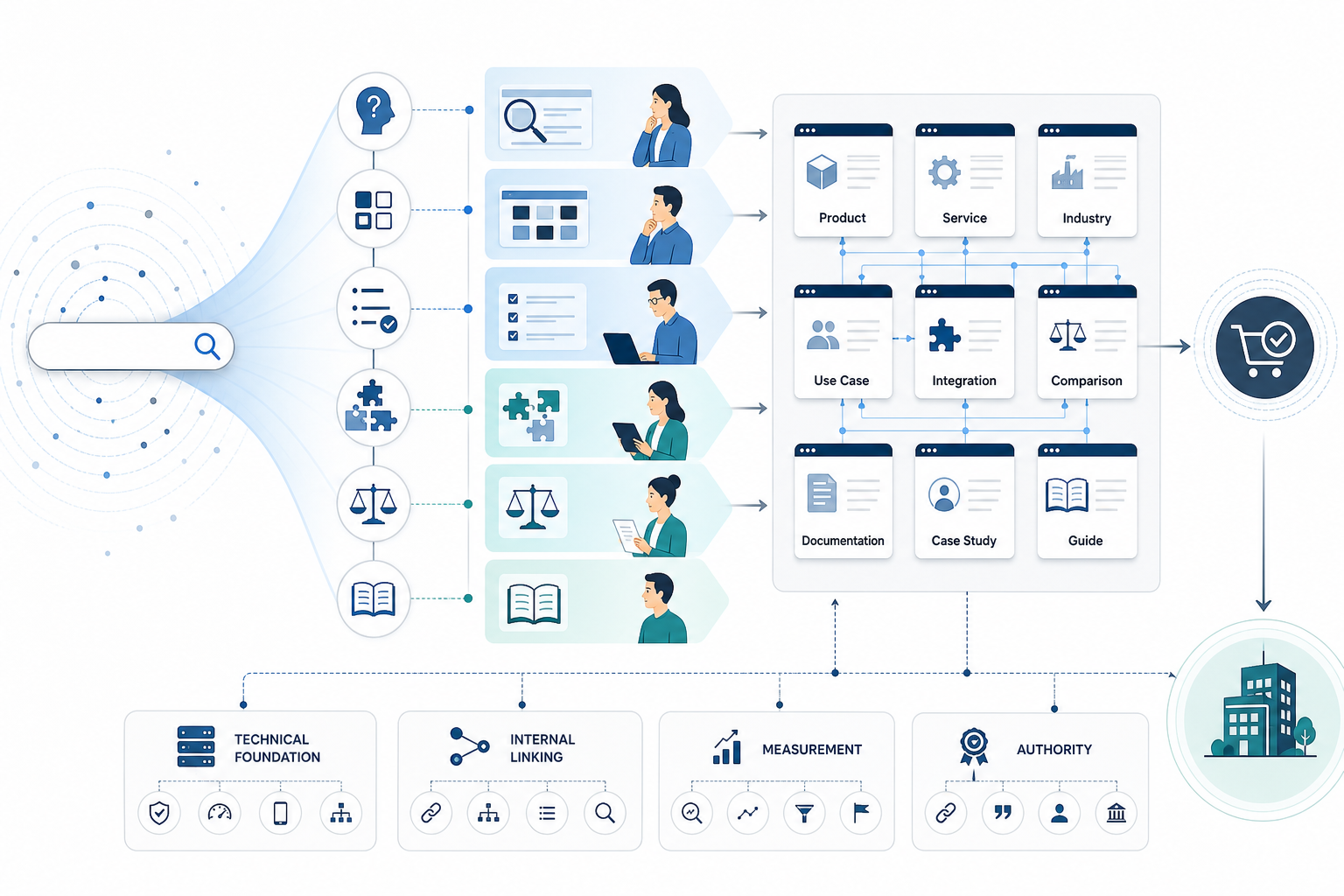
B2B SEO is the process of improving a company’s organic search visibility for queries used by people researching products, services, software, suppliers, or solutions for a business purpose. It applies established SEO principles within a business-to-business buying context, where search can support problem research, solution discovery, vendor comparison, technical evaluation, and purchasing decisions.
The defining difference is the buying context rather than a separate search-engine system. B2B search demand is connected with organizational needs such as selecting software, finding a supplier, comparing service providers, evaluating technical specifications, or solving an operational problem.
B2B SEO can apply to organizations such as:
- SaaS companies selling software to businesses
- Professional service firms such as consultancies, agencies, accounting firms, and legal firms
- Manufacturers selling components, equipment, or materials
- Distributors and wholesalers supplying commercial buyers
- Enterprise technology providers selling cybersecurity, cloud, data, CRM, or infrastructure solutions
- Logistics companies providing freight, warehousing, fulfillment, or supply-chain services
- Financial and business service providers offering commercial finance, payroll, insurance, payments, or compliance services
The people performing B2B searches can also differ according to the purchase. Searchers can include end users, department managers, engineers, technical evaluators, procurement teams, finance teams, operations teams, executives, or other stakeholders involved in researching or approving a business purchase.
Not every B2B purchase involves a large buying committee or a long sales cycle. A small business can purchase software independently within minutes, while an enterprise infrastructure purchase can involve several stakeholders and months of evaluation.
B2B search demand can include queries related to:
- Business problems, such as “reduce invoice processing time”
- Product or service categories, such as “accounts payable automation software”
- Features and capabilities, such as “OCR invoice extraction software”
- Industries, such as “ERP software for manufacturing”
- Use cases, such as “automate vendor onboarding”
- Specifications, such as “industrial pump flow rate requirements”
- Integrations, such as “Salesforce HubSpot integration”
- Vendors and suppliers, such as “industrial valve suppliers”
- Comparisons and alternatives, such as “HubSpot vs Salesforce”
- Pricing and purchasing information, such as “CRM software pricing”
- Implementation questions, such as “how to implement ISO 27001”
- Educational topics, such as “what is accounts payable automation”
B2B SEO should prioritize buyer relevance and commercial relevance rather than raw search volume alone. A query receiving 200 searches per month can be more valuable than one receiving 20,000 searches if the smaller query closely matches the product, service, technical requirement, or purchasing decision the business supports.
This does not mean B2B SEO should focus only on low-volume or high-intent keywords. Informational, category, technical, commercial, and broader discovery searches can all contribute when they relate meaningfully to the company’s offering and audience.
Relevant B2B search assets can include:
- Product pages
- Service pages
- Solution pages
- Industry pages
- Use-case pages
- Integration pages
- Comparison pages
- Alternative pages
- Case studies
- Technical documentation
- Research
- Guides
- Tools
- Templates
Content is therefore only one component of B2B SEO. The wider discipline also includes search-demand research, on-page SEO, technical SEO, internal linking, site architecture, external authority, search-performance measurement, and conversion analysis.
B2B SEO also differs from lead generation. SEO can create relevant search visibility and qualified acquisition opportunities, but turning those visitors into leads depends on factors such as positioning, page experience, proof, offer, qualification, calls to action, and the sales process.
The same distinction applies to pipeline. Rankings, impressions, clicks, and organic sessions can contribute to commercial outcomes, but they do not guarantee qualified leads, opportunities, contracts, or revenue.
B2B SEO is therefore best understood as the connection between business search demand and the pages, information, products, services, and evidence that help potential buyers discover, understand, evaluate, and act on a company’s offering.
Who Is B2B SEO For?
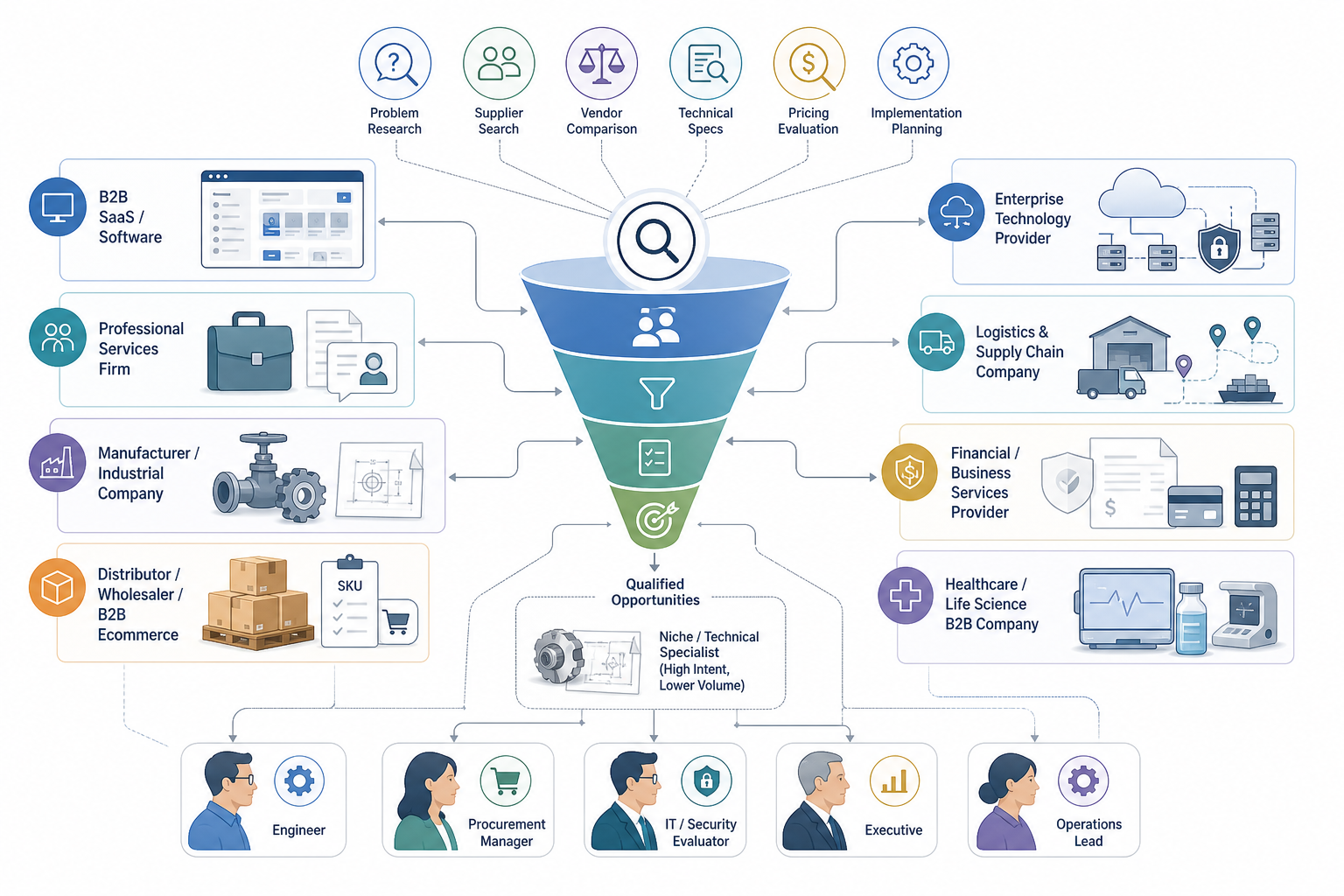
B2B SEO is for companies selling products, services, software, or specialized solutions to other businesses when buyers use search to research problems, identify suppliers, evaluate vendors, compare solutions, or support purchasing decisions.
SEO for B2B companies becomes most useful when searchable business demand exists around the problems, products, services, capabilities, specifications, industries, or providers connected with the offering.
B2B SaaS and Software Companies
B2B software companies can use SEO to capture searches related to:
- Software categories
- Features
- Use cases
- Integrations
- Alternatives
- Comparisons
- Pricing
- Technical requirements
For example, a CRM company can target searches such as “CRM for construction companies,” “Salesforce alternatives,” or “CRM with WhatsApp integration.”
These searches can introduce potential buyers before a demo, free trial, or sales conversation.
Professional Service Firms
Professional service businesses such as consultancies, marketing agencies, accounting firms, legal firms, IT providers, and engineering consultants can target searches related to expertise and service requirements.
Relevant searches can include:
- “SOC 2 compliance consultant”
- “B2B SEO agency”
- “ERP implementation consulting”
- “commercial tax advisory services”
SEO can help connect those searches with service pages, industry pages, expert resources, case studies, and consultation opportunities.
Manufacturers and Industrial Companies
Manufacturers can use SEO to capture technical and procurement-oriented demand.
Relevant searches can involve:
- Product specifications
- Materials
- Components
- Certifications
- Part numbers
- Industrial applications
- Equipment types
- Technical problems
Potential searchers can include engineers, procurement teams, distributors, operations managers, and technical buyers.
For example, searches for “316 stainless steel valve manufacturer” or a specific component specification can have limited volume but substantial commercial value.
Distributors, Wholesalers, and B2B Ecommerce Companies
B2B distributors and wholesalers can target searches connected with commercial purchasing requirements.
Examples include:
- Product categories
- Bulk quantities
- Supplier searches
- Commercial SKUs
- Part numbers
- Technical specifications
- Industry requirements
The search experience should reflect business purchasing rather than automatically following consumer ecommerce patterns.
Enterprise Technology Providers
Enterprise technology companies selling products such as cybersecurity platforms, cloud infrastructure, ERP systems, CRM platforms, data software, or network solutions can use SEO to support detailed evaluation.
Relevant searchers can include:
- IT teams
- Security teams
- Department heads
- Procurement
- Finance
- Operations
- Executives
Different stakeholders can require different information. A security evaluator can need architecture and compliance details, while an executive can need business impact, cost, and implementation evidence.
Logistics and Supply-Chain Companies
Freight, warehousing, fulfillment, transportation, and supply-chain providers can target searches related to:
- Routes
- Services
- Industries
- Locations
- Compliance
- Shipping methods
- Warehousing requirements
- Operational challenges
The goal is not simply to generate logistics-related traffic. The search should connect with a service the company can actually provide.
Financial and Business Service Providers
Business-focused providers offering commercial insurance, finance, payments, payroll, HR, compliance, or accounting services can target relevant organizational demand.
Examples include:
- “international payroll provider”
- “commercial fleet insurance”
- “B2B payment processing”
- “business expense management software”
Content in regulated sectors should remain factual and should not substitute for professional financial or legal advice.
Healthcare and Life-Science B2B Companies
Medical suppliers, laboratories, healthcare software companies, medical equipment manufacturers, and specialist service providers can target professional and organizational searches.
Examples can include:
- Equipment specifications
- Procurement requirements
- Regulatory information
- Laboratory services
- Healthcare software capabilities
The intended searcher is different from a patient performing a consumer-health search.
Niche and Technical B2B Companies
SEO can be commercially valuable even where total search volume is small.
A specialized engineering company can receive only a few highly relevant search visits for a technical specification, but one qualified enquiry can represent a substantial commercial opportunity.
Low volume does not automatically mean high value. The search still needs to match the company’s actual offering and potential customer.
Companies With Longer Evaluation Cycles
Some B2B purchases require repeated research before a prospect contacts sales.
Searches can occur around:
- Problem definition
- Category education
- Technical requirements
- Vendor comparison
- Implementation
- Pricing
- Proof
- Final evaluation
SEO can provide useful entry points throughout that research process.
This is common in complex B2B purchases but is not universal.
Companies Selling to Multiple Stakeholders
Some purchases involve several people, such as:
- End users
- Managers
- Technical teams
- Finance teams
- Procurement teams
- Legal teams
- Executives
Each stakeholder can search for different information about the same product or service.
A cybersecurity platform, for example, can need technical documentation for security teams and commercial justification for leadership.
Companies With High-Value Contracts or Accounts
B2B SEO can make commercial sense even with relatively limited traffic when customer value is high.
A service page generating ten qualified visits can have greater business impact than an informational page generating thousands of unrelated visits.
The appropriate measure is therefore not traffic alone, but the relevance and commercial potential of the visitors.
Companies Expanding Into New Markets
B2B businesses can use SEO to support expansion into:
- New industries
- New countries
- New languages
- New use cases
- New buyer groups
This opportunity depends on actual search demand, localization quality, competition, and product-market fit.
Across these business types, B2B SEO works best under several common conditions.
Research-driven purchasing: Buyers actively search for information before selecting a supplier, provider, product, or service.
Complex offerings: Products such as enterprise software, industrial equipment, consulting services, and technical solutions require explanation and supporting evidence.
Multiple information needs: Different stakeholders can research specifications, implementation, commercial value, risk, integrations, or pricing.
High commercial value: A small number of relevant search visitors can justify investment when one customer has substantial contract value.
Vendor comparison: Buyers actively compare suppliers, products, alternatives, capabilities, or implementation approaches before contacting sales.
A business professional performing a search does not automatically make the query B2B. The query should relate to an organizational, operational, professional, supplier, or business-purchasing need.
B2B SEO is also not limited to enterprise companies. Small and mid-sized businesses can benefit whenever relevant buyers use search to find the types of products, services, or solutions the company provides.
Where Does B2B SEO Fit Into B2B Marketing?
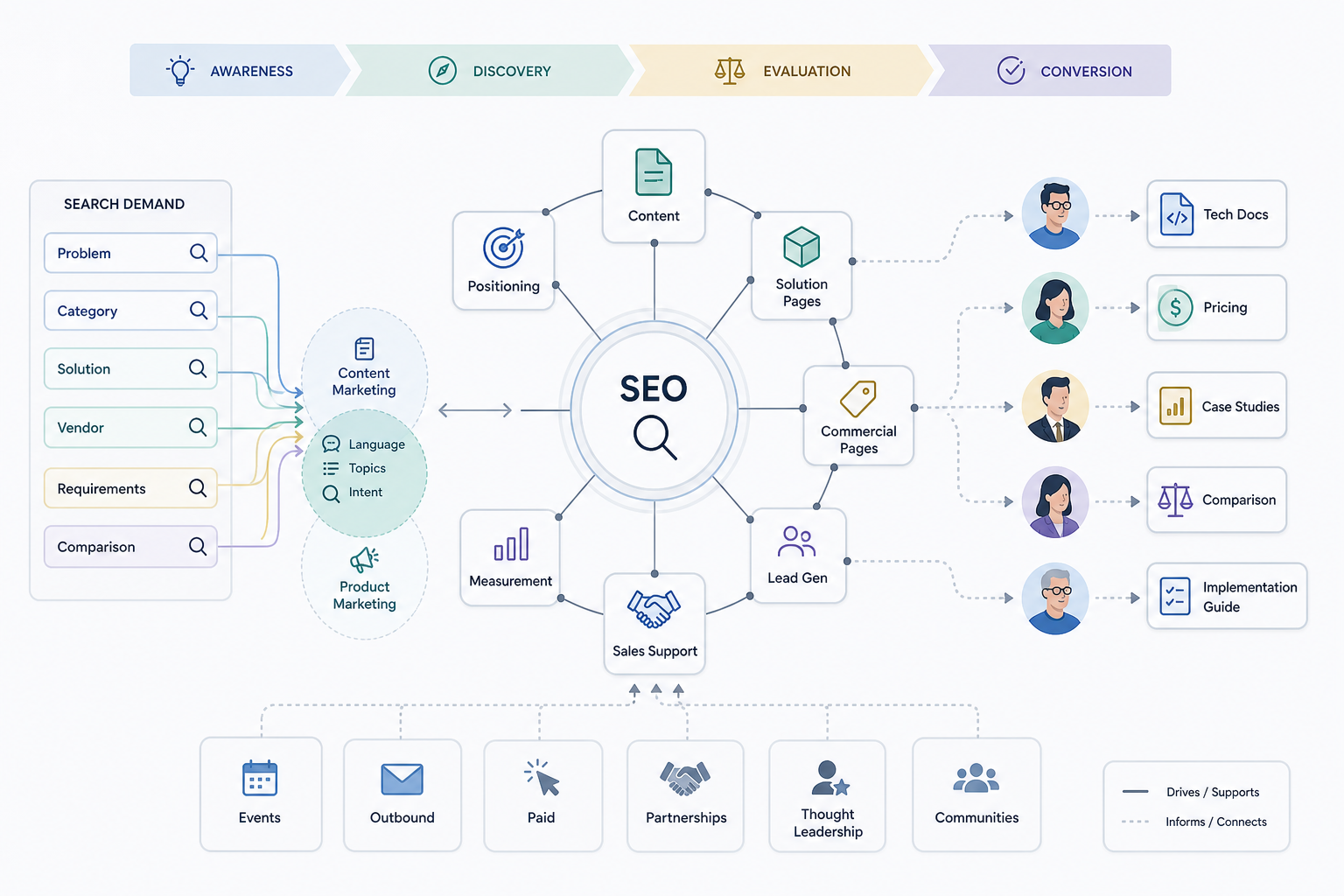
B2B SEO is an organic demand-capture and buyer-education channel within B2B marketing, helping business buyers discover problems, research solutions, compare providers, and find relevant products or services through search.
SEO does not operate independently from the wider marketing system. It connects observable search behavior with product or service positioning, content, commercial pages, lead generation, sales support, and measurement.
Its importance depends on whether meaningful search demand exists in the market.
Demand Capture
SEO captures existing search demand from buyers researching:
- Business problems
- Product categories
- Service categories
- Vendors
- Suppliers
- Tools
- Solutions
- Technical requirements
For example, a company offering procurement software can appear when a buyer searches for “purchase order automation software.”
SEO is primarily a demand-capture channel. Other B2B marketing activities such as events, outbound sales, paid media, partnerships, communities, sponsorships, and thought leadership can also create or stimulate demand.
Problem Awareness and Education
Informational resources can help business buyers understand a problem before they start evaluating providers.
Relevant assets can include:
- Guides
- Research
- Glossaries
- Technical resources
- Tutorials
- Industry reports
An informational search should not automatically be treated as an early-funnel search. An existing customer can perform an informational technical query, while a new prospect can begin directly with a commercial comparison.
Solution Discovery
Commercial pages help connect a recognized business need with an appropriate product or service.
Relevant pages can include:
- Product pages
- Service pages
- Solution pages
- Industry pages
- Use-case pages
- Category pages
For example, someone searching for “warehouse inventory automation” can discover companies providing relevant inventory-management systems.
Commercial Evaluation
B2B buyers often need evidence before selecting a provider.
Useful search assets can include:
- Comparison pages
- Alternative pages
- Vendor-selection guides
- Pricing pages
- Case studies
- Technical specifications
- Implementation guides
Commercial investigation does not always mean the buyer is immediately ready to purchase.
Multi-Stakeholder Research
A B2B purchase can involve several stakeholders.
Examples include:
- End users
- Technical teams
- Security teams
- Finance teams
- Procurement teams
- Operations teams
- Executives
SEO can support their different information needs through appropriate pages.
A technical evaluator can search for integration or security details, while a procurement manager can search for pricing or vendor requirements.
Product and Service Marketing
SEO overlaps with product or service marketing when buyers search for:
- Categories
- Features
- Capabilities
- Use cases
- Industries
- Integrations
- Competitors
- Suppliers
- Problems
Product marketing contributes positioning, differentiation, customer language, and proof.
SEO contributes information about query demand, search intent, SERP composition, competing pages, and organic-discovery requirements.
The two functions are complementary.
Content Marketing
SEO can help content teams prioritize subjects based on search demand, business relevance, buyer intent, and topical relationships.
B2B content marketing remains broader than SEO.
Assets such as:
- Thought-leadership articles
- Research reports
- Newsletters
- Webinars
- Customer stories
- Opinion pieces
can provide marketing value even when they have limited organic search demand.
Thought Leadership
SEO can improve the discoverability of expert commentary, original research, and educational resources when buyers actively search for those subjects.
SEO does not create expertise by itself. The expertise must come from genuine knowledge, experience, research, evidence, or subject-matter contribution.
Lead Generation
Organic landing pages can contribute actions such as:
- Demo requests
- Consultations
- RFQs
- Trial signups
- Contact submissions
- Resource downloads
SEO creates the acquisition opportunity.
Conversion still depends on factors such as:
- Product or service fit
- Positioning
- Offer
- Proof
- Page experience
- Qualification
- CTA
- Sales process
Account-Based Marketing Support
SEO can support account-based marketing when target industries, roles, or companies are researching relevant problems, categories, competitors, or solutions.
Search data can help identify language and subjects that matter to those audiences.
Organic pages can also be used during account-specific outreach and nurturing.
SEO data should not be treated as proof of what a specific target account is searching unless account-level evidence genuinely exists.
Sales Enablement
Resources created for search can also support sales conversations.
Examples include:
- Case studies
- Comparison pages
- Technical guides
- Implementation resources
- Industry pages
- Solution explanations
This is a secondary use of the asset rather than a replacement for dedicated sales enablement.
Demand Validation
Keyword and SERP evidence can show how people search for:
- Problems
- Categories
- Suppliers
- Products
- Services
- Solutions
This can inform positioning and content decisions.
Search data represents searchable demand, not the entire market. Important buyer needs can exist even when they produce little measurable search activity.
Technical Marketing Infrastructure
Technical SEO helps ensure intended public pages can be discovered, crawled, rendered, canonicalized, and indexed correctly.
Relevant assets can include:
- Service pages
- Product pages
- Industry pages
- Research
- Technical documentation
- Case studies
Technical accessibility allows search engines to process a page but does not guarantee rankings.
Authority and External Visibility
External signals can include:
- Editorial backlinks
- Industry citations
- Research references
- Digital PR coverage
- Partnerships
- Brand mentions
These references can strengthen the external visibility and authority associated with relevant B2B pages.
Third-party metrics such as Domain Authority or Domain Rating can provide comparative context but are not Google metrics.
Organic Performance Measurement
B2B SEO can be measured with both search indicators and commercial outcomes.
Search indicators include:
- Impressions
- Rankings
- Clicks
- CTR
- Organic landing-page traffic
Commercial outcomes can include:
- Qualified leads
- Opportunities
- Pipeline
- Revenue
The further downstream the measurement goes, the more useful it can become for evaluating commercial contribution.
Pipeline Contribution
B2B SEO becomes commercially meaningful when relevant organic search visibility contributes to qualified opportunities rather than traffic alone.
Attribution can be difficult in longer or multi-touch buying journeys because prospects can interact with several channels before converting.
SEO should therefore be evaluated using both diagnostic search metrics and business outcomes.
Customer and Partner Education
Public resources can also support existing customers and partners.
Examples include:
- Documentation
- Implementation guides
- Integration instructions
- Technical resources
- Partner material
Any impact on retention or expansion should be treated as indirect unless measurement confirms a stronger relationship.
The role of SEO for B2B marketing can be summarized across three broad functions.
Demand Capture
SEO connects existing business search demand with relevant informational and commercial pages.
Buyer Education and Evaluation
SEO helps buyers understand problems, investigate solutions, compare providers, review evidence, and validate purchasing requirements.
Pipeline Support
SEO creates qualified organic entry points that can contribute to lead and opportunity generation when the search intent, audience, offering, and conversion path align.
B2B buyers do not necessarily move through a fixed sequence of awareness, consideration, and conversion. A buyer can first discover a vendor through a comparison search, technical specification, branded query, supplier search, integration question, or broad informational topic.
Search intent and funnel stage should therefore remain separate.
B2B SEO works within the wider marketing system by capturing relevant search demand and turning it into opportunities for discovery, education, evaluation, lead generation, and measurable pipeline contribution.
How Do You Build a B2B SEO Strategy?
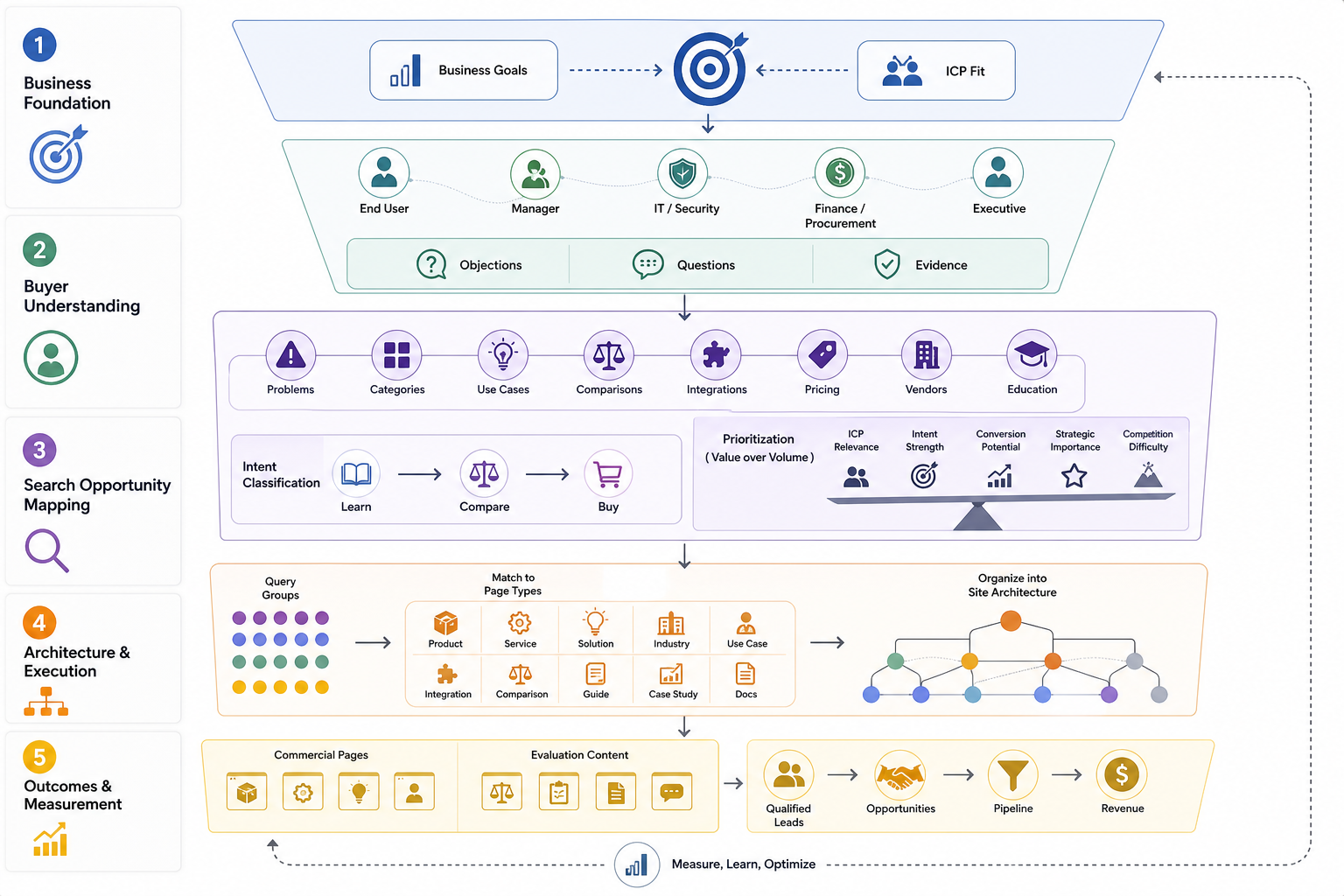
A B2B SEO strategy is built by translating business and marketing goals into prioritized search opportunities for relevant buyers, then creating the page, technical, authority, conversion, and measurement systems required to capture that demand. This applies the broader framework of an SEO strategy to B2B buying conditions, where ICP relevance, stakeholder needs, commercial intent, lead quality, and pipeline contribution influence prioritization. Business relevance, buyer intent, and lead quality should guide prioritization rather than search volume alone.
1. Define B2B Business Goals
Identify what SEO should contribute to the business.
Possible outcomes include:
- Qualified traffic
- Demo requests
- Consultations
- RFQs
- Qualified leads
- Opportunities
- Pipeline
- Revenue
Keep these outcomes separate from supporting SEO metrics such as impressions, rankings, clicks, referring domains, and organic sessions.
Traffic growth alone should not define the strategy.
2. Define the Ideal Customer Profile
Document the type of business most likely to benefit from the offering.
Relevant attributes can include:
- Company size
- Industry
- Geography
- Business maturity
- Use case
- Operational problem
- Budget context
- Purchase requirement
Use evidence such as:
- CRM data
- Sales conversations
- Customer interviews
- Support tickets
- Reviews
- Product usage
- Service delivery data
The ICP helps separate commercially relevant search demand from broader traffic opportunities.
3. Map Relevant Buying Stakeholders
Identify the people who can research, influence, approve, or use the product or service.
Examples include:
- End users
- Managers
- Engineers
- IT teams
- Security teams
- Finance
- Procurement
- Operations
- Legal
- Executives
Document the questions, objections, evaluation criteria, and evidence requirements associated with each relevant stakeholder.
Do not assume every purchase involves all of these roles.
4. Define the Product, Service, and Entity Context
Document what the company sells and how it relates to its market.
Include:
- Product or service category
- Problems solved
- Capabilities
- Features
- Industries
- Use cases
- Integrations
- Alternatives
- Competitors
- Differentiators
- Proof points
These relationships establish the commercial context within which keyword and content opportunities should be evaluated.
5. Map Relevant Search Demand
Research queries around:
- Business problems
- Categories
- Products
- Services
- Use cases
- Industries
- Specifications
- Features
- Integrations
- Alternatives
- Comparisons
- Pricing
- Vendors
- Suppliers
- Educational topics
Include informational, navigational, commercial, and transactional searches where relevant.
Do not restrict research to large-volume keywords.
6. Classify Search Intent
Determine what the searcher wants to accomplish.
Common B2B search tasks include:
- Learn about a problem
- Understand a category
- Compare products
- Evaluate providers
- Find a supplier
- Inspect a specification
- Review pricing
- Complete a commercial action
Validate intent through:
- Query wording
- Modifiers
- Ranking page types
- SERP features
- Current competing results
Allow for dominant and secondary intent where the SERP is mixed.
7. Prioritize Keywords by Business Value
Evaluate each opportunity using factors such as:
- ICP relevance
- Product or service fit
- Search intent
- Conversion potential
- Search demand
- Competition
- Strategic importance
- Current website strength
A lower-volume query can deserve greater priority when it closely matches a high-value customer requirement.
Avoid treating “money keywords” as a formal search-engine category.
8. Match Query Groups With the Correct Page Type
Assign groups of related searches to the type of page most capable of satisfying the user need.
Possible page types include:
- Product pages
- Service pages
- Solution pages
- Industry pages
- Use-case pages
- Integration pages
- Comparison pages
- Alternative pages
- Category pages
- Case studies
- Guides
- Tools
- Templates
- Research
- Documentation
Avoid creating one page for every small keyword variation.
9. Build the B2B Information Architecture
Organize the website around meaningful relationships between:
- Problems
- Products
- Services
- Solutions
- Industries
- Capabilities
- Use cases
- Integrations
- Supporting topics
Commercial pages should connect naturally with relevant educational, technical, and proof-based resources.
Avoid rigid silos when cross-topic relationships genuinely help users.
10. Build Core Commercial Pages
Create or improve pages targeting commercially relevant demand.
Examples include:
- Product-category pages
- Service pages
- Solution pages
- Industry pages
- Use-case pages
A strong commercial page should explain:
- The buyer problem
- The relevant solution
- The company’s capability
- Supporting evidence
- The appropriate next action
Avoid vague sales copy that fails to answer the business need expressed in the query.
11. Build Comparison and Evaluation Content
Create decision-support content where actual search demand exists.
Relevant assets can include:
- Product comparisons
- Vendor comparisons
- Alternative pages
- Pricing guides
- Implementation guides
- Selection criteria
- Evaluation resources
Use consistent comparison criteria.
Keep competitor claims factual and verifiable.
12. Build Educational Content Around Buyer Problems
Create useful informational resources about problems connected with the ICP and offering.
Examples include:
- Guides
- Research
- Definitions
- Workflows
- Case studies
- Technical resources
- Templates
Connect educational content with relevant commercial pages when that relationship helps the buyer.
Avoid publishing high-volume topics that have little connection with the company’s actual audience or offering.
13. Match Content With Stakeholder Needs
Different stakeholders can require different evidence.
A technical evaluator can need:
- Architecture
- Specifications
- Security
- Compatibility
- Integration information
An executive can need:
- Business impact
- Cost
- Risk
- ROI evidence
- Strategic value
A procurement team can need:
- Pricing
- Vendor information
- Terms
- Compliance
- Implementation requirements
Do not create separate pages for every persona unless search demand or distinct information needs justify them.
14. Align Each Page With Search Intent
Match the page with:
- Expected page type
- Content format
- Angle
- Depth
- Evidence
- Examples
- Calls to action
Answer the primary search need early.
Search-intent optimization is about satisfying the task, not repeating more keywords.
15. Add Evidence and Trust Signals
Support commercial claims with verifiable proof where available.
Evidence can include:
- Case studies
- Customer examples
- Certifications
- Product data
- Service data
- Research
- Expert input
- Implementation information
For example, “reduces processing time by 38% across 120 customer accounts” is stronger evidence than “dramatically improves efficiency” when the underlying data genuinely supports the claim.
Rankings themselves do not establish trust.
16. Build the Technical SEO Foundation
Ensure important public URLs can be discovered and processed correctly.
Review:
- Status codes
- Redirects
- Canonicals
- Robots directives
- XML sitemaps
- Duplicate URLs
- Rendering
- Structured data
- Mobile usability
- Website performance
Technical health makes search participation possible but does not replace relevance, content quality, or authority.
17. Optimize Page-Level SEO Elements
Align on-page elements with the page’s topic and purpose.
Relevant elements include:
- Title
- H1
- Supporting headings
- Page copy
- URL
- Internal links
- Images
- Structured data
Use descriptive language naturally.
Avoid fixed keyword-density percentages, universal title-length rules, or exact-match keyword formulas.
18. Build Internal Links Deliberately
Connect pages through relevant source-to-destination relationships.
Examples include:
- Guide to service page
- Case study to industry page
- Industry page to relevant solution
- Solution page to technical guide
- Comparison page to product page
Use descriptive anchor text.
Avoid fixed internal-link counts.
19. Build External Authority
Earn external references that are relevant to the company’s market and expertise.
Examples include:
- Editorial backlinks
- Industry citations
- Research mentions
- Digital PR
- Partnerships
- Expert contributions
Prioritize topical relevance, editorial legitimacy, and source quality over raw link volume.
Third-party authority scores should support comparison rather than determine link value by themselves.
20. Connect SEO With Conversion Paths
Match the CTA with the page purpose and buyer readiness.
Possible actions include:
- View a solution
- Review a case study
- Compare products
- Download a resource
- Request a consultation
- Submit an RFQ
- Book a demo
An educational page does not always need an aggressive sales CTA.
21. Connect SEO With Sales and CRM Data
Where measurement infrastructure permits, connect organic acquisition with:
- Leads
- Qualified leads
- Opportunities
- Deal stages
- Closed revenue
Sales feedback can reveal whether traffic from particular pages or queries produces commercially relevant prospects.
Form submissions alone can be misleading if lead quality varies significantly.
22. Measure SEO According to Business Role
Track both SEO indicators and commercial outcomes.
SEO indicators can include:
- Impressions
- Rankings
- Clicks
- CTR
- Organic traffic
- Technical health
- Backlinks
Business indicators can include:
- Qualified leads
- Opportunities
- Pipeline
- Revenue
Evaluate each page according to its intended role.
A technical guide can contribute indirectly to evaluation, while a service page can have a stronger direct lead-generation objective.
23. Identify Gaps and Reprioritize
Review:
- Missing query coverage
- Underperforming pages
- Competitor movement
- Technical issues
- Internal-link gaps
- Weak conversion paths
- Low-quality lead sources
Possible responses include:
- Create
- Improve
- Refresh
- Consolidate
- Reposition
- Internally link
- Fix technically
- Strengthen externally
- Monitor
- Leave unchanged
Not every weak metric requires a content rewrite.
24. Refine the Strategy Continuously
Reassess the strategy as the market changes.
Review changes in:
- Search demand
- Buyer needs
- SERPs
- Competitors
- Products
- Services
- Positioning
- Sales feedback
- Organic performance
A B2B SEO strategy should evolve with the company rather than remain a one-time keyword document.
The strongest B2B SEO strategies connect business goals, ICPs, relevant stakeholders, search demand, page architecture, useful content, technical accessibility, external authority, conversion paths, lead quality, and pipeline measurement.
Which Tools Support B2B SEO?
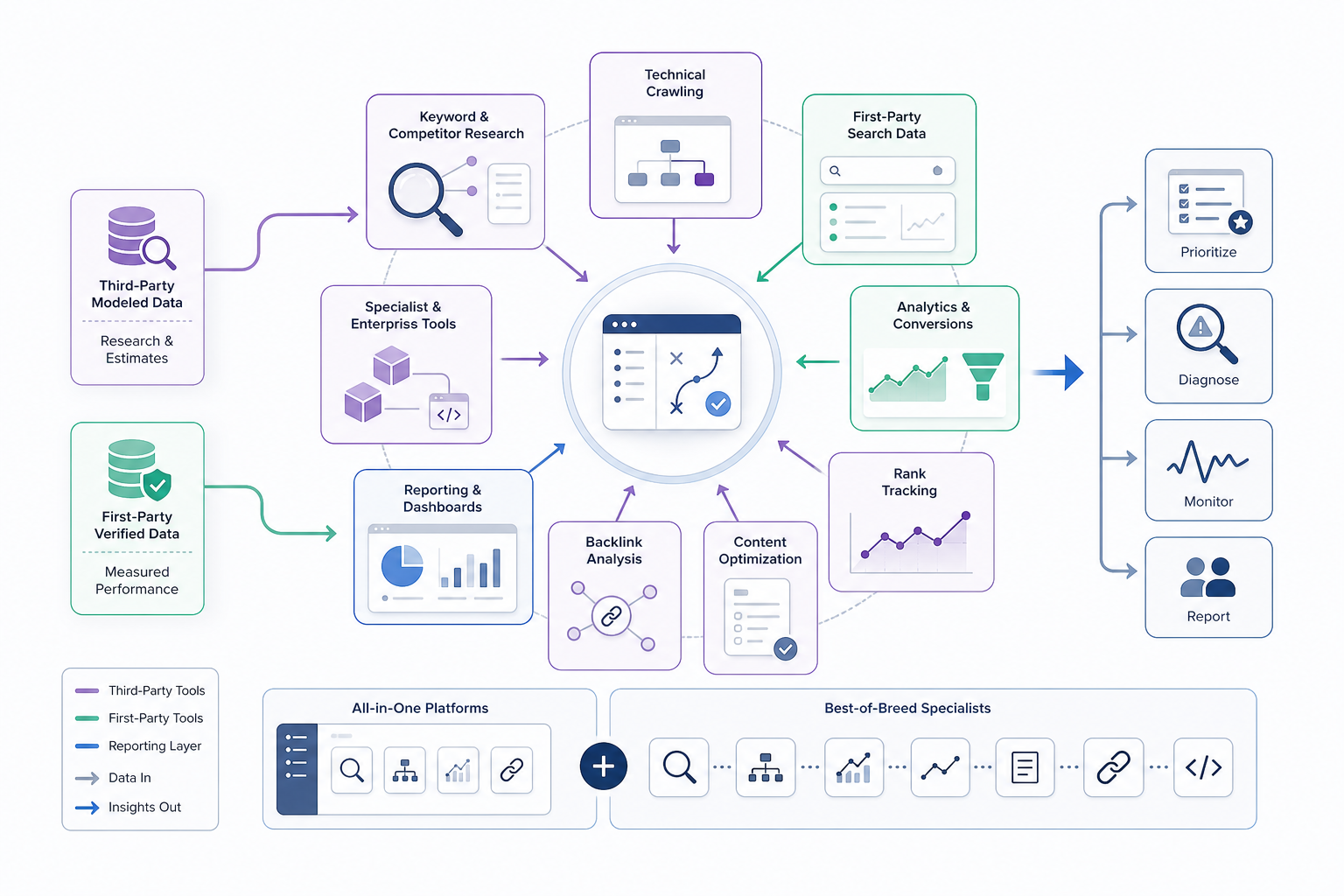
B2B SEO tools can include keyword-research platforms, competitor-analysis software, technical crawlers, backlink tools, content systems, first-party search platforms, analytics software, rank trackers, and reporting systems. The right combination depends on website complexity, market, team size, research depth, and measurement requirements.
| B2B SEO Requirement | Suitable Tools | Main Capability | Data / Output | When to Use It |
|---|---|---|---|---|
| Keyword and Intent Research | Semrush, Ahrefs, Keyword Insights | Query discovery, search-demand estimates, SERPs, competitor terms | Search opportunities and prioritization evidence | Building the B2B keyword universe |
| Competitor Research | Semrush, Ahrefs, Similarweb | Competing keywords, pages, links, visibility | Competitive gaps | Evaluating organic competitors |
| Backlink Analysis | Ahrefs, Semrush, Majestic | Referring domains, links, anchors, gains, losses | External authority evidence | Link and competitor research |
| Technical SEO Auditing | Screaming Frog, Sitebulb | Crawling, redirects, canonicals, metadata, internal links, rendering | Technical findings and affected URLs | Audits, migrations, large technical reviews |
| Search Performance Monitoring | Google Search Console, Bing Webmaster Tools | Queries, clicks, impressions, pages, indexing evidence | First-party search data | Measuring actual search performance |
| Analytics and Conversion Measurement | Google Analytics 4 | Sessions, events, conversions, landing pages | Website and conversion performance | Connecting organic traffic with actions |
| Rank Tracking | AccuRanker, SE Ranking, Advanced Web Ranking | Keyword monitoring by market, device, and location | Ranking trends | Tracking strategic B2B queries |
| Content Research and Optimization | Clearscope, Surfer SEO, Frase | SERP analysis, topical coverage, page recommendations | Content briefs and optimization evidence | Creating or improving search content |
| On-Page SEO Analysis | Screaming Frog, PageOptimizer Pro | Titles, headings, links, page elements | Page-level optimization findings | Reviewing commercial and informational pages |
| Internal Linking Analysis | Screaming Frog, Sitebulb | Incoming links, outgoing links, crawl depth, orphan discovery | Internal architecture evidence | Strengthening important commercial pages |
| SERP and Intent Analysis | Semrush, Ahrefs, live search-result review | Ranking page types, SERP features, competitor patterns | Search-intent evidence | Validating expected page format |
| Lead and Pipeline Reporting | GA4, CRM-connected dashboards, Looker Studio | Organic landing pages, leads, opportunities, revenue | Commercial SEO reporting | B2B organizations measuring pipeline contribution |
| SEO Reporting | Looker Studio, AgencyAnalytics | Multi-source dashboards and recurring reports | Stakeholder reporting | Monthly or quarterly SEO reviews |
| SEO Automation | Enterprise SEO platforms, crawlers, reporting systems | Scheduled crawls, alerts, exports, reports | Reduced recurring manual work | Larger SEO programs |
| Local SEO | Specialist local SEO tools | Local rankings, listings, citations | Local visibility evidence | Regional service businesses or multi-location B2B companies |
| Enterprise SEO | Botify, Lumar, seoClarity | Large-scale crawling, monitoring, APIs, enterprise workflows | High-volume SEO evidence | Large websites and multi-market organizations |
No single platform is universally the best B2B SEO tools.
An all-in-one platform can combine several capabilities, such as:
- Keyword research
- Competitor analysis
- Rankings
- Backlinks
- Site auditing
A specialist tool can provide greater depth in one area.
For example:
- Screaming Frog provides deeper crawl control than many broad SEO suites.
- AccuRanker specializes in rank tracking.
- Majestic specializes in backlink intelligence.
- Clearscope specializes in content optimization.
- Google Search Console provides first-party Google Search data about the company’s own website.
First-party data and third-party modeled data should also remain separate.
Google Search Console can show actual Google Search clicks and impressions recorded for the verified property.
Commercial SEO platforms can estimate:
- Competitor traffic
- Search volume
- Keyword difficulty
- Authority
- Visibility
- Backlinks
These datasets are useful for comparison and research, but they do not have the same measurement properties as first-party website data.
A practical B2B SEO tool stack can therefore include:
- Google Search Console for search-performance evidence
- Google Analytics 4 for traffic and conversion measurement
- One broad SEO research platform for keywords and competitors
- One technical crawler for website diagnostics
- One reporting layer for stakeholder communication
Specialist tools can then be added where the business requires greater depth in areas such as rank tracking, content optimization, backlink analysis, local SEO, log analysis, or enterprise crawling.
The purpose of B2B SEO tools is to provide the data, diagnostics, monitoring, and workflow support needed to make better search decisions. The strategy still determines which opportunities are commercially relevant and worth pursuing.
Need links on real SaaS and business websites?
Links are placed after your approval, on sites with guaranteed DR and traffic, with a 1-year replacement guarantee.

