
SEO Analysis: Website, Pages, Performance, Rankings & Tools
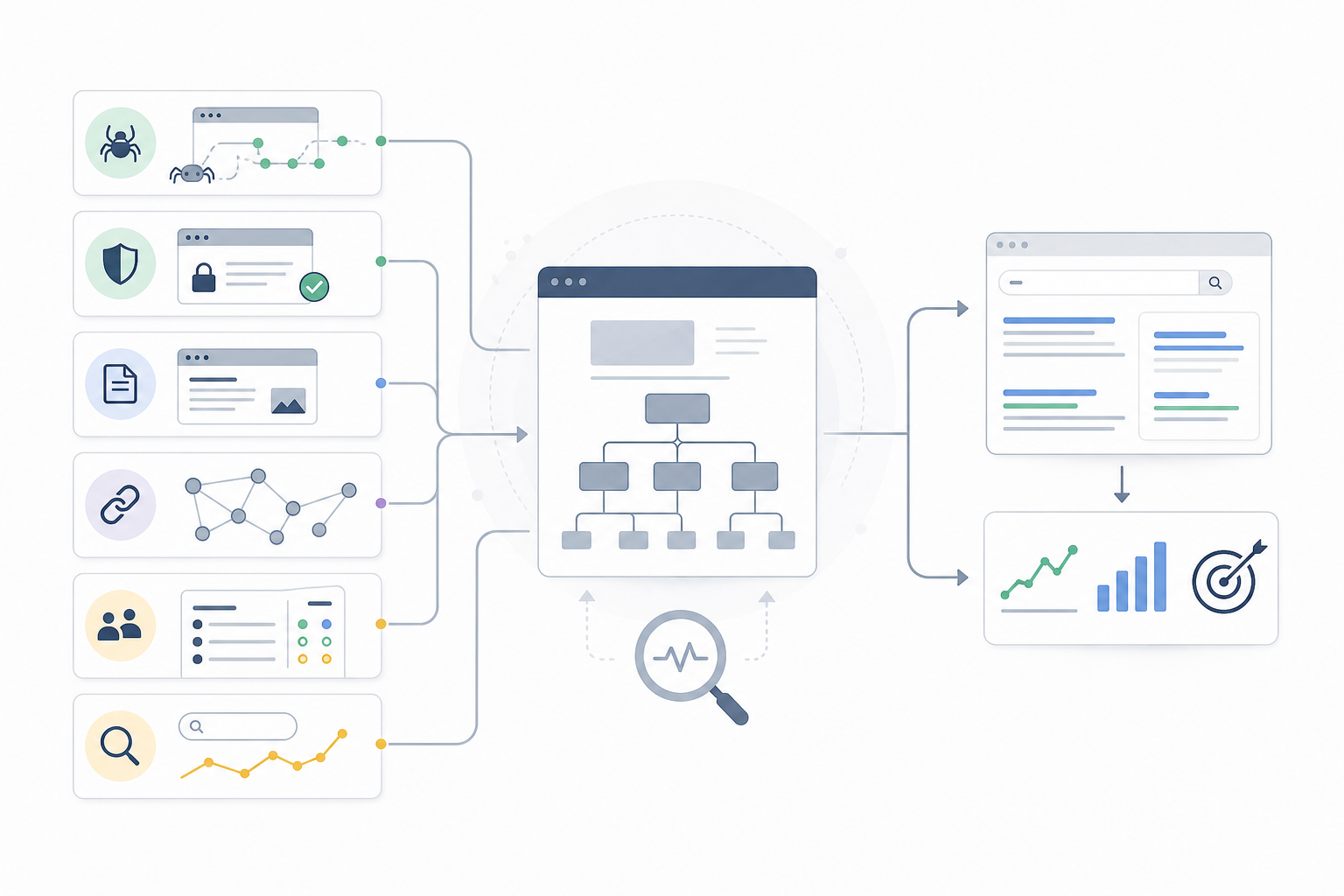
SEO analysis is the process of evaluating a website’s search condition and organic performance to understand what supports visibility, what restricts it, and where meaningful optimization opportunities exist. It connects the condition of the website with the search outcomes the website produces.
SEO analysis extends beyond checking keyword rankings or organic traffic. Rankings, impressions, clicks, traffic, and conversions represent outcomes. Analysis examines the website, individual pages, content, authority, competitors, and search demand behind those outcomes to determine why performance changes.
A website can lose organic visibility even when its content remains unchanged. Technical accessibility problems, weaker competitor pages becoming stronger, changing search intent, lost backlinks, poor internal relationships, outdated information, or reduced search demand can all influence performance. Looking at traffic alone does not identify which factor produced the change.
Effective SEO analysis examines several areas of the website. Technical and structural analysis establishes whether search engines can reliably access important content. Page-level analysis determines whether individual URLs communicate their topic and intent clearly. Content analysis evaluates whether pages provide useful and complete information. Authority analysis examines external links and competitive strength. Performance analysis then connects these conditions with observable search outcomes.
SEO analysis differs from a formal SEO audit in scope and purpose. An SEO audit usually documents website issues, evidence, impact, priorities, and recommended remediation in a structured diagnostic report. SEO analysis is broader and more continuous. It interprets website and performance data to understand strengths, weaknesses, changes, and opportunities.
Analysis also operates at different levels. Sitewide analysis examines the website as a complete search system, including architecture, topical coverage, authority, and competitive position. Individual page analysis examines the relevance, quality, HTML elements, links, and accessibility of a specific URL. Performance analysis measures how those conditions translate into rankings, visibility, clicks, traffic, and conversions.
SEO tools provide evidence across each analytical level. Crawlers expose technical patterns, Search Console provides Google Search performance data, analytics platforms measure user behavior and conversions, and third-party SEO platforms provide keyword, competitor, backlink, and visibility datasets.
No individual metric establishes an SEO conclusion on its own. A page ranking lower than before does not automatically indicate poor content. A traffic increase does not automatically represent stronger SEO performance. Effective analysis interprets website condition, page relevance, search demand, authority, competition, and business outcomes together.
Practical SEO analysis starts by evaluating the website as a complete search system before investigating individual URLs and specific performance changes.
How Do You Analyze a Website for SEO?
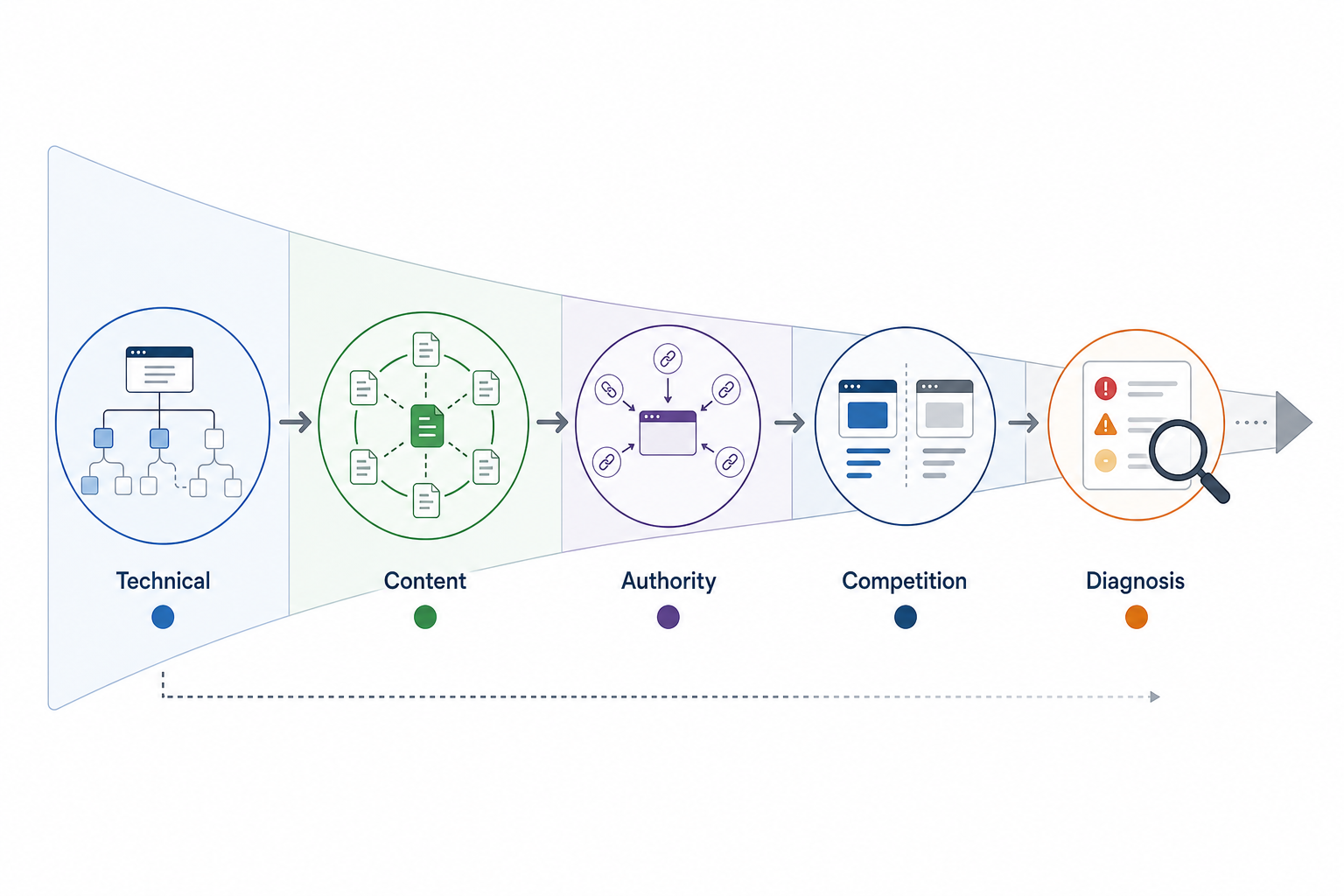
Website SEO analysis evaluates whether search engines can access the site, whether its pages support relevant search demand, whether the website has sufficient competitive authority, and where organic performance is being constrained.
A whole-site analysis moves from broad website conditions toward more specific areas requiring investigation.
1. Evaluate Technical Accessibility and Site Structure
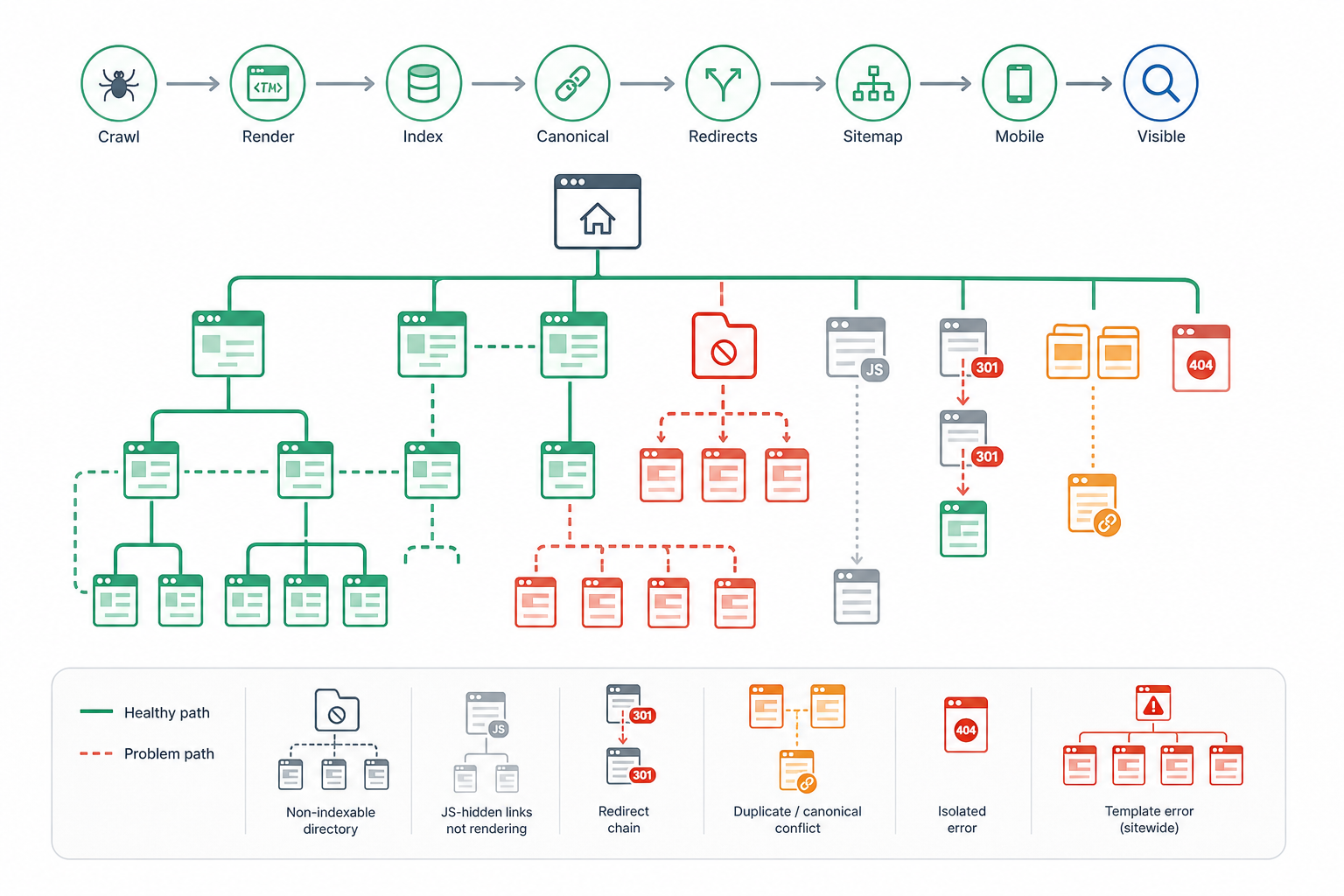
Determine whether important website sections can be discovered, crawled, rendered, and indexed reliably.
Review broad technical patterns involving:
- Crawl accessibility
- Index eligibility
- Site architecture
- URL structure
- Internal discoverability
- Redirect behavior
- Rendering
- Mobile accessibility
- Canonicalization
- Sitemap coverage
- Important technical errors
The objective at this stage is not to reproduce a complete technical SEO audit. Instead, identify sitewide technical conditions that influence search visibility.
For example, a large number of strategically important pages sitting too deep within the architecture can limit discovery and internal authority distribution. A directory containing non-indexable URLs can explain why content within that section generates little organic visibility. A JavaScript implementation that prevents important internal links from rendering can weaken crawler access across an entire template.
Technical analysis also separates isolated issues from systemic patterns. One broken URL has a different significance from a template generating thousands of broken URLs.
2. Evaluate Sitewide Relevance and Content Structure
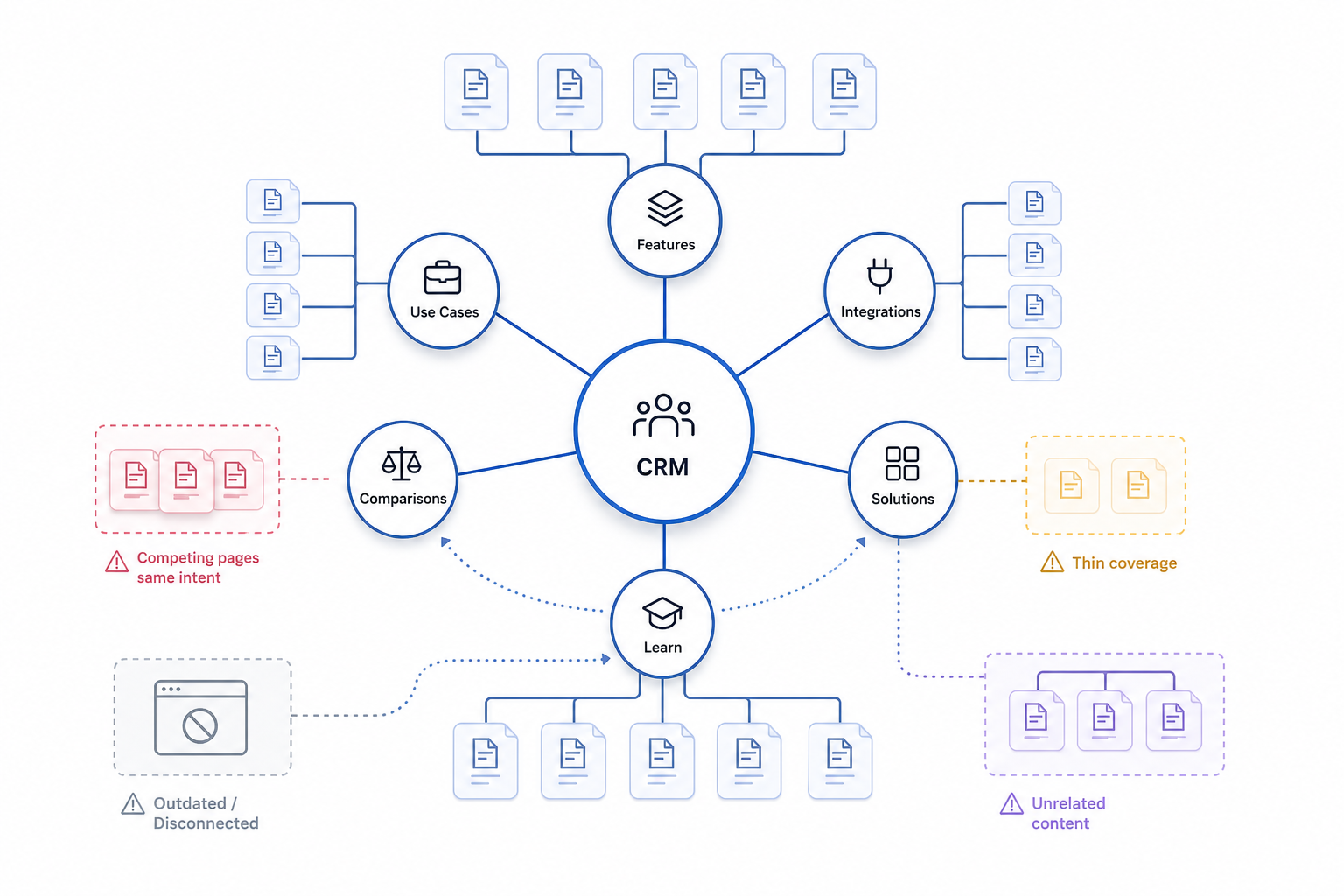
Review whether the website clearly covers the topics, products, services, problems, and search intents important to its audience and business.
Analyze:
- Major topic areas
- Content hubs
- Product and service sections
- Category structures
- Supporting informational content
- Search-intent coverage
- Topic overlap
- Missing subject areas
- Outdated sections
- Internal relationships between important pages
The website’s content architecture must make its subject areas understandable.
For example, a SaaS website targeting CRM-related searches requires clear relationships between its main CRM product page, feature pages, use-case pages, integration pages, comparison pages, and educational content. Publishing dozens of unrelated CRM articles without clear topical relationships does not automatically create stronger relevance.
Sitewide content analysis also identifies structural weaknesses.
One major topic can have excessive supporting content while another commercially important topic has almost no coverage. Several pages can address the same search intent without clear differentiation. Important product pages can exist without supporting informational content or relevant internal links.
These patterns become candidates for deeper page-level analysis.
3. Evaluate External Authority
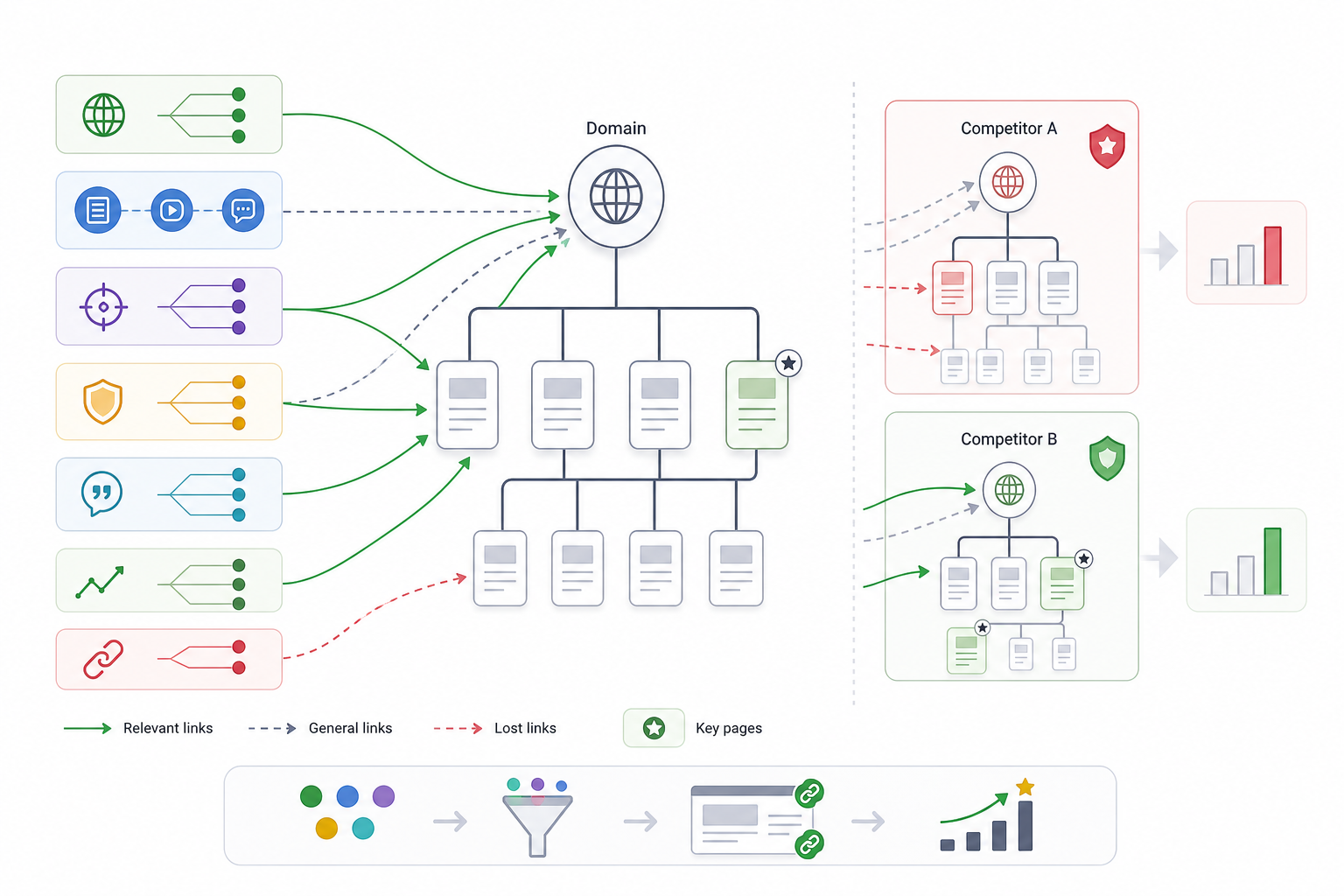
Review the website’s broader external authority and backlink profile.
Analyze:
- Relevant referring domains
- Link diversity
- Link relevance
- Link credibility
- Important externally linked pages
- Link growth
- Lost referring domains
- Competitor authority differences
- Brand mentions
Authority analysis focuses on the quality and context of external references rather than one proprietary score.
A website with a lower third-party authority metric can still compete effectively when its relevant pages receive strong topical links and satisfy search intent better than competitors. Conversely, a high authority score does not guarantee visibility for pages that lack relevance or useful information.
Review which sections attract external links. A website can possess substantial domain-level authority while its most important commercial pages receive little direct or indirect support.
Meaningful lost links also deserve attention when they affect important pages or coincide with declining visibility.
4. Evaluate the Competitive Search Position
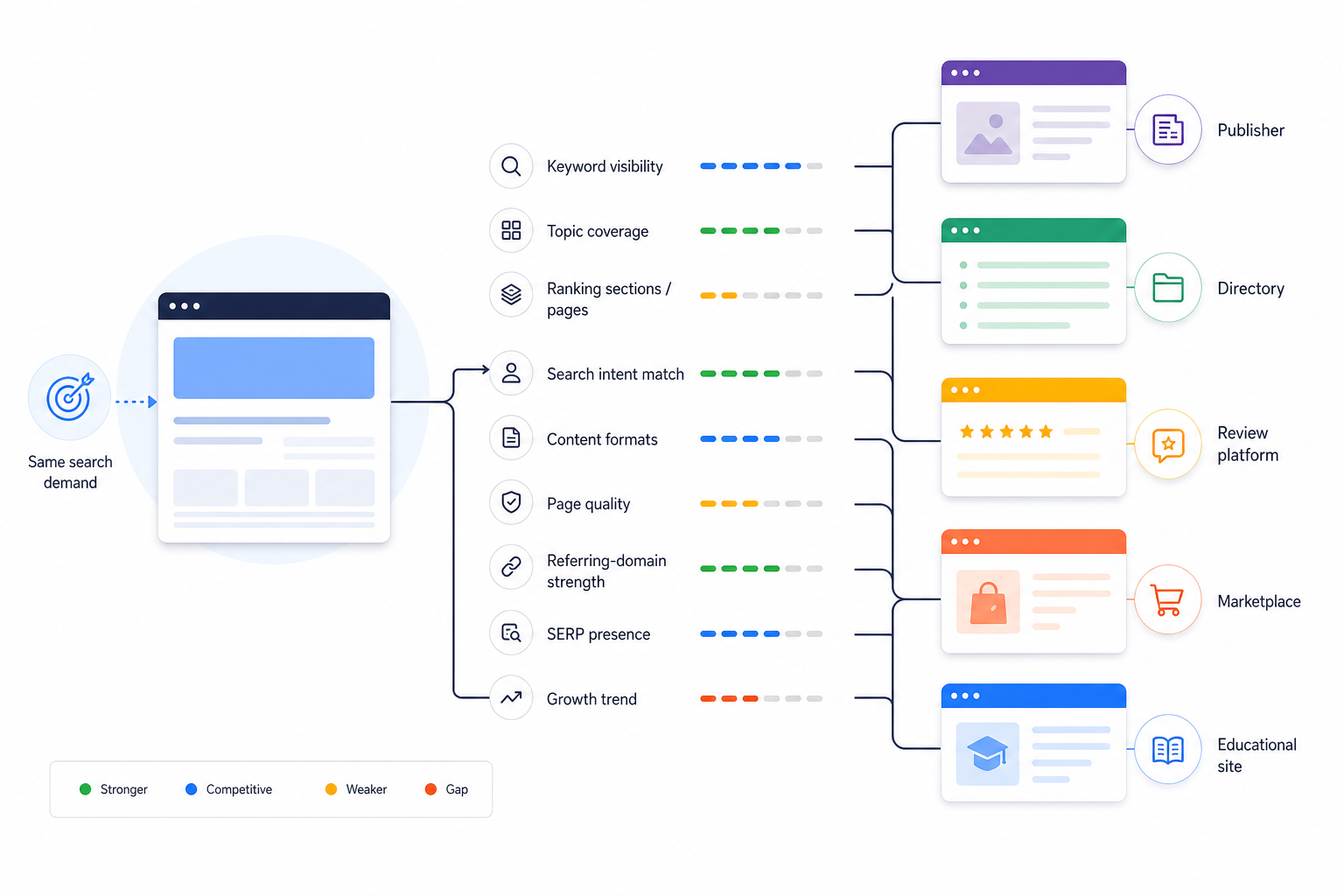
Identify the domains repeatedly competing across strategically relevant topics and queries.
Compare:
- Keyword visibility
- Topic coverage
- Ranking sections
- Search intent
- Content formats
- Page quality
- Referring-domain strength
- SERP presence
- Growth trends
SEO competitors are not limited to direct business competitors.
A software company can compete in search results with publishers, directories, review platforms, marketplaces, and educational websites. The relevant competitor is the domain repeatedly capturing the search demand the business wants to reach.
Competitive analysis reveals where the website leads and where stronger alternatives already exist.
For example, competitors can have:
- Better commercial landing pages
- Stronger informational topic coverage
- More relevant backlinks
- Better comparison content
- More effective internal linking
- Stronger visibility for long-tail queries
- Better alignment with the dominant SERP format
These differences identify areas requiring deeper analysis rather than providing instructions to copy competitors.
5. Identify Areas Requiring Deeper Analysis
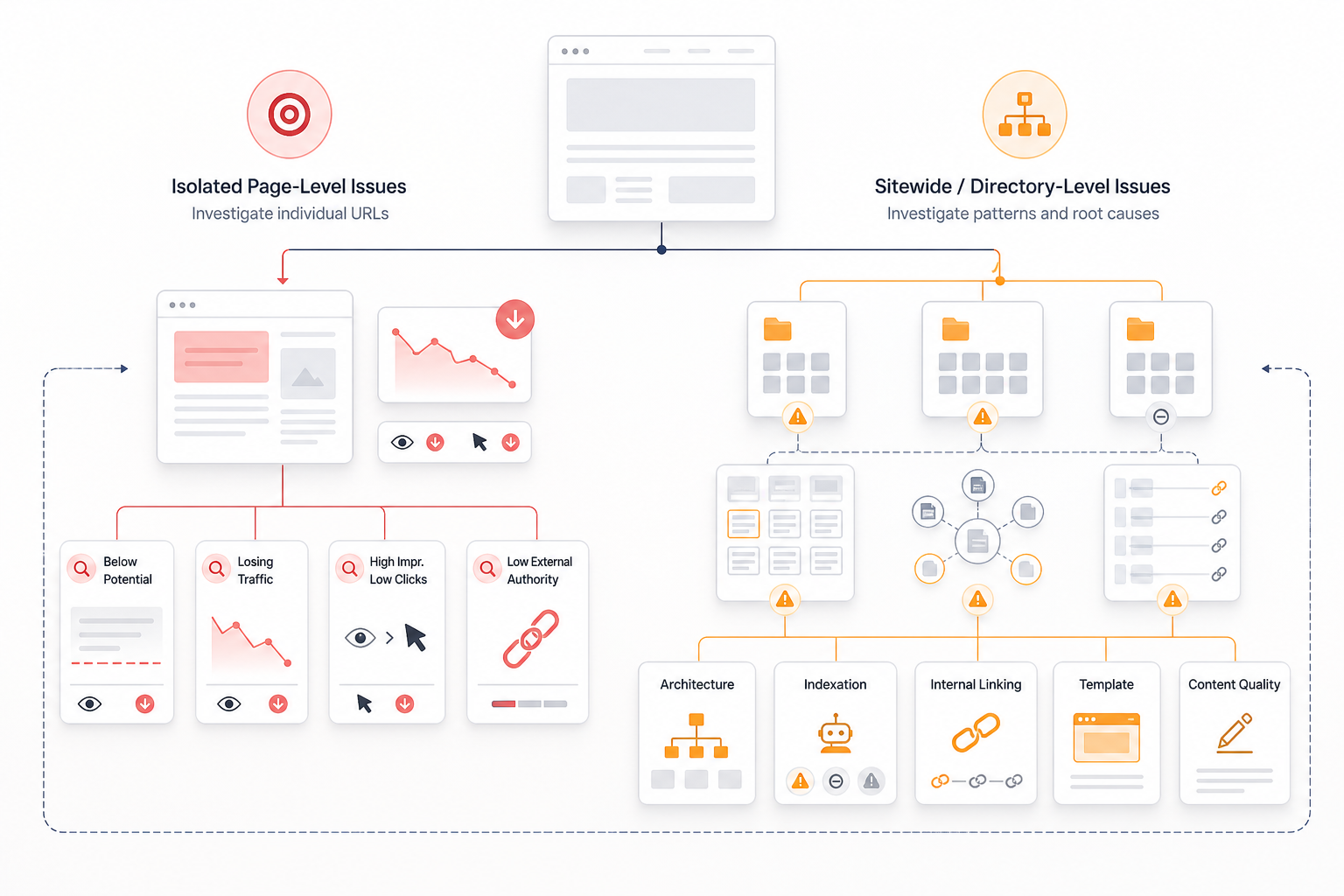
Use the sitewide findings to determine which pages, directories, topics, or patterns require closer investigation.
Focus on areas such as:
- Important pages losing visibility
- Directories with weak indexation
- Topics with poor search coverage
- Commercial pages with weak internal support
- Pages ranking below their expected potential
- Content areas losing traffic
- Sections with strong impressions but weak clicks
- Important URLs with little external authority
Separate localized page problems from broad website patterns.
If one page has weak rankings, page-level relevance can be the primary issue. If an entire directory loses visibility, the cause can involve architecture, indexation, internal linking, template changes, or broader content quality.
6. Connect Website Findings With Search Performance
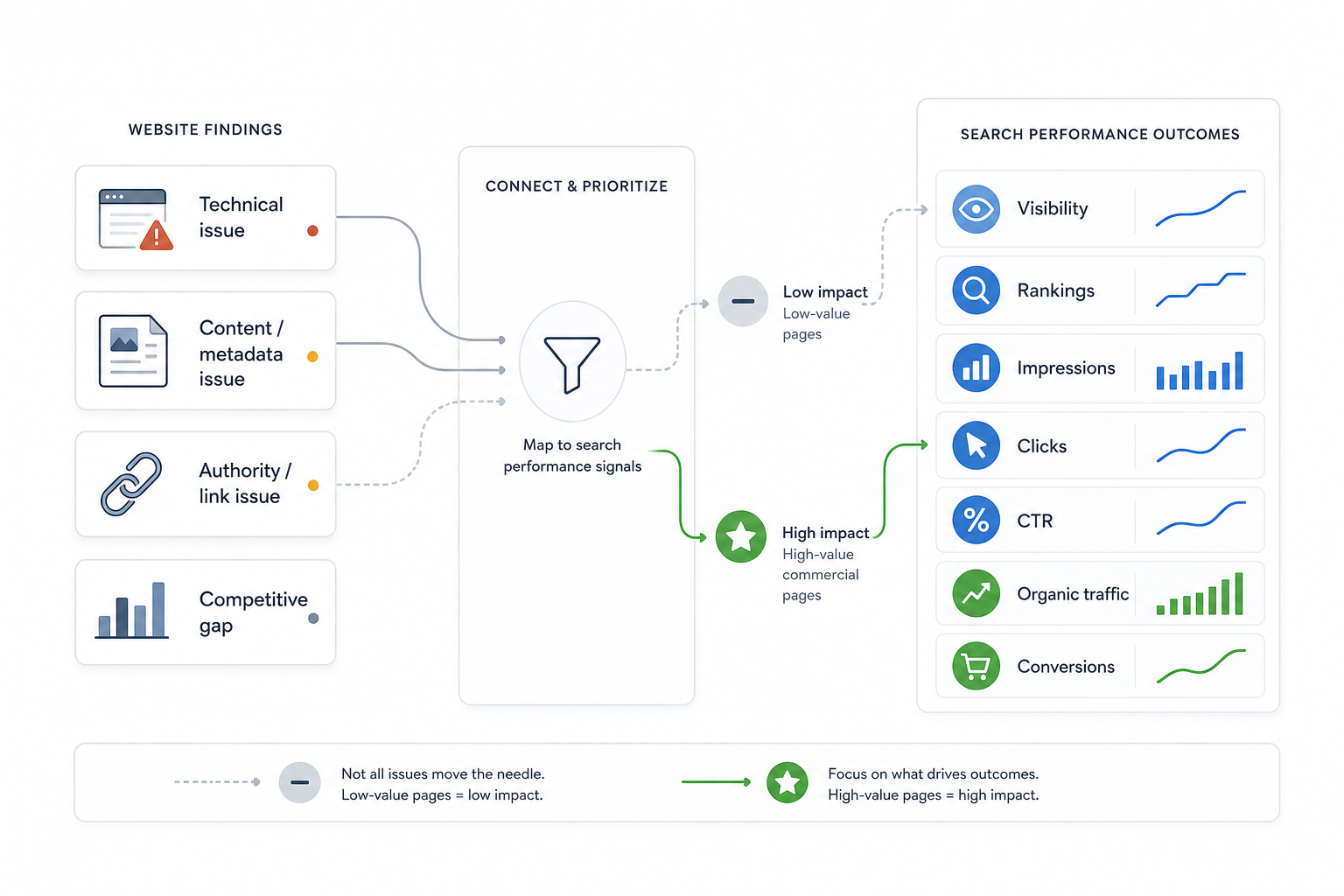
Compare identified website conditions with actual organic-search outcomes.
Review whether technical, content, authority, or competitive findings correspond with changes in:
- Search visibility
- Keyword rankings
- Impressions
- Clicks
- CTR
- Organic traffic
- Conversions
This connection prevents analysis from becoming a list of theoretical SEO issues.
For example, a metadata issue affecting low-value pages has little strategic importance when those pages generate no meaningful search demand. A smaller issue affecting a high-converting commercial directory deserves far greater attention.
Performance evidence helps determine whether an observation represents a genuine SEO constraint.
7. Prioritize the SEO Opportunities
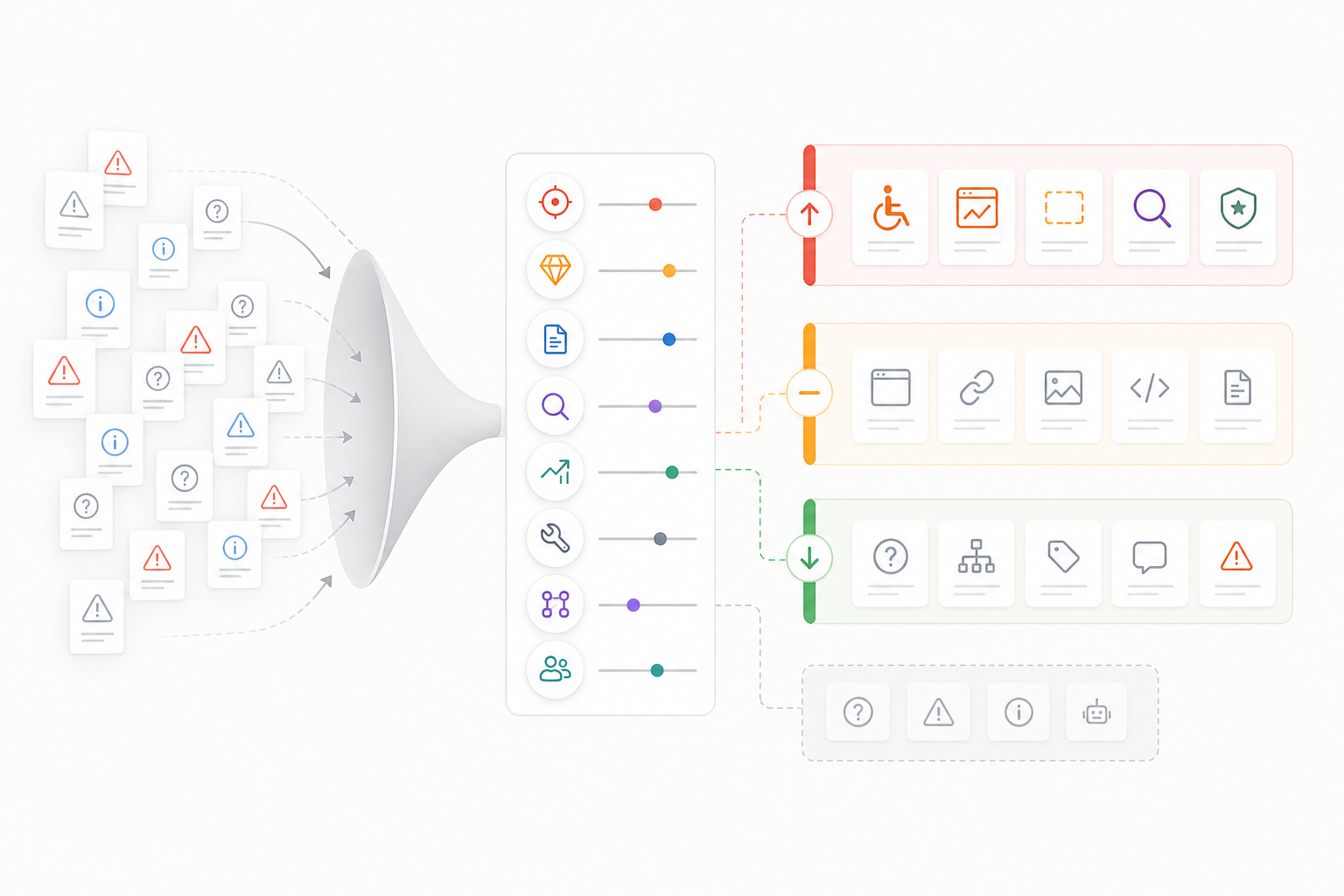
Combine validated website, page, competitive, and performance findings.
Prioritize each issue or opportunity according to:
- SEO impact
- Business value
- Number of affected pages
- Search demand
- Ranking potential
- Implementation effort
- Dependencies
- Available resources
Not every issue deserves immediate optimization.
An SEO analyzer can generate hundreds of warnings, but analysis determines which findings materially affect important search outcomes.
The highest-value opportunities often involve removing major accessibility barriers, improving strategically important pages with existing visibility, strengthening missing topic coverage, resolving significant intent mismatches, or closing competitive authority gaps.
Once the overall website condition is clear, individual URLs require more focused analysis.
How Do You Analyze a Web Page for SEO?
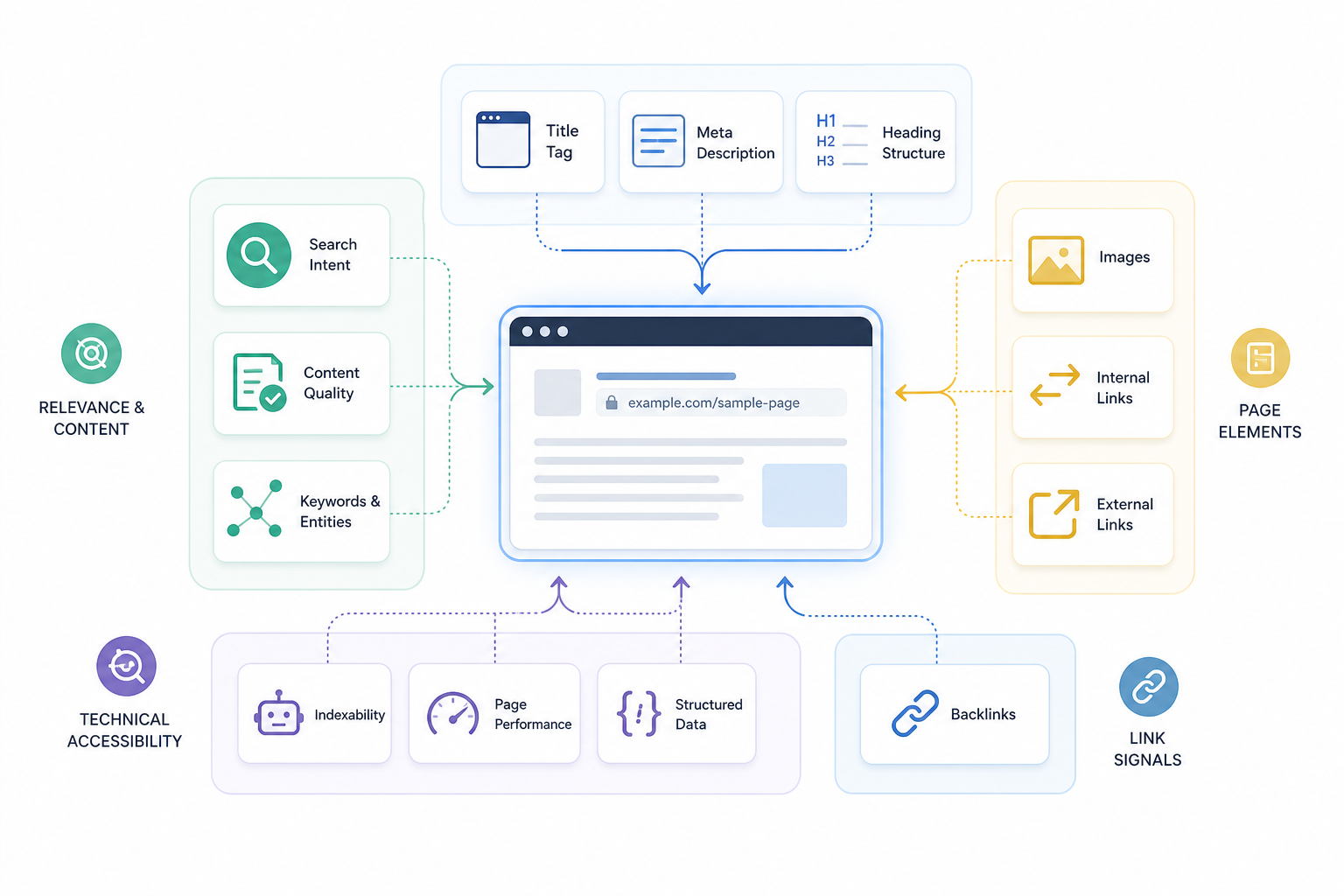
Analyzing a web page for SEO means evaluating its search intent, relevance, content quality, page elements, technical accessibility, and link signals to determine how effectively it satisfies a target search query.
Page-level analysis focuses on one URL rather than broad sitewide patterns.
- Check search intent
- Identify the primary topic and query the page targets.
- Determine what the searcher wants to accomplish.
- Compare the page format with the dominant results.
- Confirm that the content provides the type of answer users expect.
A guide targeting a query dominated by product pages can have an intent problem even when the writing is excellent.
- Check the title tag
- Review whether the title is unique.
- Confirm that it accurately describes the page.
- Check alignment with the primary topic.
- Evaluate whether it communicates relevance clearly in the SERP.
Avoid fixed title-length rules as the primary quality standard. Accuracy and clarity matter more than reaching an arbitrary character count.
- Check the meta description
- Confirm that it represents the page accurately.
- Review clarity and relevance.
- Identify duplicated or generic descriptions.
- Evaluate whether the description communicates a useful reason to visit the page.
- Check heading structure
- Confirm that the H1 establishes the central topic.
- Review whether H2 headings represent major subtopics or questions.
- Check whether H3 headings logically expand their parent sections.
- Remove unnecessary repetition and disconnected sections.
A logical heading structure reflects information relationships rather than keyword placement requirements.
- Check content quality
- Review usefulness.
- Evaluate accuracy.
- Check completeness.
- Look for original information.
- Examine examples and evidence.
- Identify outdated sections.
- Determine whether important audience questions remain unanswered.
Content quality cannot be measured through word count alone. A concise page can outperform a longer page when it answers the query more accurately and efficiently.
- Check keyword and entity relevance
- Confirm that the primary topic remains clear.
- Review supporting queries and terminology.
- Evaluate whether relevant entities and attributes appear naturally.
- Identify irrelevant keyword insertion or excessive repetition.
Strong topical relevance comes from explaining the subject completely rather than forcing a specific keyword frequency.
- Check internal links
- Review links pointing into the page.
- Examine links from the page to related resources.
- Check anchor relevance.
- Evaluate surrounding link context.
- Determine whether the page receives enough internal support for its importance.
An important commercial page with few contextual internal links can remain weakly connected even when it exists inside the main navigation.
- Check external links
- Confirm that referenced sources remain available.
- Review relevance and credibility.
- Use external evidence where factual claims require verification.
- Check images
- Review image relevance.
- Check file efficiency.
- Confirm that important images contain appropriate descriptive alt attributes.
- Evaluate whether visuals add useful information rather than functioning only as decoration.
- Check indexability
- Confirm that the page can be crawled.
- Review index eligibility.
- Check canonicalization.
- Identify unintended directives.
- Confirm that no technical condition prevents the intended URL from participating in search.
- Check page performance
- Review loading performance.
- Examine Core Web Vitals where relevant.
- Check mobile usability.
- Identify rendering issues.
- Evaluate whether page experience problems interfere with content access or use.
- Check structured data
- Validate applicable schema markup.
- Confirm that the markup accurately represents visible content.
- Identify invalid or misleading implementations.
- Check backlinks to the page
- Review relevant external links pointing directly to the URL.
- Compare page-level authority with competing results.
- Examine whether stronger competitors possess meaningful external support the page lacks.
Page-level findings become more useful when they are connected with actual rankings and performance trends.
How Do You Analyze SEO Performance and Rankings?
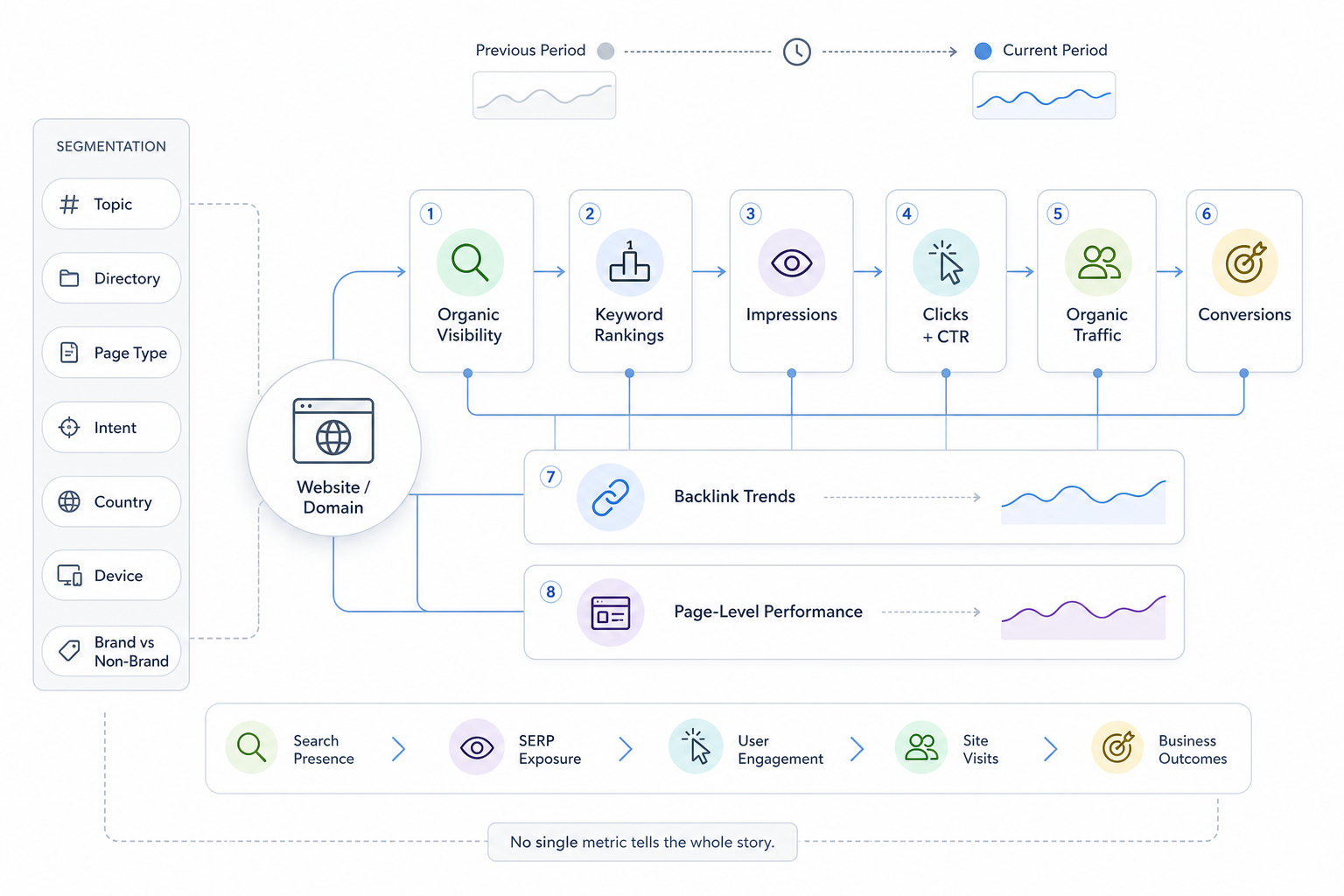
SEO performance analysis measures how search visibility, rankings, clicks, organic traffic, authority, and conversions change over time to determine whether organic search performance is improving or declining.
No single metric provides a complete view.
| Metric | What It Measures | What to Compare | What the Change May Indicate |
|---|---|---|---|
| Organic Visibility | How broadly and prominently the website appears across relevant searches | Topic groups, directories, competitors, periods | Broader gains or losses in search presence |
| Keyword Rankings | Positions for important queries | Current vs previous periods, page groups, intent groups | Changes in competitiveness |
| Impressions | How often pages appear in search results | Periods, queries, pages, countries, devices | Changes in visibility or search demand |
| Clicks | Visits generated directly from search results | Pages, queries, periods | Whether visibility generates traffic |
| CTR | Clicks relative to impressions | Query groups, pages, position ranges | Strength or weakness in search-result engagement |
| Organic Traffic | Visits arriving through organic search | Landing pages, directories, periods | Changes in acquired search traffic |
| Conversions | Leads, sales, sign-ups, or other business outcomes | Landing pages, topics, periods | Whether organic traffic produces business value |
| Backlink Trends | Changes in relevant external links and referring domains | Competitors, important pages, time periods | Changes in external authority |
| Page-Level Performance | Search and business performance of individual URLs | Similar pages, historical periods | Which pages drive gains or losses |
Organic Visibility
Evaluate the breadth and prominence of search visibility across relevant topics.
Sitewide visibility alone can hide important differences. One section can grow rapidly while another declines.
Segment visibility by:
- Topic
- Directory
- Page type
- Search intent
- Country
- Device
- Brand vs non-brand queries
The objective is to identify where visibility changes, not only whether one overall score moved.
Keyword Rankings
Track strategically relevant keywords over time.
Review:
- Top 3 rankings
- Top 10 rankings
- Top 20 rankings
- Queries entering visibility
- Queries losing visibility
- High-value keywords
- Topic-level ranking groups
Do not treat average position as one universal ranking. Search results vary by query, location, device, SERP composition, and other contextual factors.
Ranking trends become more useful when grouped around topics and pages.
Impressions
Impressions reveal how often pages receive search-result exposure.
Growing impressions can indicate:
- New keyword visibility
- Improved rankings
- Broader topic coverage
- Increased search demand
Declining impressions can indicate:
- Ranking losses
- Reduced demand
- Indexation problems
- Lost keyword coverage
- SERP changes
Impressions alone do not indicate whether users choose the result.
Clicks and CTR
Clicks show how much organic-search exposure becomes website traffic.
CTR provides additional context by comparing clicks with impressions.
Strong impression growth with weak CTR can indicate:
- Lower average positions
- Weak title relevance
- Unclear search-result messaging
- Search-intent mismatch
- SERP features absorbing clicks
CTR must be interpreted alongside position and query type. A lower CTR at position eight has a different meaning from a lower CTR at position one.
Organic Traffic
Measure sessions or users arriving through organic search.
Analyze traffic at:
- Site level
- Directory level
- Landing-page level
- Topic level
- Conversion-page level
Traffic growth does not automatically represent SEO success.
A large increase in low-value informational traffic can have less business impact than a smaller increase in commercial traffic generating qualified leads.
Conversions
Connect organic traffic with business outcomes.
Track relevant actions such as:
- Leads
- Demo requests
- Sign-ups
- Purchases
- Subscriptions
- Revenue
- Qualified inquiries
SEO performance becomes commercially meaningful when visibility and traffic contribute to intended outcomes.
Backlink and Authority Trends
Review changes in relevant referring domains and important backlinks alongside organic performance.
Significant lost links to an important page can coincide with weaker competitiveness. Strong new references can support growing authority.
Do not use one third-party authority score as proof of SEO performance.
Page-Level Performance
Identify which URLs account for sitewide gains and losses.
Review:
- Pages gaining impressions
- Pages losing impressions
- Pages gaining clicks
- Pages losing rankings
- Pages generating conversions
- Pages attracting visibility without clicks
- Pages attracting traffic without business value
Page-level analysis prevents large sitewide totals from hiding the actual source of performance changes.
Use meaningful comparison periods such as month over month, quarter over quarter, or year over year according to seasonality and available data.
When unusual changes appear, investigate technical changes, content updates, competitor movements, backlinks, SERP changes, and search demand before assigning a cause.
Reliable SEO analysis depends on combining several specialized data sources.
What SEO Analysis Tools Can You Use?
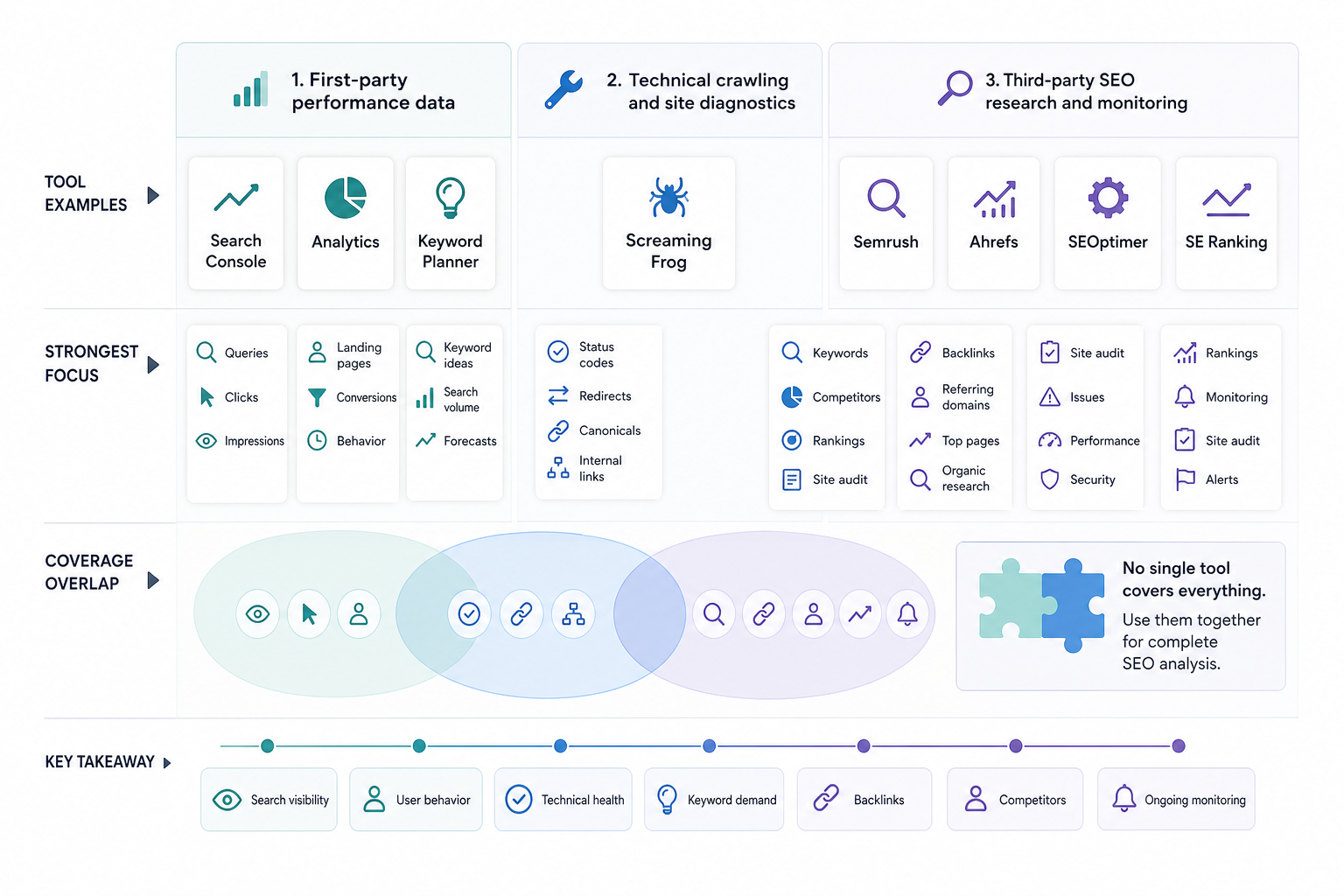
SEO analysis tools collect different types of evidence about search visibility, traffic, technical health, keywords, backlinks, pages, and competitors.
These analysis platforms form part of the broader set of SEO tools used across research, optimization, monitoring, auditing, and performance measurement.
No single SEO analyzer provides the strongest data for every analytical task.
| Tool | Best For | Main Analysis Capabilities | Access | When to Use It |
|---|---|---|---|---|
| Google Search Console | Google Search visibility | Queries, clicks, impressions, average position, pages, indexing | Free | Search-performance and indexation analysis |
| Google Analytics 4 | User and conversion analysis | Organic traffic, landing pages, engagement, events, conversions | Free | Measuring what happens after organic users arrive |
| Google Keyword Planner | Keyword discovery and demand estimates | Keyword ideas, demand estimates, paid-search context | Free with Google Ads access | Early keyword and market analysis |
| Screaming Frog SEO Spider | Technical crawling | Status codes, titles, metadata, canonicals, internal links, indexability, directives | Free / Paid | Technical and URL-level analysis |
| Semrush | Integrated SEO research | Keywords, rankings, competitors, backlinks, site auditing, visibility | Paid / limited free access | Broad SEO and competitive analysis |
| Ahrefs | Backlinks and organic competitors | Backlinks, referring domains, keyword data, ranking pages, competitor research | Paid / limited free tools | Authority, keyword, and competitive analysis |
| SEOptimer | Simplified website auditing | On-page checks, technical observations, reporting | Paid / limited access | Quick website diagnostics |
| SE Ranking | Ongoing SEO monitoring | Rankings, keywords, competitors, backlinks, website auditing | Paid | Rank tracking and broader SEO monitoring |
Google Search Console
Google Search Console provides first-party search-performance data from Google.
Use it to analyze:
- Queries
- Impressions
- Clicks
- CTR
- Average position
- Ranking pages
- Countries
- Devices
- Search appearances
- Indexation information
Search Console is particularly useful for understanding what Google already associates with the website.
A page can rank for queries that were never included in the original keyword plan. Search Console exposes these real query relationships.
Google Analytics 4
Google Analytics 4 measures what users do after reaching the site.
Use it to analyze:
- Organic sessions
- Landing pages
- Engagement
- Events
- Key actions
- Leads
- Purchases
- Revenue
Search Console explains search visibility. Analytics explains the value of the resulting visits.
Combining both provides stronger performance interpretation than relying on rankings alone.
Google Keyword Planner
Google Keyword Planner primarily supports keyword discovery and estimated search demand.
Use it to understand:
- Broad topic demand
- Related keywords
- Keyword variations
- Geographic demand
- Commercial search context
It is not a complete website-analysis platform. Its value exists mainly in keyword and market research.
Screaming Frog SEO Spider
Screaming Frog provides scalable URL-level technical analysis.
Use it to identify patterns involving:
- Status codes
- Redirects
- Titles
- Meta descriptions
- Canonicals
- H1 headings
- Internal links
- Crawl depth
- Indexability
- Directives
- Images
- Structured data
- Duplicate elements
Crawler data becomes particularly valuable on websites where manually reviewing every URL is impractical.
Automated warnings still require interpretation. A crawler identifies patterns; analysis determines whether those patterns matter.
Semrush
Semrush combines several SEO datasets inside one platform.
Use it for:
- Keyword research
- Competitor research
- Rank tracking
- Keyword gaps
- Backlink analysis
- Site auditing
- Search visibility
- Organic competitor analysis
Its third-party traffic, keyword, difficulty, and authority-related data remains modeled rather than first-party Google data.
These metrics work best for comparison and opportunity analysis.
Ahrefs
Ahrefs is particularly useful for backlink, competitor, and organic-search analysis.
Use it for:
- Referring domains
- Backlinks
- Top linked pages
- Competitor keywords
- Ranking pages
- Content opportunities
- Organic traffic estimates
- Keyword analysis
Its data helps explain how external authority and competitor search coverage differ across websites.
SEOptimer
SEOptimer provides simplified website-analysis and reporting functions.
It is useful when the objective is a faster diagnostic view rather than a highly detailed technical investigation.
Automated audit scores still require human interpretation before becoming SEO priorities.
SE Ranking
SE Ranking combines rank tracking with broader SEO research.
Use it for:
- Keyword monitoring
- Competitor tracking
- Backlink monitoring
- Website auditing
- Search visibility
- Ongoing SEO reporting
It fits recurring monitoring workflows where teams track changes over time.
First-party and third-party tools answer different questions.
Search Console and Analytics report direct performance data from Google or the website. Crawlers report observable technical conditions. Platforms such as Semrush and Ahrefs estimate competitor traffic, keywords, backlinks, authority, and search visibility using proprietary datasets.
Third-party traffic estimates, authority scores, keyword difficulty metrics, and visibility indexes work as comparative indicators rather than exact Google measurements.
Strong SEO analysis generally combines search-performance data, analytics, technical crawling, and competitive keyword or backlink evidence so conclusions reflect the complete search condition rather than one isolated metric.
In this section
Need links on real SaaS and business websites?
Links are placed after your approval, on sites with guaranteed DR and traffic, with a 1-year replacement guarantee.

