
SEO Content: Strategy, Types, Creation, Optimization & Management
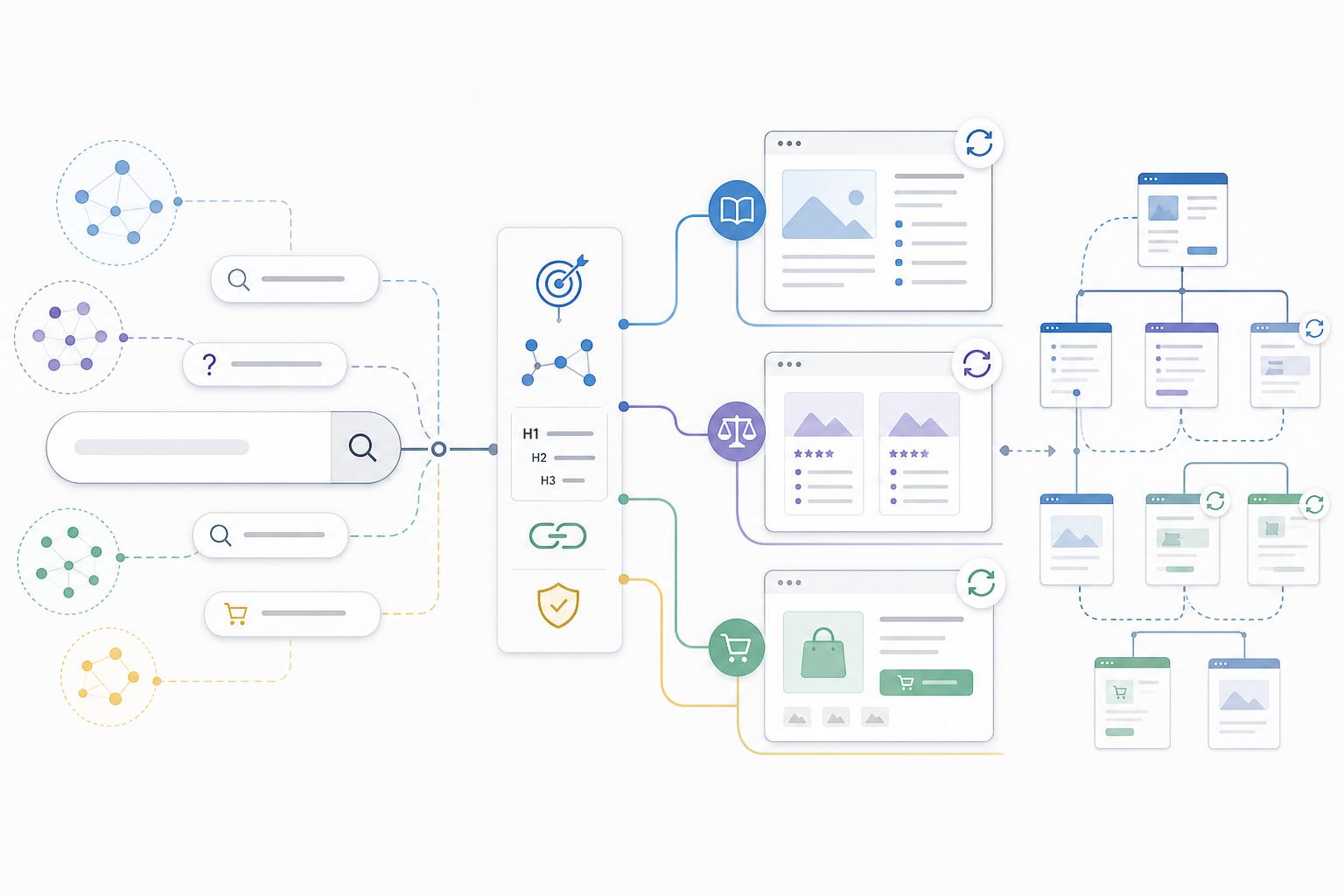
SEO content is content created and organized to satisfy search intent while helping search engines discover, understand, and rank a webpage for relevant searches. It connects what people search for with useful information that addresses their questions, problems, goals, or buying decisions.
SEO content is not simply text that contains keywords. Effective content combines search-intent alignment, topical relevance, useful information, clear structure, natural keyword usage, internal linking, credibility, and technical accessibility.
Search data reveals the topics people care about and the language they use to find information. Content turns that demand into useful pages, whether the required result is an explanation, guide, comparison, product page, service page, category page, tool, or another content format.
For example, someone searching for “what is CRM software” wants an explanation. A search for “best CRM software for startups” reflects comparison and evaluation. A search for “CRM software pricing” moves closer to a commercial decision. All three searches relate to CRM software, but each requires different information because the search intent changes.
SEO content also contributes to the broader topical structure of a website. Related articles, guides, product pages, service pages, and supporting resources establish clear subject relationships when each page serves a distinct purpose and connects naturally with relevant content.
Publishing a page does not make the content permanently complete. Information becomes outdated, competitors improve their pages, search demand changes, products evolve, and new audience questions emerge. Effective SEO content therefore requires continued evaluation and maintenance.
Understanding SEO content begins with understanding how SEO and content support the same search objective.
How Do Content and SEO Work Together?
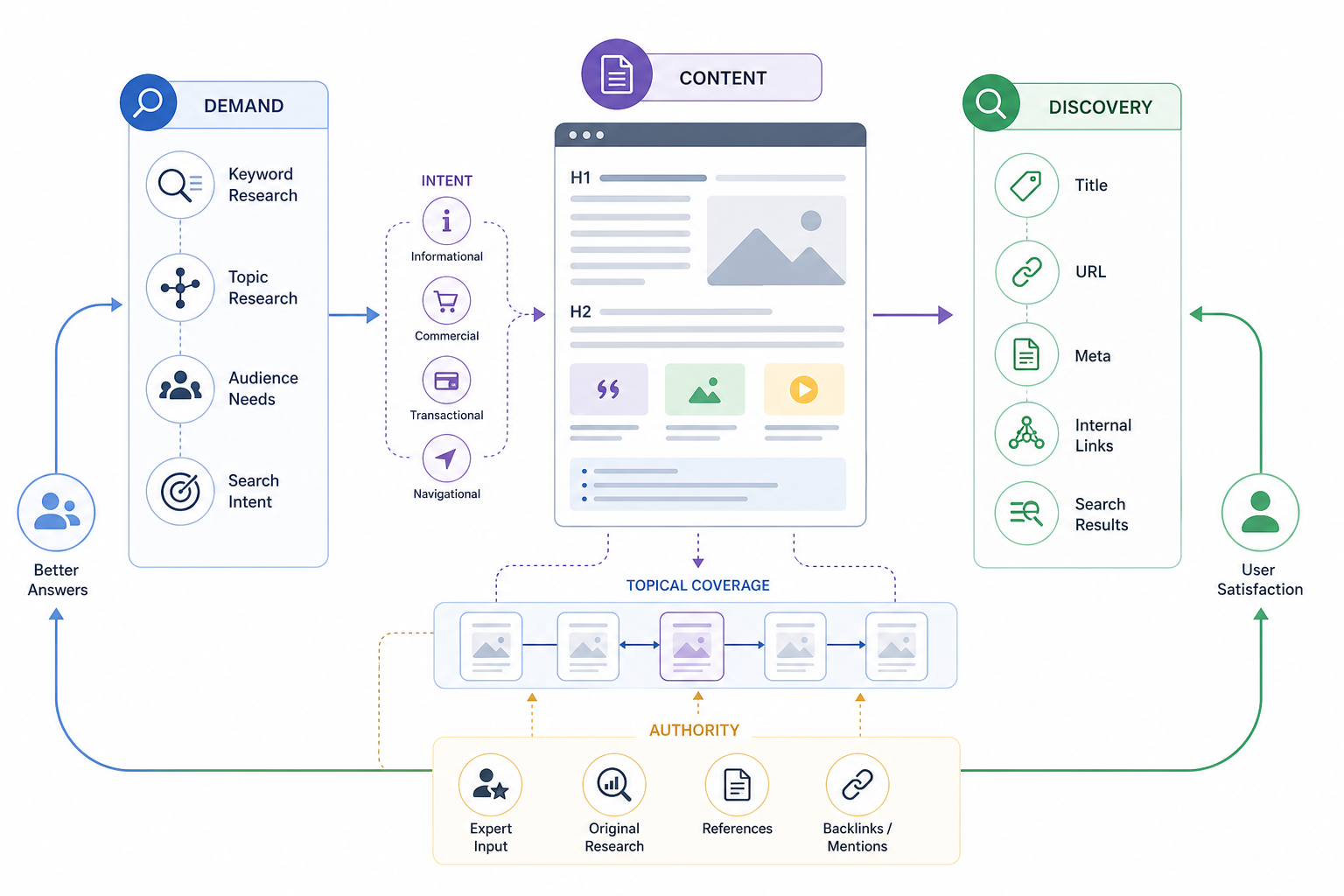
SEO and content work together by connecting search demand with useful information. SEO identifies what people search for and what they expect to find, while content supplies the information, experience, product, or solution that satisfies that demand.
SEO provides direction. Content provides substance.
A page with useful information but little connection to relevant search demand can remain difficult for its intended audience to discover. SEO activity without valuable content has little meaningful information to surface in organic search.
Several functions connect the two.
- Search demand guides content decisions
- Keyword research identifies the terms and questions audiences use.
- Topic research reveals broader subjects and related information needs.
- Audience research identifies problems, goals, objections, and priorities.
- Search-intent analysis establishes what type of response the user expects.
- Content gives search engines information to understand
- Page copy establishes the main subject.
- Headings organize related attributes and subtopics.
- Relevant entities and concepts clarify the meaning of the page.
- Images, examples, statistics, and supporting information add context.
- Internal links show relationships between relevant pages.
- SEO improves content discoverability
- Descriptive titles communicate page relevance.
- Clear headings make the subject easier to interpret.
- Descriptive URLs reinforce page purpose.
- Internal links help users and search engines discover related resources.
- Metadata provides additional context about the page in search results.
- Search intent determines what content must provide
- Informational searches require explanations, definitions, instructions, or educational resources.
- Commercial searches require comparisons, alternatives, benefits, pricing context, or evaluation criteria.
- Transactional searches require product, service, category, or conversion-oriented information.
- Navigational searches focus on reaching a specific company, product, page, or resource.
- Related content strengthens topical coverage
- Broad subjects often require several pages to cover distinct questions or attributes properly.
- Supporting pages expand specific subtopics without forcing every detail into one page.
- Contextual internal links help users move between related information.
- Clear page roles reduce unnecessary overlap between content targeting the same search intent.
- Useful content strengthens credibility and authority
- Original research provides information unavailable elsewhere.
- First-hand experience adds practical evidence.
- Expert input strengthens specialist subjects.
- Reliable references support factual claims.
- Valuable resources naturally create opportunities for mentions, citations, and backlinks.
SEO driven content therefore combines search understanding with information that genuinely satisfies the audience.
A content strategy determines how that approach is applied across the website.
What Are the Main SEO Content Strategies?
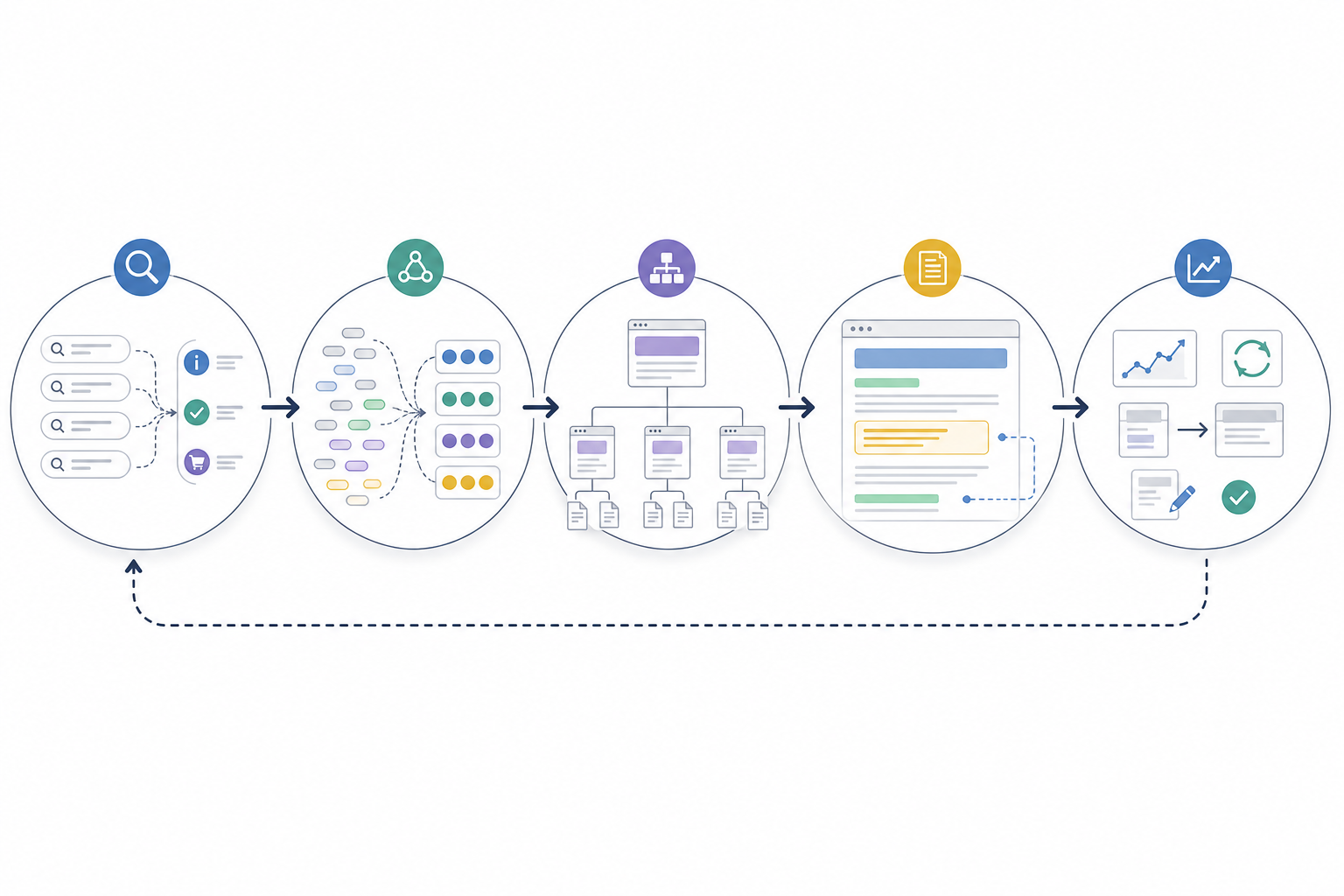
SEO content strategies are coordinated approaches for deciding which search demand to target, what content to create, how related pages fit together, and how existing content is improved over time.
These content-focused activities form part of broader SEO Strategies that coordinate organic search priorities across the website.
A strong SEO content strategy focuses on relevance rather than publication volume. More pages do not automatically create stronger organic visibility. Each page requires a clear topic, purpose, search intent, and role within the wider site.
The main strategies include:
- Audience and search-intent research
- Identify the problems, questions, goals, objections, and decisions relevant to the target audience.
- Understand whether a query represents informational, commercial, transactional, navigational, local, or another form of intent.
- Focus on searches connected with the website’s expertise, products, services, and business purpose.
- Identify what information or outcome satisfies each search.
- Keyword and topic grouping
- Research primary terms, supporting queries, related questions, long-tail searches, and relevant concepts.
- Group keywords that represent the same topic and user intent.
- Separate terms when they require different information or different page formats.
- Avoid creating multiple pages purely because keyword wording changes.
- Prioritize opportunities according to relevance, demand, business value, competition, and ranking feasibility.
- Topic architecture and internal linking
- Organize broader topics into clear central and supporting pages.
- Give each page a distinct role.
- Connect related pages through contextual internal links.
- Link important pages from relevant supporting resources.
- Avoid unnecessary overlap between pages targeting substantially the same search need.
- On-page content optimization
- Write descriptive page titles and headings.
- Answer direct questions close to the headings that ask them.
- Organize information using the format that best suits the content.
- Include contextual internal links.
- Use relevant terminology naturally.
- Add examples, images, evidence, statistics, or references where they improve understanding.
- Keep each section focused on the topic introduced by its heading.
- Performance-led content improvement
- Review search visibility, clicks, traffic, conversions, freshness, and continuing relevance.
- Improve pages with identifiable information gaps.
- Refresh outdated content.
- Consolidate pages that unnecessarily compete for the same intent.
- Preserve pages that continue to satisfy their purpose effectively.
- Remove or redirect content only when it no longer provides meaningful value.
These strategies support one another. Audience understanding informs topic selection, topic selection shapes site architecture, and the role of each page determines how that content is structured and optimized. Performance data then reveals where existing content deserves further attention.
The next decision is selecting the right content format for the search intent.
What Types of SEO Content Can You Create?
SEO content can take different forms depending on search intent, audience needs, information depth, and the role of the page in the customer journey.
An SEO article is only one possible format. Search demand can also require guides, comparison pages, product pages, videos, tools, category pages, service pages, or other resources.
The main SEO content types include:
- Blog posts and articles
- Standard SEO articles address focused informational topics and audience questions.
- Long-form articles explain broad or complex subjects in greater depth.
- Short-form posts answer narrow questions or cover focused updates.
- Editorial articles cover research, developments, trends, or expert analysis.
- Guides and educational content
- How-to guides explain a process through clear steps.
- Beginner guides establish foundational understanding.
- Advanced guides cover specialist techniques or complex subjects.
- Pillar pages provide broad coverage of a central topic and connect related resources.
- Glossaries explain industry terminology.
- Definition pages clarify individual concepts and entities.
- Tutorials combine explanation with practical instructions.
- Lists, comparisons, and visual content
- Listicles organize multiple tools, examples, ideas, options, or resources.
- Comparison pages evaluate alternatives using consistent criteria.
- Infographics present information visually.
- Charts communicate numerical relationships.
- Diagrams simplify complex structures or processes.
- Videos support subjects where demonstrations or visual explanations improve understanding.
- Commercial and transactional content
- Product pages provide product-specific information and support purchase intent.
- Service pages explain services, capabilities, use cases, and outcomes.
- Category pages organize groups of related products or services.
- Landing pages address focused commercial, campaign, feature, location, or conversion demand.
- Alternative pages help users evaluate competing solutions.
- Pricing pages address cost and plan-related searches.
- FAQs provide concise answers to closely related recurring questions.
The correct content type depends on what the user expects from the query.
A search for “how does email marketing work” requires educational information. “Best email marketing software” requires evaluation and comparison. “Mailchimp pricing” requires specific commercial information.
Using the same page format for all three searches creates an intent mismatch even though all three belong to the same broad topic.
Once the appropriate content type is clear, the page can be researched, structured, written, and optimized.
How Do You Create SEO Content?
Creating SEO content means researching what the audience searches for, understanding the required information, structuring the page logically, writing useful content, and optimizing relevant on-page elements.
1. Research Keywords and Search Intent
Identify the queries connected with the topic.
Research:
- Primary keywords
- Supporting queries
- Long-tail searches
- Related questions
- Search intent
- Ranking page types
- Common subtopics
- Relevant entities
- Competing pages
Review the search results for important queries to understand what information and content format currently satisfies the search.
A SERP dominated by product pages reflects a different user need from one dominated by informational guides.
Keyword research reveals demand, but it does not mean every discovered phrase belongs in the final page.
2. Plan and Outline the Content
Define the main topic or question before writing.
Build a logical heading structure:
- The H1 represents the central topic.
- H2 headings cover major attributes, questions, or subtopics.
- H3 headings expand narrower subjects that belong beneath an H2.
Each section needs a distinct purpose.
Place a direct answer immediately beneath a question-based heading before expanding into supporting information.
Include related questions and subtopics when they improve the completeness of the page. Remove headings that repeat information already covered elsewhere.
The outline must reflect the information the reader requires, not simply reproduce a list of keywords from a research tool.
3. Write Naturally and Clearly
Answer the primary search need directly.
Keep each paragraph focused on a clear idea. Relevant terminology, entities, attributes, and related concepts appear naturally when the topic is explained completely.
Do not insert words merely because an SEO tool identifies them as semantically related.
Match the content format to the information being communicated:
- Use paragraphs for definitions and explanations.
- Use ordered lists for sequential actions.
- Use unordered lists for categories, examples, or parallel attributes.
- Use tables for structured comparisons.
- Use definitions for terminology.
- Use images, diagrams, or video when visual information improves understanding.
Clear structure makes the information easier for readers to process.
4. Optimize On-Page Elements
Align the important page elements with the topic and search intent.
- Title: Describe the page accurately and concisely.
- H1: Establish the central topic.
- URL: Use a descriptive and concise slug.
- Headings: Represent genuine questions, attributes, or subtopics.
- Opening paragraph: Answer the primary search query directly.
- Body content: Cover the subject accurately and completely.
- Internal links: Connect relevant pages where additional information helps the reader.
- External references: Support important factual claims with reliable evidence.
- Meta description: Summarize the page clearly.
- Images: Add visual information where it improves understanding.
- Alt text: Describe meaningful images accurately.
Completing these elements does not automatically make a page effective. The finished content still requires relevance, usefulness, clarity, credibility, and accessibility.
What Makes Content SEO-Friendly?
SEO-friendly content is content that satisfies search intent, provides useful information, maintains clear topical relevance, uses an understandable structure, demonstrates credibility, and remains accessible to users and search engines.
Several characteristics define SEO-friendly content:
- It satisfies search intent
- The content addresses the objective behind the query.
- The page format matches the user’s expectation.
- The primary answer appears early.
- Supporting information expands the answer rather than delaying it.
- It provides useful information
- The page resolves the user’s question or task.
- Explanations contain enough depth for the subject.
- Examples clarify difficult concepts.
- Original information adds value beyond simple rewriting.
- Practical experience supports topics where first-hand knowledge matters.
- It maintains topical relevance
- Every section relates directly to its heading.
- Supporting concepts strengthen understanding of the main topic.
- Related entities appear because they are relevant to the explanation.
- Unrelated subjects remain outside the page.
- It uses clear information architecture
- Headings create logical relationships between topics and subtopics.
- Paragraphs explain individual ideas.
- Lists organize appropriate groups or processes.
- Tables present structured comparisons.
- Important answers remain easy to locate.
- It uses natural topical optimization
- The primary topic remains clear throughout the page.
- Supporting terms expand meaningful attributes of that topic.
- Synonyms and related terminology appear naturally.
- Exact-match keyword repetition does not control the writing.
- It contains contextual internal links
- Internal links connect directly related resources.
- Anchor text describes the linked destination.
- Important pages receive links from relevant supporting content.
- Links help users continue exploring a subject rather than existing solely for SEO.
- It demonstrates credibility
- Important factual claims use reliable evidence.
- Statistics identify their sources.
- Original research explains how the information was gathered.
- Expert authorship or review adds context where specialist knowledge matters.
- Real examples and evidence remain distinguishable from hypothetical examples.
- It remains technically accessible
- Search engines can access the page.
- Important content remains indexable.
- Internal links remain crawlable.
- Important information works on mobile devices.
- Images contain appropriate descriptive context.
- Technical problems do not prevent the page from being processed correctly.
SEO-friendly content is therefore defined by the quality and clarity of the complete page rather than by the number of times a keyword appears.
A practical example shows how these elements work together.
What Does an SEO Content Example Look Like?
An SEO content example is a finished page where search intent, useful information, logical headings, natural topical optimization, contextual links, and credibility signals support the same subject.
Consider an article targeting:
How to Choose CRM Software
Example URL
example.com/crm/how-to-choose-crm-software/
The URL communicates the page topic clearly.
H1
How to Choose CRM Software
The heading matches the task the searcher wants to complete.
Opening paragraph
Choosing CRM software requires evaluating contact management, sales processes, automation, reporting, integrations, security, usability, scalability, and pricing against the requirements of the team using the platform.
The page answers the main question immediately before expanding into detail.
H2: What Features Matter When Choosing CRM Software?
This section contains parallel evaluation criteria:
- Contact management
- Pipeline management
- Workflow automation
- Reporting
- Integrations
- User permissions
- Mobile access
- Customer support
An unordered list fits because the features represent parallel attributes rather than steps.
H2: How Do You Compare CRM Platforms?
This information follows a sequence:
- Define business requirements.
- Identify essential features.
- Shortlist suitable platforms.
- Compare the same criteria across each option.
- Test the shortlisted products.
- Evaluate implementation requirements and total cost.
An ordered list fits because one action logically leads into the next.
H3: Which Criteria Belong in the CRM Comparison?
A table provides the clearest format when several products are compared using the same attributes.
| Evaluation Criterion | CRM A | CRM B | CRM C |
|---|---|---|---|
| Pipeline management | Included | Included | Included |
| Workflow automation | Advanced | Basic | Advanced |
| Custom reporting | Included | Limited | Included |
| Required integration | Supported | Supported | Not supported |
| User permissions | Advanced | Standard | Advanced |
Relevant internal links can then connect readers with supporting resources.
A discussion of implementation can link to a CRM implementation guide. Pricing information can link to a dedicated CRM pricing resource. A section discussing sales pipelines can connect with a page explaining sales pipeline management.
Evidence strengthens the page further. A genuine CRM comparison can include product testing, screenshots, verified pricing, customer data, expert review, or a documented evaluation methodology.
A strong SEO content example looks like useful content rather than visible search-engine optimization. The optimization exists within the intent alignment, information structure, topical relevance, internal relationships, and quality of the evidence.
Published content then requires continued maintenance.
How Do You Manage SEO Content?
SEO content management is the ongoing process of monitoring, maintaining, improving, and organizing published content so it remains accurate, relevant, useful, and aligned with search demand and business objectives.
1. Maintain a Content Inventory
Keep a record of strategically important content.
Useful fields include:
- URL
- Primary topic
- Search intent
- Content type
- Topic cluster
- Publication date
- Last updated date
- Content owner
- Performance
- Current status
- Recommended action
Every important page needs a defined purpose. A content inventory makes unnecessary overlap, outdated pages, missing topics, and ownership gaps easier to identify.
2. Monitor Content Performance
Measure how important pages perform over meaningful periods.
Relevant indicators include:
- Rankings
- Impressions
- Clicks
- CTR
- Organic traffic
- Leads
- Sign-ups
- Purchases
- Revenue
- Other relevant conversions
Evaluate individual URLs together with related topics, clusters, directories, or content types where appropriate.
Short-term ranking fluctuations do not automatically indicate a problem. Sustained changes provide stronger evidence for investigation.
3. Diagnose Content Problems and Opportunities
Identify why a page gains, loses, or fails to build organic visibility.
Common issues include:
- Outdated information
- Weak search-intent alignment
- Incomplete topic coverage
- Low CTR
- Content overlap
- Keyword cannibalization
- Weak internal linking
- Broken links
- Missing evidence
- Stronger competitors
- Changed SERP expectations
- Changed products or services
Performance data identifies where investigation belongs. It does not mean every declining page requires a complete rewrite.
4. Refresh, Consolidate, or Retire Content
Update information when accuracy or usefulness declines.
Common updates include:
- Statistics
- Screenshots
- Prices
- Product features
- Examples
- References
- Regulations
- Terminology
- Recommendations
- Internal links
Consolidate pages when multiple URLs address substantially the same topic and intent without providing distinct value.
Remove or redirect pages when they no longer serve a useful purpose and after accounting for existing traffic, backlinks, internal links, and related content.
Do not update successful evergreen content merely to change the publication date. A refresh requires an actual improvement in accuracy, relevance, or usefulness.
5. Maintain Internal and Topical Relationships
Review internal links whenever important pages change.
Make sure:
- Important pages receive relevant internal links.
- Supporting content connects naturally with broader topics.
- Orphaned pages become connected where appropriate.
- Old links do not point to irrelevant or removed destinations.
- Anchor text still represents the destination accurately.
- Consolidated content retains useful internal-link relationships.
Internal linking keeps the website’s topical structure coherent as content changes.
6. Use Performance Insights to Improve Future Content
Existing pages provide evidence about what audiences search for and which content produces meaningful results.
Performance analysis can reveal:
- Topics that deserve deeper coverage
- Missing supporting content
- Emerging audience questions
- Successful content formats
- Commercial opportunities
- Declining topics
- Unnecessary page overlap
- Traffic that produces little business value
- Areas that deserve less future investment
These findings improve future content planning without requiring a separate artificial workflow inside the article.
SEO content management does not mean repeatedly rewriting every page. Its purpose is to keep the website’s content accurate, useful, contextually connected, competitive, and aligned with the search needs it exists to satisfy.
Need links on real SaaS and business websites?
Links are placed after your approval, on sites with guaranteed DR and traffic, with a 1-year replacement guarantee.

