
35 Types of Link Building: Methods, Link Types & Why They Matter for SEO
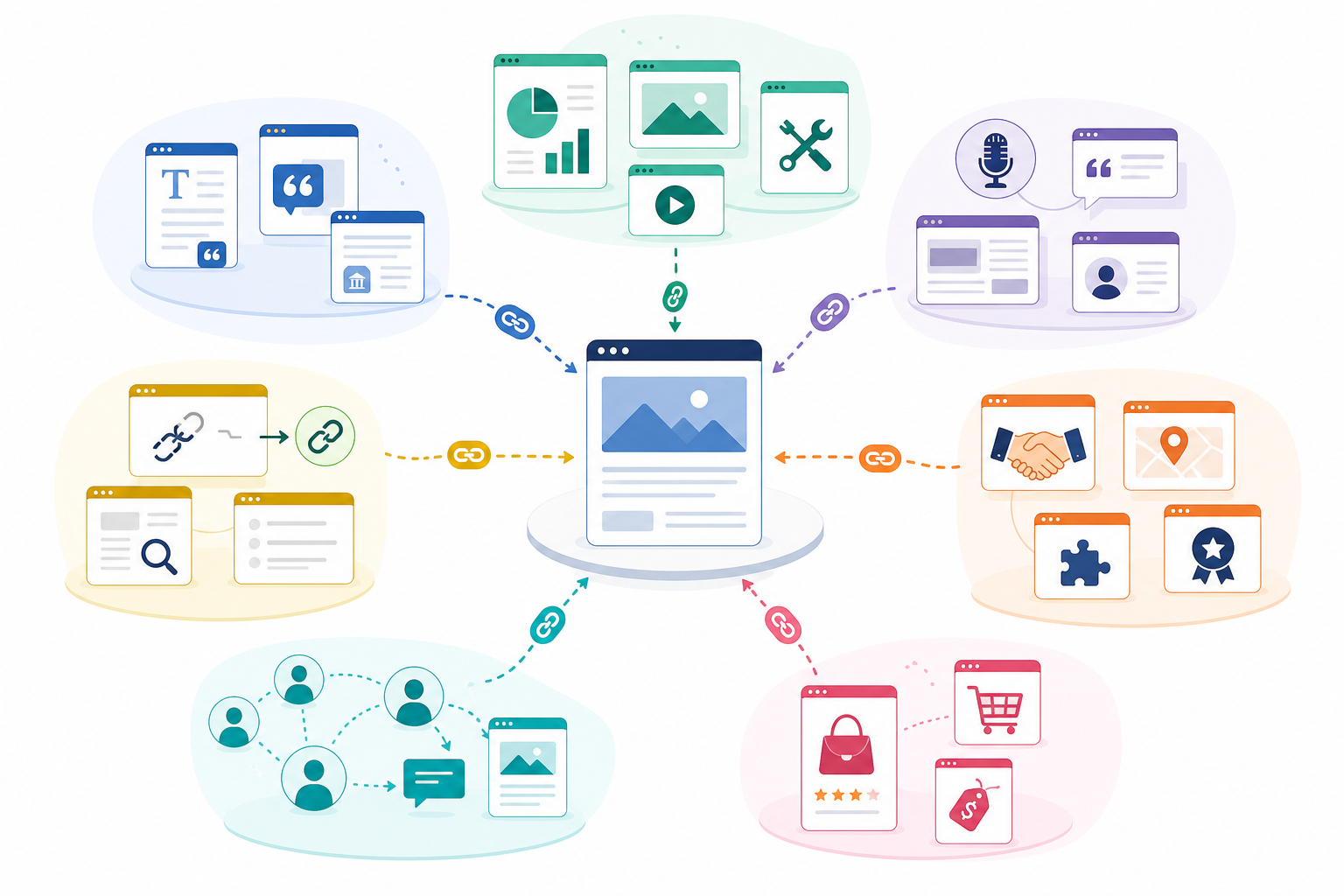
Link building includes multiple methods for earning, developing, recovering, or commercially qualifying backlinks based on why another website has a legitimate reason to reference a page. There is no single universally fixed taxonomy because the same backlink can be classified by its reference reason, acquisition method, asset, source, relationship, editorial independence, or commercial context.
For practical SEO use, the 35 types of link building in this guide are grouped according to the main factor that creates the external reference opportunity.
| Link-Building Family | What Creates the Opportunity | Included Methods | Defining Characteristic |
|---|---|---|---|
| Editorial and Citation-Led | Independent need to cite, recommend, identify, or reference something | Editorial links, research citations, reference links, product recommendations | The external publisher has its own reason to reference the destination |
| Asset-Led | A useful informational, functional, visual, or evidential asset | Content-led, skyscraper, statistics, tools, visuals, case studies, image attribution | The asset itself creates the reason to link |
| PR, Expertise, and Contribution-Led | News, expertise, authorship, commentary, or interviews | Digital PR, expert contributions, guest contributions, podcasts | Publisher demand for information or expertise creates the opportunity |
| Opportunity and Reclamation-Led | An existing gap, outdated link, mention, resource page, or competitor pattern | Resource pages, broken links, reclamation, contextual additions, competitor gaps | The external opportunity already exists before the campaign |
| Business and Relationship-Led | A real commercial, professional, industry, geographic, or community relationship | Partnerships, integrations, suppliers, associations, sponsorships, events, directories, local, industry, community | A genuine relationship creates the reference reason |
| Distribution and User-Led | Exposure among users, communities, or external audiences | Social distribution, user-generated references | Distribution creates discovery that can later produce independent references |
| Commercially Qualified | Compensation, affiliate economics, advertising, or sponsorship | Affiliate links, sponsored links | The reference has an explicit commercial context |
These families are not mutually exclusive. An original research report can be an asset-led campaign, promoted through digital PR, and ultimately receive an editorial research citation. The most useful classification is therefore based on the dominant reason the backlink exists.
The 35 methods below describe how external reference opportunities arise, not 35 Google-defined backlink categories. Link attributes such as nofollow, sponsored, and ugc describe how a hyperlink relationship is qualified, while inbound, internal, and outbound describe link direction. Those are separate classifications.
1. Editorial or Natural Link Earning

Editorial or natural link earning occurs when an external publisher independently chooses to reference a page because it adds useful information, evidence, context, attribution, or further reading to its own content.
The source can be a news publication, industry website, blogger, researcher, company, reviewer, or other publisher. Common destinations include original research, guides, products, tools, definitions, documentation, statistics, and company pages.
The defining feature is editorial independence. The publisher decides whether to link, which page to reference, where to place the link, and how to describe it. Promotion can still help the publisher discover the resource, so “natural” does not necessarily mean that no outreach or distribution occurred.
A strong editorial link has a clear reason to exist. Useful evaluation therefore includes source-page relevance, destination relevance, surrounding context, audience fit, placement, anchor wording, link attributes, and source legitimacy rather than Domain Rating or Domain Authority alone.
Best fit: distinctive resources, recognized expertise, useful products, original research, and brands that already receive external attention.
Main limitation: control is low because the publisher makes the final editorial decision.
Example: An industry writer uses a company’s original SaaS benchmark in an article and cites the benchmark page as the primary data source.
Editorial link earning differs from guest contribution because the external publisher creates the content containing the reference rather than receiving a contributed article from the target company.
2. Content-Led Link Building
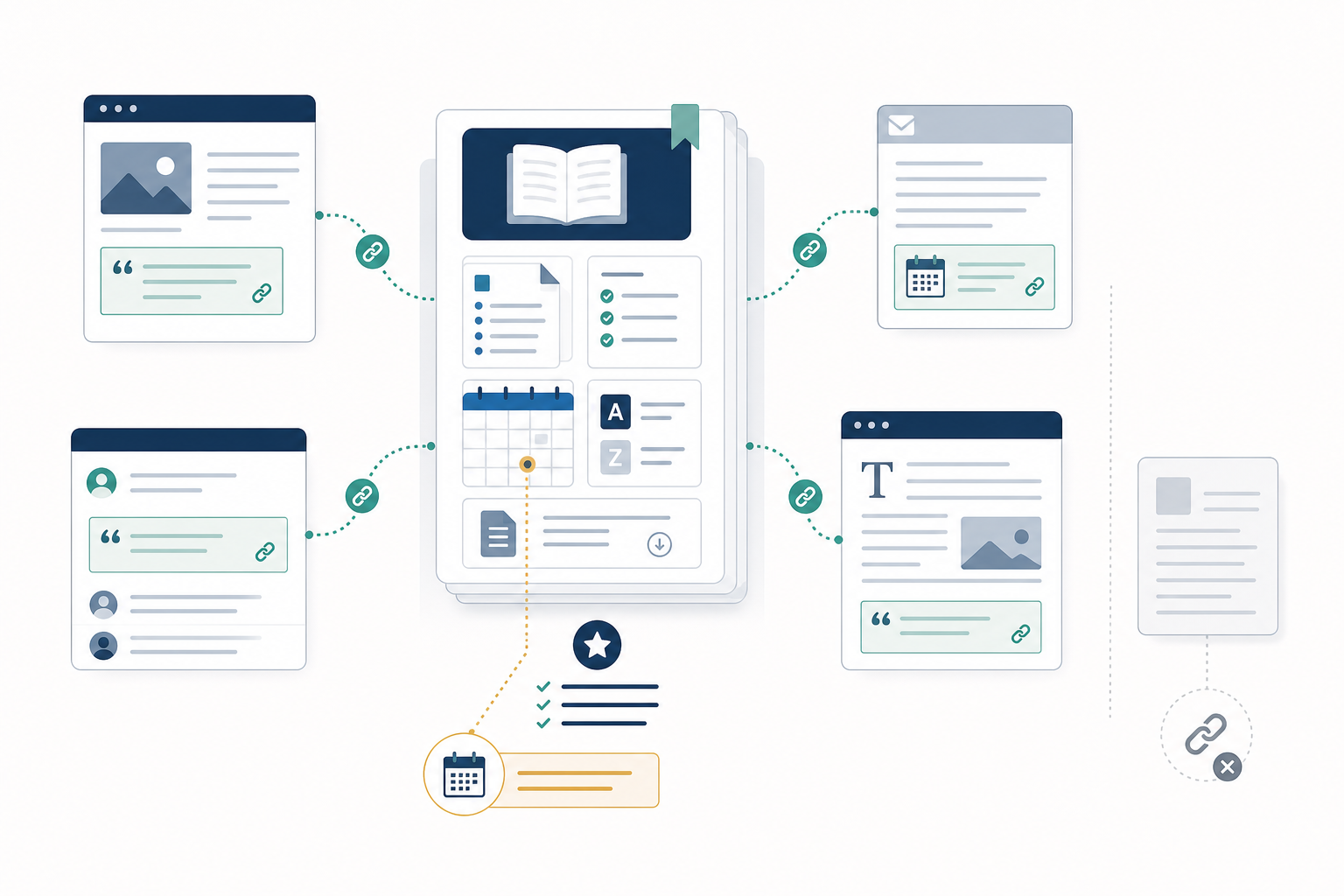
Content-led link building uses a useful piece of content as the primary reason external websites should cite or recommend a page.
Relevant assets include detailed guides, templates, checklists, glossaries, tutorials, comparison resources, reference pages, original frameworks, and educational resources. The content needs to provide something useful enough that another publisher can improve its own page by referencing it.
Content can be discovered organically or promoted through outreach, newsletters, PR, partnerships, social distribution, or professional communities. Publishing the resource alone does not guarantee backlinks.
A content-led backlink should be evaluated according to whether the source genuinely benefits from referencing the asset. A contextual citation from a relevant article can be more useful than a placement obtained solely because the source has a high third-party authority metric.
Best fit: businesses with expertise that can be converted into referenceable educational resources.
Main limitation: many topics already have substantial content supply, so generic articles provide weak differentiation.
Example: A payroll software company publishes a detailed payroll-tax calendar that accounting blogs reference when explaining filing deadlines.
Content-led link building differs from tool-based link building because the principal value comes from information rather than interactive functionality.
3. Digital PR Link Building
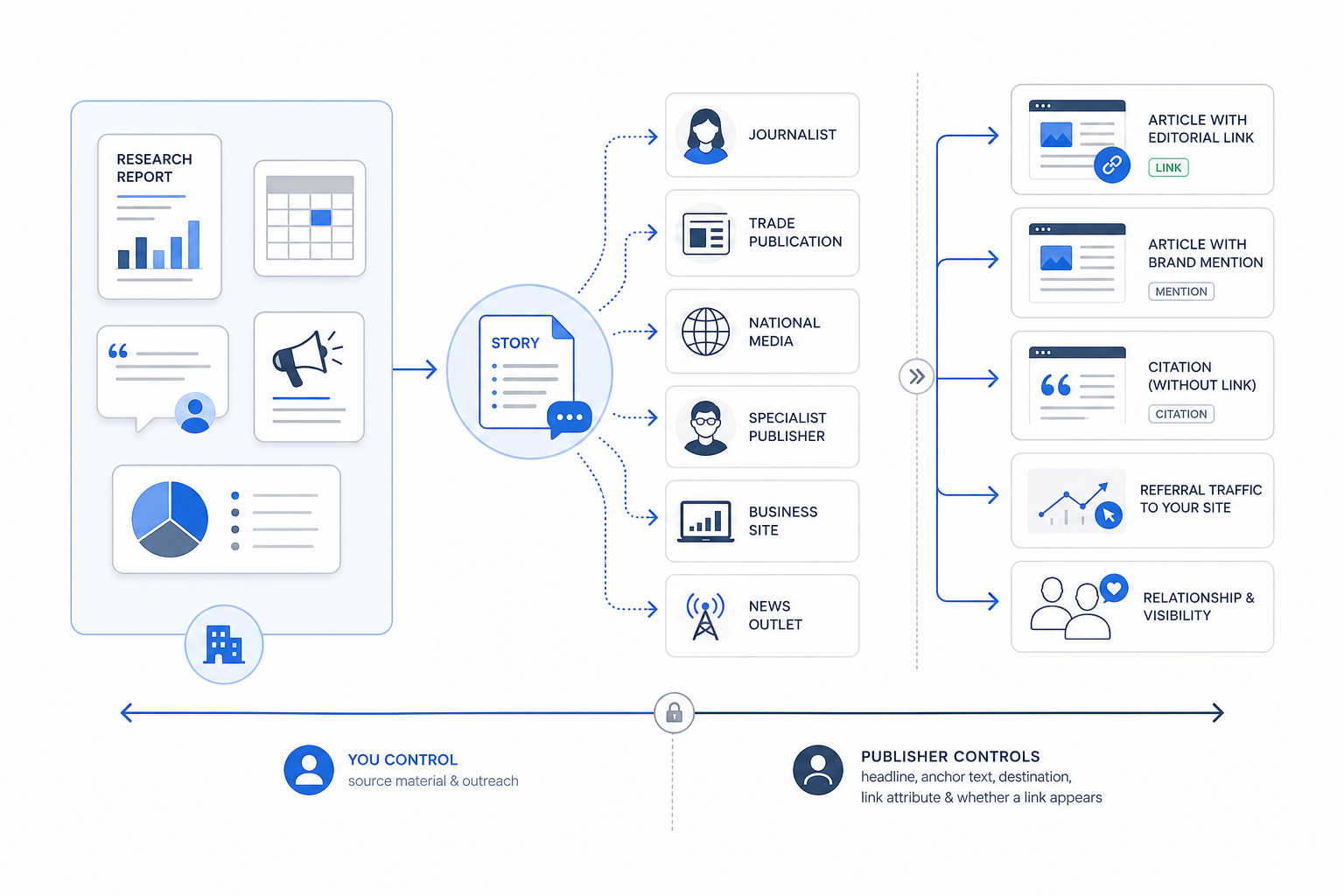
Digital PR link building uses newsworthy stories, data, expert commentary, research, company developments, or timely campaigns to earn coverage and editorial backlinks from media and publications.
Typical sources include journalists, trade publications, national media, specialist publishers, business websites, and news organizations. Common destinations include research reports, data pages, company announcements, expert profiles, tools, and supporting resources.
The publisher links because the company provides something useful to the story, such as original evidence, an expert source, a timely finding, a distinctive dataset, or a relevant development.
Control is limited. The company can choose its campaign, source material, target publications, and outreach approach, but journalists normally control coverage, anchor text, destination, link attributes, and whether a hyperlink is included at all.
Digital PR should therefore be measured through more than backlinks. Relevant outcomes can include media coverage, citations, brand mentions, referral traffic, branded visibility, journalist relationships, and links.
Best fit: companies with data, experts, research capability, newsworthy developments, or strong industry knowledge.
Main limitation: useful stories are not infinitely scalable, and media interest cannot be guaranteed.
Example: A cybersecurity company analyzes one million phishing emails, publishes its findings, and receives citations from technology publications covering the study.
Digital PR differs from ordinary outreach because the central pitch is a story, source, finding, or expert contribution rather than simply a page that the recipient might add to existing content.
4. Expert Contribution Link Building
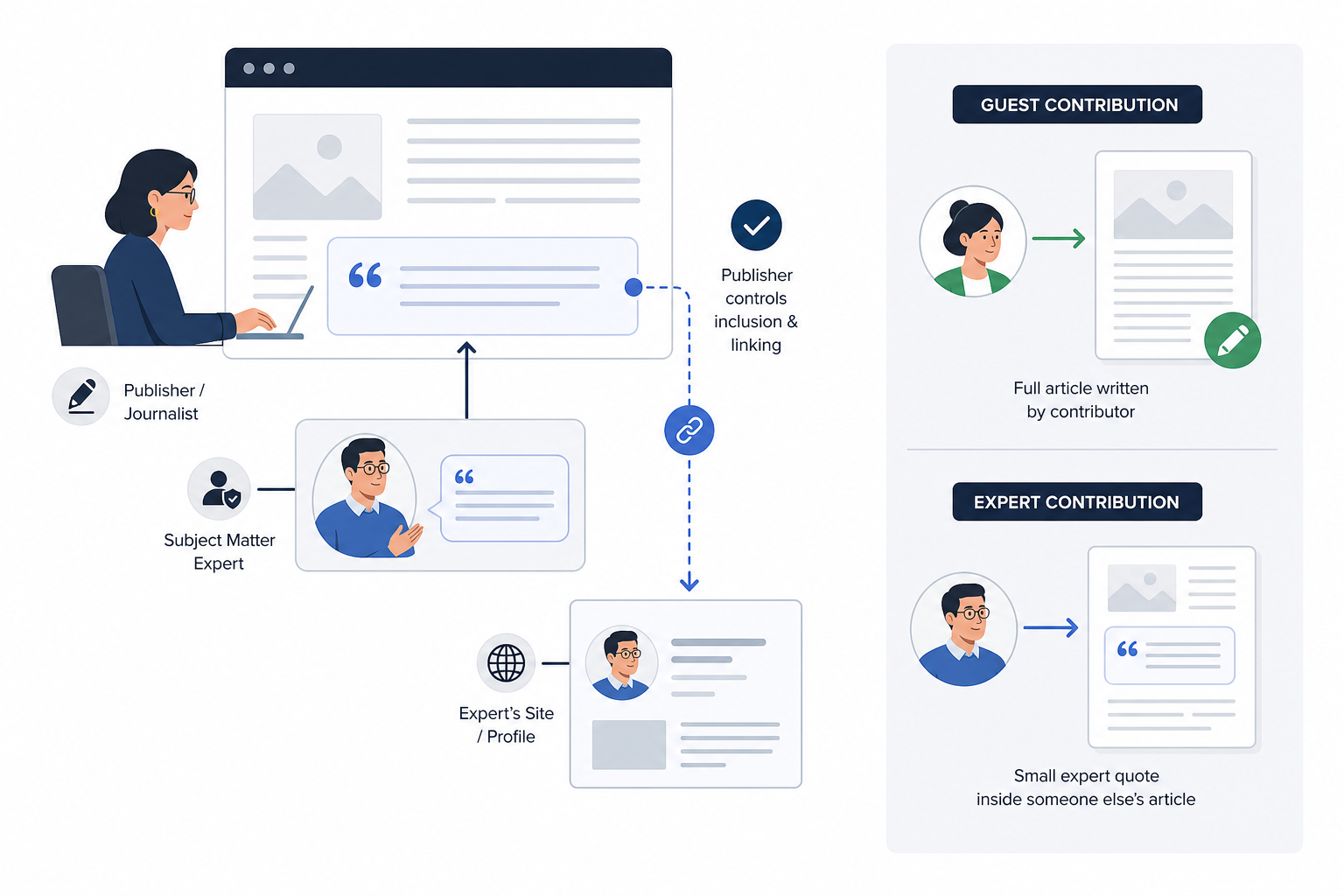
Expert contribution link building occurs when a subject-matter expert provides useful commentary, analysis, quotations, technical input, or professional insight that an external publisher attributes in its content.
Typical sources include journalists, industry publications, research organizations, newsletters, specialist blogs, and professional media. The linked destination can be the expert’s profile, company homepage, research page, relevant service page, or supporting resource.
The publisher’s reason for referencing the source is expertise. The expert contributes information that helps explain, validate, interpret, or add professional context to the publication’s own story.
Control is relatively low because the publisher decides whether the contribution is used and whether attribution includes a hyperlink.
Best fit: companies with credible executives, researchers, engineers, practitioners, analysts, or other genuine specialists.
Main limitation: weak or generic commentary provides little editorial value.
Example: A journalist writing about payment fraud quotes a fraud-prevention specialist and links to the specialist’s company as the source.
Expert contribution differs from guest contribution because the expert can provide only one quotation or piece of analysis rather than authoring the complete article.
5. Guest Contribution Link Building
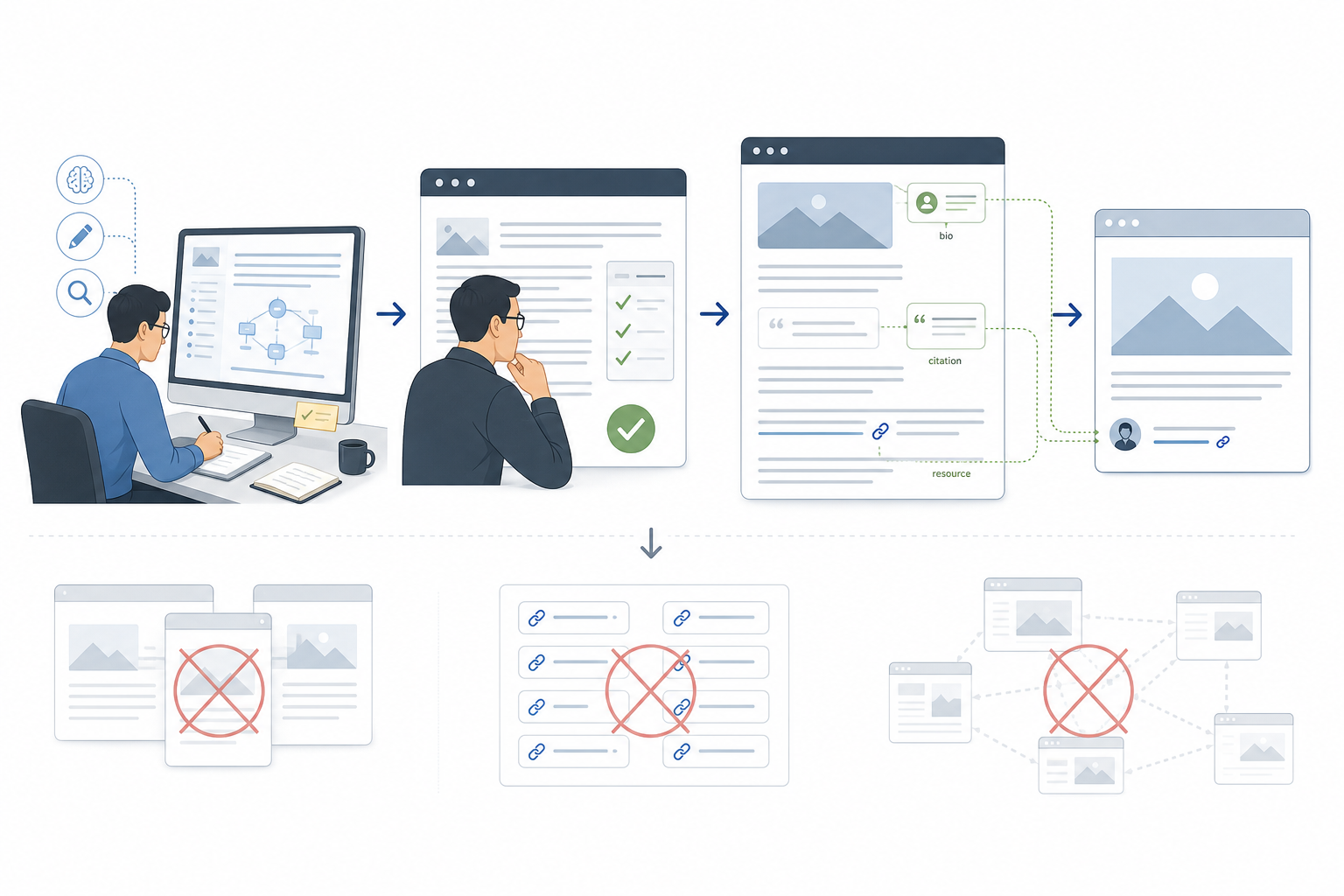
Guest contribution link building occurs when an expert contributes an original article, column, tutorial, opinion, or educational resource to an external publication and receives appropriate attribution or contextual references.
The primary value should be the contribution itself, not an exchange of content for ranking-oriented backlinks. This is the link-building application of guest posting, where an expert contributes useful content to an external publication and any backlink exists because it appropriately supports the contribution or attribution.
Suitable sources include genuine industry publications, professional websites, trade media, educational platforms, and company publications with established editorial standards.
Links can appear in:
- Author biographies
- Supporting citations
- Relevant examples
- Referenced resources
The publication determines what links are editorially appropriate. Repetitive exact-match anchors, scaled low-quality guest-post networks, and articles produced primarily to manufacture links weaken the method.
Best fit: businesses with genuine expertise and specialists capable of contributing useful information to relevant publications.
Main limitation: high-quality contributions require substantial subject expertise and editorial effort.
Example: A technical SEO specialist writes an article about JavaScript rendering for a respected development publication and receives author attribution to the company website.
Guest contribution differs from digital PR because the contributor supplies the main editorial content rather than acting primarily as a source for the publisher’s story.
6. Resource Page Link Building
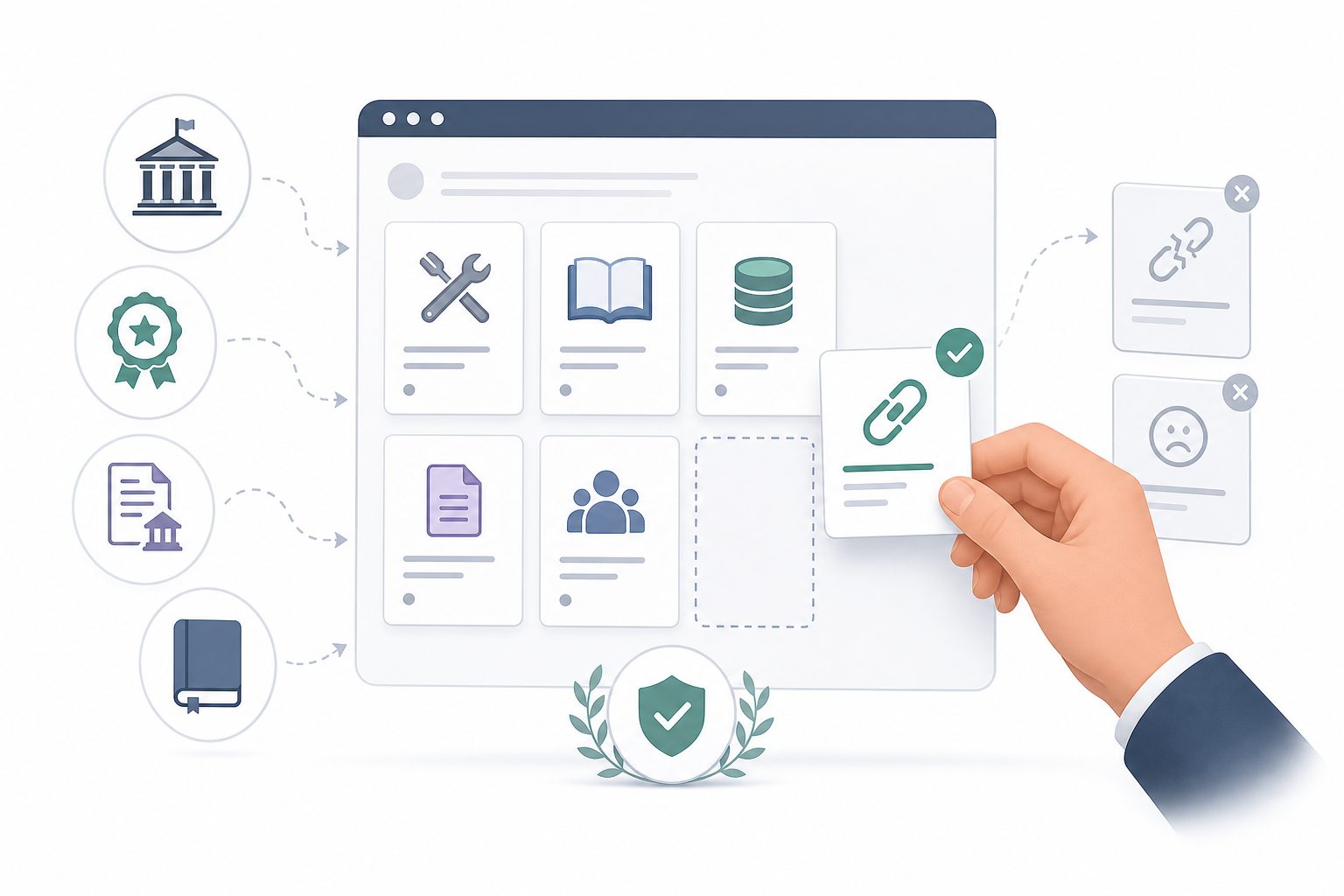
Resource page link building involves earning inclusion on an existing page that curates useful resources, tools, guides, organizations, references, or services for a particular audience.
The opportunity already exists because the publisher has decided to maintain a collection of external resources.
Suitable sources include:
- University resource pages
- Industry associations
- Professional organizations
- Educational websites
- Specialist publishers
- Government or nonprofit resources where eligible
The destination should genuinely improve the resource collection. A calculator can belong on a tools page, while an original research database can belong on a research-resource page.
Best fit: useful tools, reference guides, datasets, templates, educational resources, and legitimate organizations.
Main limitation: many “resource pages” are outdated, abandoned, or created mainly for link exchanges, so qualification is important.
Example: A nonprofit maintains a page of free accessibility tools and adds a genuinely useful accessibility checker after reviewing it.
Resource page link building differs from contextual link addition because the source page already exists specifically to curate resources.
7. Broken-Link Building
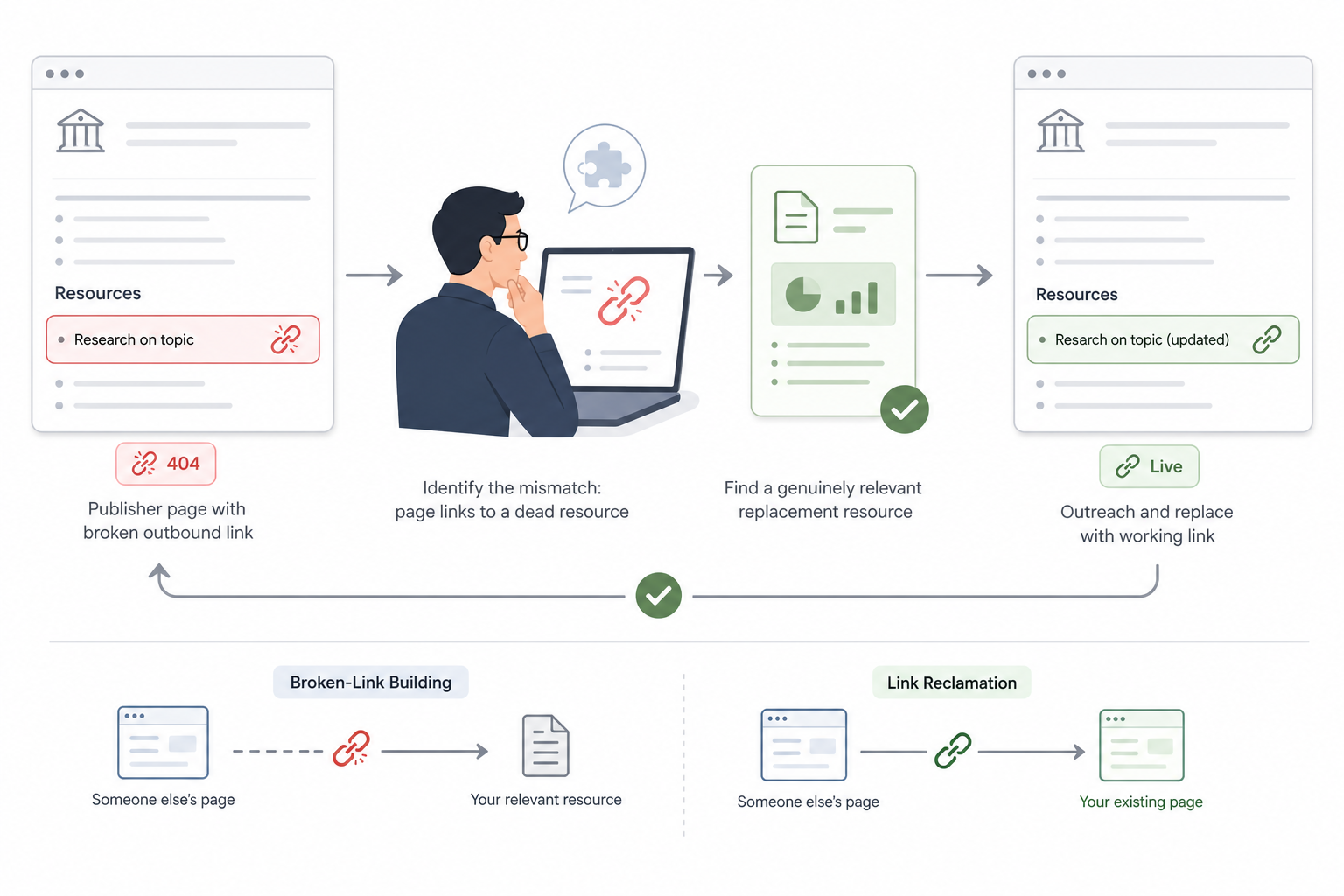
Broken-link building involves finding an external webpage that links to an unavailable resource and suggesting a genuinely relevant replacement that serves the same reader need.
The publisher already has a reason to link because its page contains a reference to a resource that no longer works.
A viable replacement should closely match the original purpose. Replacing an unavailable research report with an unrelated service page does not solve the publisher’s problem.
Potential sources include:
- Resource pages
- Guides
- Research articles
- Educational pages
- Reference lists
Best fit: businesses with high-quality resources that genuinely replace obsolete or deleted content.
Main limitation: many broken links have no suitable replacement, and many publishers will simply remove the reference rather than replace it.
Example: A university guide links to a discontinued statistics resource. A company with an updated equivalent dataset contacts the university, which replaces the broken reference with the current resource.
Broken-link building differs from link reclamation because the broken link originally points to another resource, while reclamation normally restores a relationship the target website previously had.
8. Link Reclamation
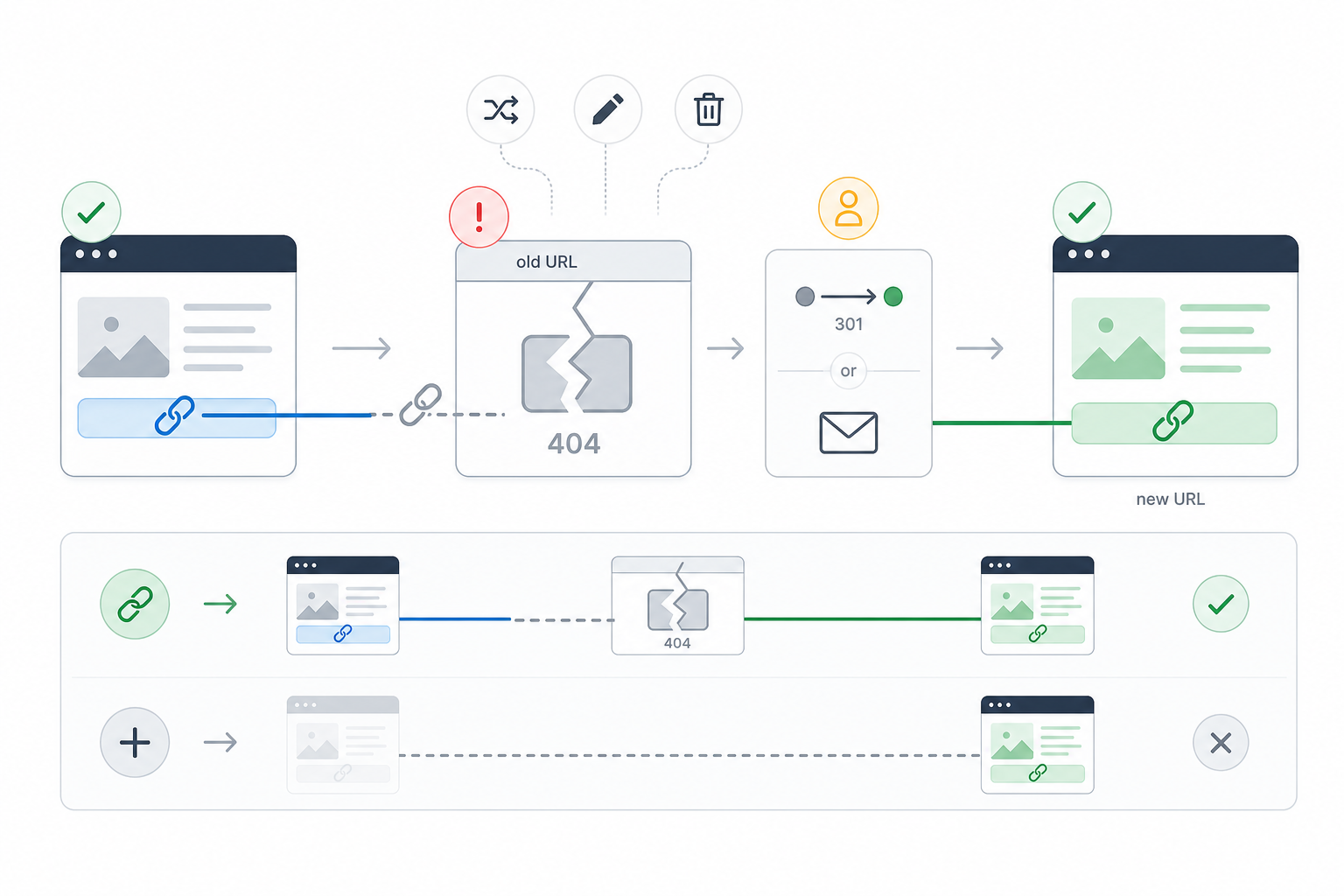
Link reclamation is the process of recovering a backlink that previously pointed to a website but was lost or became ineffective because of a URL change, migration, deleted page, publisher edit, or other change.
The original external relationship already existed. The objective is to restore or correctly redirect that relationship rather than create a completely new reference reason.
Common situations include:
- Website migrations
- Changed URL structures
- Deleted resources
- Incorrect redirects
- Publisher updates
- Broken destination URLs
Reclamation can involve restoring the original page, implementing an appropriate redirect, or contacting the source when an editorial update is required.
Best fit: established websites with historical backlinks, migrated URLs, large content archives, or frequently changing resources.
Main limitation: not every lost link should be recovered. The original source or destination can become irrelevant.
Example: A research report changes URLs during a redesign, causing several publications to link to a 404 page. The company redirects the old URL to the current report.
Link reclamation differs from unlinked mention reclamation because a backlink already existed.
9. Unlinked Mention Reclamation
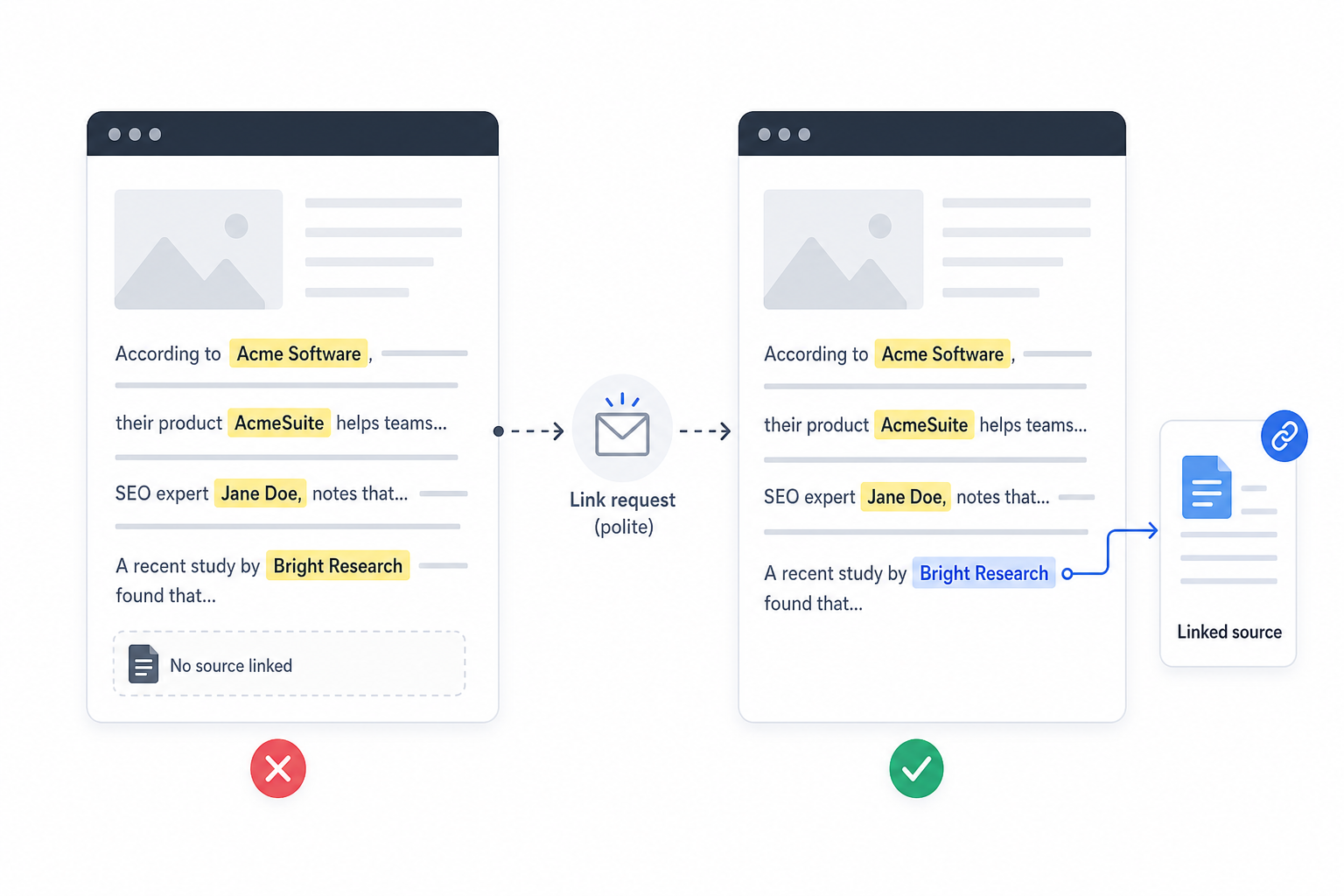
Unlinked mention reclamation involves identifying an external page that already mentions a company, product, study, expert, or resource and requesting a hyperlink when linking would improve attribution or reader access.
The source has already established the relationship by mentioning the entity.
Suitable opportunities include:
- Brand mentions
- Product references
- Research citations
- Expert quotations
- Company announcements
- Data references
Not every mention requires a link. A passing brand reference can be perfectly clear without one.
Best fit: recognized brands, companies receiving media coverage, proprietary research, products frequently reviewed, and quoted experts.
Main limitation: the publisher has no obligation to add a hyperlink merely because the entity is mentioned.
Example: An article cites statistics from a company’s annual report by name but does not link to the source. The company asks the publisher to add the original report for verification.
Unlinked mention reclamation differs from contextual link addition because the source already mentions the target entity.
10. Contextual Link Addition
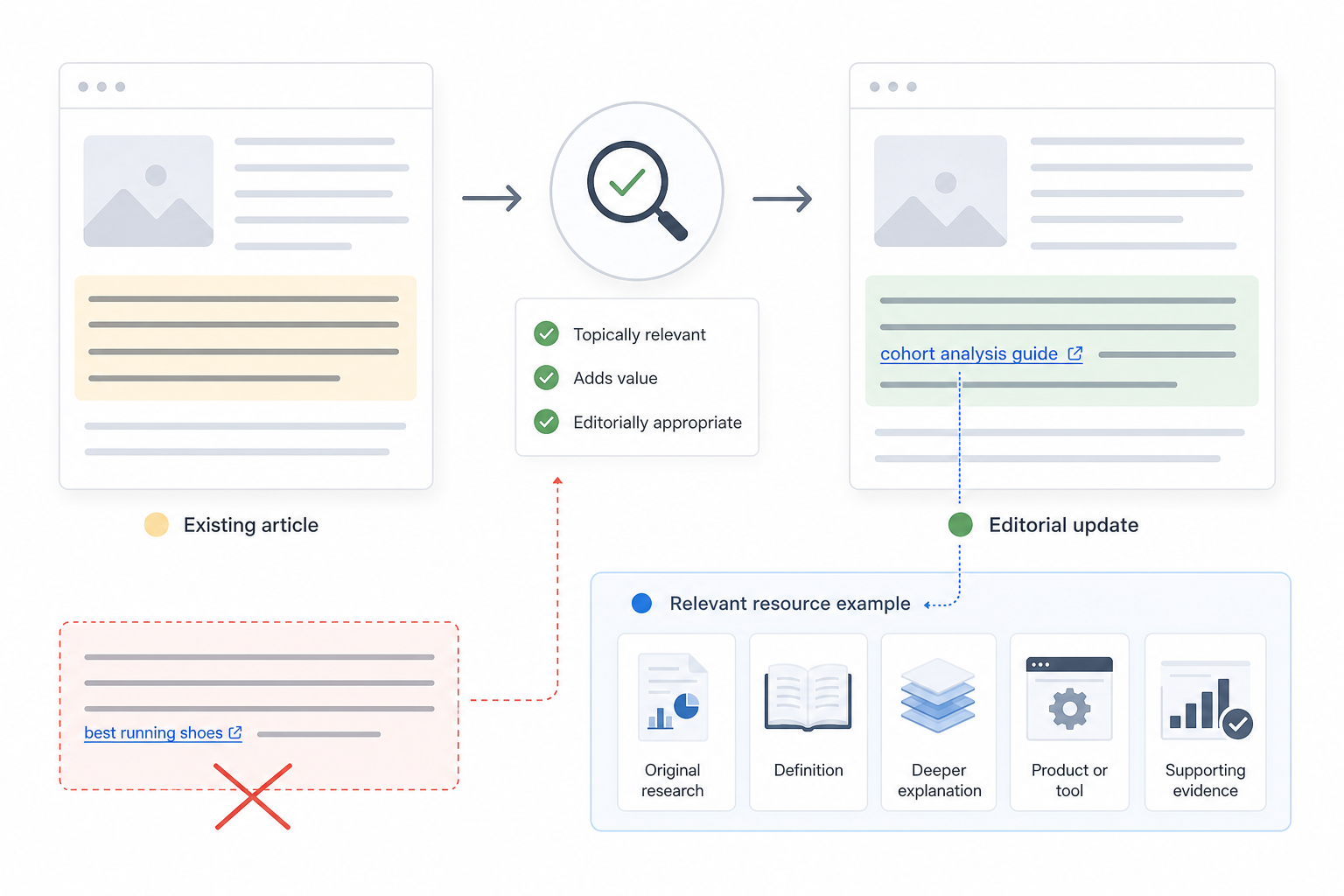
Contextual link addition occurs when an existing external article gains a new hyperlink because a relevant destination provides useful supporting information that improves the existing passage.
The source page is already published, but no prior mention or broken reference necessarily exists. These additions are often described as niche edit links when a relevant link is editorially added to an existing published page rather than placed through newly created content.
The strongest opportunities occur when the destination provides:
- Original evidence
- A useful definition
- Further explanation
- A product being discussed
- Supporting research
- A relevant tool
The publisher should have an editorial reason to update the page. Adding an arbitrary backlink to an unrelated sentence does not create useful context.
Best fit: strong evergreen resources, research, tools, definitions, and useful supporting pages.
Main limitation: the method can become manipulative when existing articles are treated simply as places where links can be inserted.
Example: An article explaining customer retention discusses cohort analysis but provides no practical resource. The publisher adds a link to a detailed cohort-analysis calculator that improves the section.
Contextual link addition differs from unlinked mention reclamation because the target entity does not have to be mentioned before the new reference is added.
11. Partnership Link Building
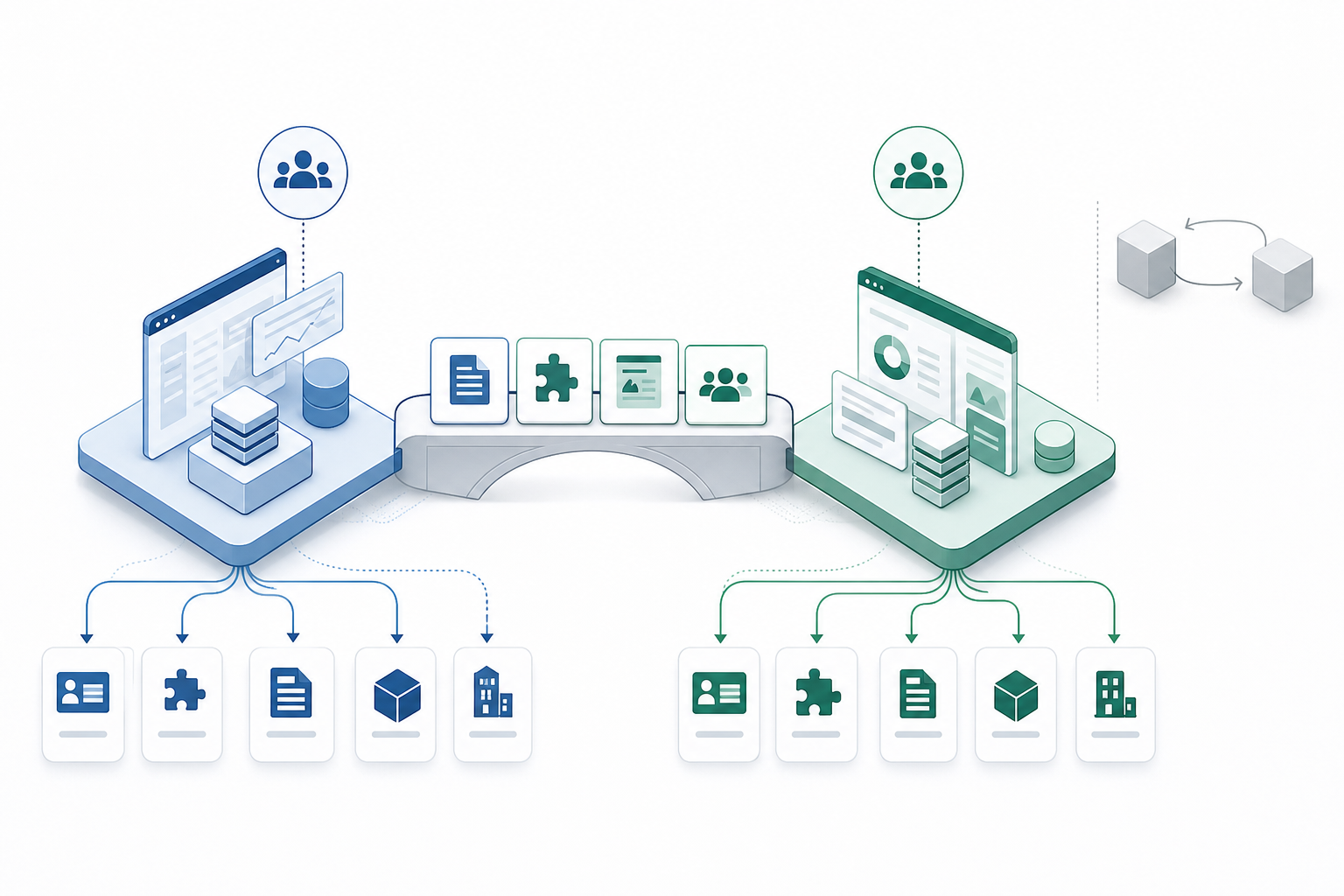
Partnership link building uses a genuine business collaboration as the reason two organizations or their resources are referenced online.
Relevant relationships include:
- Co-marketing partnerships
- Technology partnerships
- Research collaborations
- Strategic alliances
- Customer partnerships
- Channel partnerships
The backlink should represent the underlying business relationship rather than exist solely because both parties agreed to exchange links.
Potential destinations include partner pages, integration pages, joint resources, case studies, product pages, and company profiles.
Best fit: companies with active ecosystems, joint initiatives, strategic collaborations, or complementary products.
Main limitation: partnership opportunities depend on real commercial relationships and are therefore not infinitely scalable.
Example: Two SaaS companies publish a joint implementation guide for shared customers and reference each other’s relevant integration resources.
Partnership link building differs from systematic reciprocal link exchange because the business relationship creates independent value beyond the backlink.
12. Integration Link Building
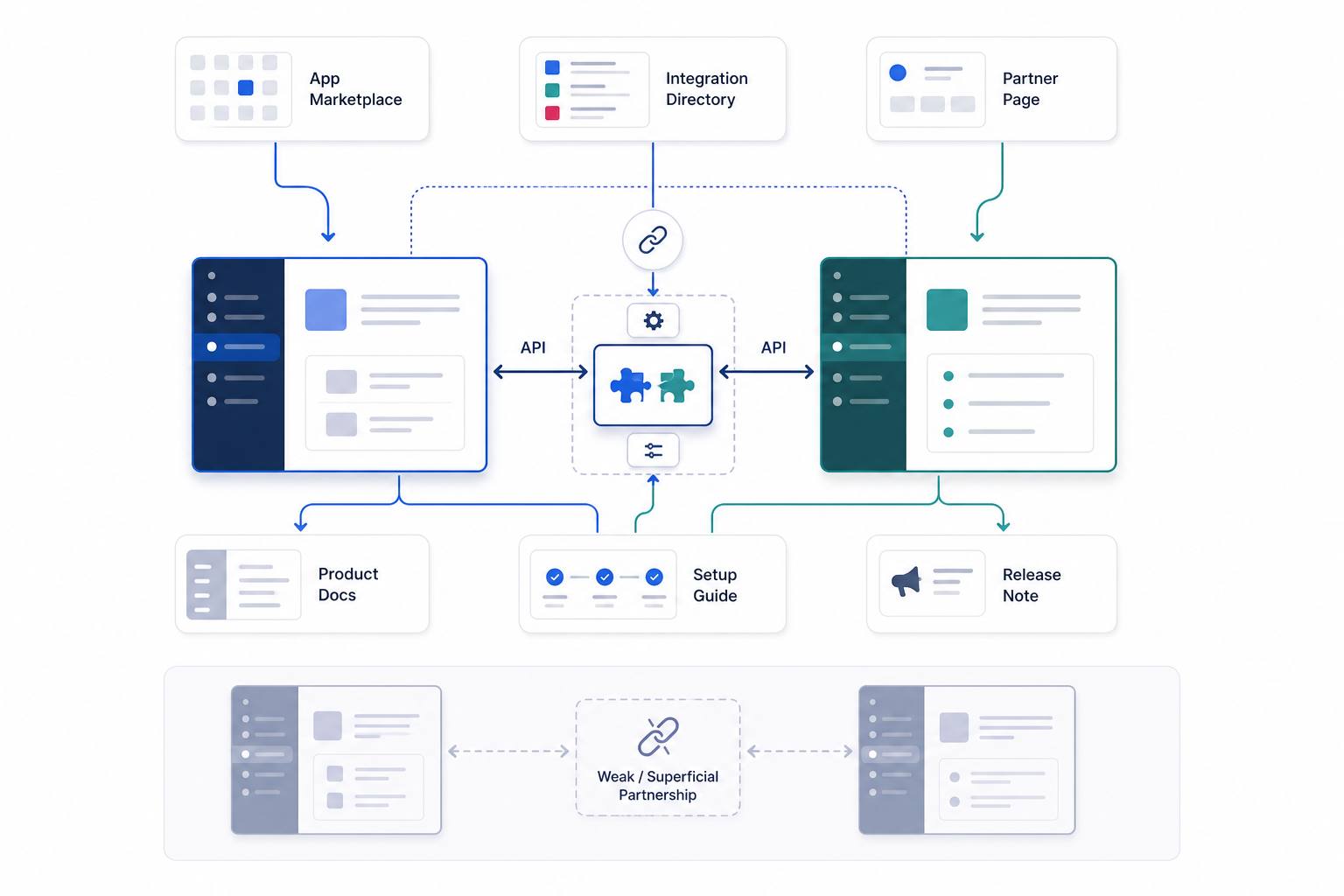
Integration link building occurs when two compatible products or platforms reference one another because a real technical integration exists between them.
Common sources include:
- App marketplaces
- Integration directories
- Partner pages
- Product documentation
- Setup guides
- Release announcements
The link helps users understand compatibility, installation, configuration, or product relationships.
Best fit: SaaS platforms, ecommerce software, developer tools, payment providers, CRM systems, analytics products, and other connected technologies.
Main limitation: creating superficial integrations solely to obtain backlinks provides weak product and user value.
Example: A CRM integrates with an email automation platform. Both companies publish documentation explaining the integration and reference the other product where users need it.
Integration link building differs from general partnership link building because technical interoperability is the central reference reason.
13. Supplier or Vendor Link Building
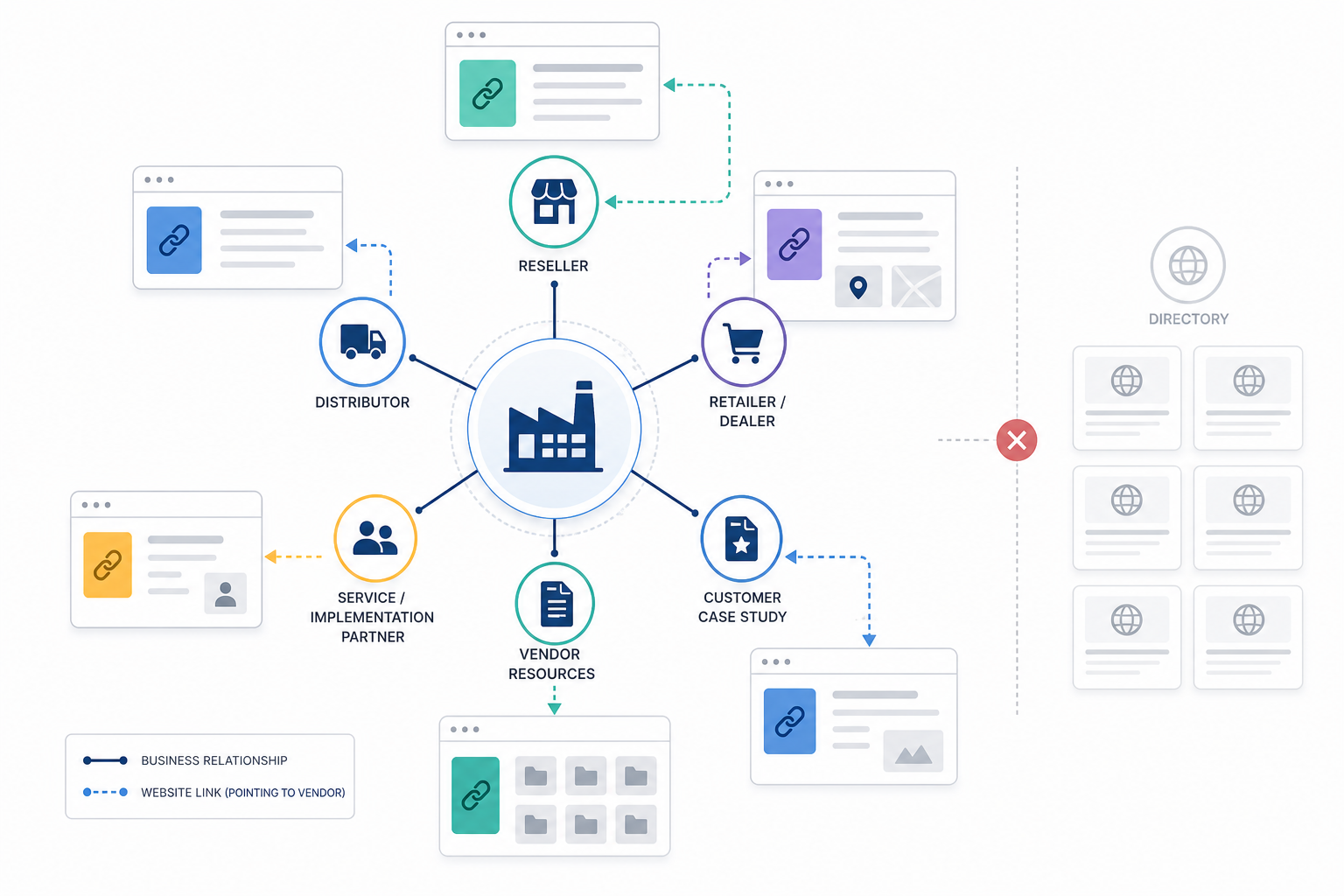
Supplier or vendor link building occurs when a real supply-chain or commercial relationship creates a legitimate reason for a manufacturer, supplier, distributor, reseller, retailer, or service provider to reference another business.
Examples include:
- Authorized reseller pages
- Supplier directories
- Distributor lists
- Dealer locators
- Customer case studies
- Vendor-resource pages
The reference helps users identify where products come from, where they can be purchased, or who provides a related service.
Best fit: manufacturers, distributors, ecommerce retailers, B2B suppliers, agencies, technology vendors, and service ecosystems.
Main limitation: the link should accurately represent the commercial relationship.
Example: A software vendor lists an implementation agency as an authorized service partner and links to the agency’s relevant service page.
Supplier or vendor links differ from generic directories because eligibility comes from an actual commercial relationship.
14. Association Link Building
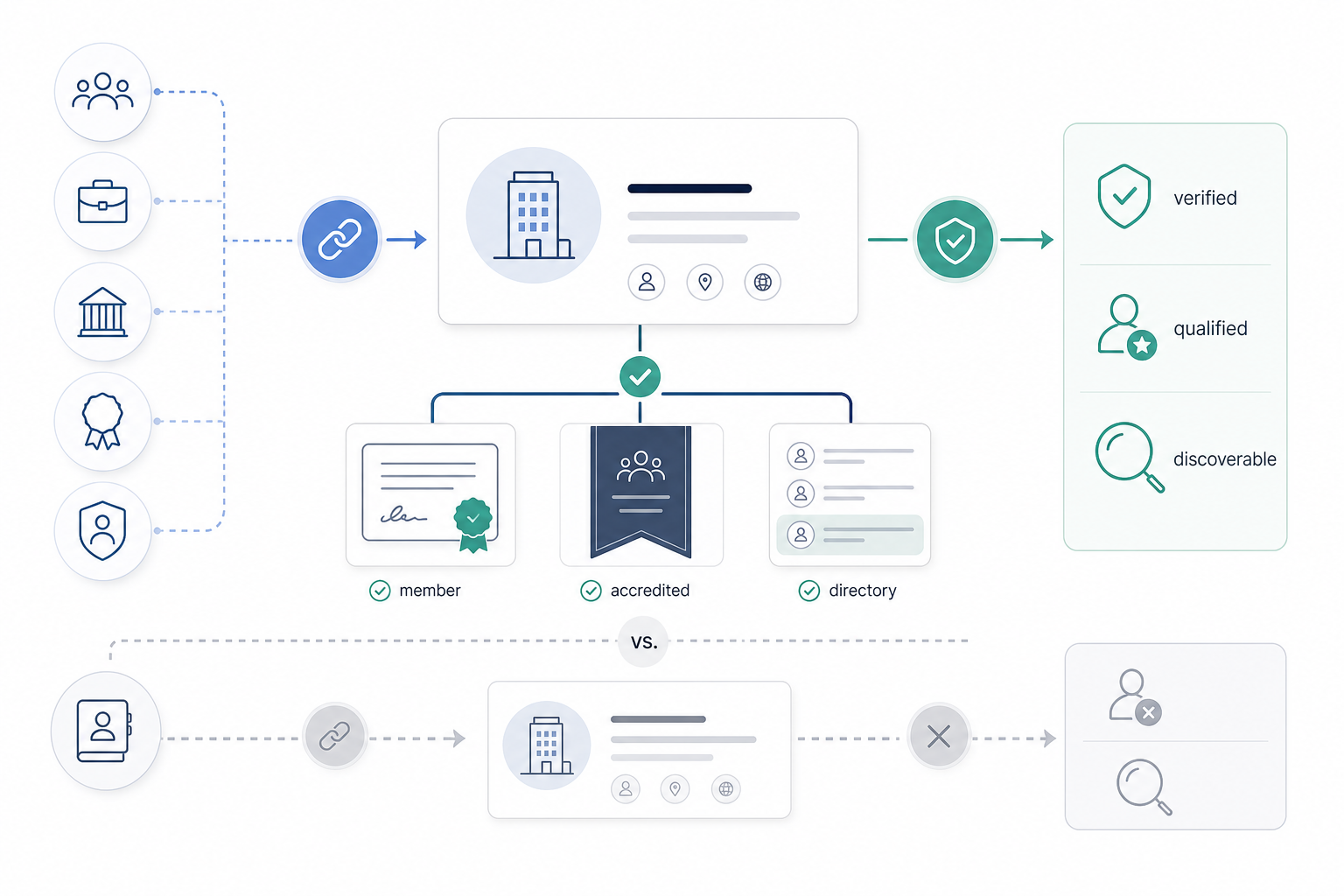
Association link building uses membership, accreditation, certification, professional participation, or industry affiliation as the reason an association references a business or individual.
Potential sources include:
- Professional associations
- Trade organizations
- Chambers
- Certification bodies
- Member directories
- Industry councils
The strongest association links help users verify membership or find qualified providers.
Best fit: regulated professions, B2B companies, local businesses, consultants, manufacturers, and organizations with legitimate professional memberships.
Main limitation: joining irrelevant associations merely for backlinks adds little business value.
Example: An engineering consultancy becomes an accredited member of a professional engineering association and appears in its member directory.
Association links differ from directory links because membership or professional affiliation creates the eligibility.
15. Sponsorship Link Building
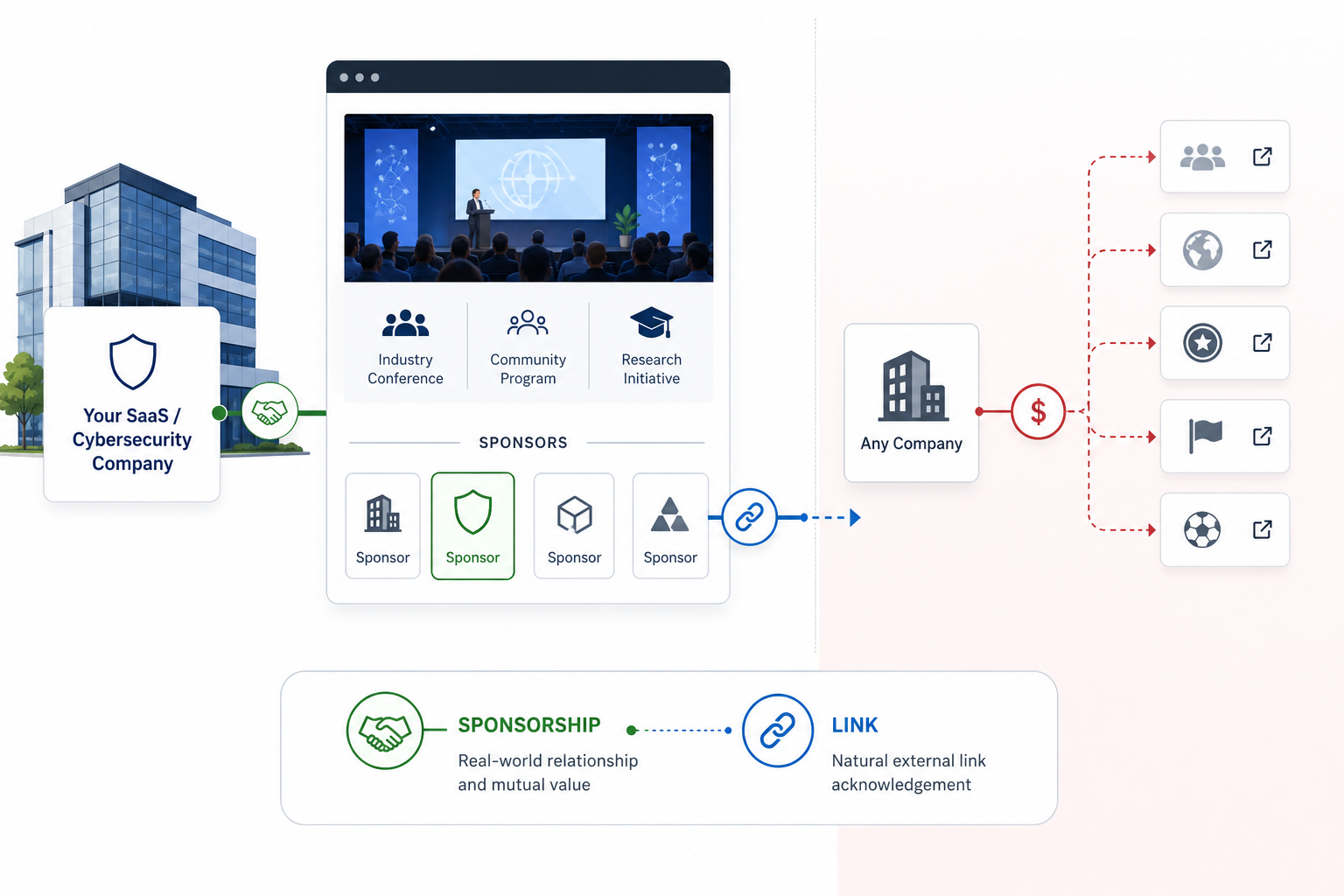
Sponsorship link building occurs when a genuine sponsorship relationship results in an acknowledgement, sponsor profile, event page, organization page, or other external reference.
Relevant sponsorships include:
- Industry conferences
- Community events
- Nonprofits
- Sports organizations
- Research initiatives
- Professional programs
The sponsorship should have independent marketing, community, or business value.
Because compensation is involved, the resulting links can have a commercial context and may require appropriate qualification.
Best fit: businesses already investing in events, community programs, industry activity, or brand partnerships.
Main limitation: purchasing arbitrary sponsorships solely to acquire ranking-oriented links can create low-value or policy-sensitive activity.
Example: A cybersecurity company sponsors an industry conference and is listed with other sponsors on the event website.
Sponsorship link building describes the broader relationship that creates the opportunity; a sponsored link describes the commercial qualification of a specific hyperlink.
16. Event Link Building
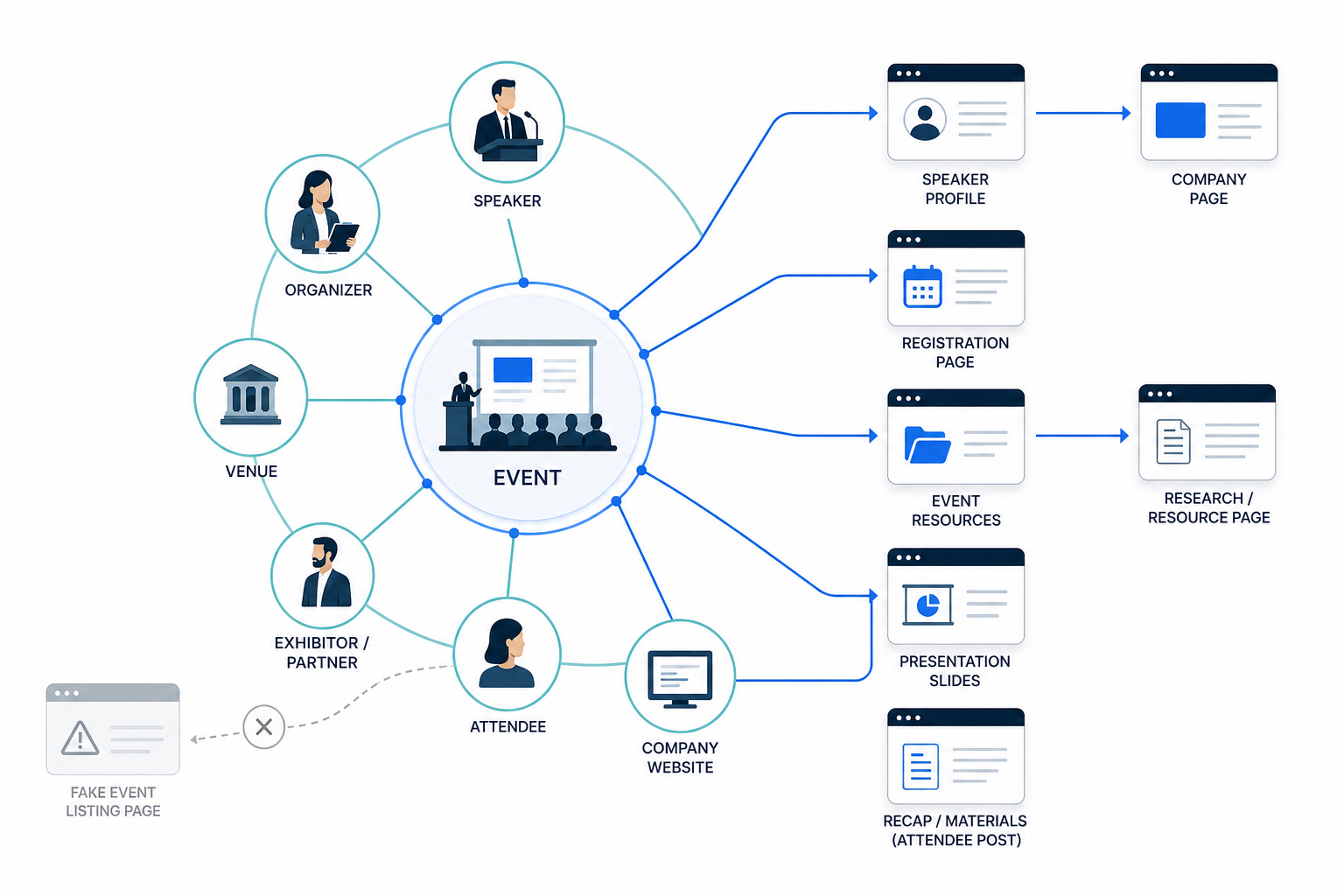
Event link building occurs when participation in a genuine event creates a reason for organizers, speakers, venues, sponsors, exhibitors, attendees, or partners to reference one another online.
Potential events include:
- Conferences
- Webinars
- Workshops
- Meetups
- Trade shows
- Community events
Common destinations include speaker profiles, company pages, event resources, research, registration pages, and presentation materials.
Best fit: businesses actively participating in relevant professional or community events.
Main limitation: fabricated event pages or low-value event listings created mainly for links provide little legitimate value.
Example: A data scientist speaks at an analytics conference, and the conference speaker page links to the scientist’s company profile.
Event link building differs from sponsorship link building because participation rather than financial sponsorship can create the reference.
17. Directory Link Building
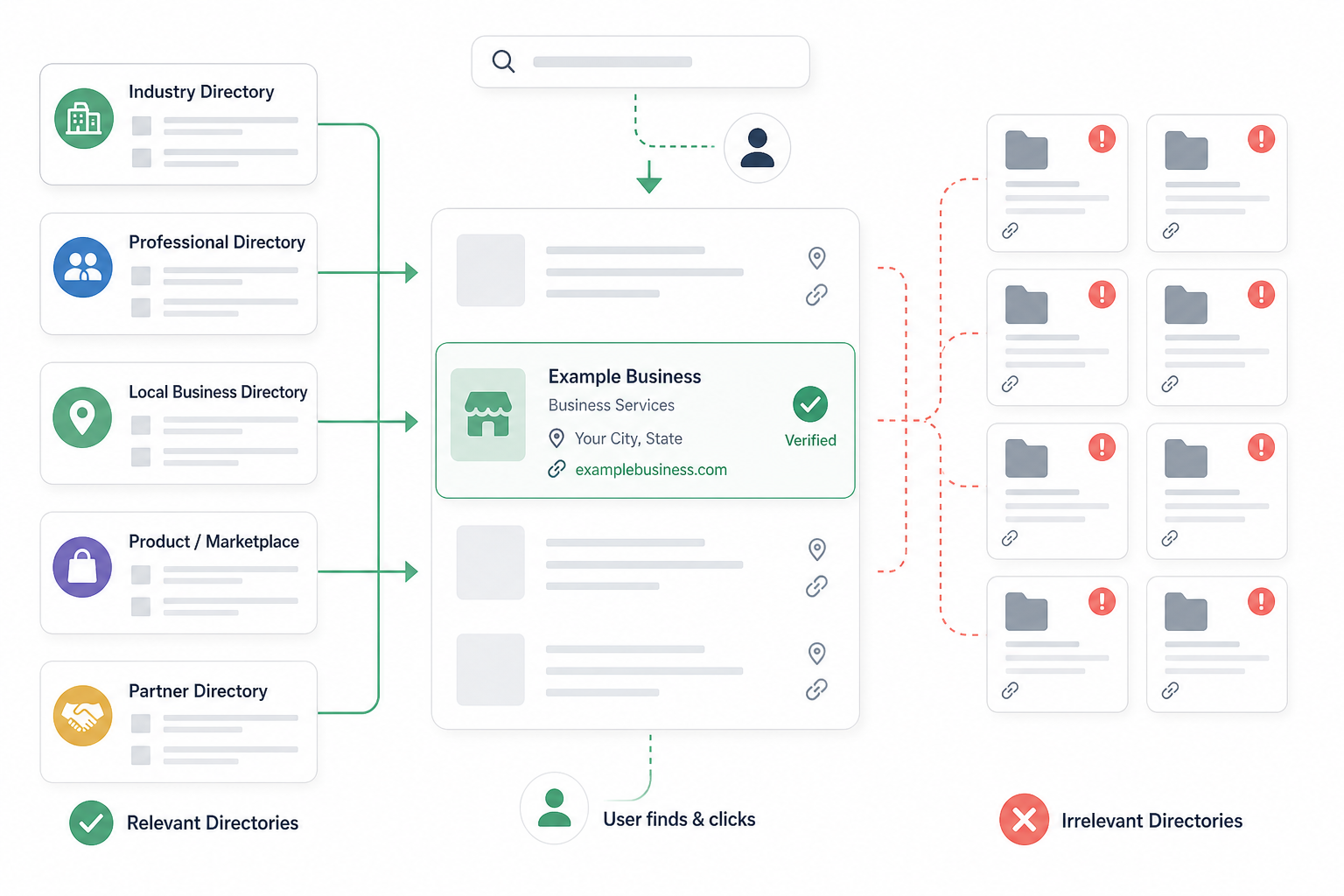
Directory link building involves placing an accurate business, product, professional, or organizational listing in a legitimate directory designed to help users discover relevant entities.
Useful directories include:
- Industry directories
- Professional directories
- Local business directories
- Product directories
- Partner directories
- Marketplace listings
A directory link is useful when the directory has a real audience or discovery purpose.
Best fit: local businesses, professional services, SaaS ecosystems, manufacturers, suppliers, and industries where directories are widely used.
Main limitation: mass submission to unrelated or automatically generated directories creates little user value.
Example: A licensed architect appears in a professional directory that customers use to find registered practitioners.
Directory link building differs from association link building because directory eligibility does not necessarily require organizational membership.
18. Local Link Building
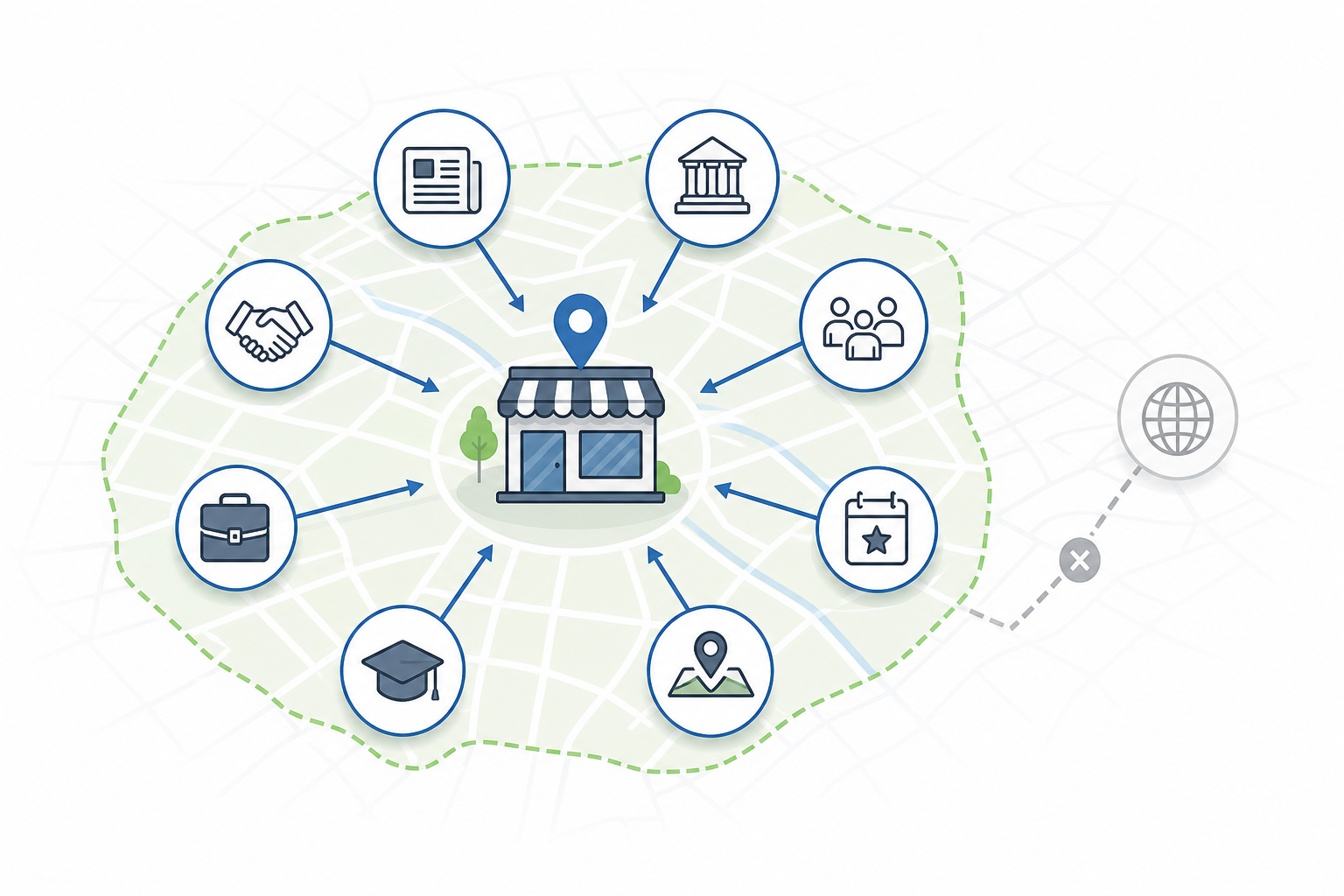
Local link building focuses on earning references from organizations, publications, businesses, and resources connected with a genuine geographic market.
Potential sources include:
- Local news websites
- Chambers of commerce
- Community organizations
- Local events
- Universities
- Tourism resources
- Regional business groups
- Local partners
The geographic relationship should be real. A business serving Surat, for example, has a stronger reason to appear in a Surat business resource than in an unrelated directory targeting another region.
Best fit: restaurants, clinics, salons, tradespeople, stores, hotels, local professional services, and multi-location businesses.
Main limitation: geographic relevance alone does not make a website legitimate or useful.
Example: A local newspaper covers a restaurant’s community food initiative and links to the restaurant for further information.
Local link building differs from industry link building because geography is the primary relationship.
19. Industry Link Building
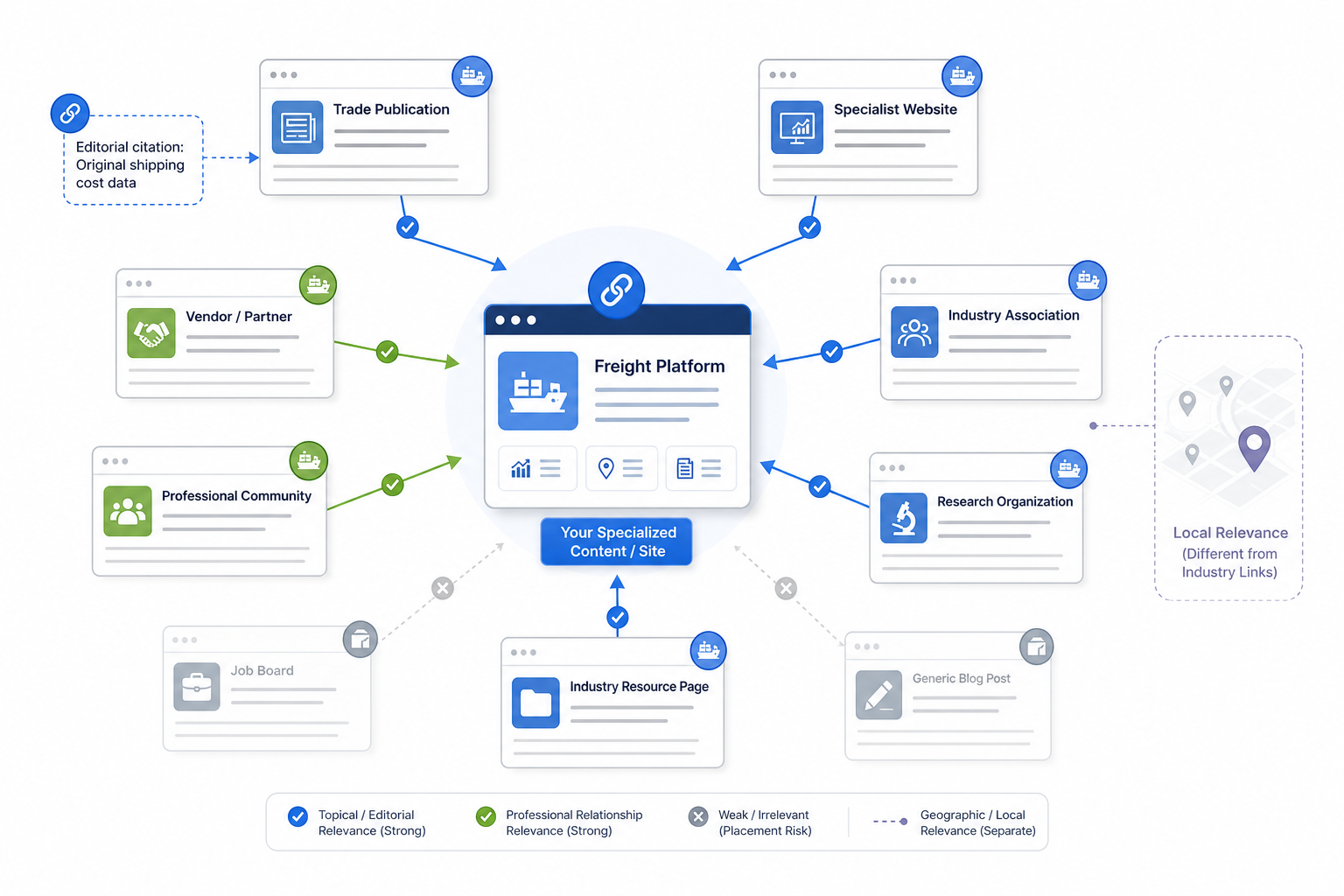
Industry link building involves earning backlinks from publications, organizations, resources, companies, and communities that operate within or closely relate to the same professional or commercial sector.
Relevant sources include:
- Trade publications
- Specialist websites
- Industry associations
- Research organizations
- Vendors
- Professional communities
- Sector-specific resource sites
Industry relevance should be evaluated at page and audience level rather than by domain category alone.
Best fit: specialized B2B companies, technical businesses, professional services, SaaS companies, manufacturers, and regulated industries.
Main limitation: a link from an industry website is not automatically useful if the source page is irrelevant or exists mainly for link placement.
Example: A logistics publication references original shipping-cost data published by a freight platform.
Industry link building differs from local link building because the main relationship is topical or professional rather than geographic.
20. Competitor-Gap Link Building
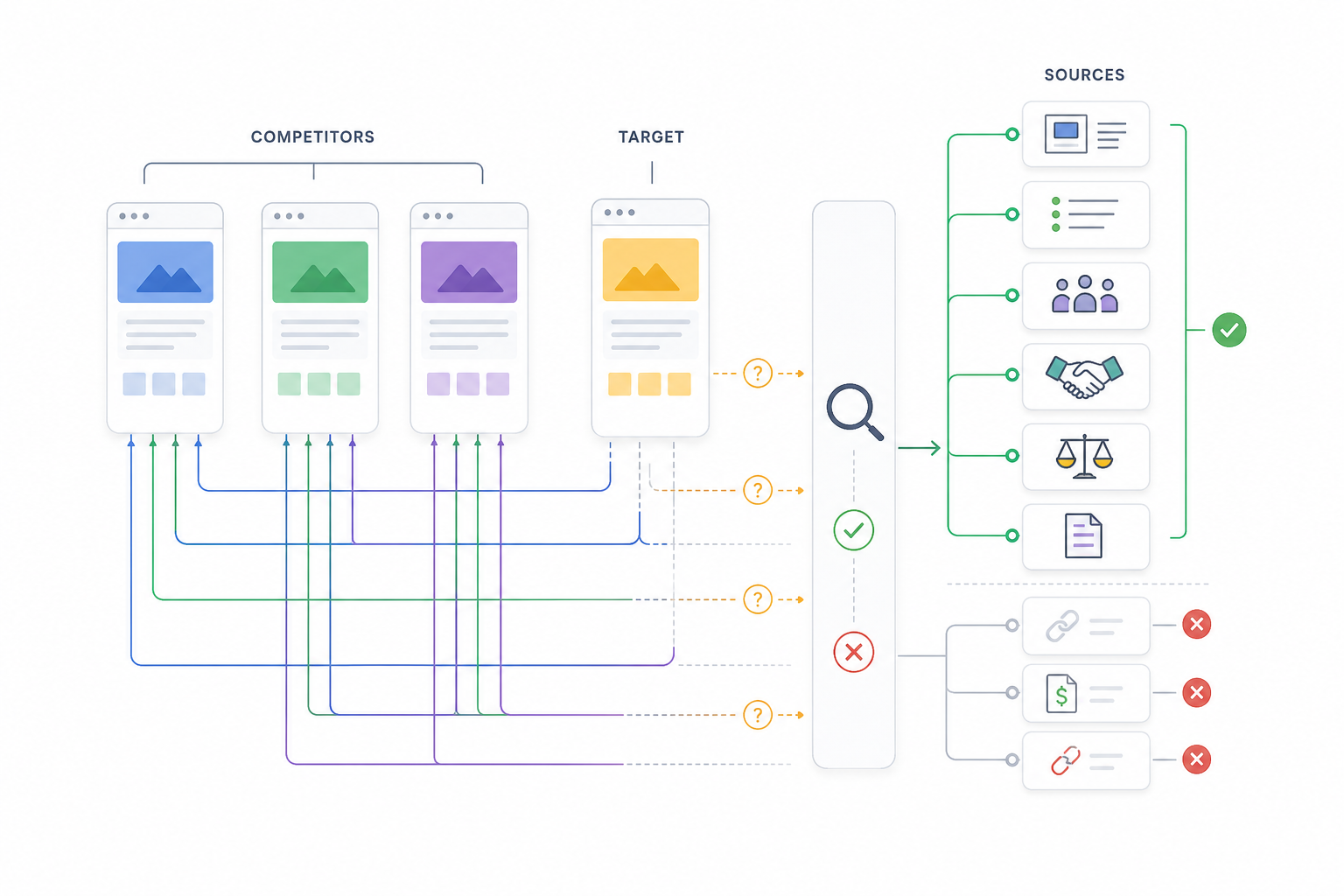
Competitor-gap link building uses backlink analysis to identify external websites that reference competing pages but not the target website, then evaluates whether a legitimate equivalent opportunity exists.
The method is useful for discovering:
- Publications
- Resource pages
- Associations
- Partners
- Comparison pages
- Research citations
- Directories
A competitor link is evidence of a possible relationship, not proof that the target website deserves the same backlink. Analyzing competitor backlinks helps reveal which publishers, resources, partnerships, and citation patterns may represent legitimate opportunities worth investigating for your own site.
Best fit: established markets where multiple comparable competitors already receive external references.
Main limitation: blindly replicating competitor backlinks can reproduce weak, outdated, paid, irrelevant, or inaccessible opportunities.
Example: Three competing project-management tools are listed in an industry software resource, but another relevant product is missing. The company contacts the resource owner with accurate information about its product.
Competitor-gap link building differs from ordinary prospecting because competitor backlink data provides the initial opportunity signal.
21. Skyscraper-Style Link Building
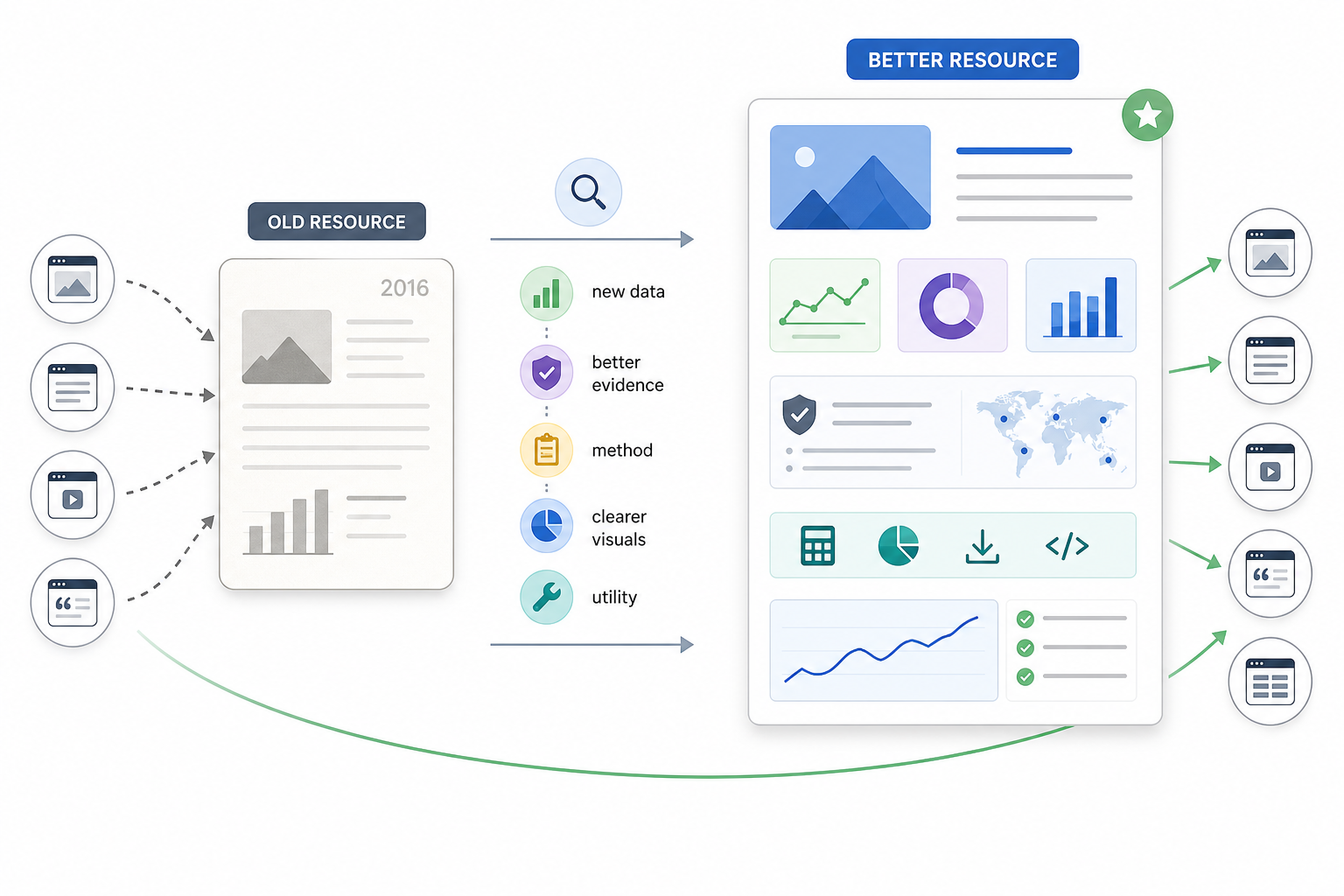
Skyscraper-style link building involves finding an existing resource that attracts citations, creating a materially better resource, and promoting the improved asset to audiences or publishers likely to find it useful.
“Better” should mean an actual improvement such as:
- Newer data
- More complete evidence
- Better methodology
- Stronger usability
- Additional tools
- Clearer visuals
- Greater practical utility
Simply making an article longer does not make it a stronger reference.
Best fit: topics with proven citation demand but outdated or incomplete resources.
Main limitation: recreating existing information with minor cosmetic changes provides little reason for publishers to replace their current references.
Example: Existing ecommerce benchmark articles use data from 2022. A company publishes a transparent 2026 dataset covering more stores and clearly documents its methodology.
Skyscraper-style link building differs from general content-led link building because it begins with an existing referenceable asset and attempts to create a materially stronger alternative.
22. Statistics and Data Link Building
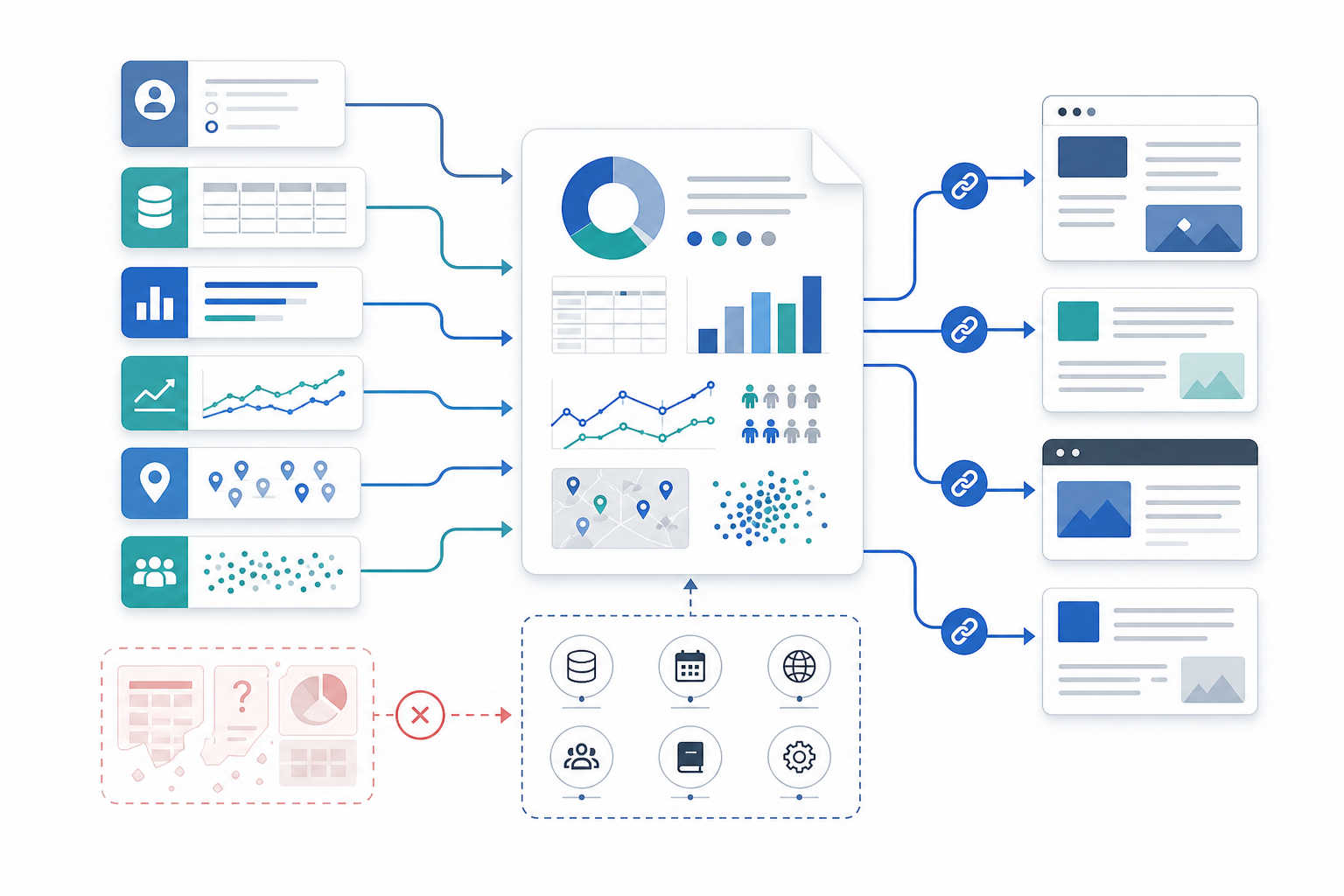
Statistics and data link building uses original, aggregated, or carefully maintained quantitative information as the principal reason other publishers cite a page.
Useful assets include:
- Surveys
- Benchmarks
- Market datasets
- Industry statistics
- Usage data
- Trend analyses
- Public-data compilations
The strongest data assets explain the source, period, geography, sample, definitions, and methodology needed to interpret the numbers.
Best fit: companies with proprietary data, research capability, strong public-data analysis, or recurring market insights.
Main limitation: weak methodology, stale figures, unsourced statistics, or recycled numbers reduce citation value.
Example: A recruitment platform publishes annual hiring benchmarks based on anonymized data from 100,000 job listings, and HR publications cite the findings.
Statistics and data link building differs from research citation links because data building describes the asset strategy, while a research citation describes the resulting reference reason.
23. Tool-Based Link Building
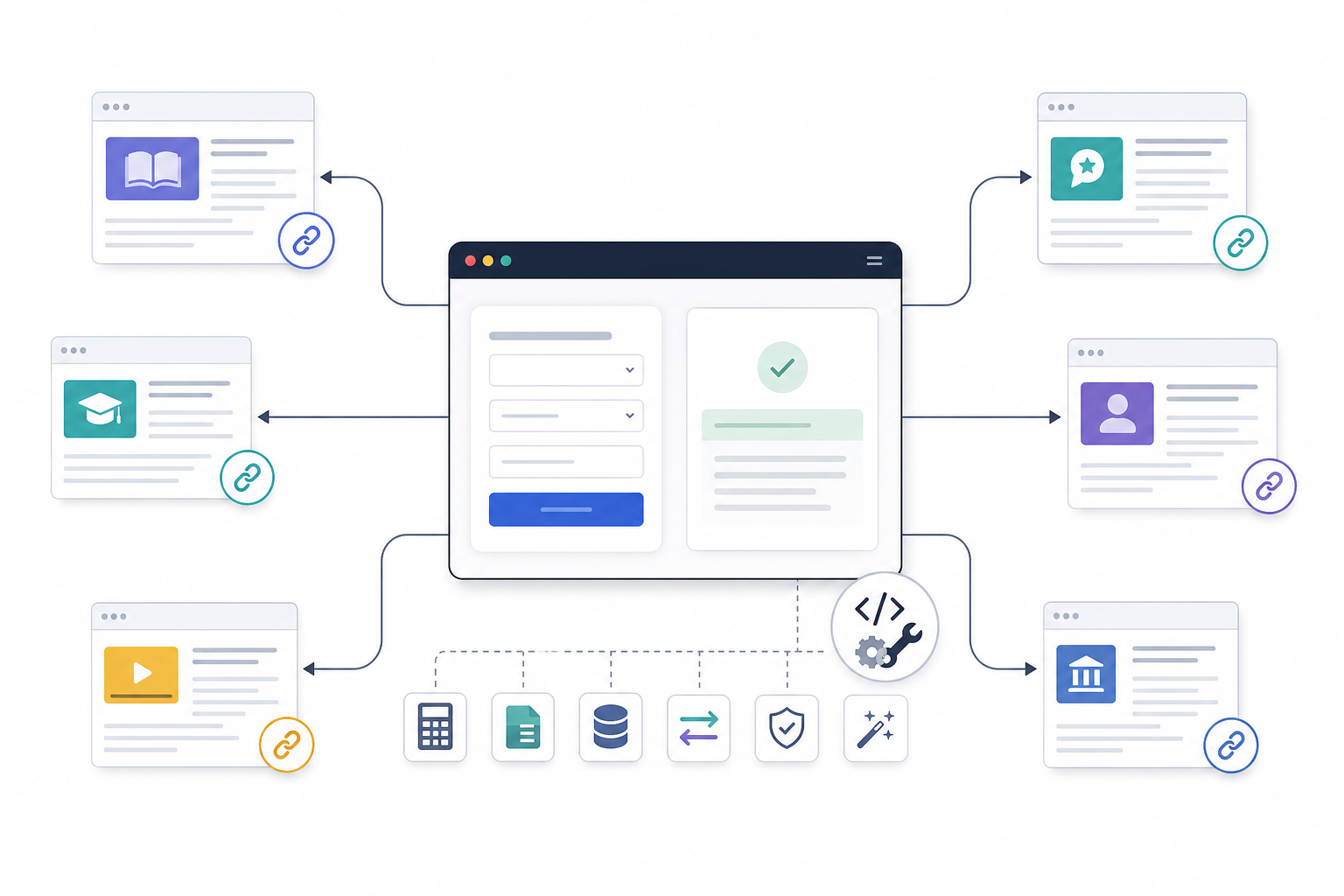
Tool-based link building uses a functional resource such as a calculator, generator, checker, database, template builder, or interactive utility to create a reason for external websites to recommend it.
Useful tools solve a recurring user task.
Examples include:
- Mortgage calculators
- ROI calculators
- Schema generators
- Salary databases
- Unit converters
- Audit tools
- Templates
The tool can earn links from guides, resource pages, tutorials, reviews, educational sites, and professional publications.
Best fit: companies with development capability and a problem that can be solved through a useful repeatable utility.
Main limitation: building a tool requires development and maintenance, and a generic tool with no differentiation can struggle to attract references.
Example: A SaaS company launches a free email-signature generator that small-business guides recommend to their readers.
Tool-based link building differs from content-led link building because functionality is the main reference value.
24. Visual Asset Link Building
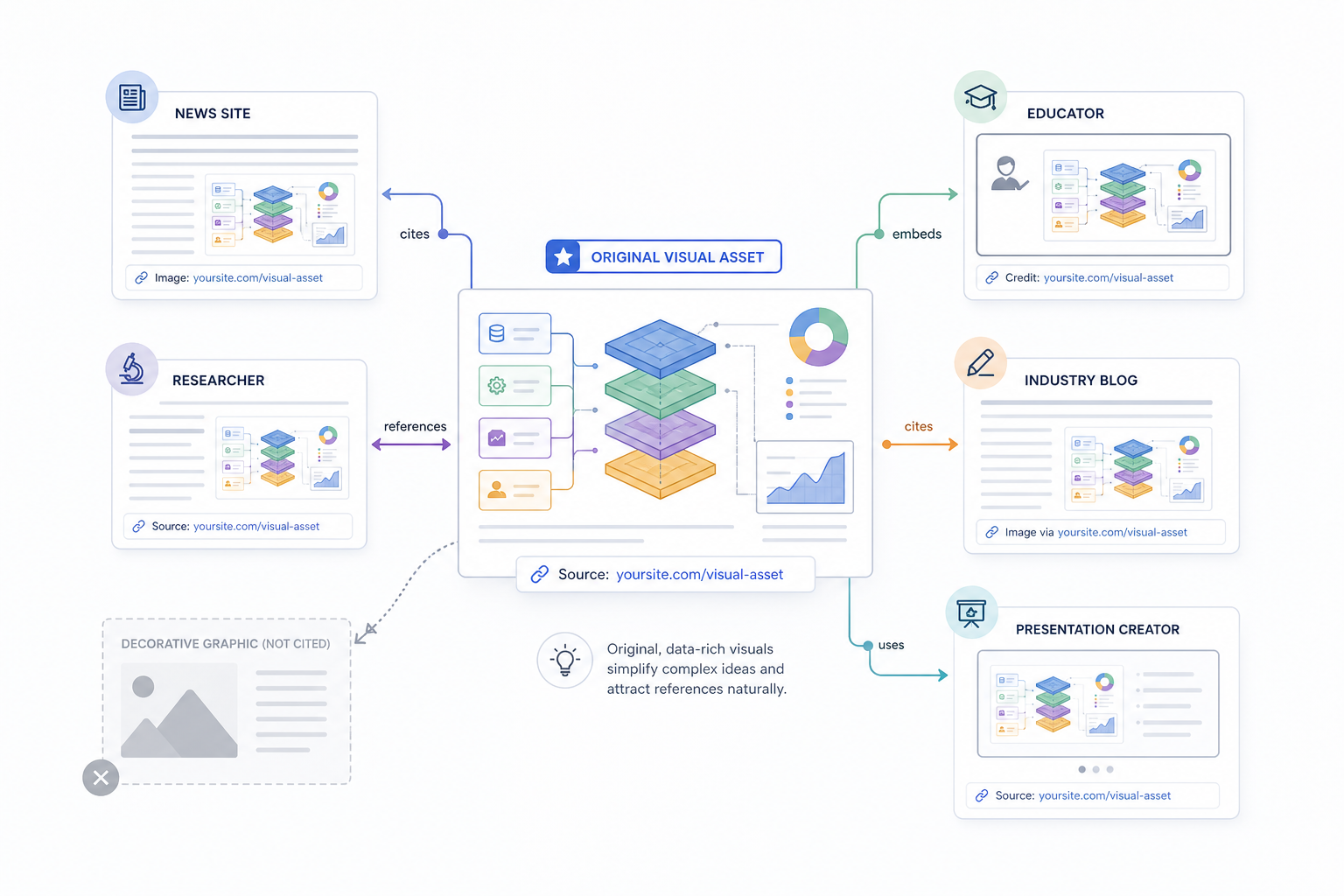
Visual asset link building uses original graphics, diagrams, charts, maps, illustrations, infographics, or data visualizations as resources other websites can cite, embed, explain, or reference.
Strong visual assets simplify information that is otherwise difficult to understand. A strong visual can therefore function as a linkable asset when its data, explanation, or originality gives other publishers a genuine reason to reference the source.
External sources can include:
- Publishers
- Educators
- Researchers
- Industry blogs
- News websites
- Presentation creators
The image or graphic should have a clear original source so publishers can attribute it accurately.
Best fit: data-heavy topics, technical explanations, process visualization, comparisons, and subjects where a diagram provides genuine explanatory value.
Main limitation: decorative graphics rarely create strong citation demand.
Example: A cloud-security company creates an original diagram explaining a complex zero-trust architecture, and technology publications reference it when explaining the model.
Visual asset link building differs from image attribution links because the former describes creating and promoting visual assets, while image attribution describes the backlink received when another source reuses one.
25. Case Study Link Building
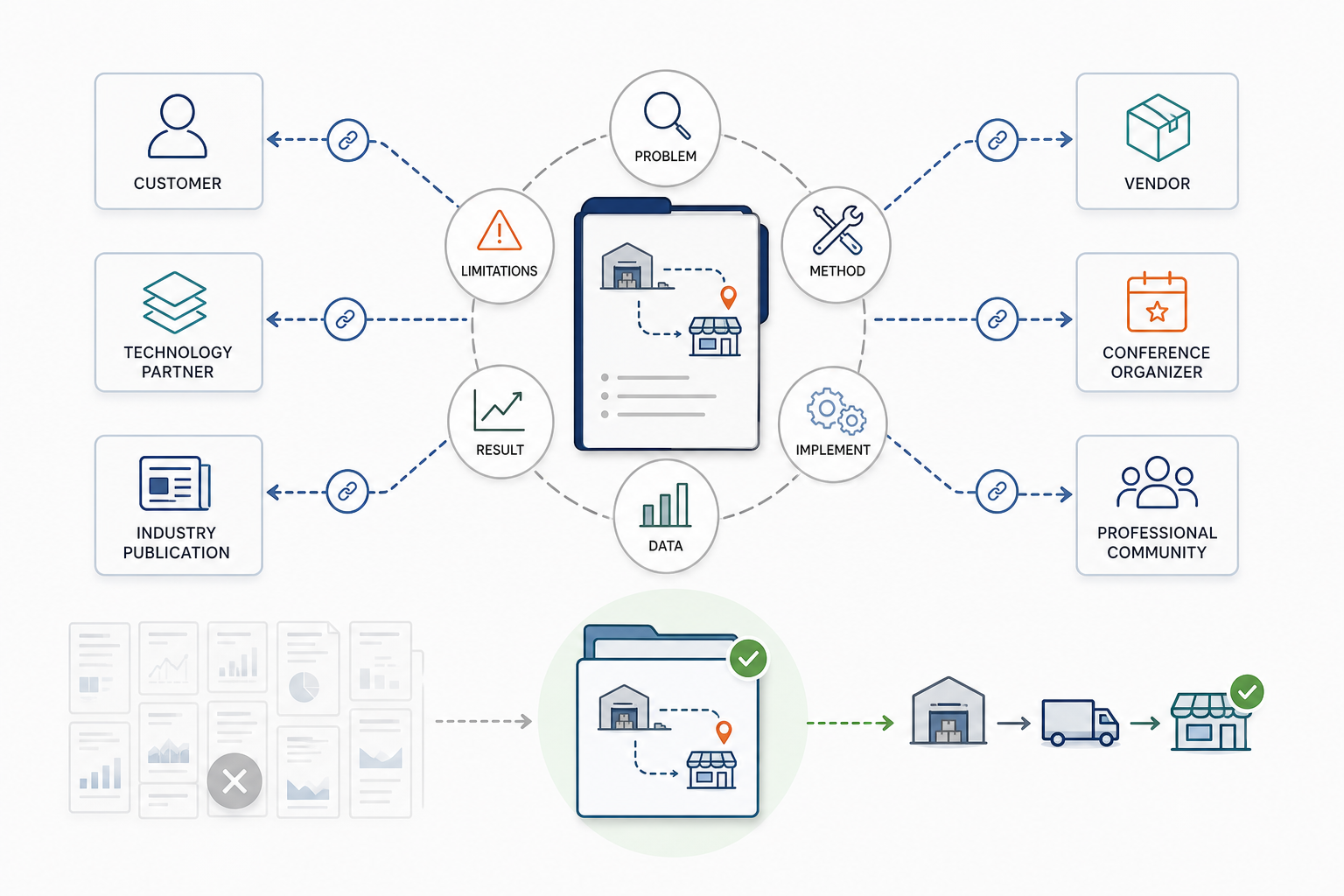
Case study link building uses a documented real-world project, implementation, experiment, or customer outcome as evidence that external organizations have a reason to reference.
A useful case study can include:
- Problem
- Method
- Implementation
- Data
- Result
- Limitations
Potential sources include customers, technology partners, industry publications, vendors, conference organizers, and professional communities.
Best fit: companies with measurable customer outcomes, noteworthy implementations, unusual projects, or collaborative work.
Main limitation: promotional stories without verifiable evidence provide limited reference value.
Example: A logistics company documents how a retailer reduced average delivery time by a measured amount, and the retailer references the joint case study from its own operations page.
Case study link building differs from statistics link building because the evidence is centered on one documented situation rather than a broader dataset.
26. Podcast and Interview Links
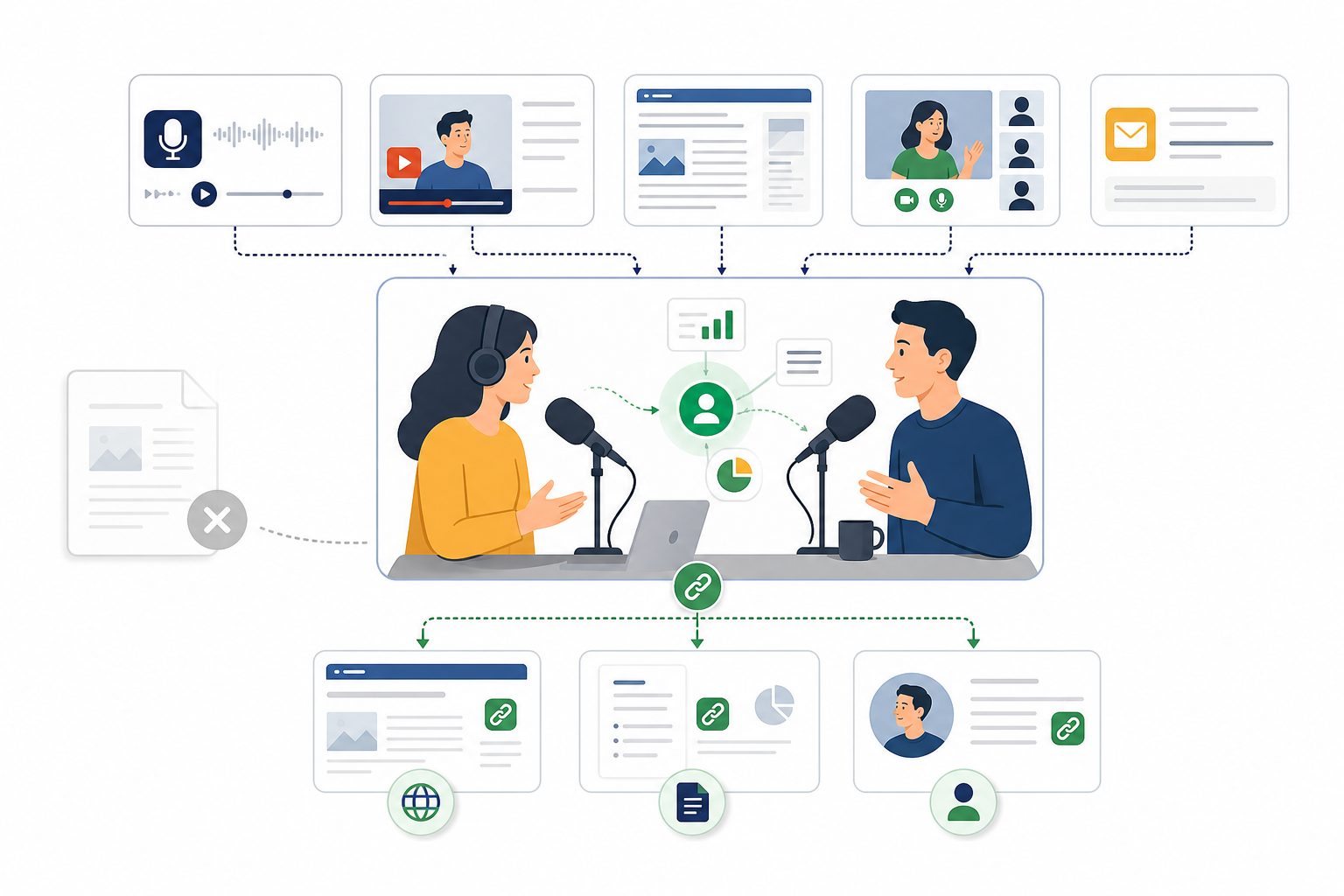
Podcast and interview links occur when an expert, executive, founder, researcher, or practitioner participates in an external interview and the host or publisher links to the guest or supporting resources.
Potential sources include:
- Podcasts
- YouTube interviews
- Industry publications
- Expert Q&As
- Webinars
- Newsletter interviews
The primary value is the guest’s contribution to the discussion. Links commonly appear in show notes, guest profiles, episode descriptions, or supporting resources.
Best fit: businesses with experts who can provide distinct knowledge, experience, stories, or analysis.
Main limitation: appearance volume does not guarantee relevant audiences or strong referral value.
Example: A CRO specialist appears on an ecommerce podcast, and the show notes link to the specialist’s original checkout benchmark study.
Podcast and interview links differ from guest contributions because the format is conversational or interview-led rather than a contributed article.
27. Community Link Building

Community link building develops legitimate external references through meaningful participation in professional, technical, local, industry, or interest-based communities.
Relevant environments include:
- Open-source projects
- Professional groups
- Industry communities
- Local organizations
- Technical communities
- Member ecosystems
The reference should arise because a contribution, project, resource, business, or participant is genuinely relevant to the community.
Best fit: businesses already participating in real ecosystems where knowledge sharing or collaboration matters.
Main limitation: dropping links into forums, comments, or communities without genuine participation is spam rather than community link building.
Example: A developer contributes documentation to an open-source project, and the project references a useful compatibility tool maintained by the developer’s company.
Community link building differs from user-generated references because the company or its representative actively participates in the community relationship.
28. Social Distribution for Link Earning
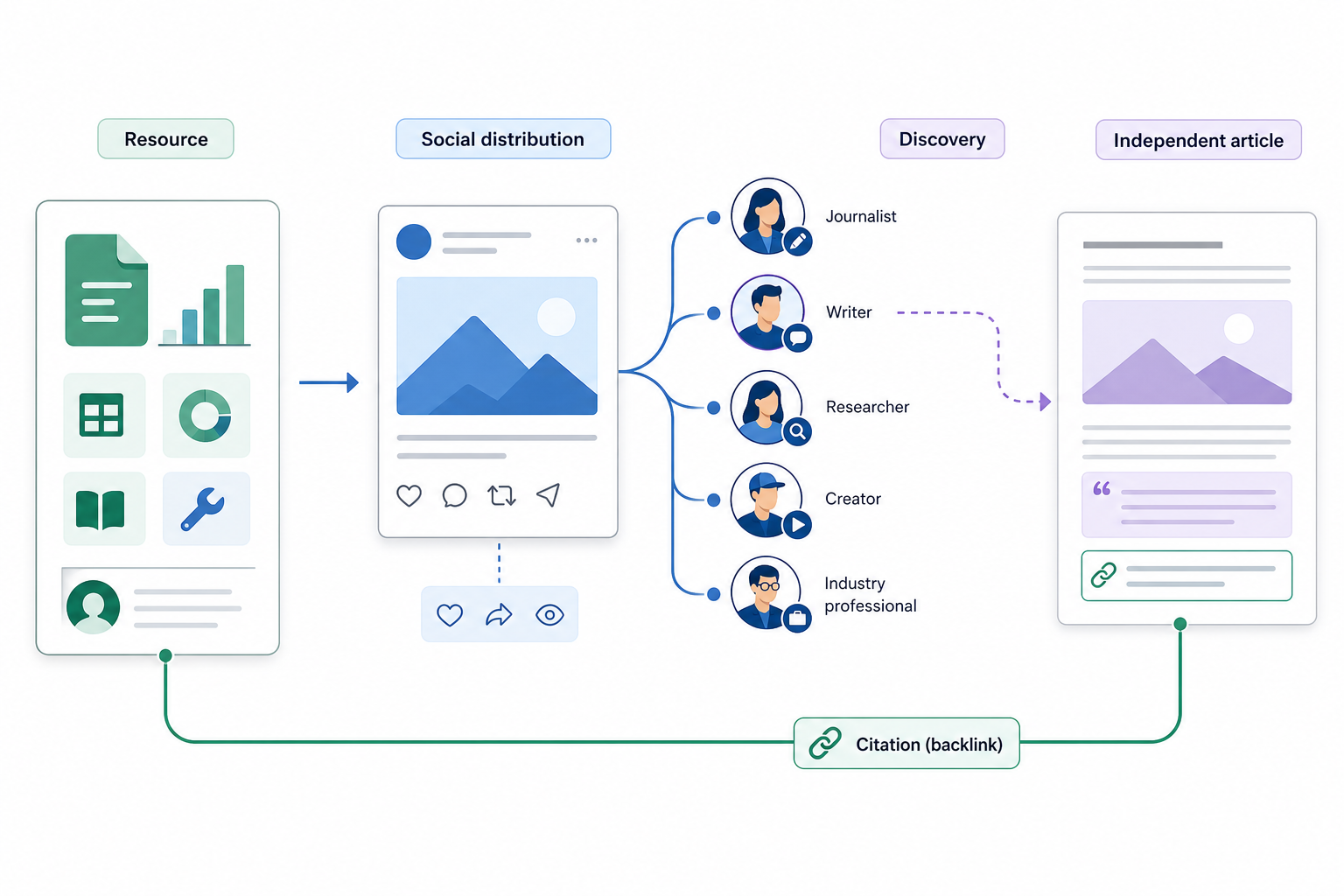
Social distribution for link earning uses social platforms to expose a useful resource to journalists, writers, researchers, creators, customers, or other people who may later reference it independently.
The social post itself is not necessarily the SEO backlink.
Distribution can increase discovery of:
- Research
- Data
- Tools
- Visualizations
- Guides
- News
- Expert commentary
The eventual backlink can come from a separate publication whose writer discovered the resource through social media.
Best fit: resources with strong audience relevance and businesses with access to active professional or industry networks.
Main limitation: likes, shares, and impressions do not automatically translate into backlinks.
Example: A researcher shares a new industry dataset on LinkedIn. A journalist discovers it through the post and later cites the original study in an article.
Social distribution differs from user-generated references because distribution is primarily a discovery mechanism rather than the external citation itself.
29. User-Generated References
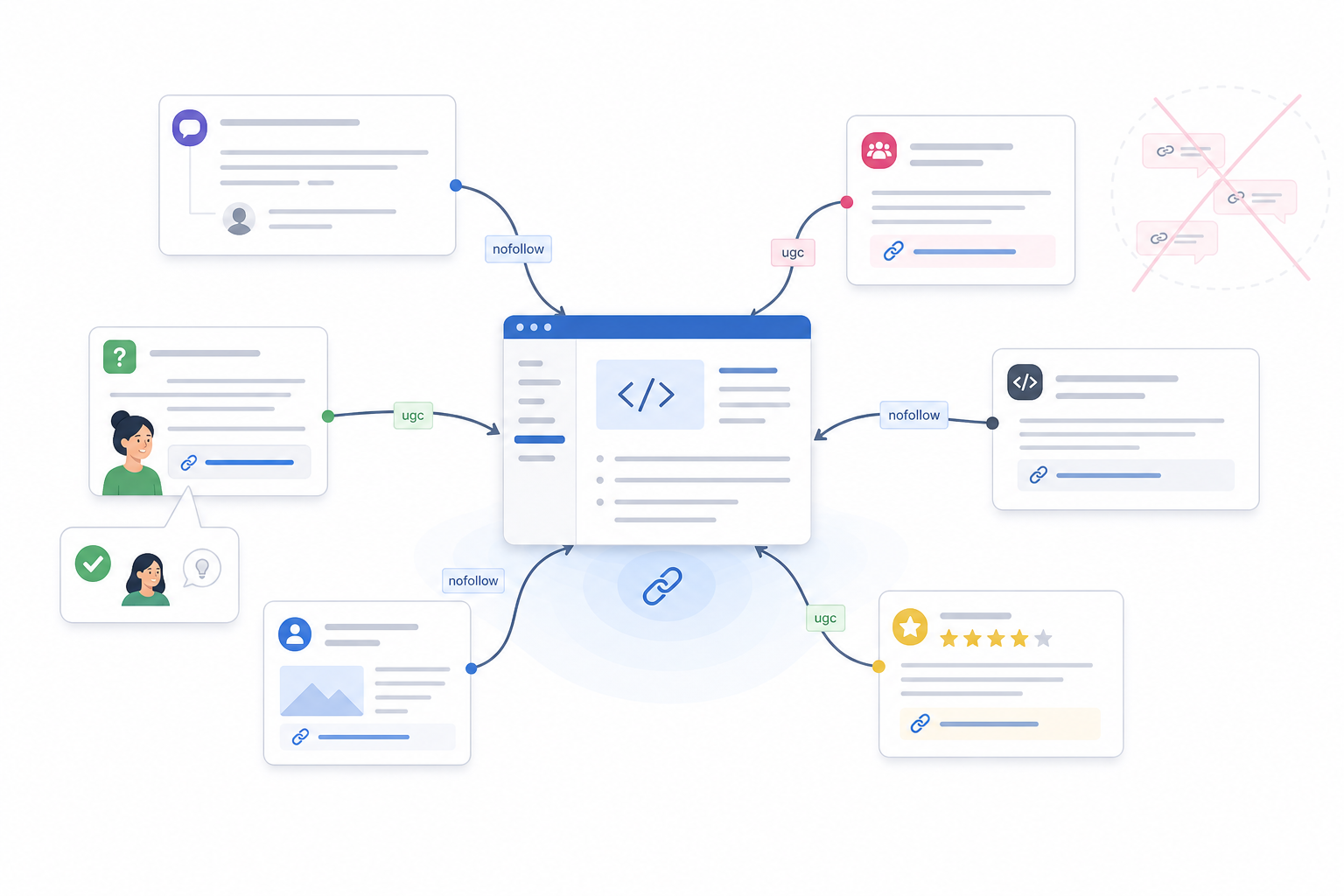
User-generated references occur when customers, community members, developers, contributors, forum participants, or other users independently link to a relevant resource within content they create.
Potential environments include:
- Forums
- Community posts
- User profiles
- Q&A platforms
- Open-source discussions
- Customer websites
- Reviews where links are permitted
The reference should genuinely help the user’s audience.
Search engines and platforms can apply attributes such as ugc or nofollow to these links. That does not remove their potential referral, discovery, or audience value.
Best fit: useful products, tools, documentation, research, communities, and resources people naturally discuss.
Main limitation: manufacturing forum posts, comments, or fake user activity solely to create backlinks is manipulative and often prohibited by platform policies.
Example: A developer answering a technical question on a community platform links to official API documentation because it directly answers the problem.
User-generated references differ from community link building because the reference is independently created by a user rather than developed through the company’s direct community participation.
30. Image Attribution Links
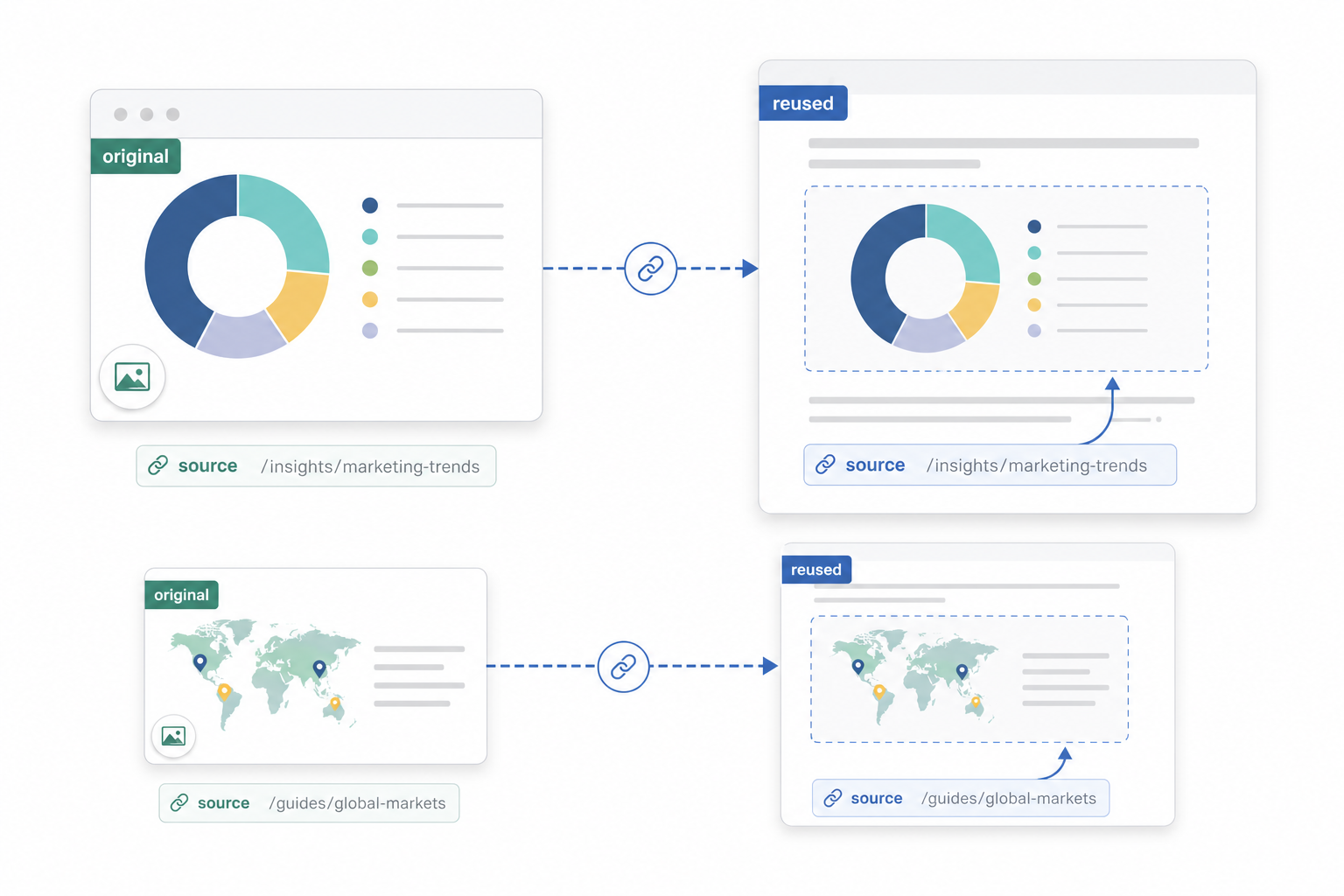
Image attribution links occur when another website reuses an original image, chart, diagram, photograph, or visualization and links back to the original creator as the source or credit.
Common assets include:
- Charts
- Infographics
- Diagrams
- Original photography
- Maps
- Data visualizations
The source link exists because attribution helps identify where the visual originated.
Best fit: organizations that publish distinctive, reusable visual material.
Main limitation: many websites can reuse an image without attribution, and legal ownership does not automatically mean a backlink is required in every reuse context.
Example: A marketing publication embeds an original conversion-rate chart and links to the company’s underlying research as its source.
Image attribution links differ from visual asset link building because attribution describes the resulting link after an asset is reused.
31. Research Citation Links
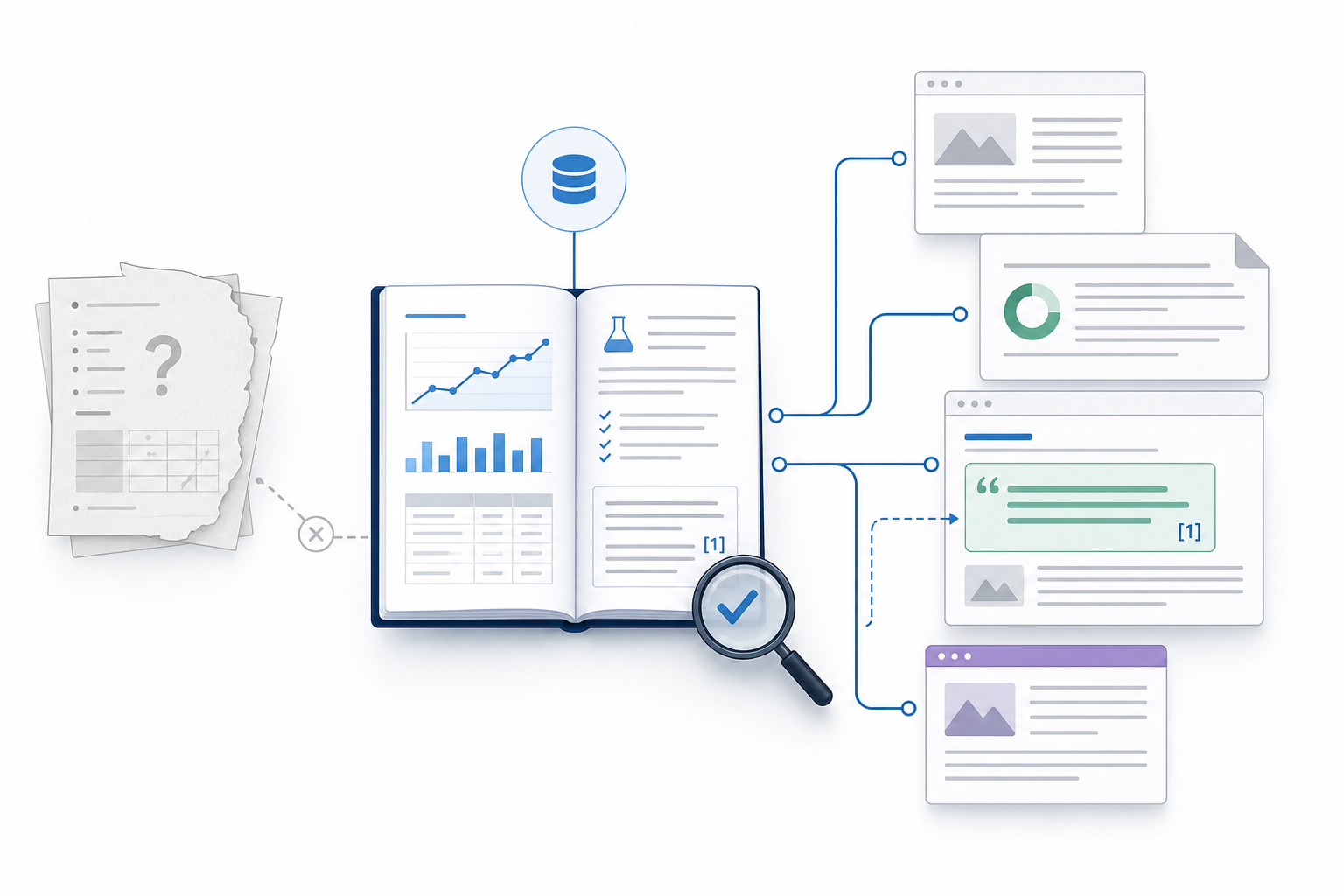
Research citation links occur when an external author, journalist, analyst, researcher, or publisher links to the original source of evidence used in its own work.
Common destinations include:
- Research papers
- Surveys
- Experiments
- Industry reports
- Datasets
- Benchmarks
- Methodology pages
The reference reason is evidential. The publisher wants readers to verify, inspect, or learn more about the underlying research.
Best fit: organizations producing original, transparent, and relevant research.
Main limitation: poor methodology, unclear sampling, unsupported conclusions, or missing source information reduce citation value.
Example: A financial publication discusses SaaS churn trends and links to the original dataset behind the statistic it quotes.
Research citation links differ from statistics and data link building because research citation describes why the external publisher links, while data link building describes how the target creates citation-worthy assets.
32. Product or Service Recommendation Links
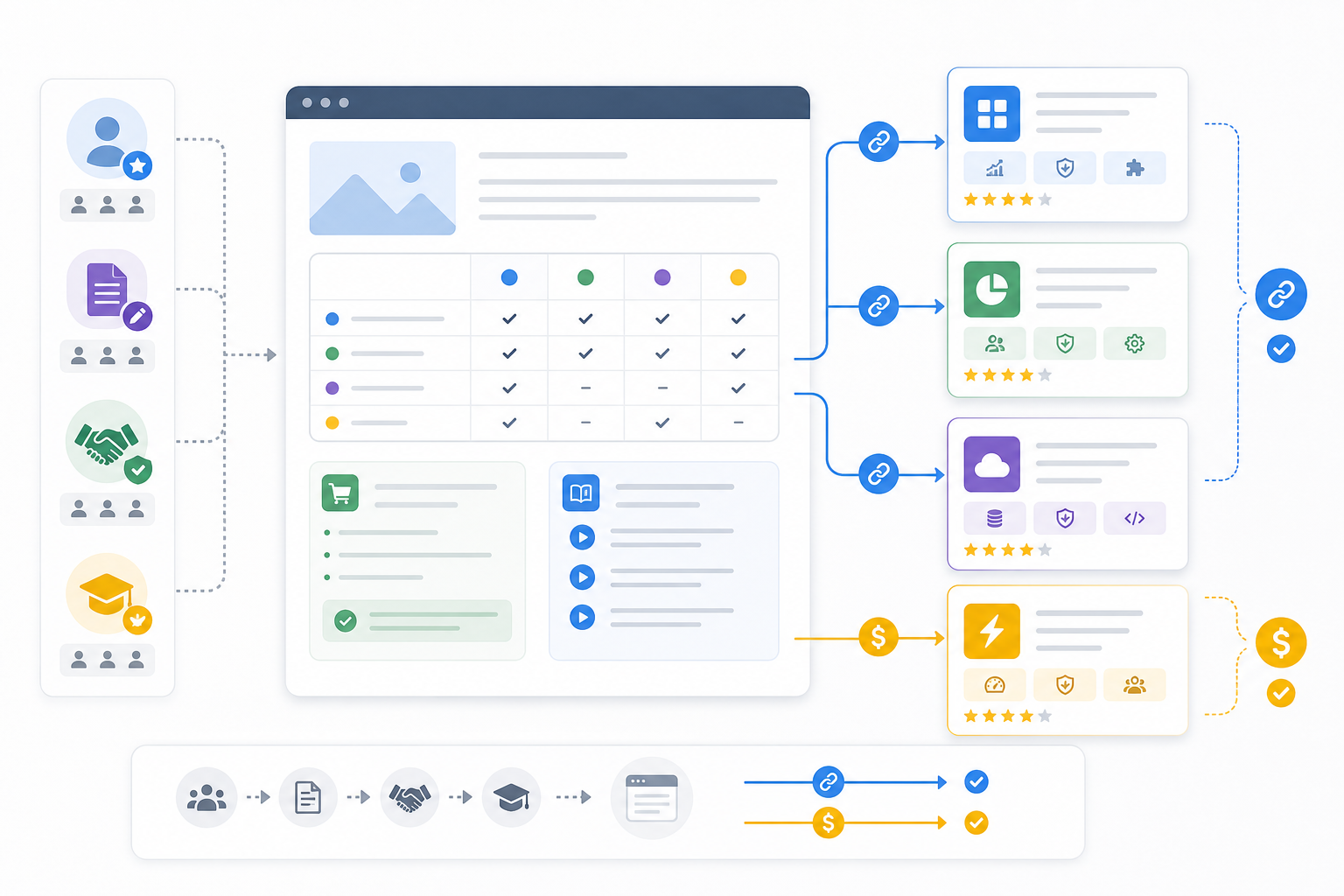
Product or service recommendation links occur when a publisher, reviewer, customer, partner, or specialist references a product or service because it is relevant to a recommendation, comparison, tutorial, resource list, or buying decision.
Common sources include:
- Product reviews
- Comparison articles
- Buying guides
- Industry resources
- Partner pages
- Tutorials
Commercial pages can receive legitimate backlinks when the product itself is the useful destination.
Best fit: products and services with clear use cases, differentiation, active customers, integrations, reviews, or industry recognition.
Main limitation: recommendation links can be editorial, affiliate, sponsored, or commercially influenced, so the relationship should be represented accurately.
Example: A video-production publication compares several editing platforms and links directly to each product being reviewed.
Product recommendation links differ from affiliate links because an independent recommendation does not necessarily involve commission.
33. Affiliate Links
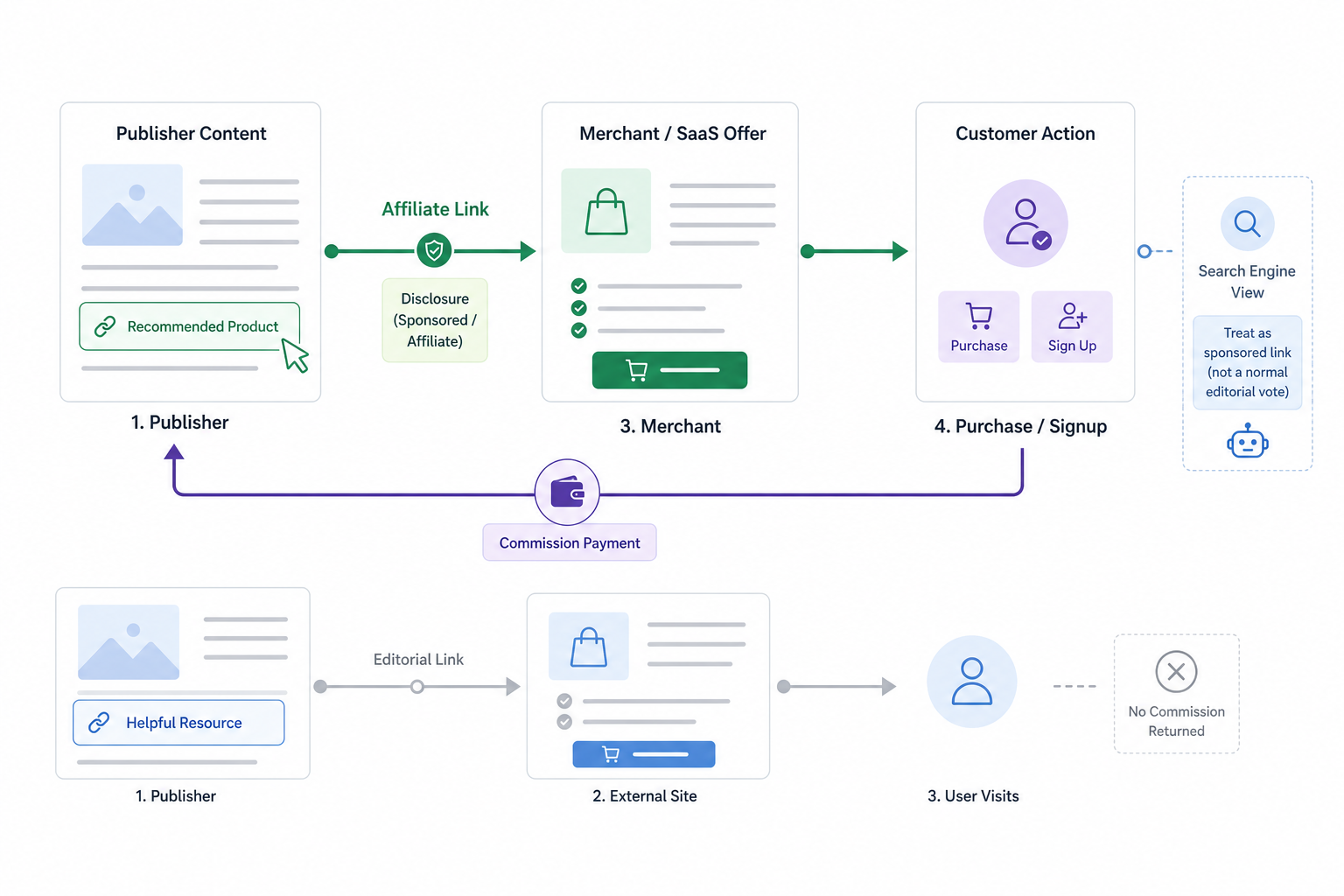
Affiliate links are commercially influenced hyperlinks through which a publisher can receive compensation, usually when a referred user completes an action such as a purchase, signup, or subscription.
Typical sources include:
- Review websites
- Comparison publications
- Creators
- Newsletters
- Buying guides
- Affiliate partners
Affiliate links primarily support distribution, referral traffic, and customer acquisition.
Because compensation influences the relationship, appropriate disclosure and search-engine qualification can be required.
Best fit: products or services with formal affiliate programs and measurable referral economics.
Main limitation: an affiliate link should not be presented as an independent editorial backlink simply because it appears inside an article.
Example: A software comparison website links to a CRM through its affiliate program and earns commission on qualifying purchases.
Affiliate links differ from ordinary recommendation links because compensation is explicitly tied to referral performance.
34. Sponsored Links
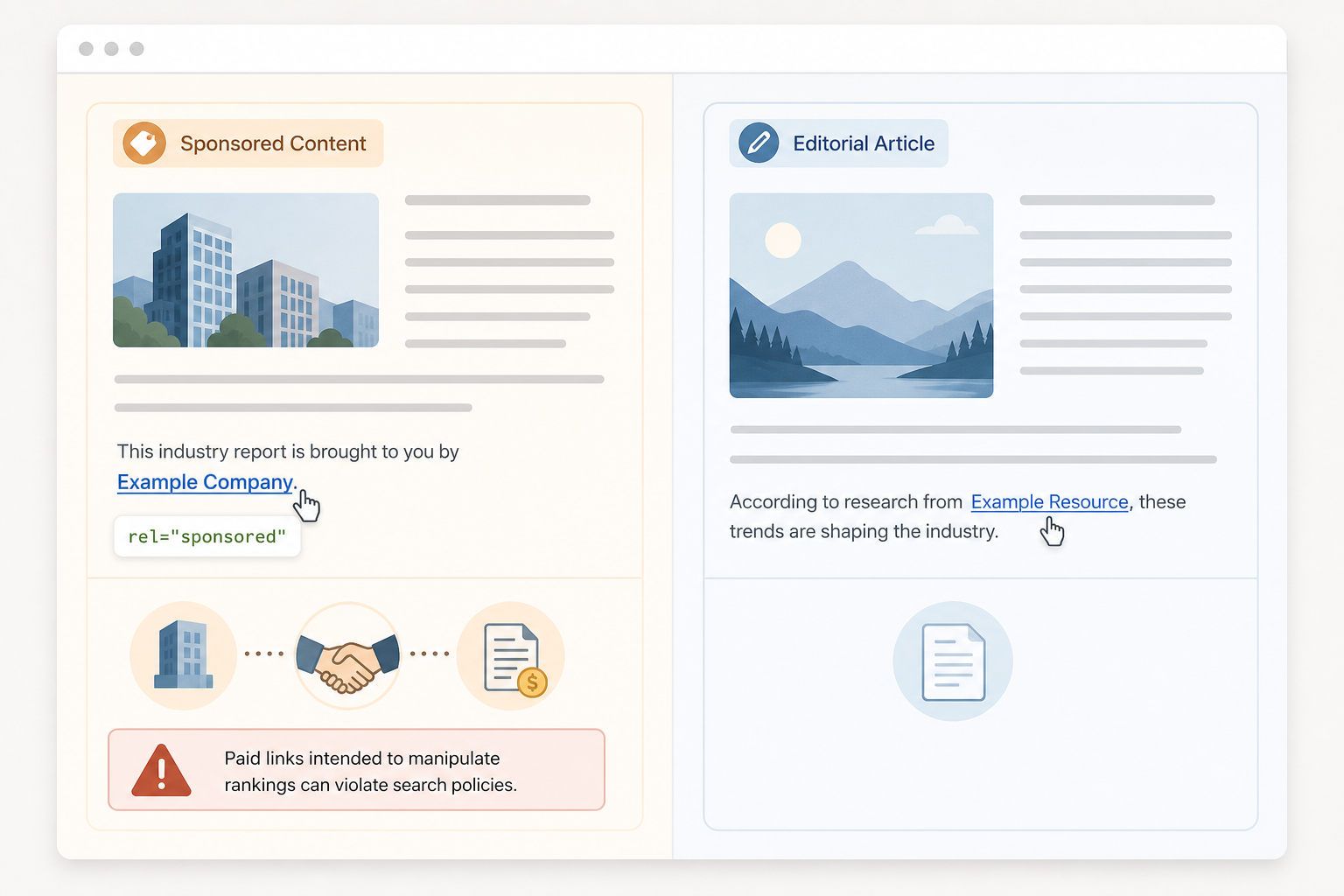
Sponsored links are hyperlinks placed within a compensated advertising, sponsorship, paid-content, or other commercial arrangement.
They can appear in:
- Sponsored articles
- Advertorials
- Paid partnerships
- Sponsorship pages
- Promotional features
- Commercial content
Their legitimate value can include referral traffic, audience exposure, brand discovery, and customer acquisition.
Paid relationships should not be represented as independent editorial endorsements. Search engines provide rel="sponsored" for links created as part of advertising or compensated placements.
Best fit: legitimate advertising, media, sponsorship, and commercial distribution campaigns.
Main limitation: purchasing links primarily to manipulate ranking systems creates search-policy risk.
Example: A company sponsors a publisher’s industry report, which includes a clearly disclosed sponsor reference to the company.
Sponsored links differ from sponsorship link building because “sponsored link” describes the commercial status of the hyperlink itself, while sponsorship link building describes a broader relationship that can create several types of references.
35. Citation or Reference Links
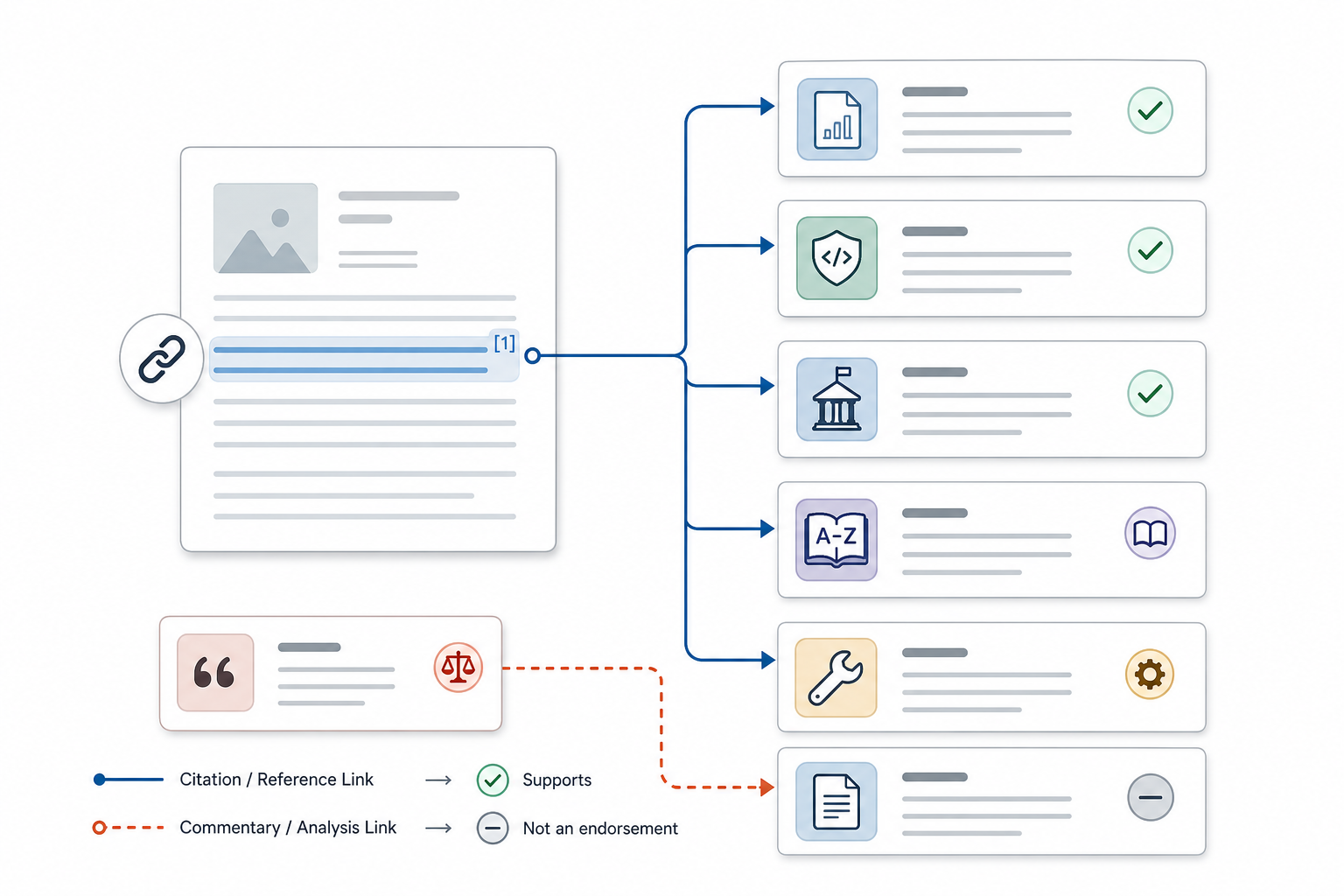
Citation or reference links occur when an external webpage links to another resource to identify its source, support a claim, provide evidence, define a term, attribute information, or give readers additional material.
Typical destinations include:
- Original documentation
- Research
- Statistics
- Definitions
- Government sources
- Product documentation
- Technical specifications
- Primary-source statements
The source links because the destination improves sourcing or understanding.
Best fit: authoritative reference resources, original evidence, documentation, research, and definitions.
Main limitation: a citation does not automatically mean endorsement. Sources can be cited for criticism, comparison, attribution, or factual verification.
Example: A technical article explaining a browser API links to the official specification so readers can verify the implementation details.
Citation links overlap with research citations and editorial links but are broader because the reference can support any relevant factual or explanatory purpose.
Which Types of Links Matter for SEO?
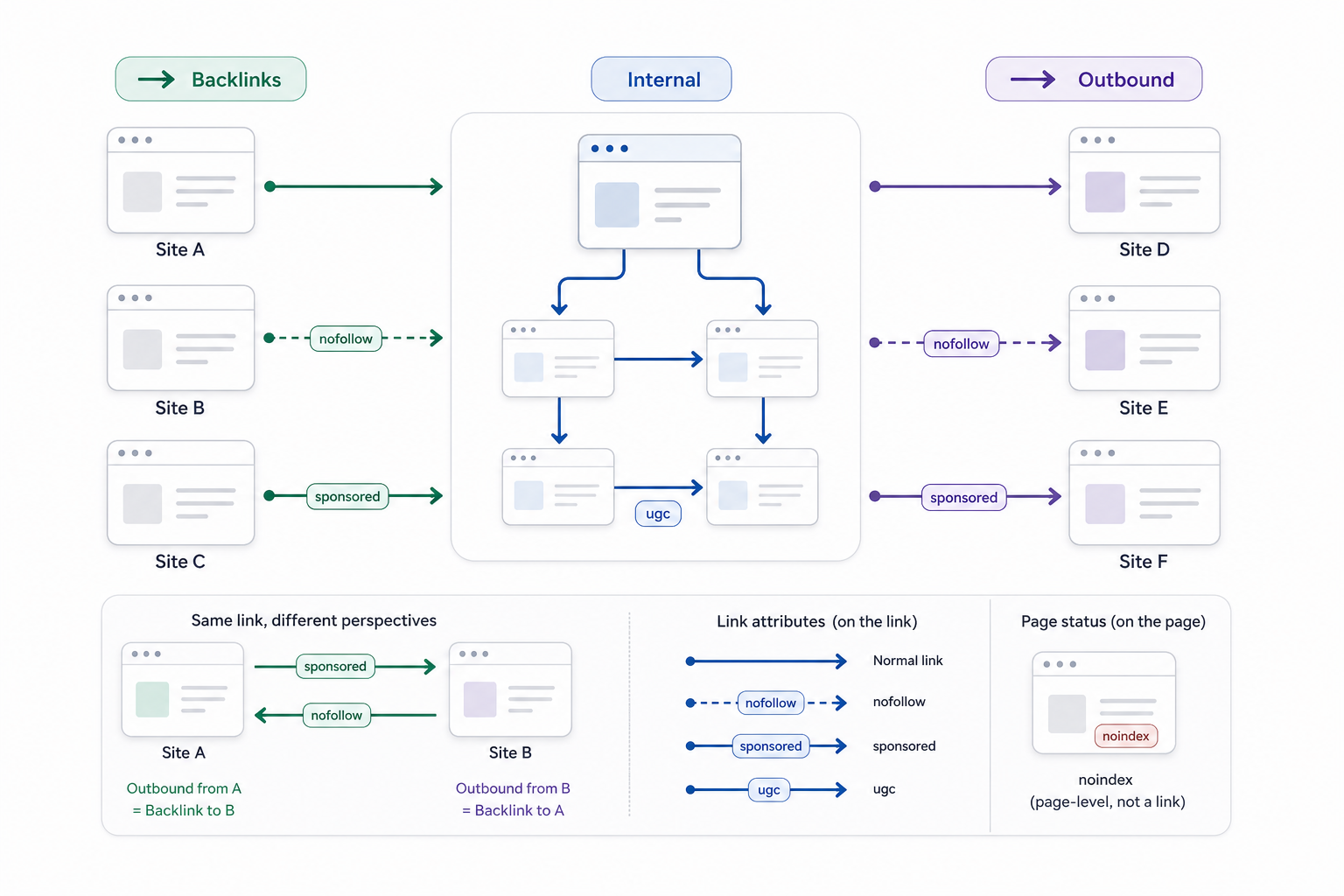
The principal structural types of links in SEO are backlinks or inbound links, internal links, and outbound links. The distinction is based on where the hyperlink originates and where it points, while attributes such as nofollow, sponsored, or ugc describe an additional property of the link rather than a separate direction.
| Link Type | Direction | Main SEO Function | User Function | Key Limitation |
|---|---|---|---|---|
| Backlink / Inbound Link | External website to your website | External discovery, contextual relationships, link-based search signals | Moves users from another site to yours | Not every backlink is relevant or beneficial |
| Internal Link | One page to another page on the same website | Discovery, hierarchy, page relationships, internal navigation | Helps users explore related resources | Does not replace external recognition |
| Outbound Link | Your website to another website | External sourcing, context, attribution, reference | Helps users reach supporting information | Linking to a famous domain does not automatically improve rankings |
Backlinks or Inbound Links
A backlink is a hyperlink from an external domain to a page on the website being evaluated.
Its possible functions include:
- External page discovery
- Referral traffic
- Contextual relationships
- Link-based ranking signals
- Audience discovery
The same external domain can create one backlink or many backlinks. Backlink count and referring-domain count are therefore different measurements.
Internal Links
Internal links connect pages within the same website.
They can help:
- Users navigate related pages
- Crawlers discover URLs
- Communicate hierarchy
- Connect parent and supporting topics
- Provide anchor context
- Distribute internal link signals
Contextual internal links appear within page content, while structural internal links can appear in menus, breadcrumbs, footers, sidebars, and other navigation components.
Internal links can improve discovery and architecture, but they do not guarantee indexation or rankings.
Outbound Links
Outbound links connect a page on the website being evaluated with a different domain.
Useful reasons for outbound linking include:
- Citing original evidence
- Attributing data
- Referencing documentation
- Identifying a product or company
- Directing readers to supporting information
- Providing additional resources
Linking to a high-authority website does not automatically increase the linking page’s ranking.
The same hyperlink can also be described differently depending on perspective. A link from Website A to Website B is an outbound link for Website A and a backlink for Website B.
How Do Follow and Nofollow Links Differ?
A standard or “follow” link is an ordinary hyperlink without a rel="nofollow" qualification, while a nofollow link contains rel="nofollow" to provide search engines with additional information about the relationship. “Dofollow” is an SEO-industry term; there is no rel="dofollow" HTML attribute.
| Characteristic | Standard / Follow Link | Nofollow Link |
|---|---|---|
| HTML | Normal <a href> hyperlink | Contains rel="nofollow" |
| Default Status | Ordinary hyperlink | Explicitly qualified |
| Search Treatment | Can be considered normally within link-based systems | Qualification provides additional guidance to search engines |
| Referral Traffic | Clickable | Clickable |
| User Navigation | Works normally | Works normally |
| Ranking Role | Can participate normally where relevant and legitimate | Should not be treated as identical to an ordinary editorial link |
| Typical Use | Normal references, citations, navigation | Relationships a publisher wants to qualify |
A nofollow link is not automatically worthless. It can still generate referral traffic, audience discovery, citations, customer acquisition, and brand exposure.
Likewise, a followed backlink is not automatically valuable. It can still be irrelevant, artificial, manipulative, or poorly placed.
Other relationship attributes include:
rel="sponsored", which can be appropriate for advertising, sponsorship, affiliate, or other compensated relationships.
rel="ugc", which can be appropriate for user-generated content such as forum posts and comments.
Link attributes should not be confused with link direction. A backlink can be standard, nofollowed, sponsored, or user-generated depending on the context.
They should also not be confused with noindex. Nofollow concerns a hyperlink relationship; noindex concerns whether a page should appear in search results.
Why Do Different Types of Links Matter for SEO?
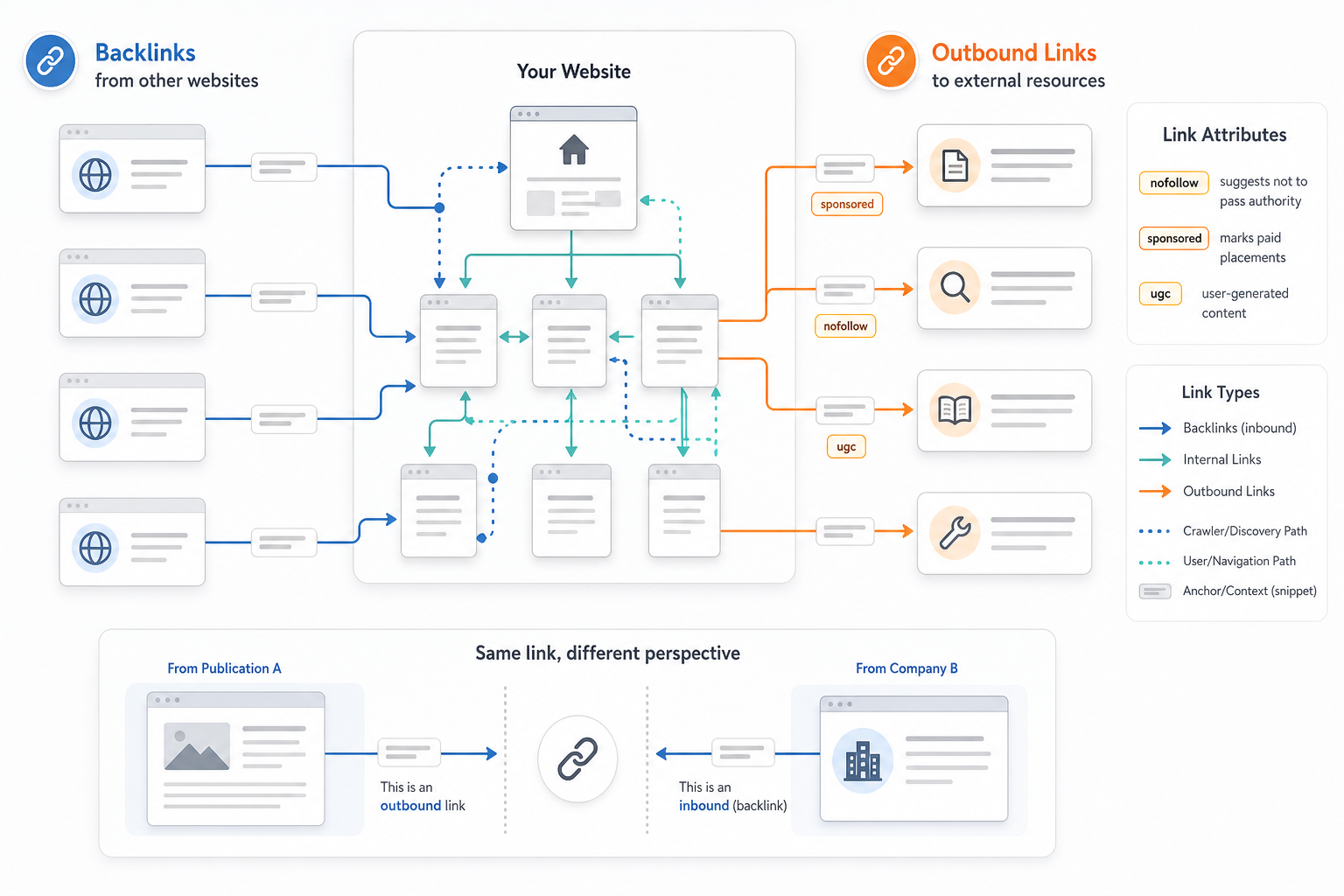
Different link types matter because they connect webpages in different ways and therefore support different search and user functions, including discovery, navigation, website structure, external referencing, sourcing, context, and referral traffic. Backlinks, internal links, and outbound links solve different problems rather than forming a universal best-to-worst hierarchy.
Why Backlinks Matter
Backlinks connect independent websites.
They can:
- Create external relationships between webpages
- Expose destination URLs to crawlers
- Contribute to link-based ranking systems
- Add contextual information around a destination
- Send referral visitors
Their possible search value depends on attributes such as relevance, source legitimacy, editorial reason, destination fit, surrounding context, anchor wording, and link qualification.
Backlinks do not replace useful content, search-intent alignment, technical accessibility, or internal architecture.
Why Internal Links Matter
Internal links organize relationships inside one website.
They can:
- Help crawlers find pages
- Help users navigate
- Connect parent and supporting resources
- Communicate hierarchy
- Provide anchor context
- Distribute internal link signals
A page with no meaningful internal paths can be harder for users and crawlers to discover.
Internal links do not automatically create “topical authority,” and adding more internal links does not guarantee better rankings.
Why Outbound Links Matter
Outbound links connect a website with independent external information.
They can help a page:
- Cite original evidence
- Attribute facts
- Identify external entities
- Reference documentation
- Provide further reading
- Direct users to useful tools or resources
Their principal purpose is usefulness, sourcing, and external context rather than manipulating rankings.
Why Link Direction Matters
The direction determines the relationship.
Inbound links represent connections coming from the external web.
Internal links represent connections within the website.
Outbound links represent connections from the website to external resources.
The same hyperlink can play more than one role depending on perspective. If Publication A links to Company B, Publication A has created an outbound link while Company B has received a backlink.
Why Link Attributes Matter
Attributes such as nofollow, sponsored, and ugc can provide additional information about an individual hyperlink relationship.
The direction and attribute answer different questions:
Direction identifies where the hyperlink connects.
Attribute qualifies the nature of that relationship.
Why Acquisition Method Matters
The 35 link-building methods in this guide describe how or why a backlink arises.
A digital PR backlink, broken-link replacement, research citation, partnership link, and affiliate link are all inbound links from the receiving website’s perspective, but their editorial reasons, acquisition mechanisms, levels of control, commercial contexts, and user purposes differ.
Understanding those differences allows link building to be evaluated according to why the link exists and what function it performs, rather than treating every backlink as an identical unit of SEO value.
Need links on real SaaS and business websites?
Links are placed after your approval, on sites with guaranteed DR and traffic, with a 1-year replacement guarantee.

