
SEO Audit: Importance, Scope, Process, Reporting & Services
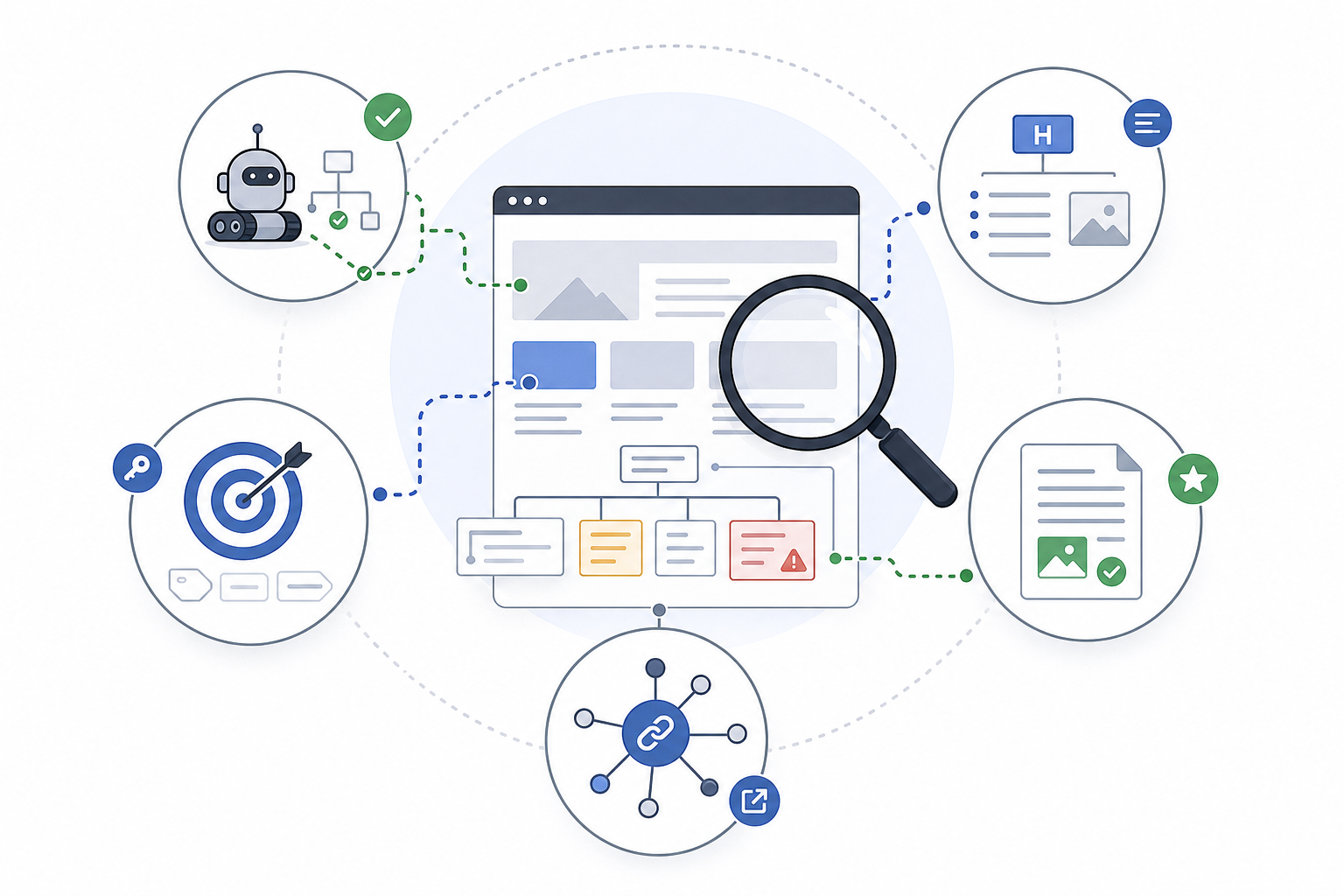
An SEO audit is a systematic evaluation of a website that identifies issues and opportunities affecting organic search visibility, accessibility, relevance, content quality, and authority. It diagnoses the current SEO condition of a website and identifies the factors supporting or restricting its search performance.
An audit does not improve rankings by itself. It provides evidence about what is happening across the website, why important pages or sections perform the way they do, and which problems deserve attention.
Weak organic performance rarely comes from one isolated factor. Search engines first require access to a website, then require clear page-level information, relevant targeting, useful content, and sufficient competitive authority. Problems at any of these levels can restrict visibility.
A complete SEO audit therefore examines several areas:
- Technical accessibility
- On-page optimization
- Keyword targeting
- Content quality
- External authority
The objective is not to create the longest possible list of SEO warnings. A useful audit separates material problems from minor observations and identifies which findings have the greatest effect on important pages, search visibility, traffic, conversions, or business objectives.
SEO audits also provide a baseline for future work. When the current condition of the website is documented, later changes in rankings, traffic, indexation, content performance, and authority can be evaluated against a known starting point.
The value of an SEO audit starts with understanding why this diagnosis matters.
Why Is an SEO Audit Important?
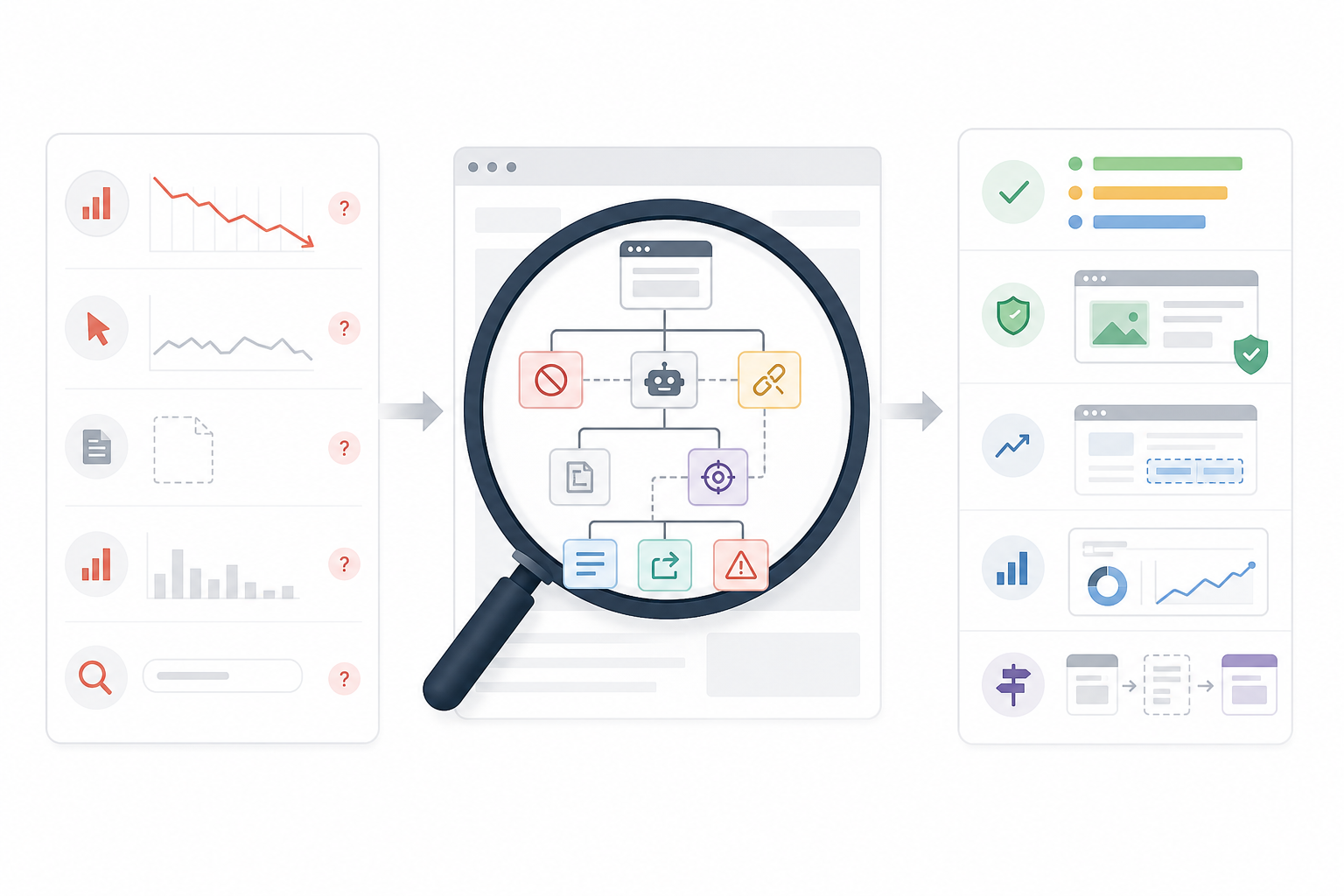
An SEO audit is important because it identifies the underlying causes of weak or constrained organic search performance and shows which issues or opportunities deserve attention first.
The main benefits include:
- Diagnose search-performance problems
- An audit replaces assumptions with evidence.
- It helps explain why important pages lose rankings, attract fewer clicks, fail to enter the index, or generate less organic traffic than expected.
- It connects visible performance changes with the website conditions associated with them.
- Reveal hidden constraints
- Rankings and traffic data show outcomes, but they do not always explain the cause.
- Deeper analysis can expose problems involving crawl access, indexation, internal linking, targeting, content quality, or authority that basic performance reports do not reveal.
- Protect existing organic visibility
- Audits identify issues that place valuable pages, rankings, backlinks, or indexed content at risk.
- Early detection reduces the chance that technical changes, content removal, redirect mistakes, or structural problems create wider losses.
- Identify growth opportunities
- Existing pages can have unrealized potential.
- An audit can expose pages with partial rankings, weak internal support, incomplete content, missed keyword coverage, or limited external authority.
- These findings provide clearer areas for organic growth than publishing content without diagnosis.
- Improve prioritization
- Not every SEO issue has the same impact.
- An audit distinguishes critical blockers from medium-value improvements and minor observations.
- SEO resources can then focus on work with stronger relevance to performance and business goals.
- Establish a performance baseline
- Audit findings document the current state of the website.
- That baseline makes later changes easier to evaluate.
- Teams can compare future crawling, rankings, traffic, conversions, content performance, and authority against the original findings.
- Support major SEO decisions
- Audits provide evidence before migrations, redesigns, platform changes, large content initiatives, domain changes, and structural updates.
- The analysis identifies important pages, existing risks, and areas that require protection during the change.
An audit creates value only when validated findings lead to appropriate action. The audit itself is the diagnostic layer; implementation creates the performance change.
Producing that diagnosis requires examining the major components of the website that influence organic search.
What Does an SEO Audit Include?
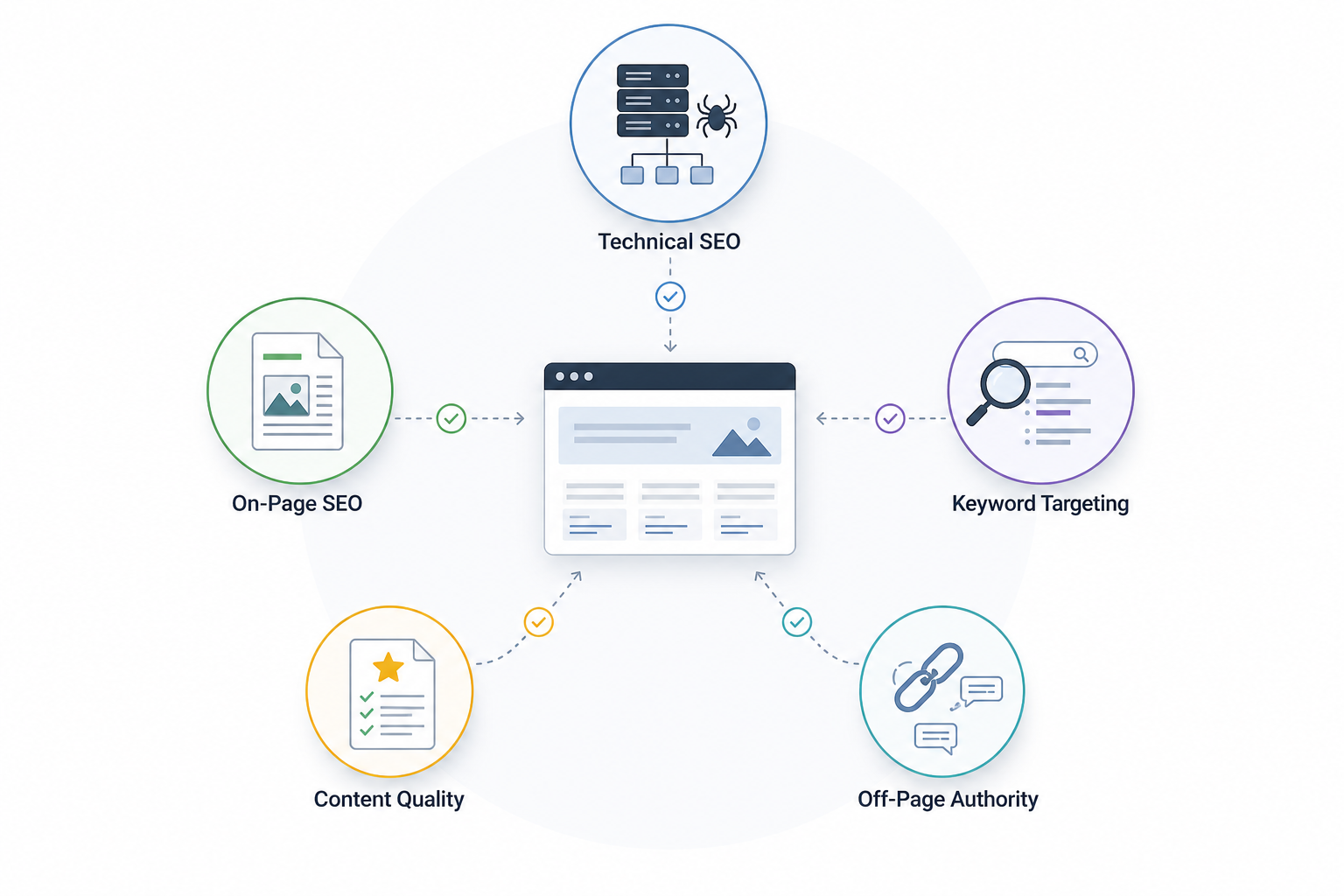
A complete SEO audit evaluates the website layers that influence search-engine access, page relevance, keyword targeting, content usefulness, and external authority.
The primary audit areas are:
- Technical SEO: Evaluates whether search engines can discover, crawl, render, understand, and index the website.
- On-page SEO: Evaluates whether individual pages communicate their topic, purpose, hierarchy, and relationships clearly.
- Keyword targeting: Evaluates whether relevant queries are assigned to suitable pages and whether current visibility aligns with search intent and business goals.
- Content quality: Evaluates whether pages remain accurate, useful, complete, differentiated, and strategically valuable.
- Off-page authority: Evaluates the links, referring domains, mentions, and external authority supporting the website.
Each area answers a different diagnostic question. A page can contain excellent content and still fail because search engines cannot access it. A technically healthy page can remain weak when it targets the wrong intent. A relevant page can struggle against competitors with stronger authority.
A useful SEO audit checklist therefore covers the complete set of relevant SEO layers without mixing their responsibilities.
What Does a Technical SEO Audit Cover?
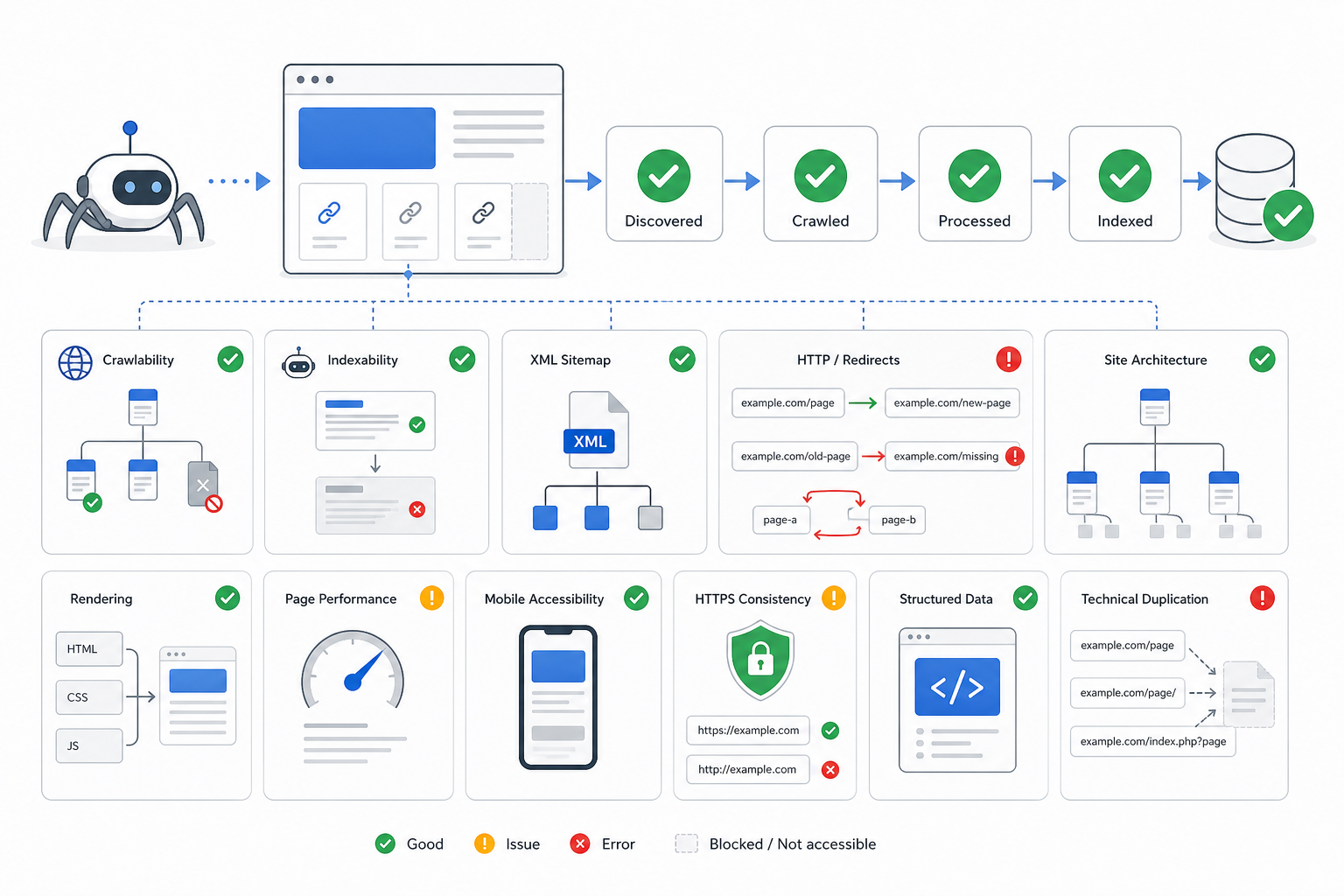
A technical SEO audit checks whether search engines can reliably discover, crawl, render, understand, and index a website.
The audit provides the diagnostic layer of broader Technical SEO, identifying technical conditions that can restrict search-engine access, processing, and organic visibility.
Important technical checks include:
- Crawlability
- Review robots.txt directives.
- Check access restrictions.
- Identify blocked resources.
- Review crawl paths.
- Check server accessibility.
- Confirm that important URLs remain reachable to search-engine crawlers.
- Indexability
- Review noindex directives.
- Check canonicalization.
- Identify duplicate URL states.
- Confirm that important pages remain eligible for indexing.
- Investigate pages excluded from the index when exclusion conflicts with the site strategy.
- XML sitemaps
- Confirm that sitemaps are accessible.
- Review whether they contain the intended canonical URLs.
- Remove inappropriate redirected, duplicate, blocked, or non-indexable URLs.
- Check whether sitemap information reflects the active website structure.
- HTTP responses and redirects
- Identify broken URLs.
- Review server errors.
- Find redirect chains.
- Detect redirect loops.
- Check unnecessary redirects.
- Confirm that important URLs return the intended response.
- Technical site architecture
- Review URL hierarchy.
- Examine click depth.
- Identify technically orphaned pages.
- Check whether important sections remain reachable through crawlable links.
- Review navigation structures that affect crawler access.
- Rendering
- Confirm that important text and links remain available when JavaScript or client-side rendering is involved.
- Check whether dynamic elements appear correctly after rendering.
- Identify important content that exists in the interface but remains unavailable to search engines.
- Page performance
- Review loading performance.
- Examine Core Web Vitals where they affect important page groups.
- Identify template-level performance problems.
- Separate isolated performance warnings from widespread issues affecting user experience.
- Mobile accessibility
- Confirm that important content appears on mobile.
- Review navigation and interactive elements.
- Check whether mobile users can access the same essential information and functionality.
- HTTPS and protocol consistency
- Identify insecure resources.
- Review mixed-content problems.
- Check inconsistent HTTP and HTTPS versions.
- Confirm that protocol redirects resolve consistently.
- Structured data
- Validate relevant schema markup.
- Confirm that structured data represents visible page content accurately.
- Identify invalid, misleading, or incomplete implementations.
- Technical duplication
- Review URL parameters.
- Check canonical variants.
- Identify protocol or trailing-slash inconsistencies.
- Review faceted navigation.
- Detect other technical patterns that create unnecessary duplicate URLs.
A technical audit focuses on access and processing. Content quality, keyword targeting, backlink quality, and contextual relevance belong to separate audit layers.
Once search engines can reliably access and process the website, the next question is whether individual pages clearly communicate what they represent.
What Does an On-Page SEO Audit Cover?
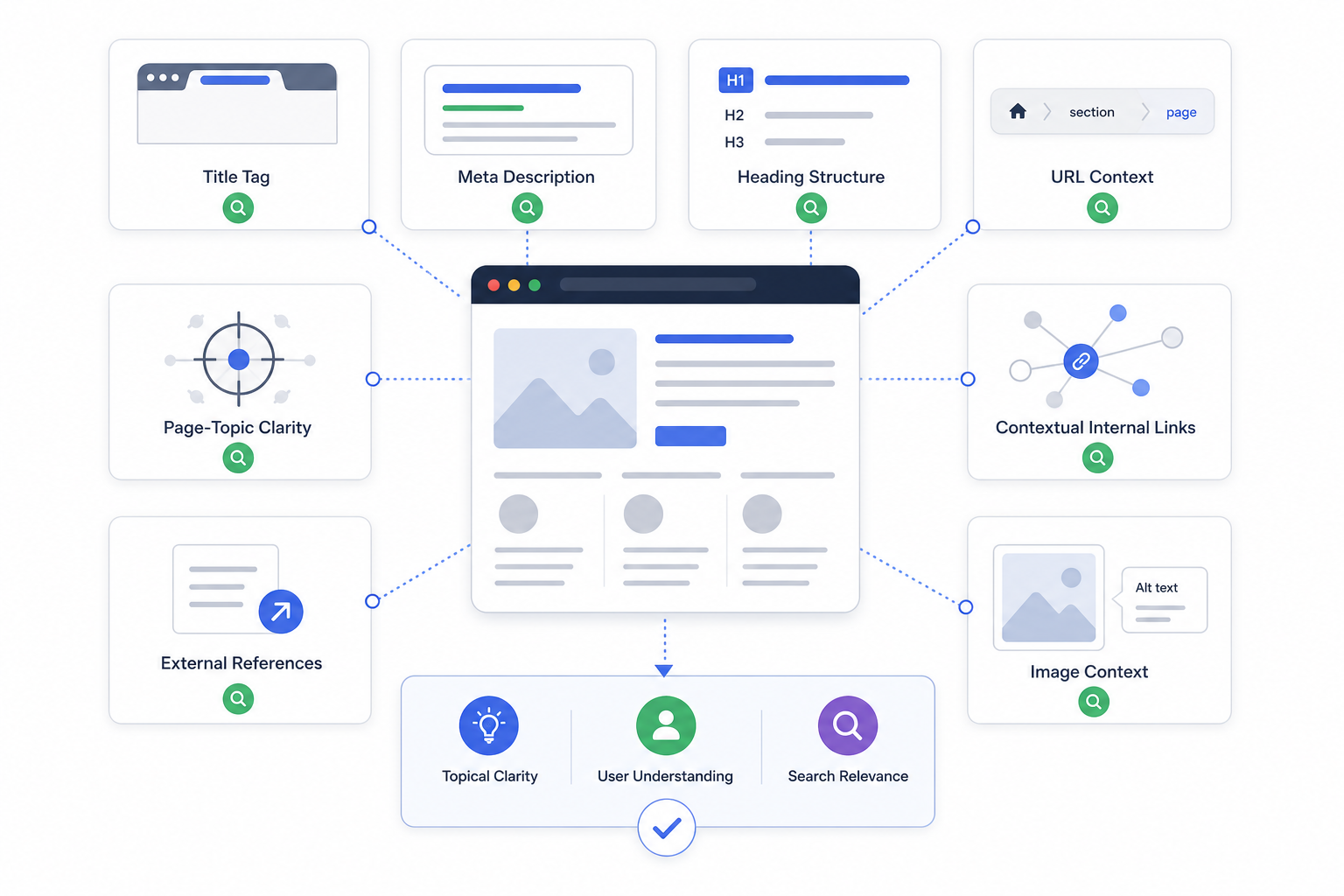
An on-page SEO audit evaluates the page-level elements and contextual signals that communicate a page’s topic, hierarchy, purpose, and relevance.
This audit evaluates the existing implementation of on-page SEO to identify where page-level signals strengthen or weaken topical clarity and search relevance.
The main checks include:
- Title tags
- Review uniqueness.
- Check topical accuracy.
- Confirm that the title represents the actual page.
- Identify duplicated, misleading, or unclear titles.
- Meta descriptions
- Review relevance and clarity.
- Check whether descriptions accurately represent page content.
- Identify unnecessary duplication across important pages.
- Heading structure
- Review the relationship between H1, H2, and H3 headings.
- Confirm that the H1 establishes the central topic.
- Check whether supporting headings organize the subject logically.
- Identify headings that introduce unrelated or repetitive information.
- URL context
- Review whether URLs are descriptive and stable.
- Check whether page paths reflect logical website organization.
- Identify confusing or unnecessarily complex URL patterns.
- Page-topic clarity
- Confirm that the central subject remains clear throughout the page.
- Review whether supporting attributes reinforce the topic.
- Identify sections that dilute or contradict the intended purpose.
- Contextual internal links
- Review whether related pages link to appropriate destinations.
- Check anchor text for descriptive relevance.
- Examine the surrounding context of important links.
- Identify pages that lack meaningful internal support.
- External references
- Check whether external sources remain functional.
- Review whether references support claims where evidence matters.
- Remove or replace irrelevant or outdated references.
- Image context
- Review descriptive alt attributes.
- Confirm that important images support the surrounding information.
- Identify images whose context or accessibility remains unclear.
An on-page SEO audit does not rely on rigid universal rules for title length, heading counts, or keyword frequency. The objective is to determine whether page elements strengthen topical clarity, user understanding, and search-result relevance.
After evaluating page-level relevance, the next task is checking whether the website targets the correct search demand.
What Is a Keyword Audit?
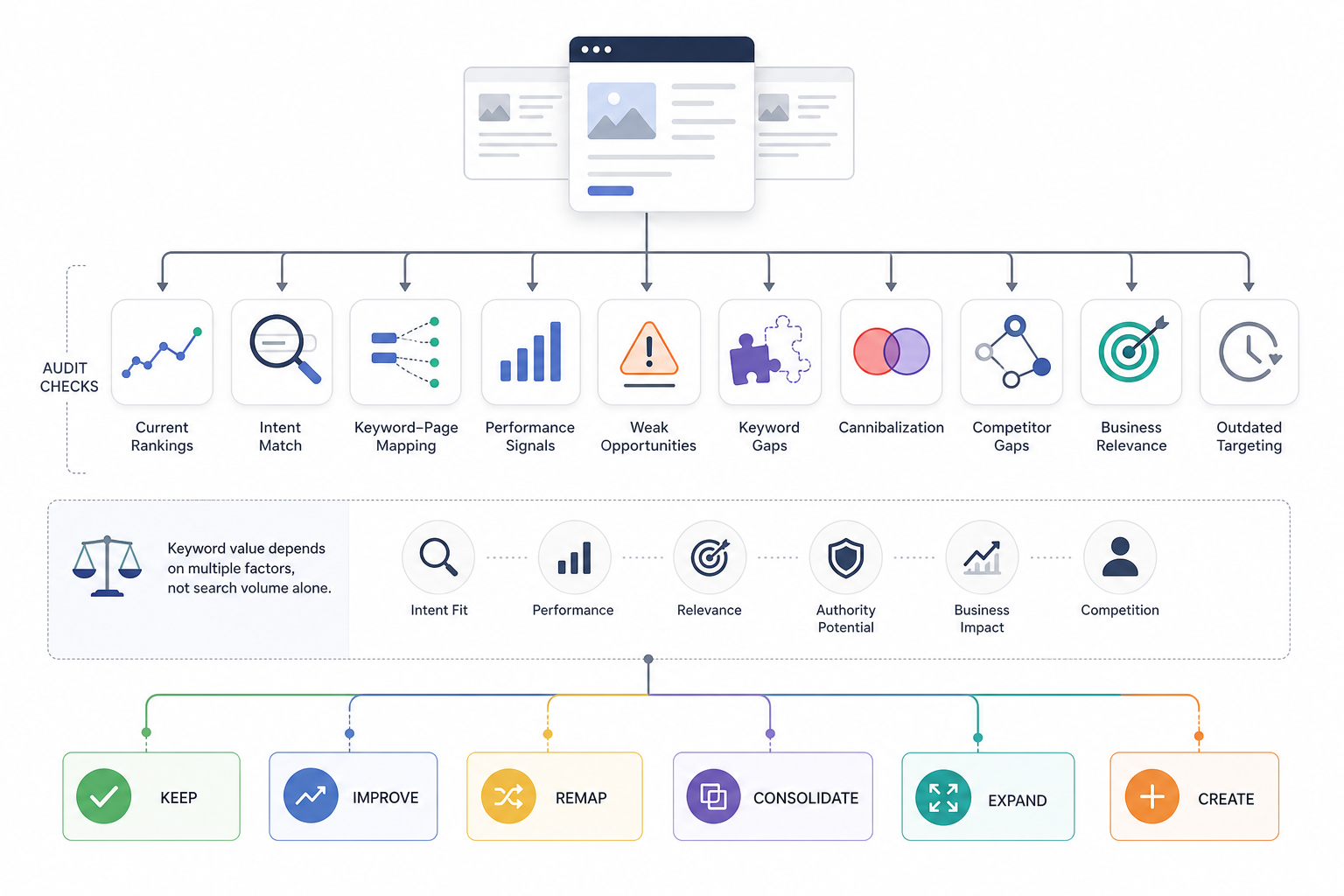
A keyword audit is an evaluation of how effectively a website’s existing keyword targeting supports rankings, organic traffic, search intent, and business goals.
Keyword research discovers new opportunities. A keyword audit evaluates the targeting and performance already present across the website.
The main checks include:
- Check current rankings
- Identify the queries each important page currently ranks for.
- Review where visibility remains strong, weak, growing, or declining.
- Distinguish valuable rankings from unrelated search visibility.
- Check search intent
- Confirm that each page satisfies the purpose behind its target queries.
- Identify pages targeting informational terms with commercial content or commercial terms with purely informational content.
- Check keyword-to-page mapping
- Verify that important keyword groups connect with the most relevant URLs.
- Confirm that each important page has a clear targeting role.
- Identify queries assigned to pages that no longer represent the subject accurately.
- Check keyword performance
- Review impressions.
- Analyze clicks.
- Evaluate rankings.
- Compare organic traffic.
- Review conversions where reliable first-party data exists.
- Check weak opportunities
- Find terms where the website already has partial visibility.
- Identify queries ranking below their realistic potential.
- Determine whether stronger page relevance or content can improve existing visibility.
- Check keyword gaps
- Identify relevant queries the website does not currently target.
- Review long-tail searches.
- Find missing topic areas and audience questions.
- Check keyword cannibalization
- Identify multiple URLs competing for substantially the same query or intent.
- Determine whether separate pages serve genuinely different purposes.
- Consolidate or differentiate pages when unnecessary overlap exists.
- Check competitor gaps
- Compare relevant search competitors.
- Identify valuable terms where competitors have stronger visibility.
- Filter opportunities according to relevance and business value.
- Check business relevance
- Remove or deprioritize keywords that generate visibility without supporting the website’s audience, products, services, or goals.
- Check outdated targeting
- Identify keyword targets that no longer reflect current offerings, audience language, or search behavior.
Keyword value does not come from search volume alone. Intent, relevance, current visibility, ranking feasibility, traffic potential, and business value all contribute to the decision.
Keyword audit findings commonly lead to actions such as keep, improve, remap, consolidate, expand, or create.
Keyword issues also reveal whether the underlying pages still contain the right information.
What Is an SEO Content Audit?
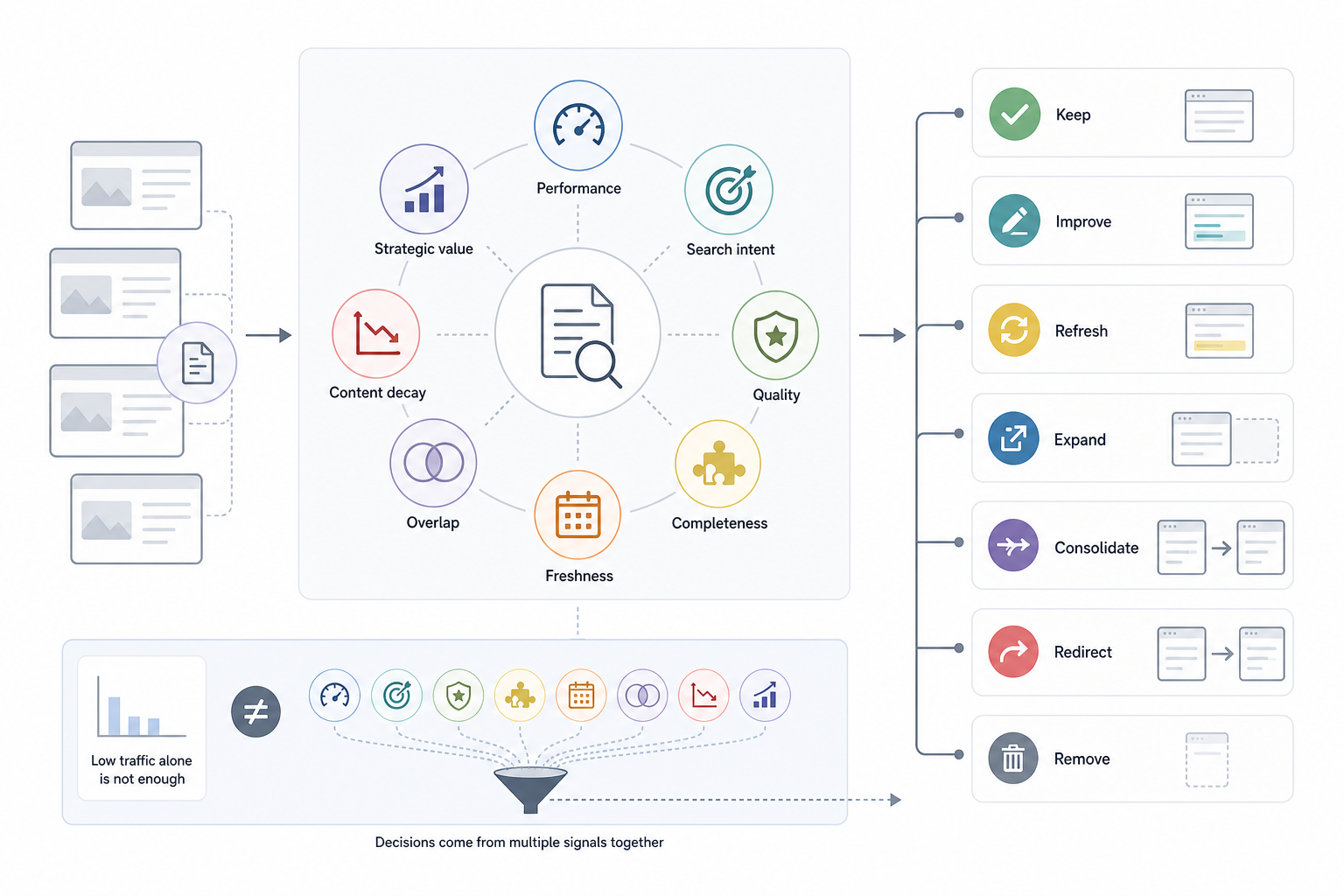
An SEO content audit is an evaluation of the quality, usefulness, completeness, freshness, performance, and strategic role of existing website content.
A keyword audit evaluates queries and targeting. A content audit evaluates the pages used to satisfy that search demand.
Important content-audit checks include:
- Review the content inventory
- Record existing URLs.
- Categorize page types.
- Document target topics.
- Record publication and update dates where relevant.
- Identify the strategic role of important pages.
- Review page-level organic performance
- Evaluate organic traffic.
- Review conversions.
- Check engagement where the metric adds useful context.
- Compare sustained gains, losses, and stagnation over meaningful periods.
- Review search-intent satisfaction
- Determine whether each page still satisfies its assigned intent.
- Check whether the user receives the information or experience expected from the query.
- Review content quality
- Evaluate accuracy.
- Check usefulness.
- Review clarity.
- Examine originality.
- Assess evidence and examples.
- Determine whether the content resolves the user’s main need.
- Review topical completeness
- Identify missing attributes.
- Find unanswered questions.
- Review important entities and supporting concepts.
- Check whether the page covers the subject deeply enough for its intended purpose.
- Review freshness
- Identify outdated statistics.
- Replace obsolete screenshots.
- Review old product information.
- Update superseded recommendations.
- Correct facts that no longer represent the subject accurately.
- Review content overlap
- Find pages with substantially duplicated information.
- Determine whether differentiation remains meaningful.
- Consolidate overlapping assets when separate pages no longer serve distinct purposes.
- Review content decay
- Identify pages showing sustained declines in useful organic or business performance.
- Investigate whether outdated, incomplete, or weaker content contributes to the decline.
- Review strategic value
- Determine whether each page supports audience needs, topical coverage, conversions, authority, product discovery, or another meaningful website objective.
After evaluation, each page can receive an appropriate decision:
- Keep
- Improve
- Refresh
- Expand
- Consolidate
- Redirect
- Remove
Low traffic alone does not justify deletion. Word count alone does not establish content quality. The decision depends on usefulness, performance, topical value, audience relevance, and the role the page plays within the website.
After evaluating the website’s owned content, the remaining major layer is external authority.
What Does an Off-Page SEO Audit Cover?
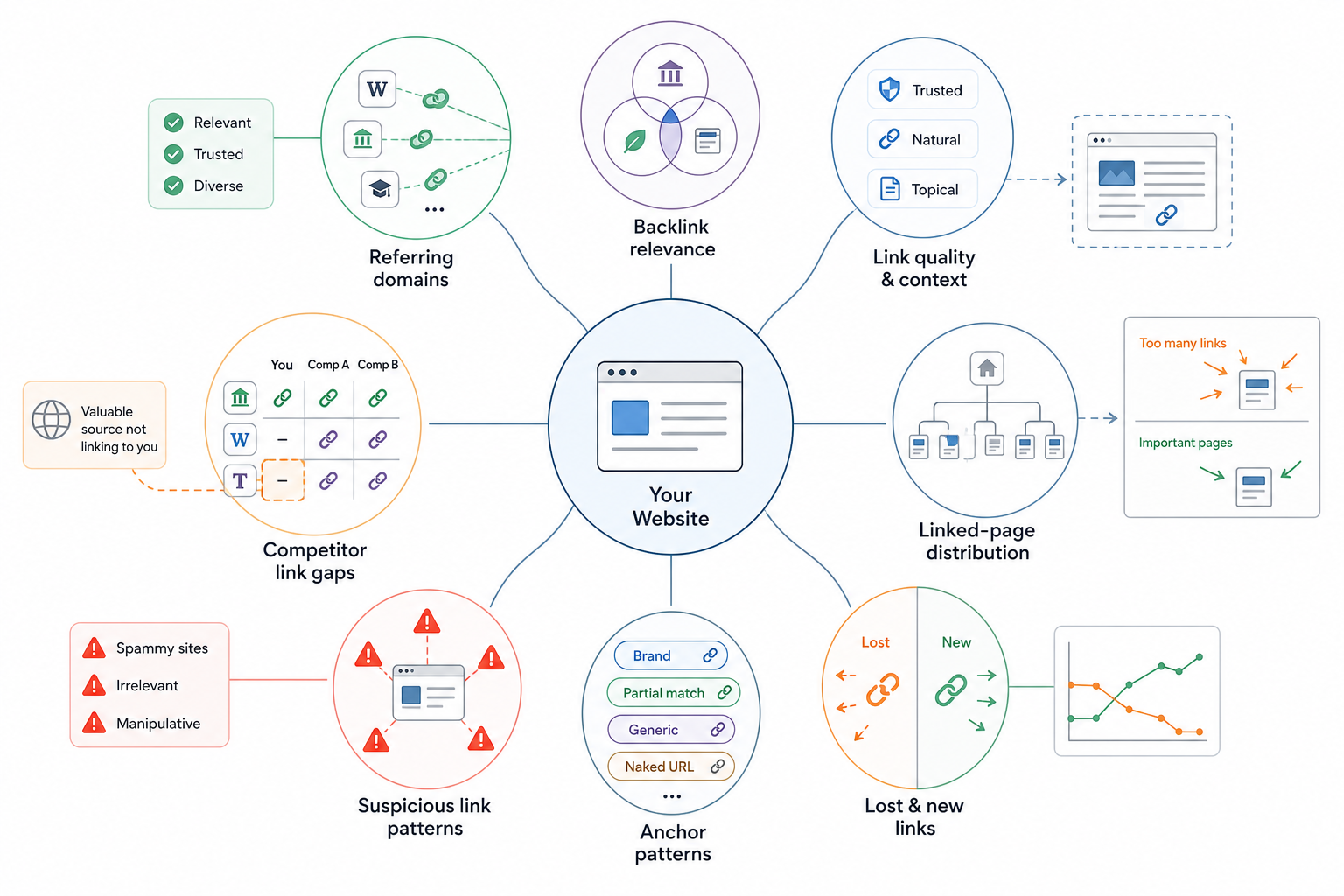
An off-page SEO audit evaluates the external signals supporting a website’s authority, reputation, and competitive search position.
The audit focuses on external references rather than owned page content. Where the analysis specifically concerns backlinks, referring domains, anchors, and link-source quality, a dedicated link building audit examines those link-level signals in greater depth.
Important checks include:
- Referring domains
- Review the number of unique linking websites.
- Evaluate relevance.
- Examine credibility.
- Check diversity.
- Identify repeated link-source patterns.
- Backlink relevance
- Determine whether important links come from pages and websites related to the subject, industry, product, audience, or service.
- Link quality and context
- Review editorial placement.
- Examine surrounding content.
- Evaluate source credibility.
- Identify links that appear naturally earned versus manipulative or artificial.
- Linked-page distribution
- Identify which website pages attract external links.
- Determine whether strategically important pages receive meaningful support.
- Check whether authority remains concentrated on pages with little strategic value.
- Lost and new links
- Review meaningful changes in referring domains.
- Identify important lost links.
- Examine new relevant links gained over time.
- Investigate unusual changes when they correspond with visibility changes.
- Anchor patterns
- Review branded anchors.
- Examine topical and partial-match anchors.
- Check exact-match and generic anchors where they provide useful diagnostic context.
- Interpret anchors together with link placement rather than in isolation.
- Suspicious patterns
- Investigate manipulative, irrelevant, paid, automated, or questionable links when evidence indicates a genuine issue.
- Do not classify links as harmful solely because a third-party tool labels them “toxic.”
- Competitor link gaps
- Identify relevant referring domains linking to competitors but not the target site.
- Review competitor assets earning strong links.
- Distinguish legitimate authority opportunities from irrelevant or low-quality sources.
- Brand mentions
- Identify relevant references to the brand that do not include links.
- Review how these mentions contribute to the wider external-authority picture.
Third-party authority scores remain comparative metrics rather than Google measurements. The audit focuses on relevance, credibility, context, linked assets, and competitive differences.
Once all major SEO layers are covered, the remaining question is how deeply the website requires investigation.
How Comprehensive Should an SEO Audit Be?
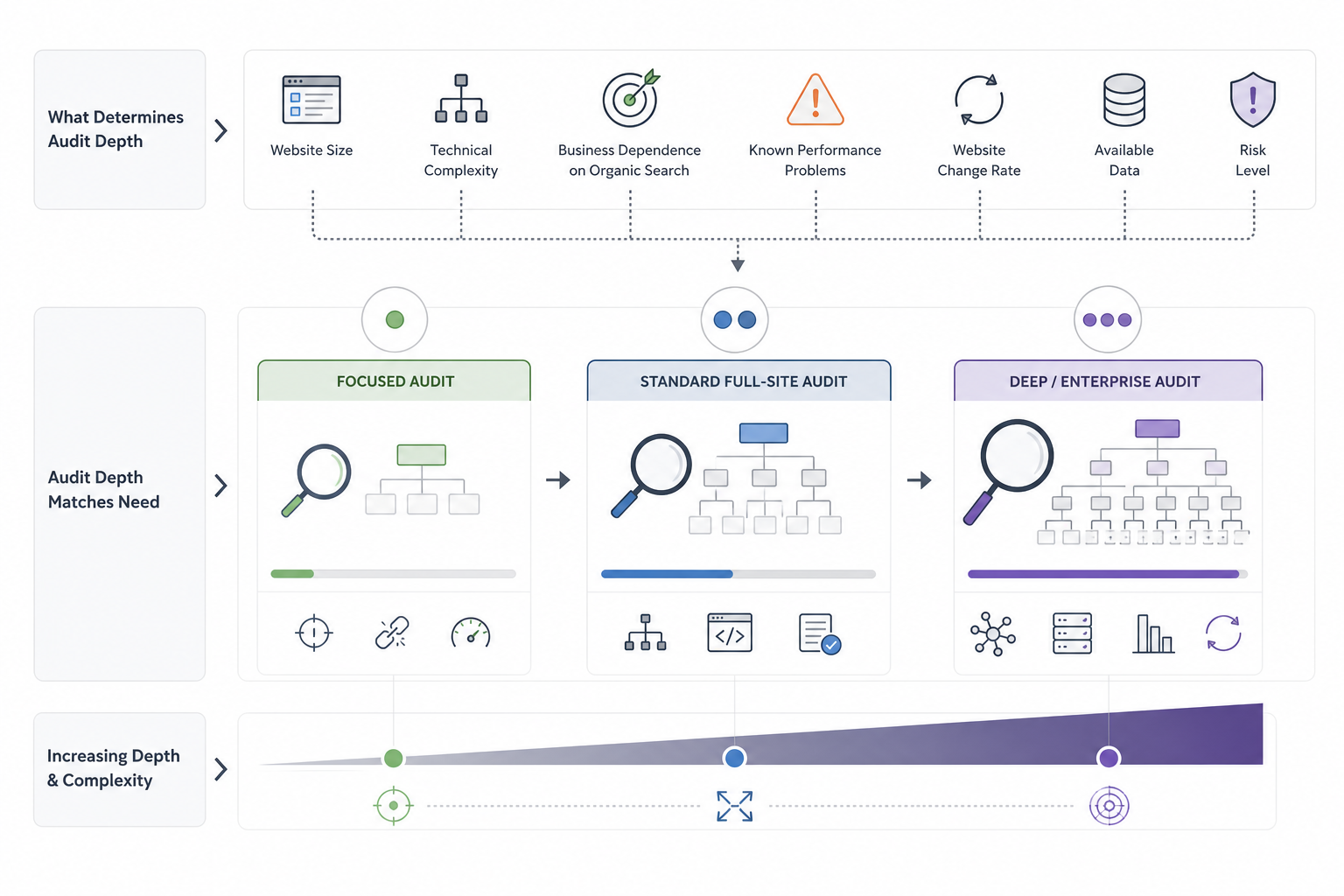
An SEO audit must be deep enough to identify the causes of meaningful search-performance problems without expanding into checks that have little relevance to the website.
Audit scope determines which SEO areas receive analysis. Audit comprehensiveness determines how deeply those relevant areas are investigated.
Several factors determine the required depth:
- Website size
- Larger URL inventories require more crawling, segmentation, sampling, and validation.
- Large sites also contain more templates, sections, and page types that can behave differently.
- Technical complexity
- JavaScript rendering increases diagnostic complexity.
- Faceted navigation creates larger URL states.
- International sites require deeper architecture analysis.
- Multiple subdomains, large catalogs, and unusual indexation systems require additional investigation.
- Business dependence on organic search
- Websites that rely heavily on organic traffic justify stronger validation because SEO problems carry greater commercial risk.
- Known performance problems
- Sudden visibility losses, indexation changes, migration problems, or recurring technical issues require deeper investigation into the affected area.
- Website change rate
- Frequently changing websites require broader validation than stable websites because new problems enter the system more often.
- Available data
- Access to crawl data, Search Console, analytics, server logs, historical rankings, and backlink information affects how deeply root causes can be investigated.
- Risk level
- Migrations, redesigns, domain changes, platform changes, and major structural work justify deeper auditing because mistakes can affect large parts of the site.
SEO audits broadly fall into three levels:
- Focused audit
- Appropriate when the problem is narrow and already isolated to a particular SEO area.
- Examples include indexation problems, internal linking, a migration review, or a content decline within one section.
- Standard full-site audit
- Appropriate when the objective is to understand the overall SEO condition of a typical website.
- It evaluates the main technical, on-page, keyword, content, and authority layers at a practical level.
- Deep or enterprise audit
- Appropriate for large, technically complex, high-risk, or unresolved websites.
- The audit can include segmentation, template analysis, server-log investigation, deeper content evaluation, and recurring diagnostics.
A larger audit is not automatically a better audit. The best audit produces validated root causes and useful priorities rather than the largest possible number of warnings.
Once scope and depth are clear, the audit can be performed systematically.
How Do You Perform an SEO Audit?
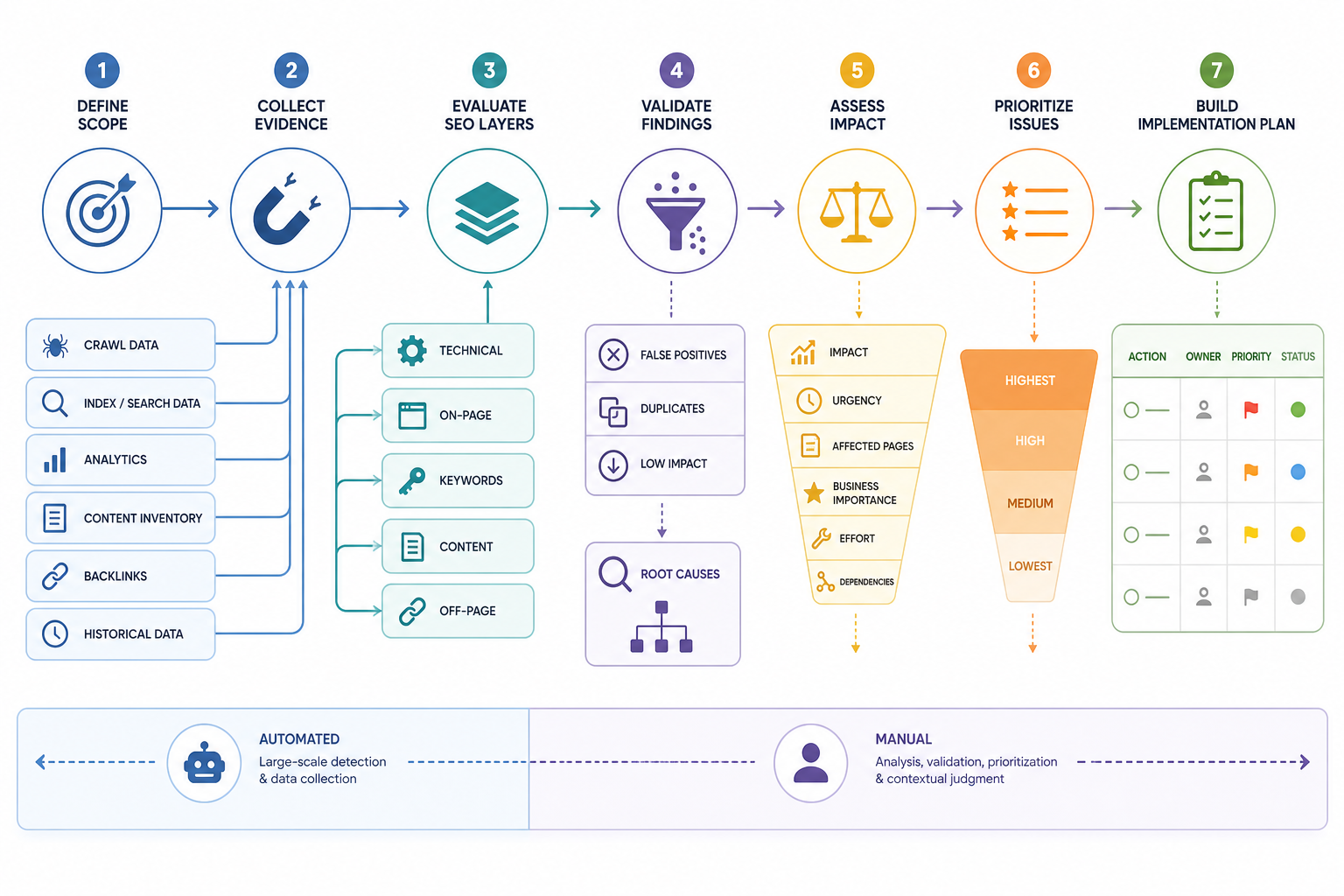
An SEO audit is performed by defining the diagnostic scope, collecting relevant website and search data, evaluating the required SEO layers, validating the findings, assessing their impact, and prioritizing the resulting issues.
1. Define the Audit Scope
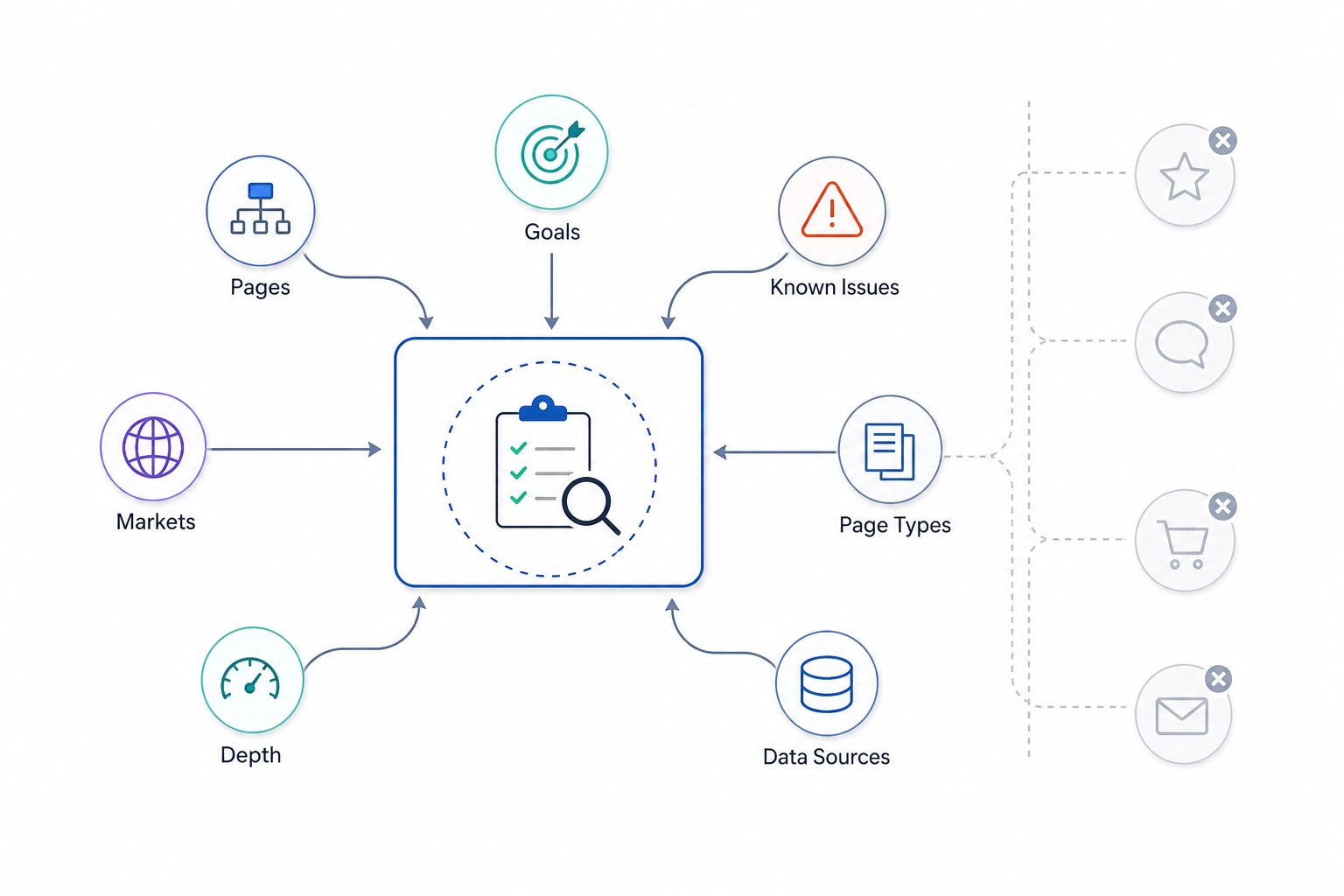
Establish:
- Business objectives
- Website sections included
- Known SEO problems
- Relevant markets
- Important page types
- Required audit depth
- Available datasets
Scope prevents the audit from expanding into irrelevant checks.
2. Collect the Audit Evidence
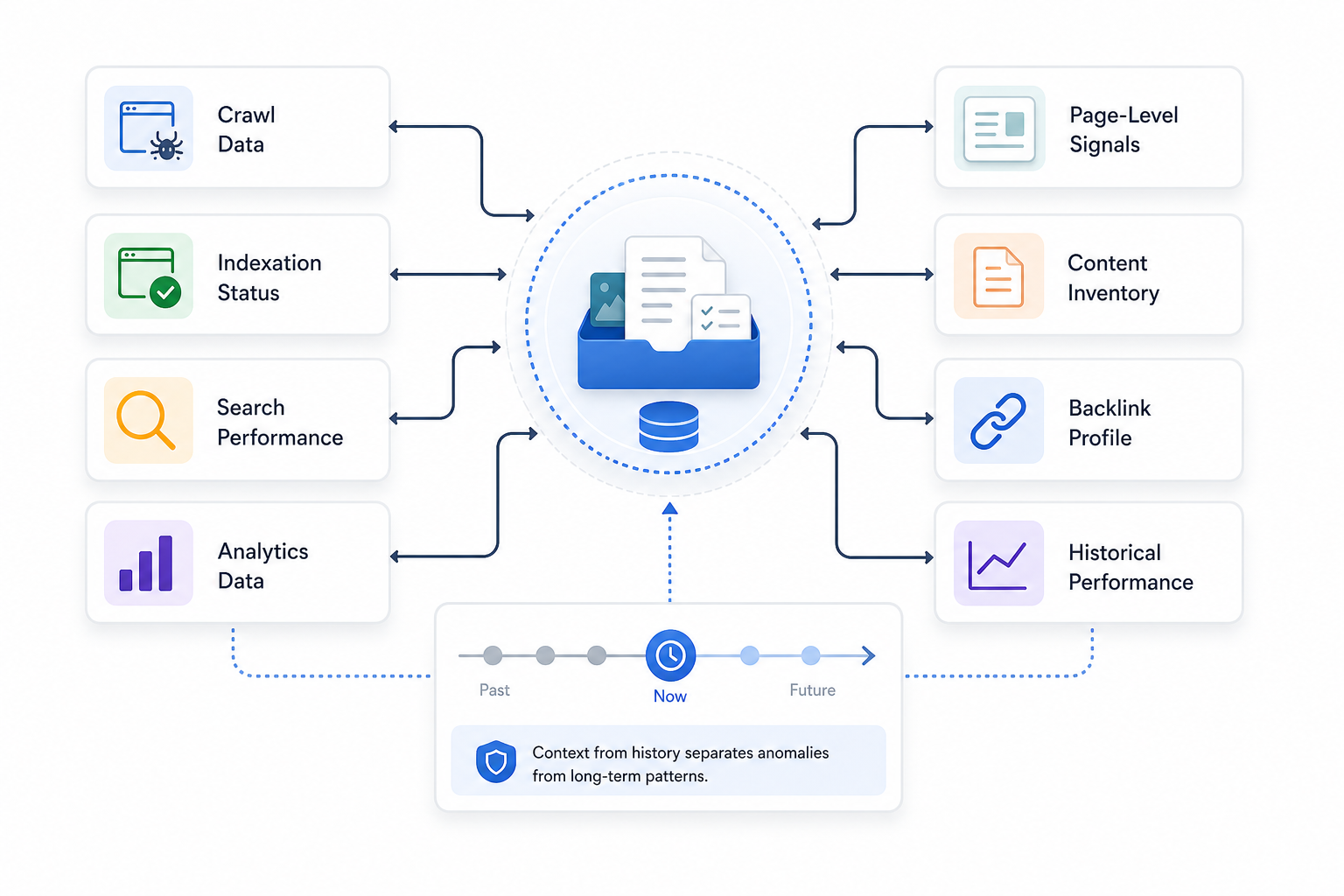
Gather the data required for the defined scope.
Useful sources include:
- Website crawls
- Indexation data
- Search-performance data
- Analytics
- Page-level data
- Content inventories
- Backlink information
- Historical performance data
Automated sources provide scale and consistency. Historical information helps distinguish temporary anomalies from sustained patterns.
3. Evaluate the Relevant Audit Layers
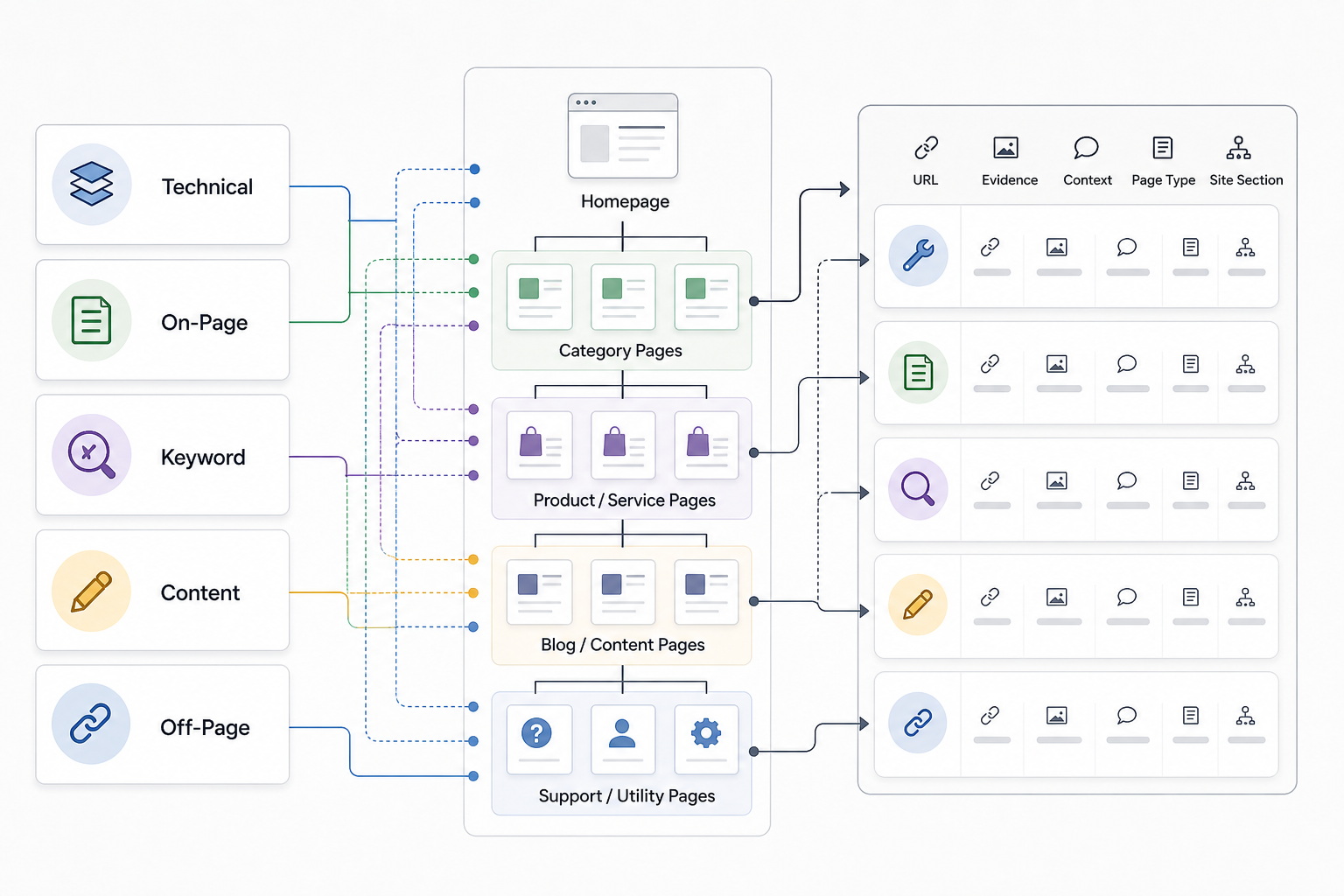
Apply the technical, on-page, keyword, content, and off-page criteria to the relevant website areas.
Record findings together with:
- Affected URLs
- Evidence
- Relevant context
- Page type
- Website section
Keep the finding specific enough for later validation.
4. Validate the Findings
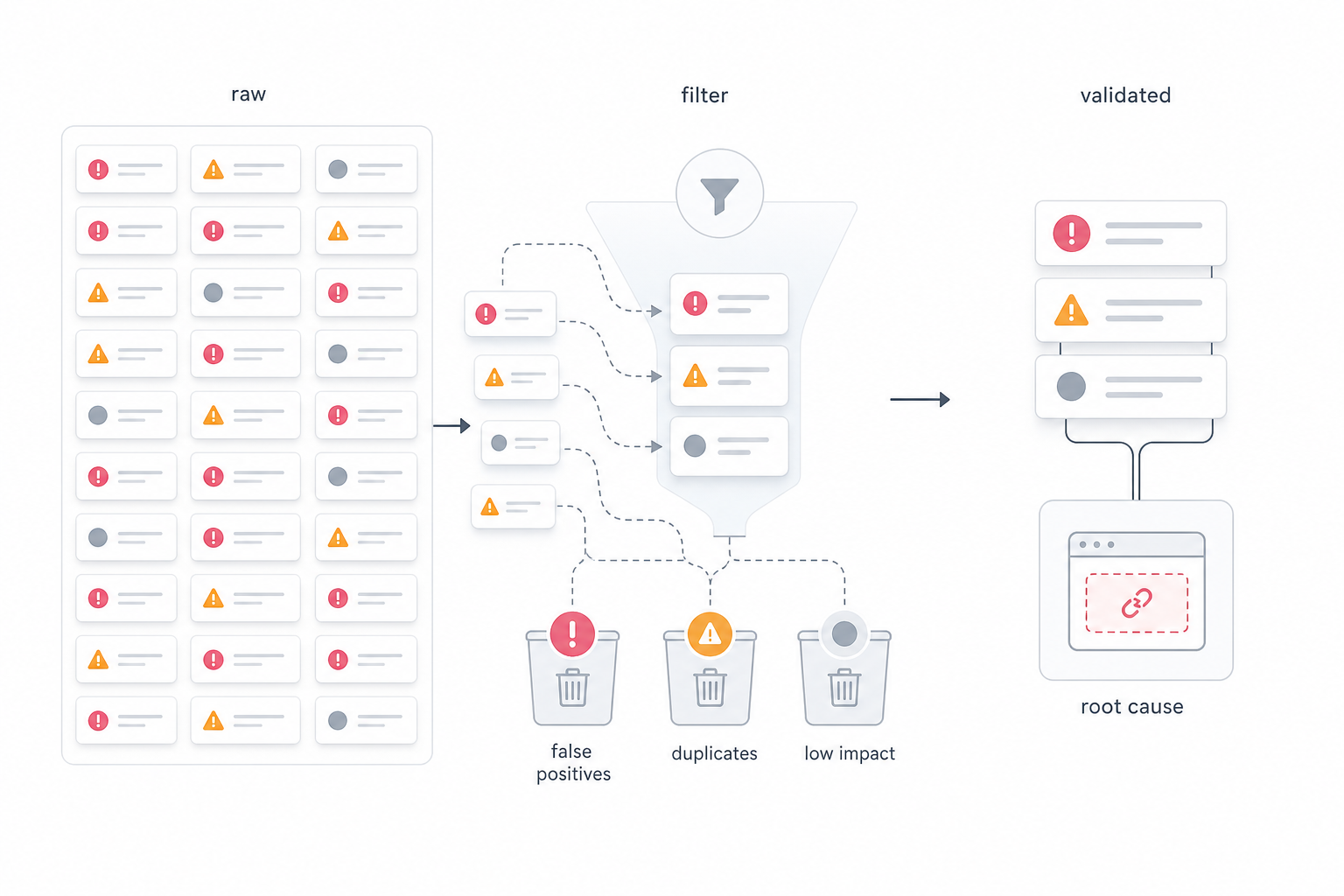
Review automated warnings before treating them as genuine SEO issues.
Remove:
- False positives
- Duplicate findings
- Tool warnings with no practical impact
- Observations that do not affect the website’s objectives
Investigate root causes rather than reporting only symptoms.
For example, hundreds of broken internal links can originate from one faulty template. Reporting every URL separately hides the underlying problem.
5. Assess SEO Impact
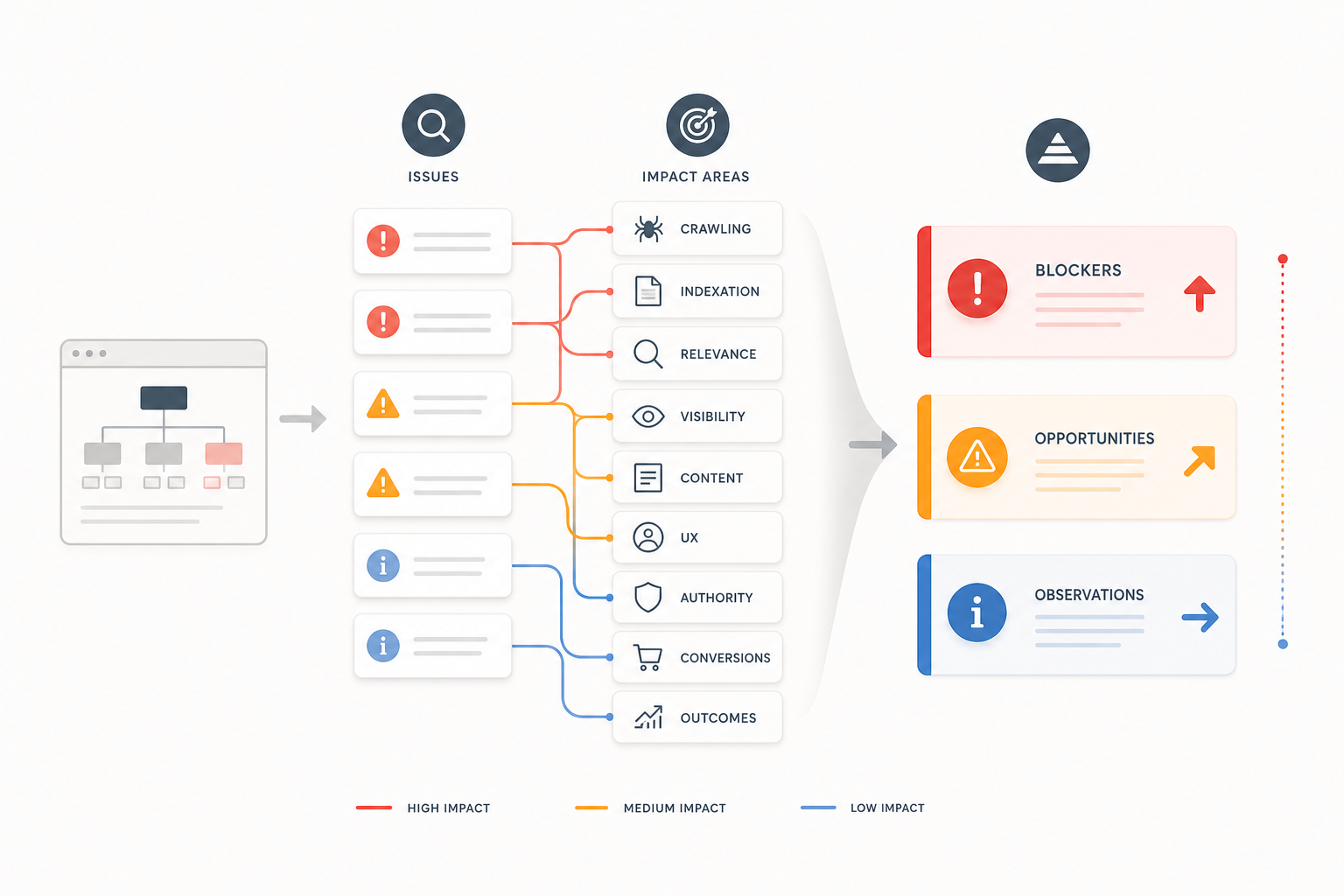
Determine what each validated issue affects.
Impact can relate to:
- Crawling
- Indexation
- Search relevance
- Organic visibility
- Content performance
- User experience
- Authority
- Conversions
- Business outcomes
Separate critical blockers from optimization opportunities and minor observations.
6. Prioritize the Issues
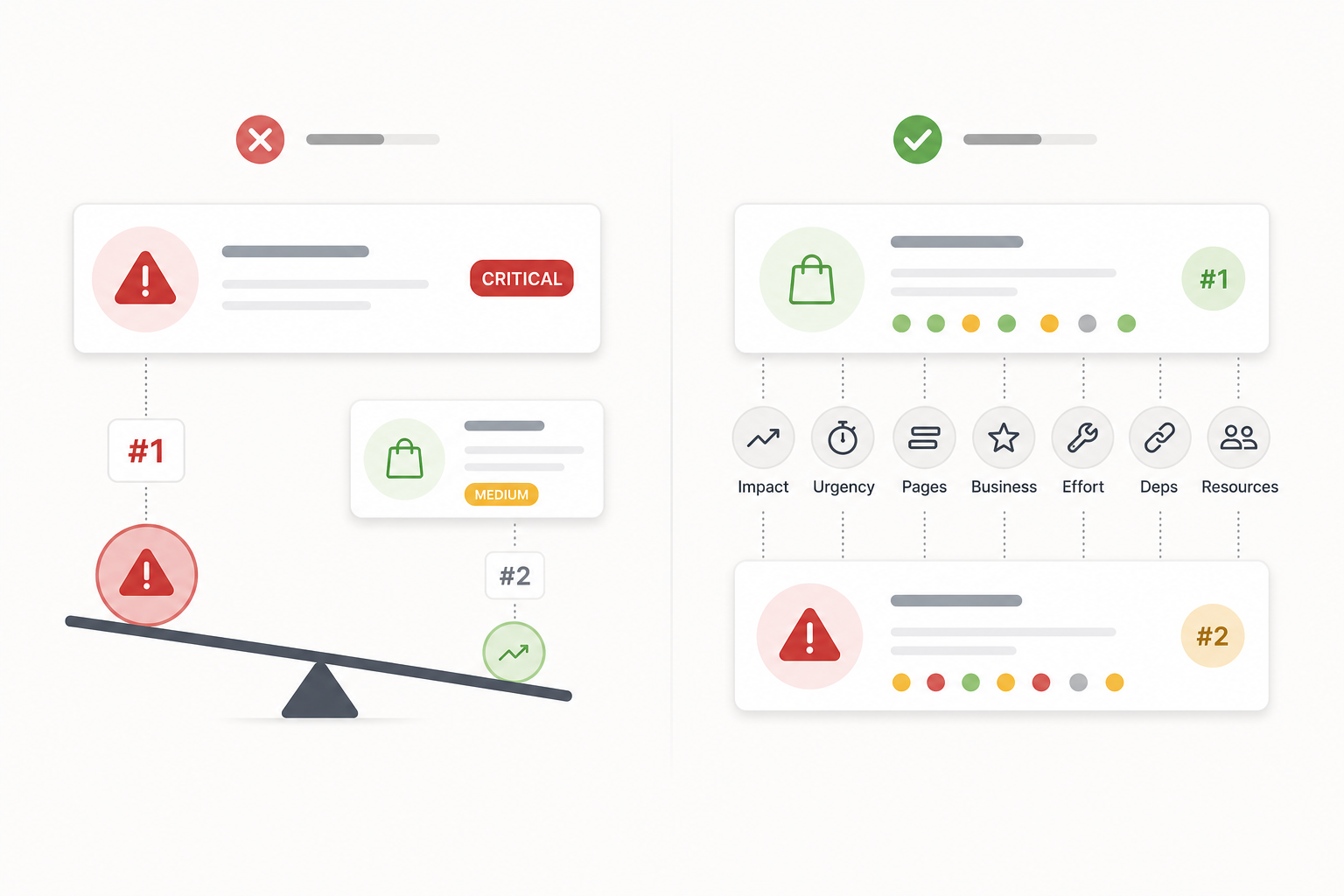
Rank findings according to:
- SEO impact
- Urgency
- Number of affected pages
- Business importance
- Implementation effort
- Dependencies
- Available resources
Do not use a tool-generated severity score as the sole prioritization method.
A warning labeled “critical” by a crawler can have limited business impact, while a less dramatic issue affecting an important commercial directory can deserve immediate attention.
7. Build the Implementation Plan
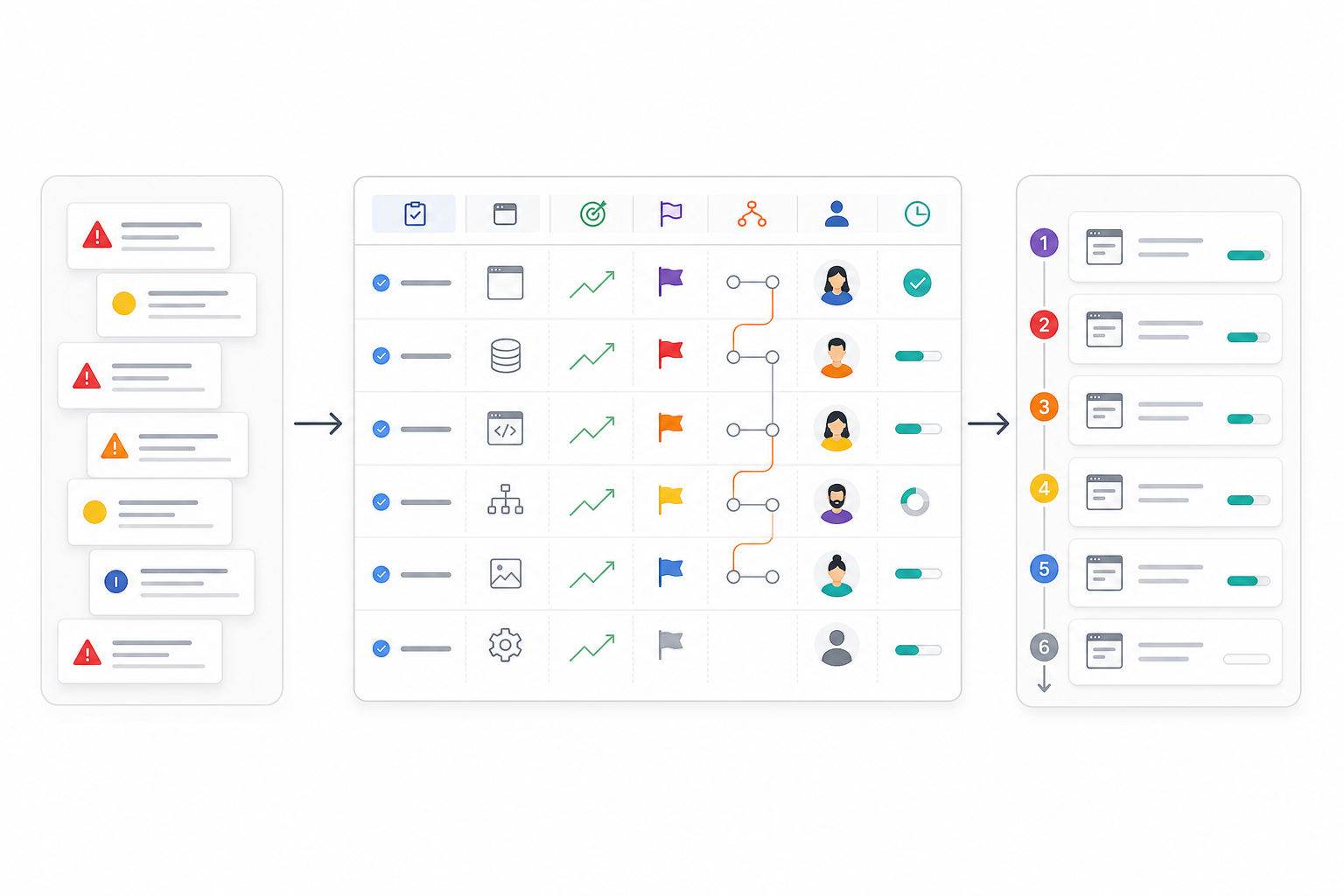
Convert important findings into clear actions.
Record:
- Required action
- Affected URL or system
- Expected outcome
- Priority
- Dependencies
- Owner
- Status
The audit becomes useful when the final output supports decisions rather than functioning as a collection of warnings.
Should You Perform an SEO Audit Manually or With a Tool?
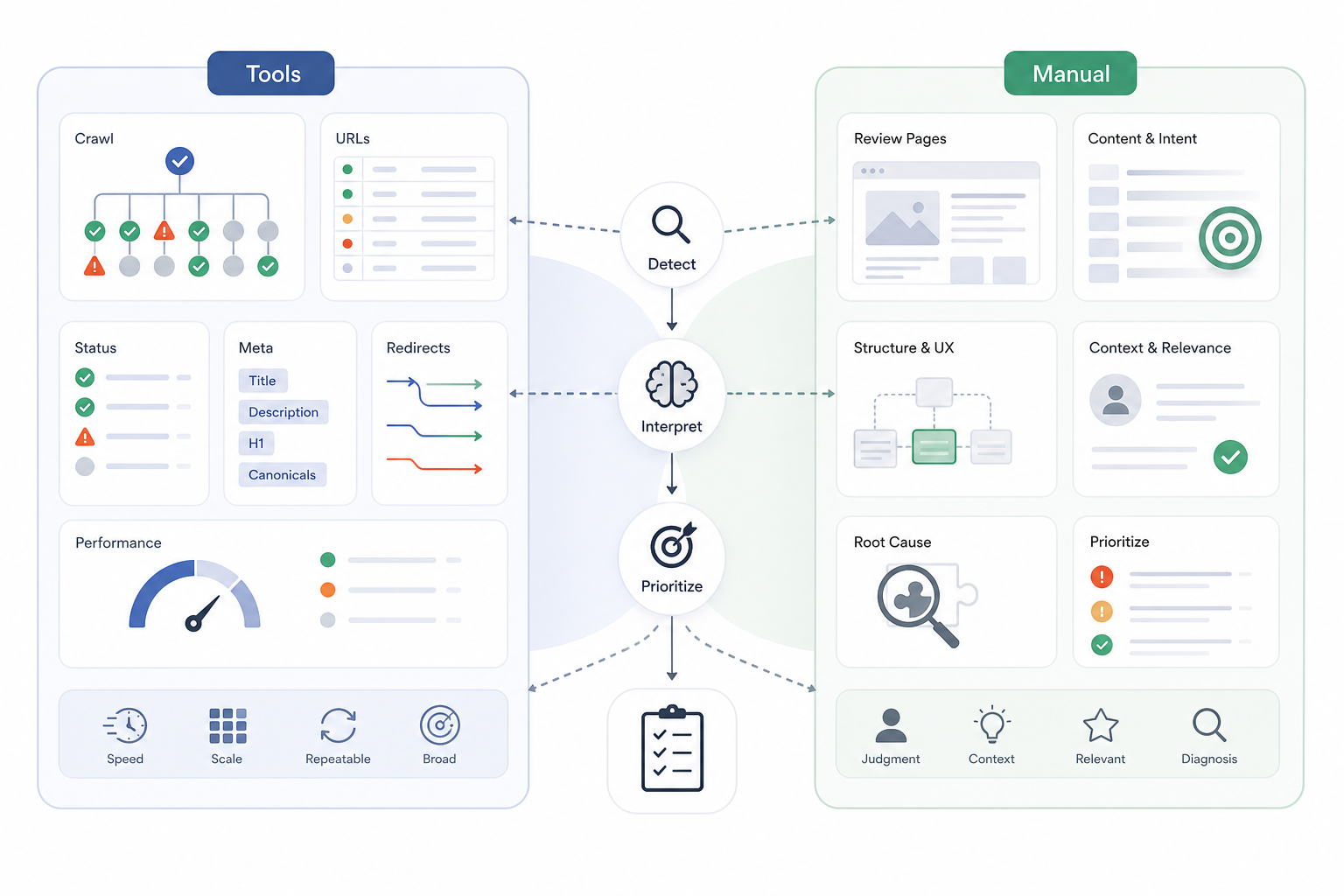
A complete SEO audit combines automated tools with manual analysis because automation and human review solve different diagnostic problems.
| Attribute | Automated Audit Tools | Manual SEO Audit | Best Use |
|---|---|---|---|
| Speed | Process large amounts of data quickly | Requires more review time | Use tools for scalable collection |
| Scale | Finds sitewide patterns across many URLs | Better for selected pages and complex cases | Automate broad detection |
| Technical detection | Surfaces status codes, redirects, metadata patterns, crawl issues, structured data, and other technical signals | Validates whether detected issues matter | Combine automated detection with manual validation |
| Content judgment | Provides limited contextual understanding | Evaluates usefulness, intent, clarity, and quality | Use manual review for content decisions |
| User experience | Measures technical indicators | Identifies confusing interfaces and real interaction problems | Use both technical data and human testing |
| Diagnosis | Identifies symptoms and anomalies | Investigates causes and significance | Use manual interpretation |
| Prioritization | Often assigns generic severity scores | Evaluates business and SEO importance | Use human judgment |
| Repeatability | Effective for recurring crawls and monitoring | More resource-intensive | Automate recurring checks |
Tools such as website crawlers, Google Search Console, backlink platforms, and performance-testing systems provide efficient data collection.
Manual analysis remains essential for questions involving:
- Search intent
- Content usefulness
- Business relevance
- User experience
- Root-cause diagnosis
- SEO impact
- Prioritization
Automation becomes increasingly valuable as website size and technical complexity increase. Manual review becomes more important as the question requires greater contextual interpretation.
How Long Does an SEO Audit Take?
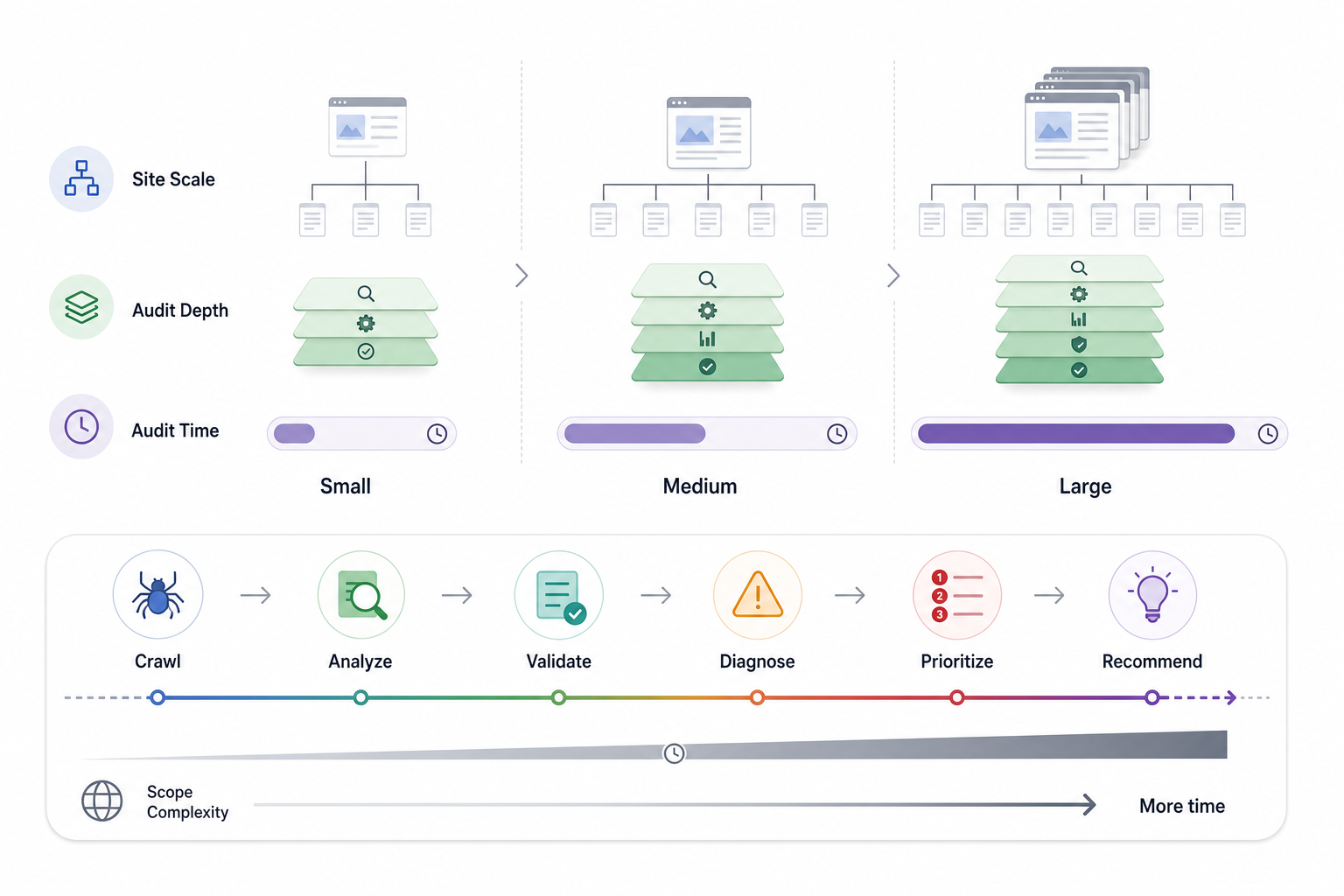
An SEO audit can take from a few hours for a basic automated review to several weeks for a comprehensive audit of a large or technically complex website.
There is no universal duration because audit time depends on scope, site size, complexity, data quality, and the amount of manual investigation required.
| Website Size | Typical Audit Depth | Approximate Time |
|---|---|---|
| Small website | Basic to detailed audit | A few hours to several days |
| Medium website | Thorough multi-layer audit | Roughly one to two weeks |
| Large or complex website | Comprehensive audit with deeper validation | Several weeks |
An automated crawl can finish much faster than a completed audit. Crawling only collects part of the evidence. Interpretation, validation, diagnosis, prioritization, and recommendations require additional analysis.
The main factors affecting duration include:
- Website size
- Larger sites create more crawl data.
- More templates and sections require segmentation and validation.
- Audit scope
- A technical-only audit is narrower than a full audit covering technical SEO, keywords, content, links, and performance.
- Manual versus automated analysis
- Automation reduces collection time.
- Manual validation increases diagnostic depth.
- Technical complexity
- JavaScript, international architectures, faceted navigation, large e-commerce catalogs, and migration problems increase investigation requirements.
- Data quality
- Conflicting crawl, analytics, ranking, Search Console, or backlink data requires additional validation.
The right timeline is the amount of time required to produce validated findings and useful priorities, not simply the time required to finish crawling the website.
How Do You Create an SEO Audit Report?
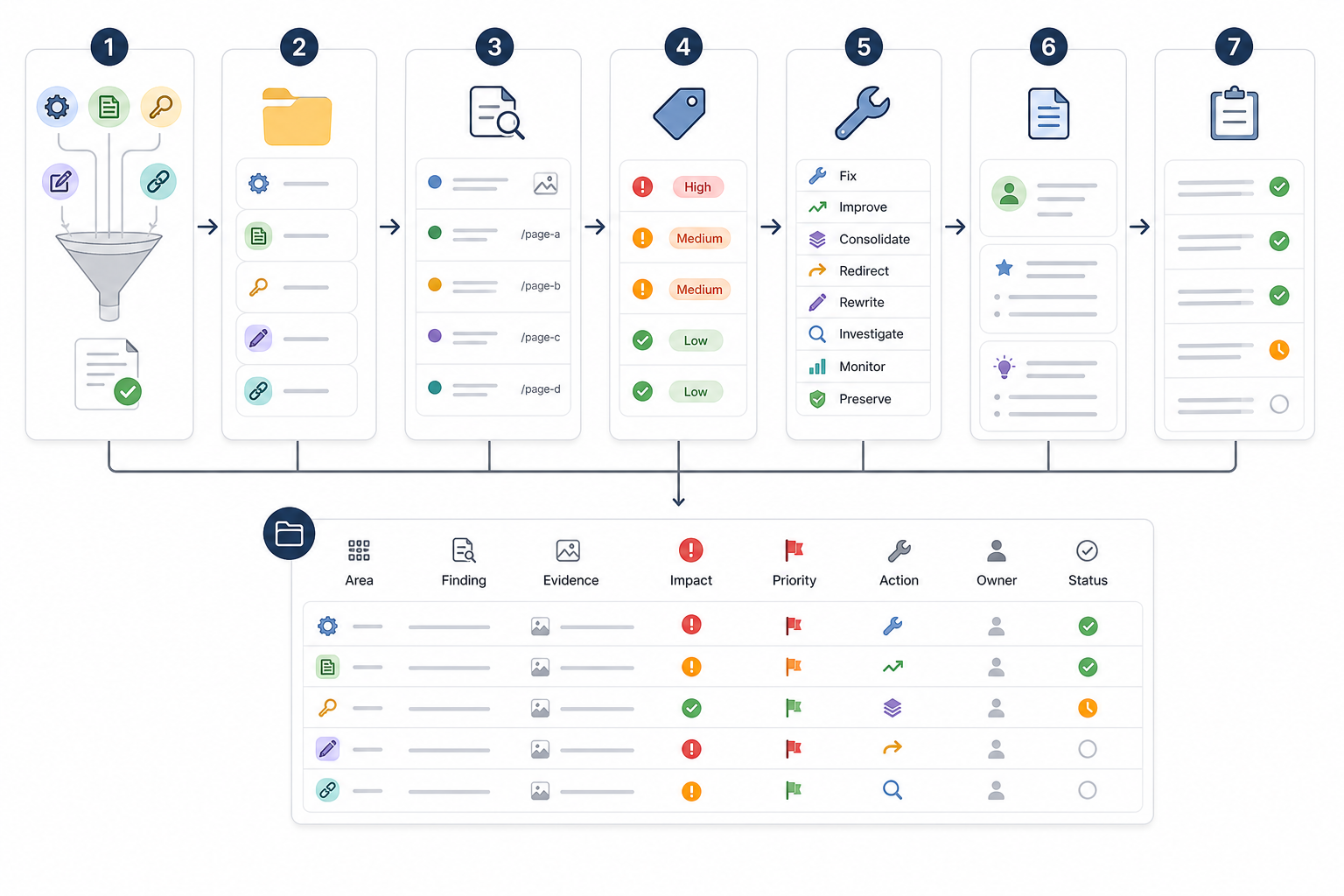
An SEO audit report is created by organizing validated audit findings into a decision document that explains the evidence, impact, priority, and recommended action for each important issue.
Report creation begins after the diagnostic and validation work is complete.
1. Consolidate the Validated Findings
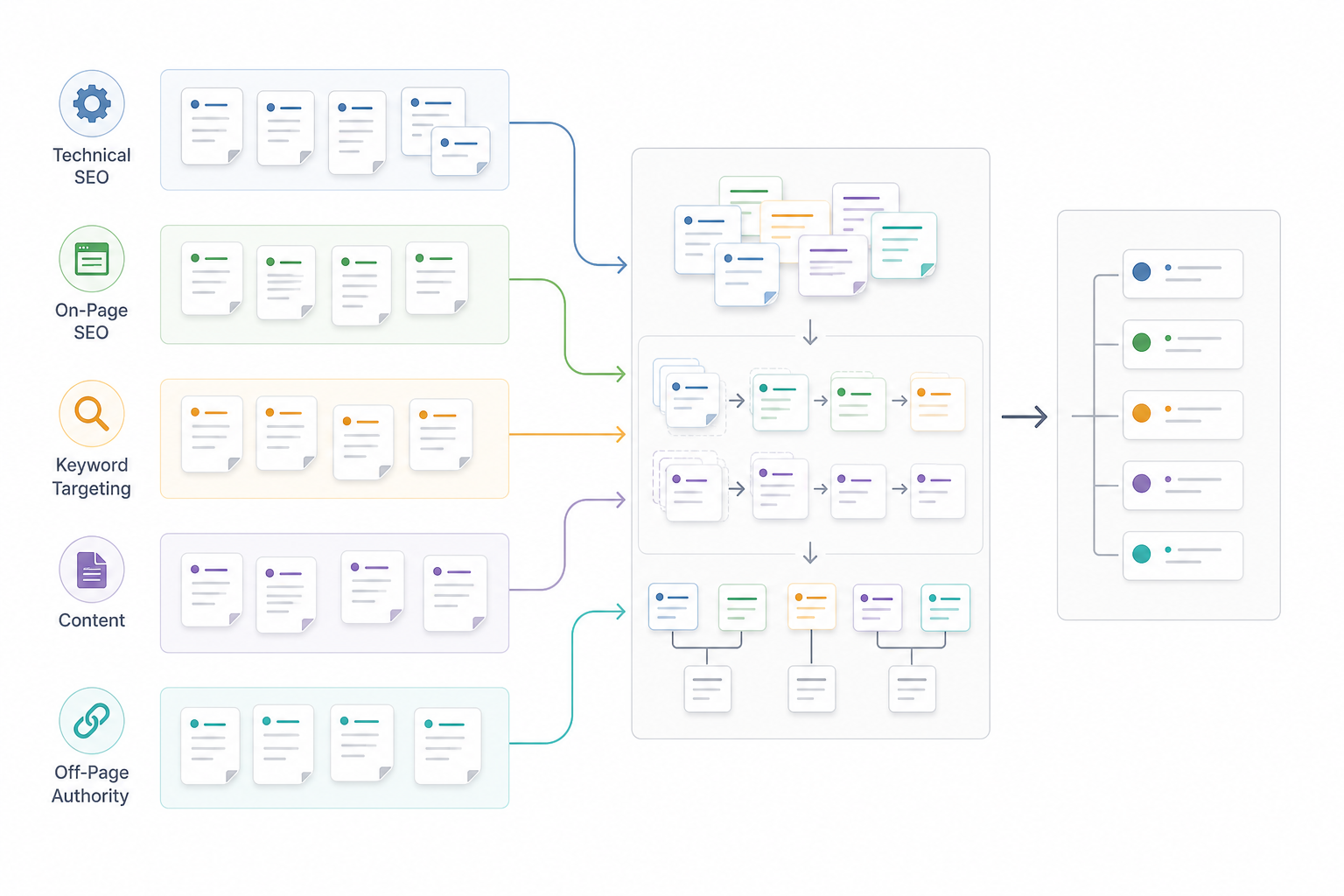
Bring together the confirmed findings from:
- Technical SEO
- On-page SEO
- Keyword targeting
- Content
- Off-page authority
Remove duplicated observations so one underlying problem does not appear several times under different labels.
2. Organize Findings by Audit Area
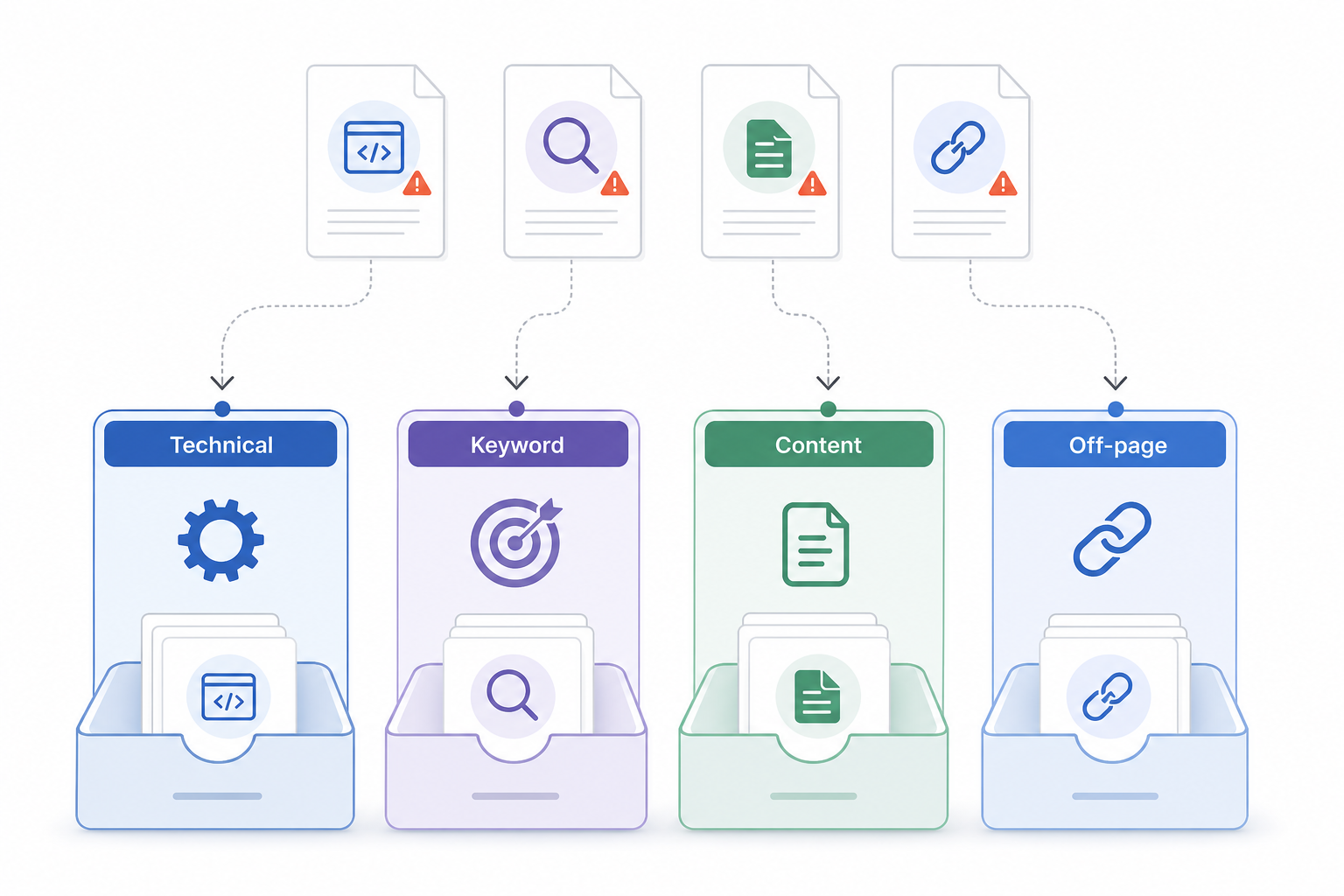
Keep issues grouped according to their cause.
This separation makes ownership and implementation clearer.
For example:
- Structured data belongs under technical SEO.
- Keyword cannibalization belongs under keyword targeting.
- Outdated content belongs under content.
- Referring-domain gaps belong under off-page SEO.
3. Explain Each Finding
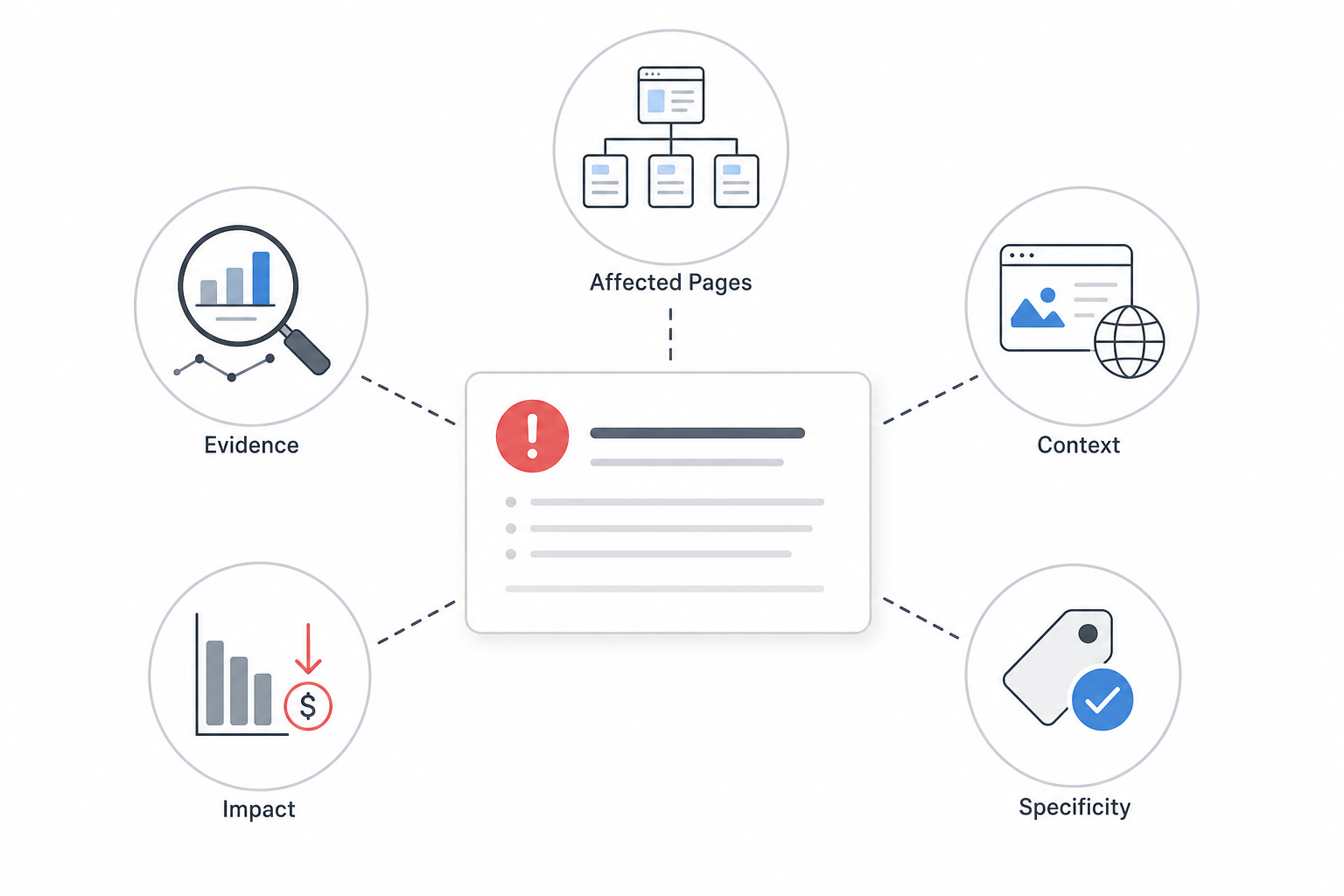
Every important finding requires:
- A clear description
- Affected URLs or sections
- Supporting evidence
- Relevant context
- SEO or business impact
Avoid vague labels such as “bad SEO” or “poor optimization.” The report must explain exactly what the issue is.
4. Assign Impact and Priority
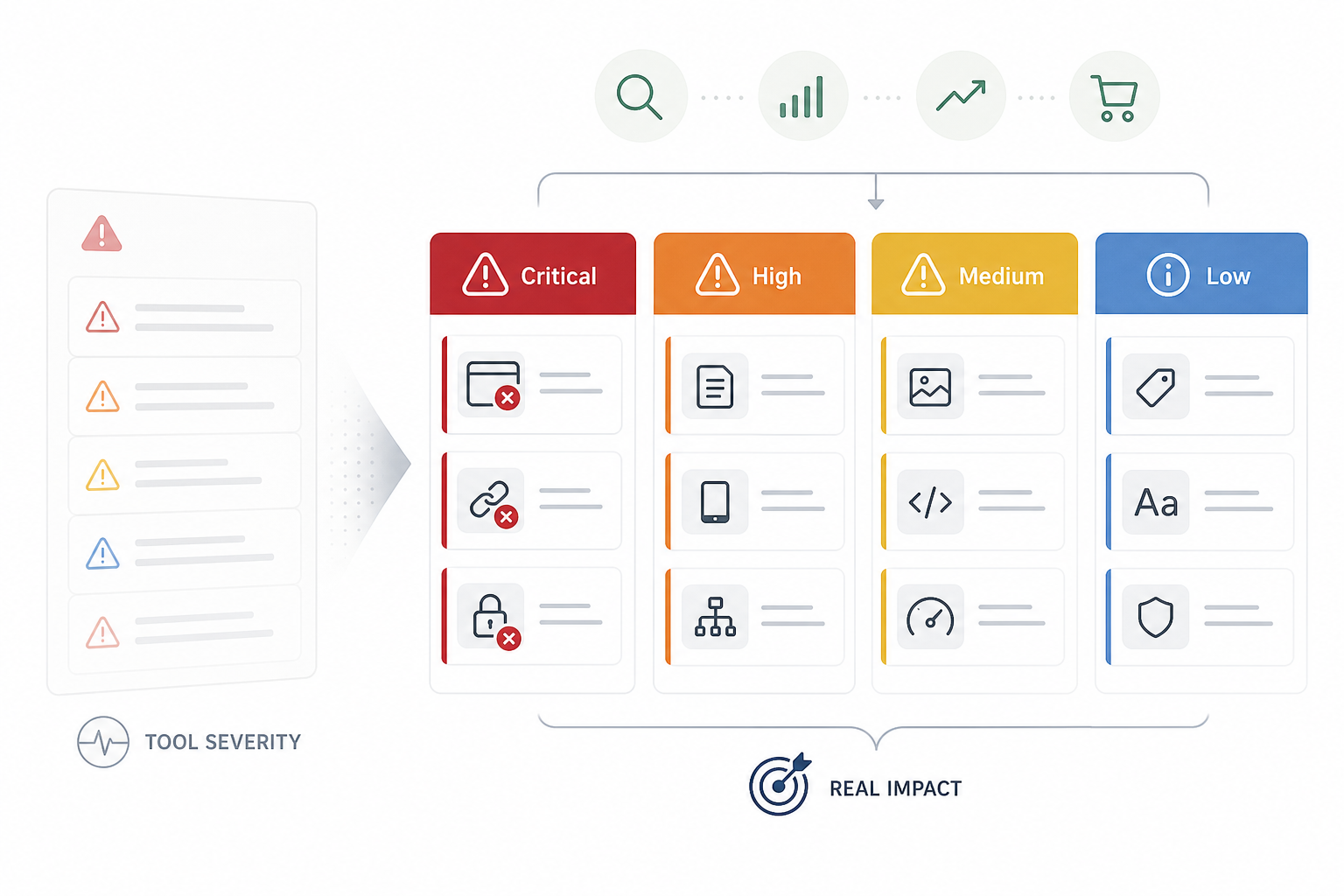
Use the prioritization established during the audit.
Categories can include:
- Critical
- High
- Medium
- Low
Priority must reflect real impact rather than the visual severity assigned by an audit tool.
5. Add Recommended Actions
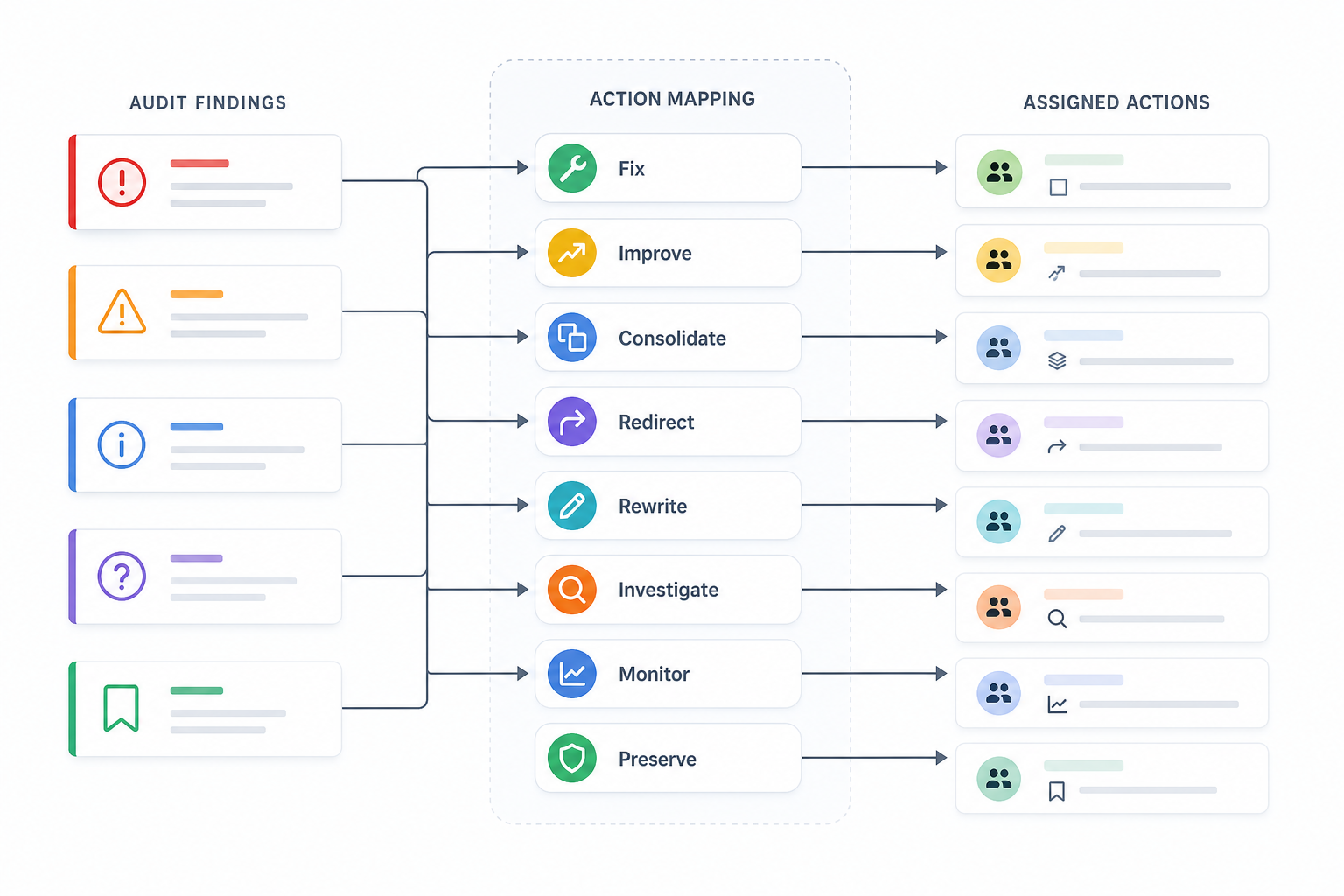
Translate each important finding into a clear next action.
Recommendations can involve:
- Fix
- Improve
- Consolidate
- Redirect
- Rewrite
- Investigate
- Monitor
- Preserve
Keep the recommendation specific enough for the responsible team to understand what happens next.
6. Write the Executive Summary

Summarize:
- Overall SEO condition
- Most important constraints
- Largest opportunities
- Highest-priority actions
- Important risks
Keep the summary decision-oriented. It does not require every issue contained in the detailed report.
7. Build the Implementation Summary
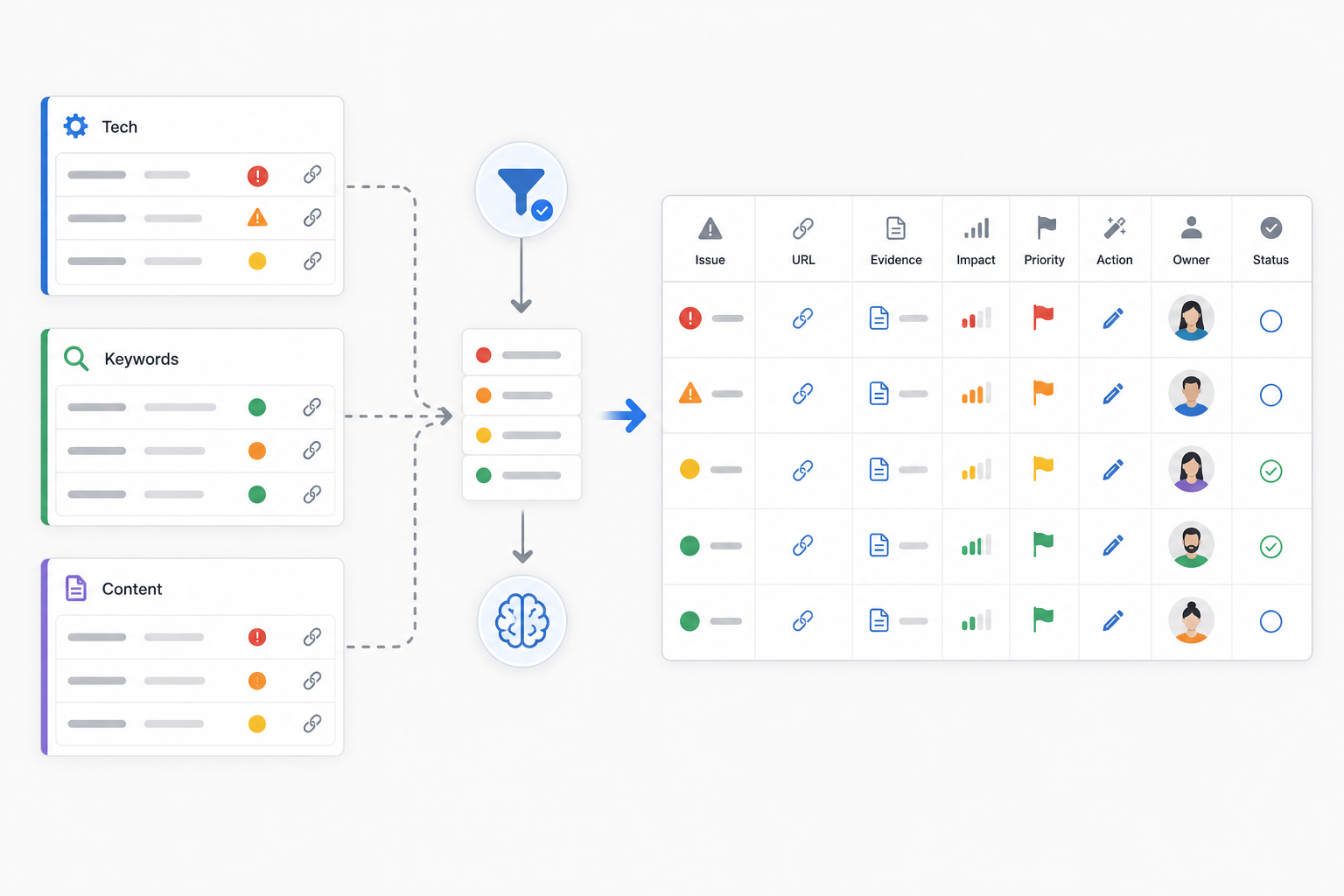
Consolidate the highest-priority recommendations into a practical view.
A useful report table can look like this:
| Audit Area | Finding | Affected URL(s) | Evidence | SEO Impact | Priority | Recommended Action | Owner | Status |
|---|---|---|---|---|---|---|---|---|
| Technical SEO | Example issue | /example/ | Supporting evidence | High | High | Recommended fix | — | Open |
| Keyword Audit | Example issue | /example-page/ | Ranking data | Medium | Medium | Improve targeting | — | Open |
| Content Audit | Example issue | /guide/ | Outdated information | Medium | Medium | Refresh page | — | Open |
Raw crawler exports do not replace an audit report. The final document requires interpretation.
A useful SEO audit report allows a stakeholder to understand what is wrong, why it matters, what action is required, and which work deserves priority.
What Does an SEO Audit Example Look Like?
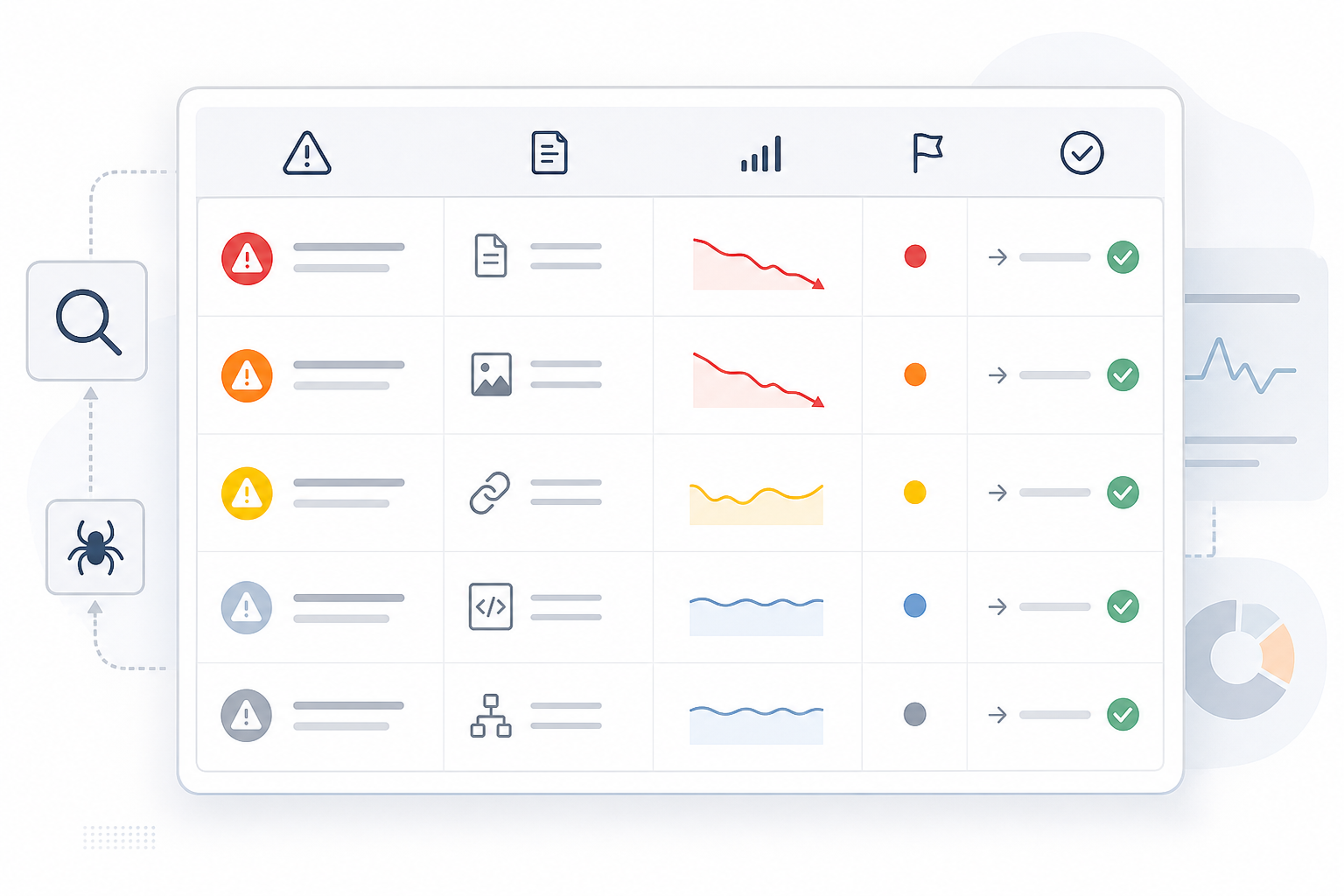
An SEO audit example shows how completed findings appear in a structured report containing the issue, evidence, SEO impact, priority, and recommended action.
Consider a hypothetical software website with declining organic visibility.
Executive Summary Example
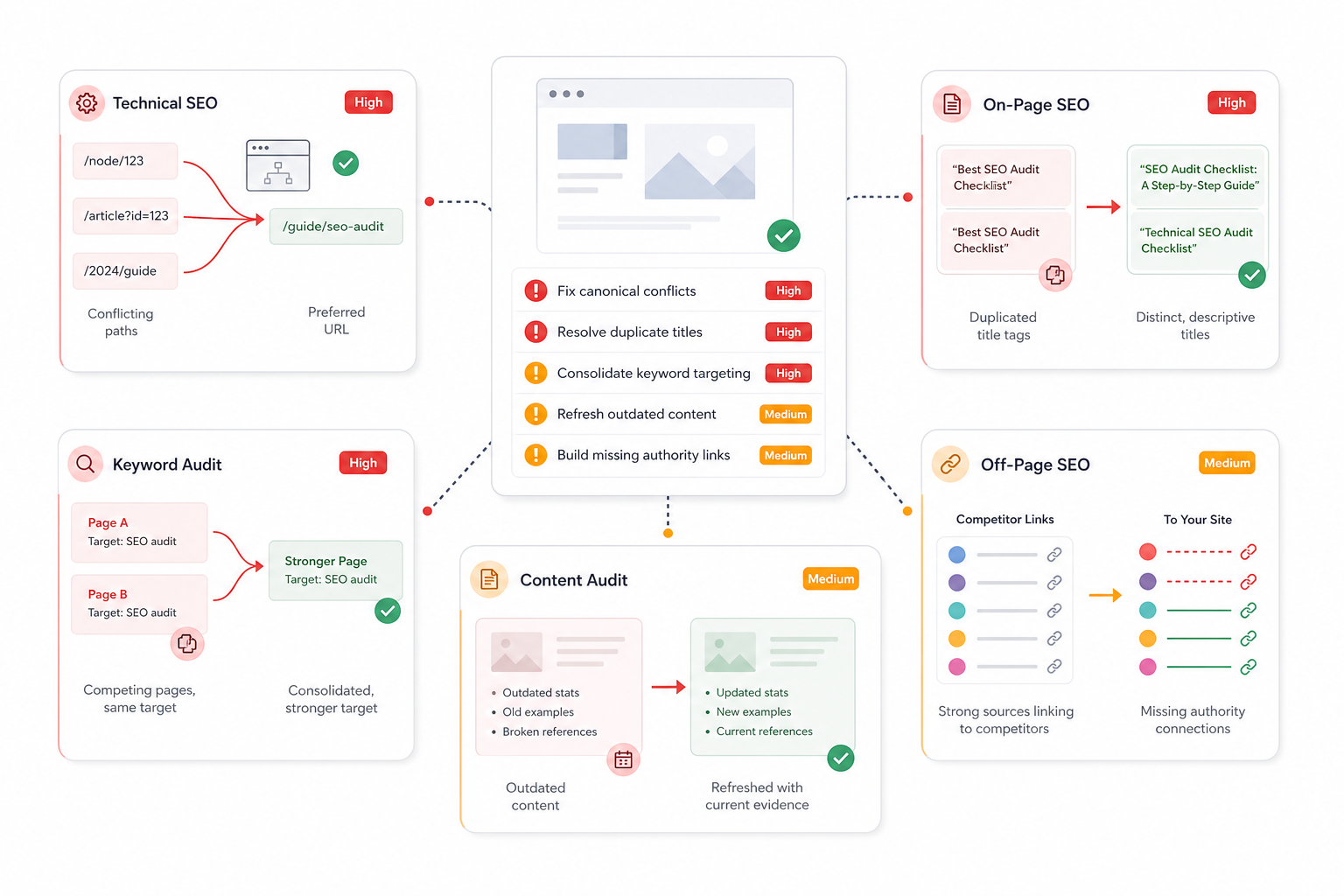
The website has a generally accessible technical foundation, but several high-value sections contain indexation inconsistencies, overlapping keyword targeting, outdated content, and weaker referring-domain support than competing websites.
The highest-priority constraint affects important product pages with inconsistent canonical signals. The largest growth opportunity exists across several commercial queries where the website already has partial visibility but weak page targeting.
The immediate focus is correcting the technical indexation issue, consolidating overlapping keyword targets, improving high-value commercial pages, and strengthening relevant authority around the most important sections.
All example values below are illustrative.
| Audit Area | Example Finding | Evidence | SEO Impact | Priority | Recommended Action |
|---|---|---|---|---|---|
| Technical SEO | Several canonical product URLs point to inconsistent variants | Crawl and canonical review | Search engines receive conflicting indexing signals | High | Standardize canonical implementation |
| On-Page SEO | Important service pages use unclear and duplicated titles | Page-level audit | Weak topic clarity and SERP presentation | Medium | Rewrite titles around each page’s actual purpose |
| Keyword Audit | Two URLs compete for the same commercial query | Ranking and page-mapping data | Visibility is divided across overlapping pages | High | Consolidate targeting into the stronger URL |
| Content Audit | High-traffic guide contains outdated product screenshots and statistics | Manual content review | Reduced accuracy and usefulness | Medium | Refresh information and evidence |
| Off-Page SEO | Competitors receive relevant links from industry publications absent from the target site | Backlink comparison | Weaker competitive external authority | Medium | Evaluate suitable authority opportunities |
Implementation Summary Example
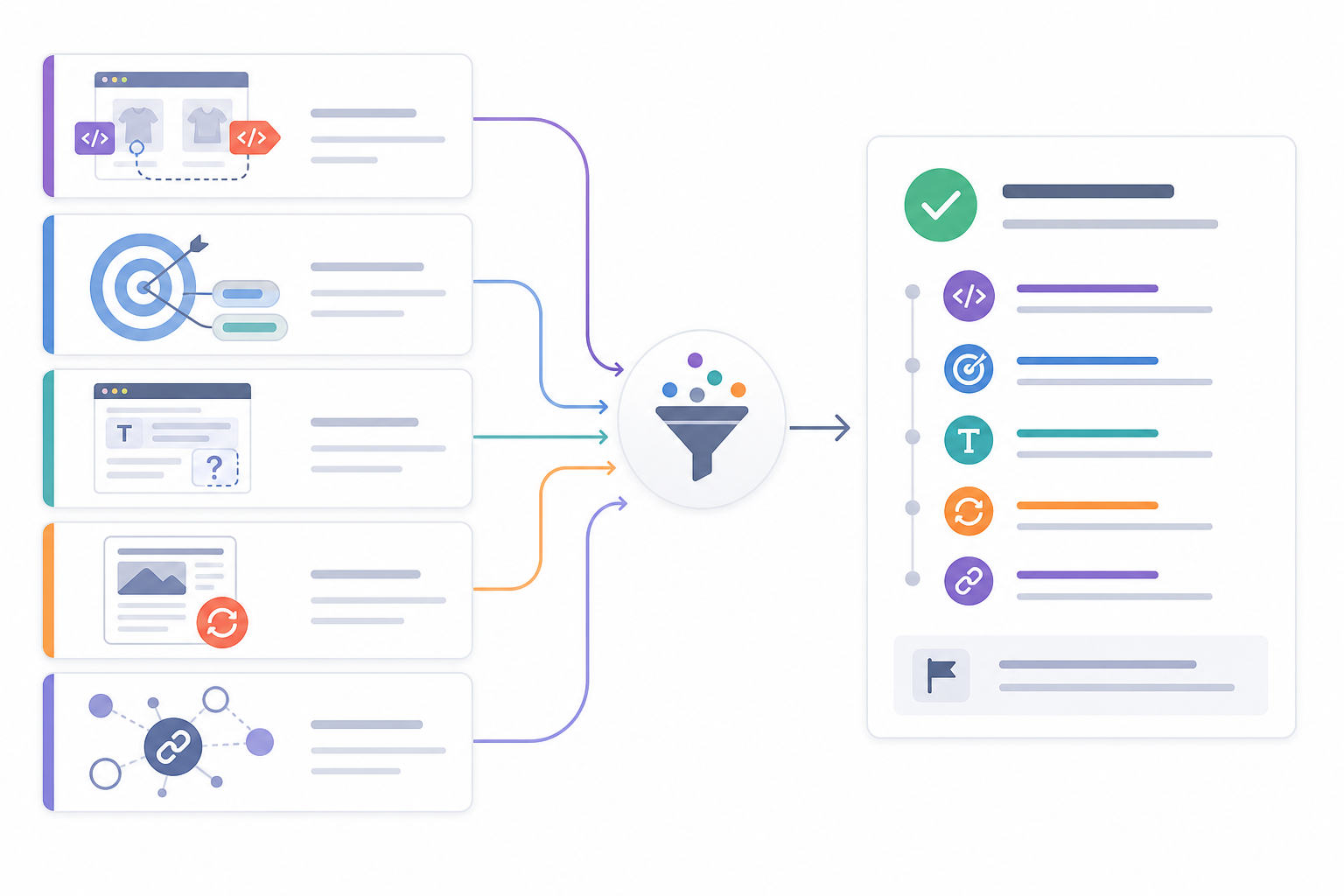
- Resolve conflicting canonical signals on affected product pages.
- Consolidate overlapping commercial keyword targeting.
- Improve titles and page-topic clarity across priority service pages.
- Refresh outdated high-value content.
- Evaluate relevant authority gaps identified through competitor backlink analysis.
The example demonstrates how separate findings become a coherent decision document rather than a list of disconnected SEO warnings.
When Should You Hire an SEO Audit Service?
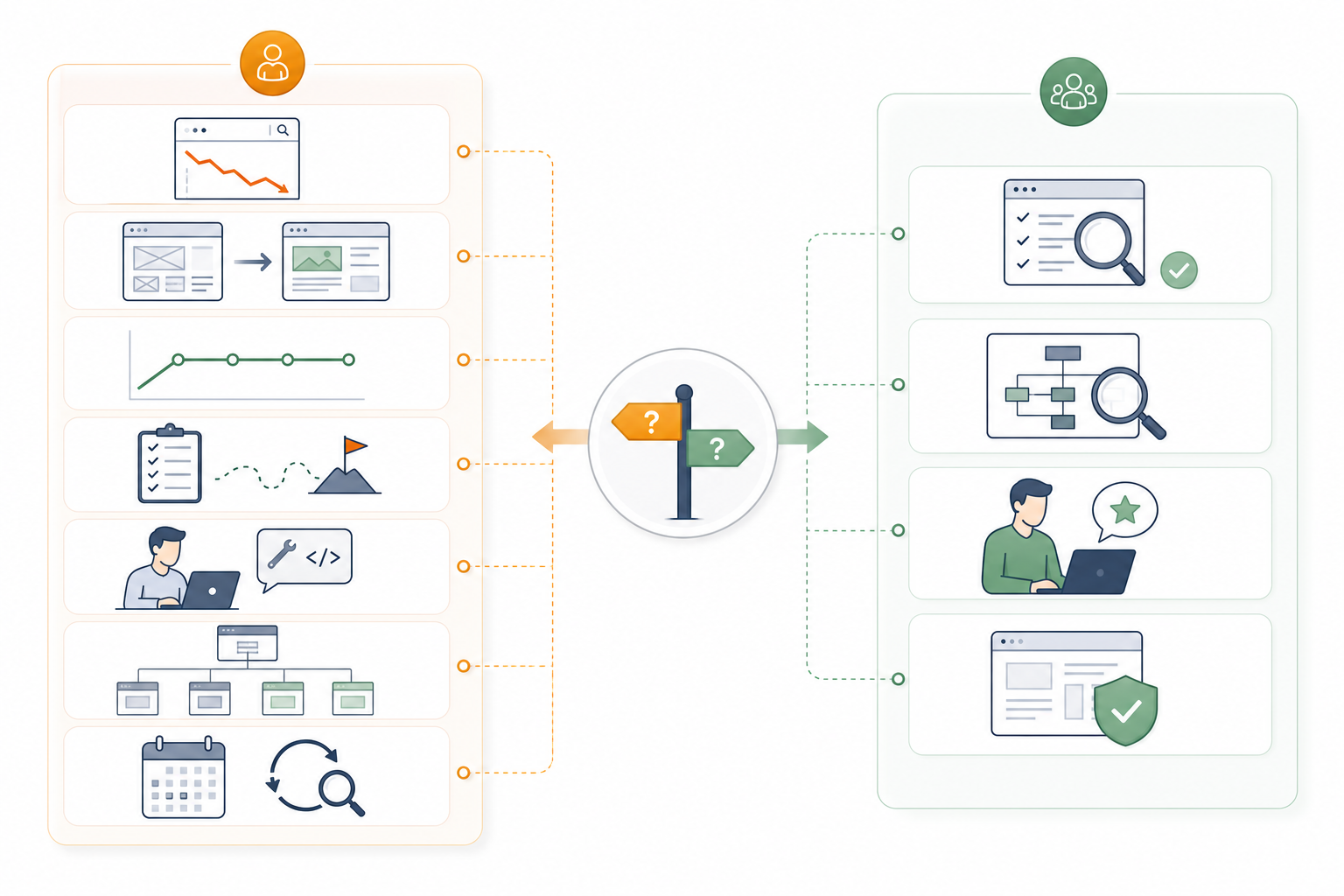
An SEO audit service is useful when a website has unexplained search-performance problems, faces major structural changes, or requires diagnostic expertise that the internal team does not have.
Several situations justify external audit support.
- After a sudden organic traffic drop
- External analysis becomes valuable when rankings, clicks, traffic, or organic revenue fall without an obvious cause.
- The audit can investigate indexation changes, technical problems, content losses, ranking shifts, or other likely causes.
- Before a redesign or migration
- Audit the existing website before changing the CMS, domain, templates, URL structure, or information architecture.
- Important URLs, internal links, metadata, redirects, indexation signals, and existing organic equity require documentation before the change.
- When SEO growth becomes stagnant
- An external audit can expose deeper technical, content, keyword, authority, or structural constraints when routine optimization no longer produces growth.
- This is especially relevant when teams continue publishing or optimizing without understanding why performance remains flat.
- At the start of a new SEO engagement
- An audit establishes the baseline before a new agency, consultant, or internal team begins making changes.
- It gives the new strategy a documented starting point.
- When internal expertise is limited
- Specialist support becomes useful when the website requires advanced technical SEO, migration analysis, large-scale crawling, indexation diagnosis, or other skills absent from the internal team.
- When the website becomes more complex
- Large e-commerce catalogs, international structures, JavaScript-heavy websites, faceted navigation, multiple subdomains, and complex architectures increase diagnostic requirements.
- For periodic deep reviews
- Sites heavily dependent on organic search benefit from deeper reviews when they undergo frequent technical, content, product, or structural changes.
- Audit frequency depends on website risk, size, rate of change, and commercial dependence on organic visibility rather than one fixed universal schedule.
External support is not necessary for every traffic decline or minor SEO issue. Internal teams with sufficient data and expertise can diagnose straightforward problems effectively.
An SEO audit service creates the greatest value when the risk or cost of missing the underlying problem exceeds the cost of specialist analysis.
Need links on real SaaS and business websites?
Links are placed after your approval, on sites with guaranteed DR and traffic, with a 1-year replacement guarantee.

